
 AU
AU
 UK
UK
 CA
CA
 US
US
 IND
IND

 NZ
NZ

Sector Landscape and Outlook
The country has abundant geothermal resources owing to various volcanic areas as well as faults and tectonic features. However, the proportion of electricity generation from the same is much lower due to low temperature. Despite this, the electricity generation from geothermal accounts for less than a fifth of the country’s electricity supply, due to the low efficiency of around 15%.
Target Set for Net-Zero Carbon Emissions by 2050
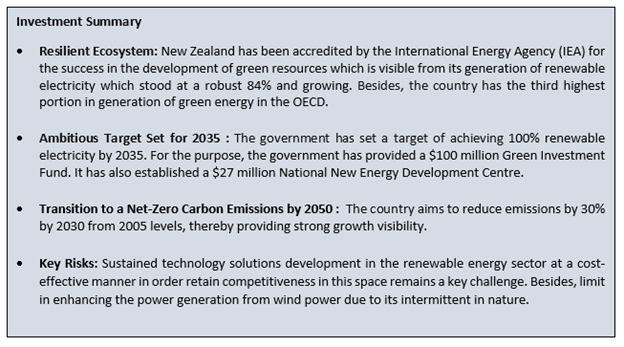
As per the Paris Agreement, New Zealand aims to reduce emissions by 30% by 2030 from 2005 levels. With the implementation of the Climate Change Response (Zero Carbon) Amendment Act by New Zealand, which stated a target of becoming net-zero carbon emissions by 2050. However, for biogenic methane the country has set a target of reducing emissions by 24-47% below 2017 levels. Meanwhile, the country is mulling possibilities of increasing the generation of renewables electricity to 100% by 2035 supported by its large hydro storage capacity.
Rebound in Greenhouse Gas Emissions in September 2020 Quarter
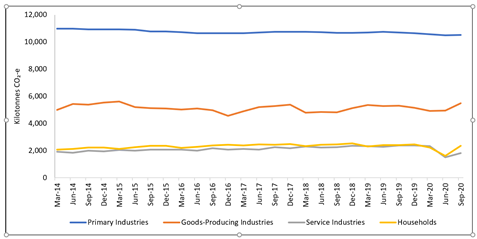
After a decline in the emissions in the June 2020 quarter, the country witnessed a bounce back in the September 2020 quarter with an increase of 9.1% (1,682 kilotonnes). The overall uptick in industry and household emissions was witnessed across the board as reflected in Exhibit 1 below. However, the total emissions were lower by 8.1% (1,641 kilotonnes) in the June quarter, as per the seasonally adjusted data from stats NZ. This was primarily due to the impact of lockdown amid Covid-19 restrictions which forced citizens to remain at home. Emissions for all seven industries witnessed an uptick in the September quarter (although agriculture, forestry, and fishing remained almost at the same level).
Exhibit 1: Seasonally Adjusted Emissions by Industry Group and Household (Kilotonnes Co₂-E), March 2014–September 2020 Quarters
Source: Stats NZ; Chart Created by Kalkine Group
Traction in Solar Power Capacity
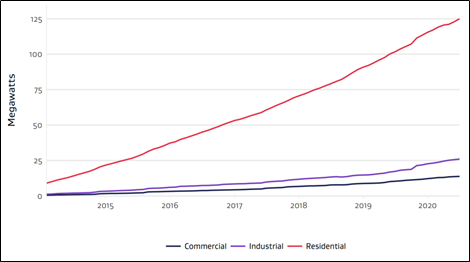
Albeit the contribution from the solar power to total generation remain minuscule, as the contribution from solar PV stood at just over 0.3% in 2019 at 126 GWh, however, the power generation from the same has witnessed a decent growth of 27% YoY in 2019. This was further aided by sustained traction in the solar PV capacity which has witnessed a tremendous growth of 36% from 2014 to 3,954 MW in 2019, as clearly reflected in exhibit 2 below. This uptick was supported by increased uptake of residential systems. Notably, solar PV in residential usage account for a significant portion of 80% of existing its capacity.
Exhibit 2: Sector Wise Solar Capacity
Source: MBIE NZ
Target Set for Enhancing the Renewable Energy Generation Share to 100%
The long-term growth prospects of New Zealand’s renewable energy sector hold prominence driven by government’s initiatives which institutionalizes enhanced usage of the same. This coupled with the benefits of pertinent rise in the country’s electricity demand as well as sustained declines in the cost of solar and wind technology and restricted gas supply scenario are also likely to positively impact the renewable energy sector.
With the country that generates around 84% of its electricity from clean, renewable resources such as hydro, geothermal and wind, is likely to witness the share of electricity generation from renewable energy to the overall electricity generation of the country to surpass 90% and 95% by 2035 and 2050 respectively.
Accelerated Usage of Renewable Energy for Transportation
New Zealand transportation sector accounts for 20% of all greenhouse gas emissions. In a further step towards reducing New Zealand carbon emissions, the government is also encouraging wider usage of clean energy by promoting efficient and low-emissions transport systems. With the accelerated pace of usage of electric vehicles in the country, the government has earmarked of achieving 64,000 electric vehicles by the end of 2021. This enlightens the visibility on the sustainability of the growth momentum of the sector.
Key Risks and Challenges:
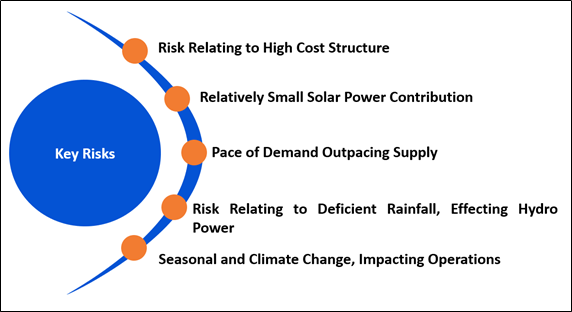
Since New Zealand met majority of its requirement from renewable energy space however, its future competitiveness will require consistent innovation of technology solutions in a cost-effective manner. Considering, the power generation from wind power is intermittent in nature, there is restriction in boosting the wind power generation which can be achieved by augmenting the wind generation capacity.
Exhibit 3: Key Risks in Renewable Energy Sector:
Source: Analysis by Kalkine Group
New Zealand has various emerging renewable energy resources with prospects for future electricity as well as fuel and direct heat production. Nevertheless, the developers in this space witness various challenges emanating from immature markets coupled with little awareness among the consumers. Further, evolving technologies as well as unknown impact on environment or deficient backup infrastructure also possess greater challenges.
Meanwhile, during the low rainfall period may pose a negative impact on the hydro storage and would lead to lower hydro power generation in the country. To compensate the lower renewable generation amidst adverse seasonal or climatic conditions, the country will have to rely on non-renewable sources to fulfil the gap of sustained acceleration in demand for electricity.
Outlook
The demand prospects of the New Zealand renewable energy sector is on the rise in order to the address the impact of climate change and the transition to a low emissions economy. NZ, being one of the leading nations has the third highest share in the OECD in generation of renewable electricity. As the country boasts of ample natural resources coupled with benefits of high annual average capacity, advanced technologies, and strong track record of innovation in the renewable energy, it provides immense growth opportunities in the sector..
New Zealand's annual average capacity stood at around 50% for hydro, while that for geothermal the annual average capacity was around 95% for geothermal, and 40% for wind (that remain among the highest globally).
Apart from this, strong support from the government through funding and investments has been a driving factor for the sector. The government has not only set up a $100 million Green Investment Fund but has also established a $27 million National New Energy Development Centre as well as provided various investments towards the renewable energy through the $3 billion Provincial Growth Fund. All these investments support by the government are aimed at garnering 100% renewable electricity by 2035 and transition to a Net-Zero Carbon Emissions economy by 2050.
Besides, the sector is also likely to get a boost from the massive infrastructure investment package worth over $3 trillion which is expected to be announced by the US President in tranches. The huge infrastructure investment package is expected to provide tailwinds to the investments in clean energy space and thus bodes well for this sector globally.
Apart from the sector-specific factors, we have also analyzed four NZX-listed companies operating in the same sector. This report covers their insights, outlook, performance and potential as expected to be delivered in the near to medium term.
1. Vector Ltd (Recommendation: Buy, Potential Upside: Low Double-Digit) (M-Cap: NZ$4.08 billion, Gross Dividend Yield: 4.552%)
Business Description:
Vector Ltd (NZX: VCT) is a leading New Zealand infrastructure company and is engaged in owning as well as managing a unique portfolio of energy and fibre optic infrastructure networks in NZ.
Outlook
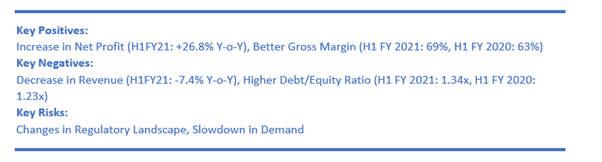
Driven by Auckland’s continuing growth, the company is aiming c15,000 new electricity connections in FY21. Its advanced meter deployment remains on track as it targets 30-40k advanced meters in NZ and 120-130k in Australia. Meanwhile, the company has raised its FY21 adjusted EBITDA guidance to $500-520 million, up from previous guidance of $480-$500 million. Besides, the company continues to invest in innovative technologies and infrastructure in order to aid its customers and in-turn to drive growth.
Valuation Methodology: Price/Earnings Based Relative Valuation (Illustrative)
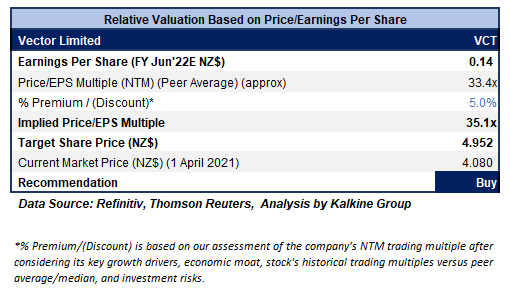
We have applied Price/Earnings based relative valuation (on an illustrative basis) and the target price reflects a rise of low double-digit (in % terms). We have applied a slight premium to Price/Earnings Multiple (NTM) (Peer Average) considering increase in net profit and the fact that it has increased its FY21 adjusted EBITDA guidance.
Given healthy liquidity position, strong balance sheet and decent outlook, we give a “Buy” recommendation on the stock at the current market price of $4.080 per share, up by 0.74% on 1st April 2021.
2. Infratil Limited (Recommendation: Hold, Potential Upside: Low Double-Digit) (M-Cap: NZ$5.1 billion, Gross Dividend Yield: 3.018%)
Business Description:
Infratil Limited (NZX: IFT) invests in growth sectors, and the objective of the company is to deliver above-average returns to the shareholders over the long-term.
Outlook:
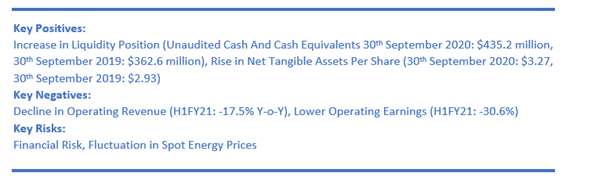
The company continues to look for opportunities in key growth sectors and new geographies to take advantage of long-term demand growth. The company stated that $300 million equity raise in the month of June 2020 is expected to provide capital flexibility as well as to finance growth opportunities. Meanwhile, IFT has guided its FY21 Proportionate EBITDAF from continuing operations to stay in between $440 -$470 million.
Valuation Methodology: Price/Earnings Based Relative Valuation (Illustrative)
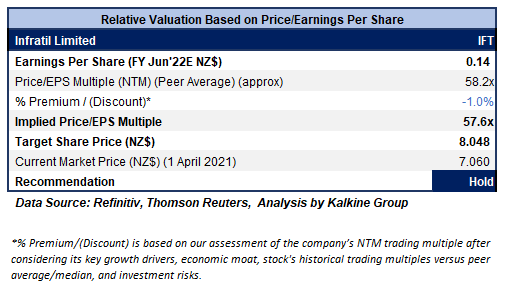
We have applied Price/Earnings based relative valuation (on an illustrative basis) and the target price reflects a rise of low double-digit (in % terms). We have applied a slight discount to Price/Earnings Multiple (NTM) (Peer Average) due to the risks associated with effective execution of recent acquisition undertaken by the company and sustained high capital expenditure level.
Considering the robust capital position and liquidity, we give a “Hold” recommendation on the stock at the current market price of $7.060 per share, down by 0.91% on 1st April, 2021.
3. Genesis Energy Limited (Recommendation: Hold, Potential Upside: Low Double-Digit) (M-Cap: NZ$3.6 billion, Gross Dividend Yield: 6.490%)
Business Description:
Genesis Energy Limited (NZX: GNE) is a New Zealand based diversified energy company, which sells LPG, electricity, and reticulated natural gas via the retail brands of Genesis and Energy Online.
Outlook:
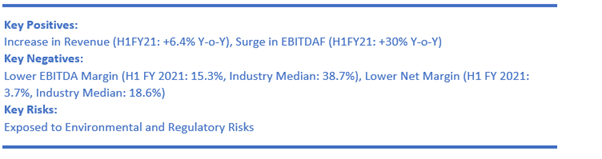
Meanwhile, GNE has upgraded its EBITDAF guidance for FY21 to $415 million - $425 million from $395 million - $415 million. The company has guided its FY21 capital expenditure of up to $95 million. Genesis’ future-gen strategy has a target to economically displace baseload thermal electricity generation with 2,650GWh of reliable as well as affordable renewable electricity to help the country’s transition to the low carbon future.
Valuation Methodology: Price/Earnings Based Relative Valuation (Illustrative)
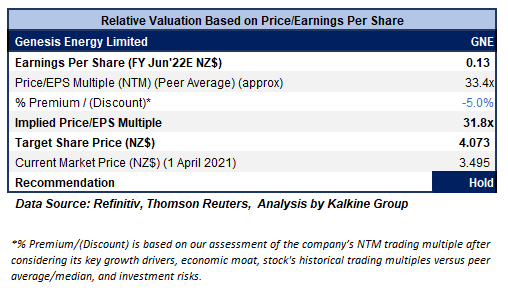
We have applied Price/Earnings based relative valuation (on an illustrative basis) and the target price reflects a rise of low double-digit (in % terms). We have applied a slight discount to Price/Earnings Multiple (NTM) (Peer Average) considering that its wholesale segment witnessed low hydro inflows as well as a volatile gas market.
Considering its EBITDAF guidance, future-gen strategy update and strategic outlook, we give a “Hold” recommendation on the stock at the current market price of $3.495 per share, up by 0.14% on 1st April 2021.
4. Trustpower Limited (Recommendation: Hold, Potential Upside: Low Double-Digit) (M-Cap: NZ$2.6 billion, Gross Dividend Yield: 5.485%)
Business Description:
Trustpower Ltd (NZX: TPW) is NZ's 5th largest electricity generator as well as 4th largest energy retailer by market share, with ~12% electricity retail market share.
Outlook
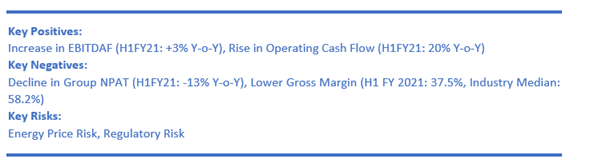
The company is witnessing a rapid growth in its telco business as 50% of its customers take two or more products. Besides, it is the only participant to hold credible market share in both energy and telco. Further, it is exploring opportunity to grow its share of the Fibre and Wireless Broadband markets.
The company is having strong asset base in both generation and ISP infrastructure. TPW is focused towards incremental value creation in generation, cost optimisation and volume gains.
Meanwhile, the company guided its FY21 EBITDAF to stay between $185 - $205 million, with expected generation volumes for FY21 to stay at ~1,702 GWh (incl KCE). It has also guided its FY21 capex to be in the range of $34 million - $44 million.
Valuation Methodology: Price/Earnings Based Relative Valuation (Illustrative)
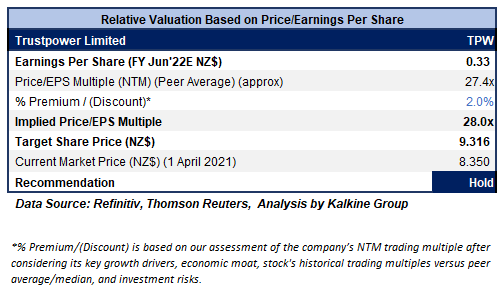
We have applied Price/Earnings based relative valuation (on an illustrative basis) and the target price reflects a rise of low double-digit (in % terms). We have applied a slight premium to Price/Earnings Multiple (NTM) (Peer Average) considering the rapid growth in the telco business and increase in operating cash flow.
Considering its robust asset base, decent H1FY2021 performance and outlook, we give a “Hold” recommendation on the stock at the current market price of $8.350 per share, up by 1.46% on 1st April 2021.
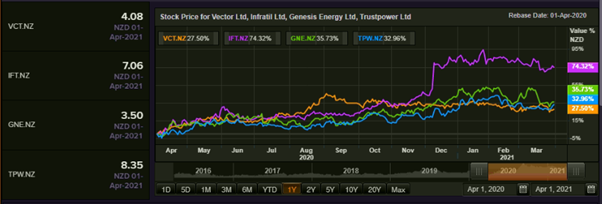
Comparative Price Chart (Source: Refinitiv (Thomson Reuters))
Disclaimer
Kalkine New Zealand Limited is authorised to provide class advice only. The information on this site does not take into account any of your investment objectives, financial situation or needs. Before you make a decision about whether to acquire a financial product, you should obtain the Product Disclosure Statement from the product issuer. You should consider the appropriateness of advice taking into account your own objectives, financial situation and needs and seek independent financial advice before making any financial decisions.
Past performance is not a reliable indicator of future performance.
 Please wait processing your request...