
 AU
AU
 UK
UK
 CA
CA
 US
US
 IND
IND

 NZ
NZ

Port and Transportation Sector Landscape
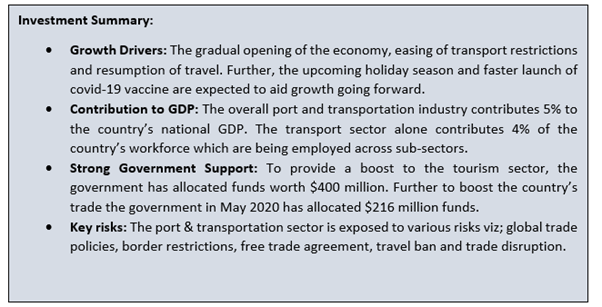
Port and Transportation industry is one of the significant industries of New Zealand, with the overall transport sector contributing 5% to the country’s national GDP. Considering the importance of the transport sector to the country’s economy, it is also one of the prominent employments generating sector of the country. The transport sector alone contributes 4% of the country’s workforce which are being employed across sub-sectors as visible in the Figure 1 below. Regionally, Auckland hired 42% of all the transport sector workers. This sector is immensely driven by trade activities, influx of tourists, global supply chain, among others. The primary users of rail transport services include dairy product manufacturers, coal miners, among others. However, the companies doing export businesses are the top users of air and sea freight services.
Besides, ports are also the crucial distribution channel for trade business that includes both domestic as well as international and played a crucial support for New Zealand’s economy. This is clearly reflected from the fact that 99 percent of the merchandise imports as well as exports (by volume) pass through the country’s sea ports.
According to the report published “Briefing to the Incoming Minister of Transport” by Maritime New Zealand in October 2017, NZ has 14 commercial ports, and they are handling $70.9 Billion of exports and $67.2 Billion of imports by sea. North Island supply chain is very critical as ~55% of the country’s freight originates in or is destined for Northland, Auckland, Waikato as well as Bay of Plenty regions.
Figure 1: Employment in Transport Sector Across Sub-Verticals
.png)
Source: MBIE, Stats NZ BDS; Chart Created by Kalkine Group
Notably, the road transport sector caters to most of the overall employment generation within the Transportation Sector in New Zealand accounting for 40% of the mix as clearly mentioned in the Figure 2 below.
Figure2: Road Transport is a Prime Employment Contributor
.png)
Source: MBIE, Stats NZ BDS; Chart Created by Kalkine Group
Key Growth Drivers
Some of the key growth drivers for Air Travel and Port Sector which can act as a catalyst in the post COIVID-19 environment have been highlighted below: -
Resumption of Transport Services Post Covid-19 Pandemic
Factors such as the opening of the economy, easing transport restrictions, and emergency approval of COVID-19 vaccine in the UK as well as expected approval in the US augurs well for growth going ahead both in travel and port sectors. Resumption of travel to some extent has been witnessed. In addition, the easing of border restrictions by the countries worldwide, has enlightened the scope for the sector’s growth visibility as this will led to normalcy in the global supply chain and boost exports for the country. This is particularly evident from the rise in country’s exports data with exports from New Zealand to China, the largest trading partner of the country rising by 6.8% during the period from August 2019 to July 2020.
Comparing provisional NZ goods trade data for fortnight to August 26, 2020 with same fortnight in 2019, total exports to all the countries witnessed a rise of 8.05% from $1.81 Bn to $1.96 Bn. However, total imports from all the countries witnessed a fall by 9.3% from $2.64 Bn to $2.39 Bn.
As mentioned in Figure 3 below, transportation sector also finds its wings spread across other primary sectors of New Zealand, which further exhibit resilience during uncertain times.
Figure 3: Top Users of Transport Services
.png)
Source: MBIE, Stats NZ
Holiday Season Round the Corner
Transport and logistics sector also majorly relies on demand and supply situation. With the gradual opening of the economy as the impact of Covid-19 is now largely behind and the government is easing restrictions in opening the marketplace coupled with upcoming holiday and Christmas season, the demand and supply chain of the goods is likely to accelerate, thus providing a promising outlook for the sector. This is particularly evident from the latest uptick in retail sales in the country with retail volume registering a growth of 8.3% YoY during the quarter ended September 2020. In addition, growth in sales in terms of value was witnessed across 14 regions of the country.
Trade activities showed steadiness despite the disruptions caused by COVID-19 as visible in Figure 4 considering the period of March 2020 vs. March 2019.
Figure 4: Imports and Exports Activities by Country’s Key Ports
.png)
Source: MBIE, Stats NZ
Ease in Travel Restrictions to Boost the Sector
Domestic as well as international travel is also one of the formidable drivers for the rebound of the sector altogether. Due to the pandemic, currently the government is operating approximately 124 flights on a weekly basis as against the pre-COVID level where the flights running were more than 600 flights weekly. Notably, with almost all regions in the country falling into the level 1 covid-19 alert zone, thus leading to easing in travel restrictions by the government. Further New Zealand and Australia are working on an air bubble travel arrangement to boost tourism. So, this is a first of a kind of arrangement by the government. This is expected to be materialised soon and is likely to boost tourism post the COVID-19 pandemic. Besides, with the likely launch of treatment of COVID-19 vaccine in the foresight, as various global companies are at their last stage of getting approval by the international designated authorities. This is expected to provide a further fillip to the port and transportation sector altogether.
Although the arrival of visitors declined by 1.4 million during April-September 2020 to reach 27,700 as against the same period last year, however, visitor arrivals from the international destination witnessed slight growth in September 2020 higher by 700 to 8,600 as against August 2020, as per the data reported by the Stats NZ.
Key Risks and Challenges
.png)
Source: Kalkine Group
Supply Disruption caused by Covid-19 Pandemic
The country’s port and transport sector rely strongly on trade and the impact of this pandemic has adversely impacted the sector as governments across countries implement border restrictions. In the face of these restrictions, the cumulative value of the exports to all countries witnessed a correction of about $787 million from 1 February 2020 to 29 April 2020 as compared to the same period in 2019. The decline was driven by the fall in the export value witnessed in late March and early April 2020, as there were Alert Level 4 restrictions. Majority of the negatives seems to be priced in for the sector, and therefore, may witness a rebound in 2021.
Delay in Economic Recovery Globally
This sector vastly banks on demand and supply situation. The persistent slowdown in most global economies has cast a shadow over the sector growth visibility. Any further delay in the rebound of the global economies from the adverse impact of this pandemic will further weigh of the growth prospect of the sector going forward. However, in the longer run, given governments globally streamlining their budgets aiming at bringing their respective economies back on track, is expected to ease pressure on economic recovery and also create opportunities for the country’s sector players to expand to other geography to gain scale.
Extended Restriction on Full Resumption of Travel
Continued suspension of air and sea travel with major tourist destinations and border restrictions may further negatively impact the sector. With probable air bubble agreement with Australia in sight, more such agreements may follow, thus acting as a key enabler for the sector.
Outlook
Although the sector in 2020 was impacted by the Covid-19 leading to slow down in business sentiments, increased trade restrictions and ban on travel. However, we believe most of the negatives has been largely behind, with the easing of restrictions, and financial support through fiscal stimulus which will lead to improvement in business sentiments going forward. To provide a boost in the tourism sector, the government has allocated funds worth $400 million which will act as a cushion for the sector, and will in-turn will drive the transportation sector. Further to boost the country’s trade the government in May 2020 has allocated $216 million funds as per the data provided by the New Zealand Trade and Enterprise (NZTE). Besides news relating to the launch of Covid-19 vaccines to be much sooner than later has also brightened the outlook of the sector as a whole. Gradual easing of border restrictions is expected to drive rebound in the trade activities as well, which bodes well for the sectors' long term outlook. Consequently, the long-term outlook of the sector looks promising.
Apart from the sector-specific factors, we have also analyzed four NZX-listed companies operating in the transport and logistics sector. This report covers their insights, outlook, performance and potential as expected to be delivered in the near to medium term.
1) Napier Port Holdings Ltd (Recommendation: Buy, Potential Upside: Low Double-Digit) (M-Cap: NZ$695.56 Million, Gross Dividend Yield: 1.956%)
About the company
Napier Port Holdings Ltd (NPH) is the shipping gateway which connects the centre of NZ with the people as well as markets of the world.
Outlook
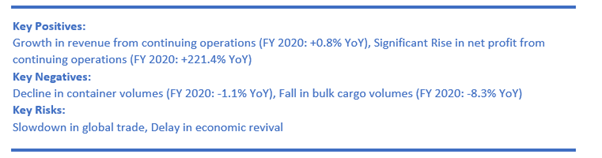
Notwithstanding the adverse challenges due to the prevailing Covid-19, NPH has delivered resilient performance for the full-year ended September 2020 and there was significant progress on the strategic development initiatives. However, volumes across container and bulk cargo declined by 1.1% and 8.3%, respectively. With sufficient net cash balance of $7.9 Mn at the end of FY20, it can be said that the company will be able to meet the capex requirement. The company is maintaining cautious perspective while it continues to pursue strategic initiatives. It also stated that opportunities in the national supply chain is expected to grow trade volume.
Technical Overview:
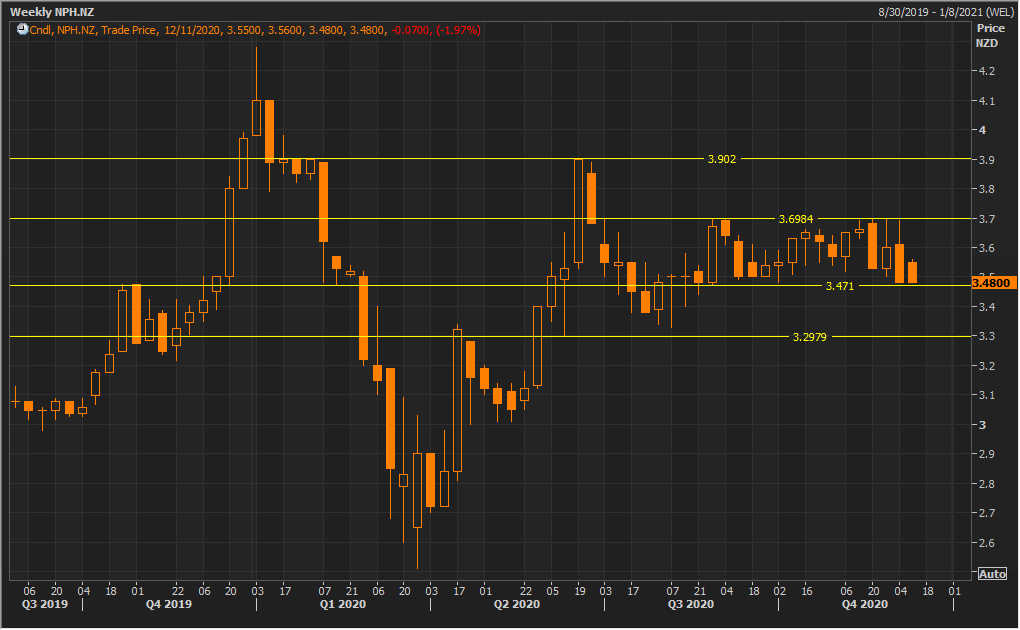
NPH prices are trading in a long consolidation phase on a weekly time frame chart. Prices seems to trade in the existing consolidating range. The immediate support level is NZ$3.471, break of the same will take the prices down to its next supporting level at NZ$3.297. On the higher side, immediate resistance level is NZ$3.698, if break from upside will take the prices upto its next resistance level at NZ$3.902.
Valuation Methodology: P/CF Based Relative Valuation (Illustrative)
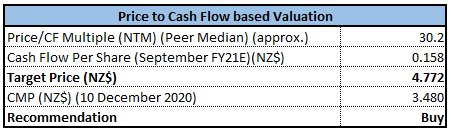
P/CF Based Relative Valuation (Source: Refinitiv (Thomson Reuters))
Note: All forecasted figures and peers have been taken from Thomson Reuters, NTM-Next Twelve Months
We have applied P/CF based relative valuation (on an illustrative basis) and the target price reflects a rise of low double-digit (in % terms).
2) Auckland International Airport (Recommendation: Hold, Potential Upside: Low Double-Digit) (M-Cap: NZ$12.075 Billion)
About the company
Opened in 1966, Auckland International Airport (NZX: AIA) happens to be the third busiest international airport in Australasia.
Outlook:
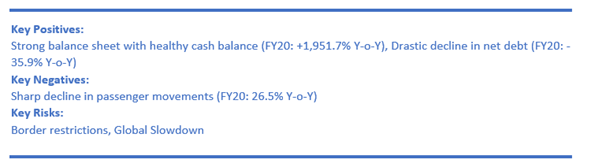
In the face of Covid-19 challenges, the company has reported a dismal performance in FY20 with revenue declining by 23.7% YoY as passenger traffic reduced by 26.5% YoY. Resultantly, operating EBITDAFI plunged by 53.1% YoY, leading to 63% YoY decline in reported profit after tax.
However, the company’s investment property business reported a sturdy performance in FY20 sharply in contrast to its airport business. Although Covid-19 pandemic had an unprecedented bearing on the operations and the financial performance of the company, however, the company is well advanced in reinforcing its balance sheet by raising equity capital worth $1.2 Bn in April 2020.
Also, resumption of domestic flying from Auckland reinstates our confidence on its long-term growth prospects of the company. The company stated that domestic passenger numbers in the month of September 2020 were 63.4% up as compared to August 2020, reflecting the change in the NZ’s alert levels at the end of August 2020.
Technical Overview:
Weekly Chart
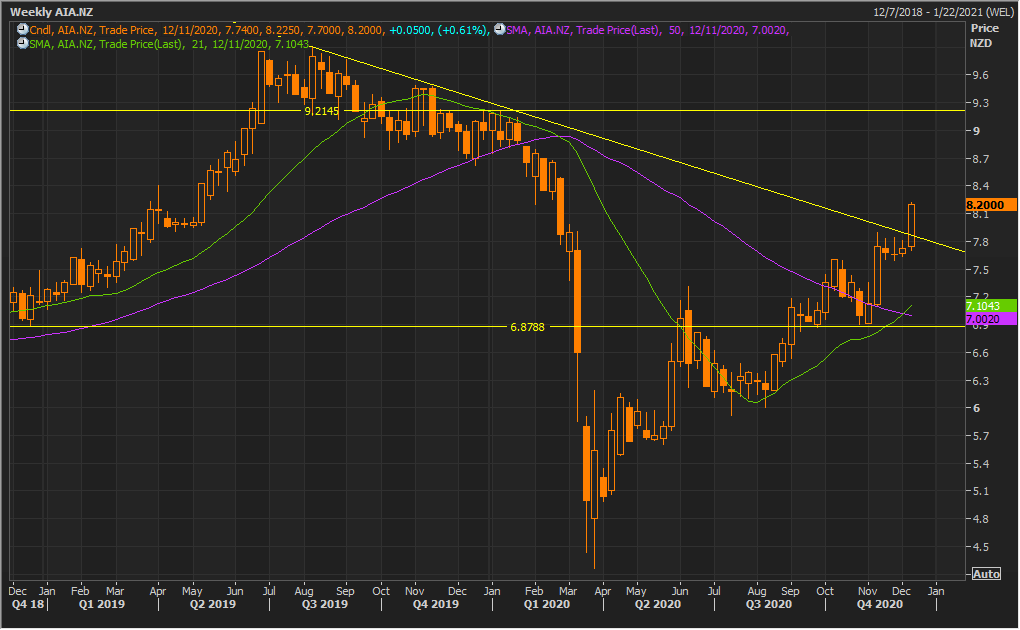
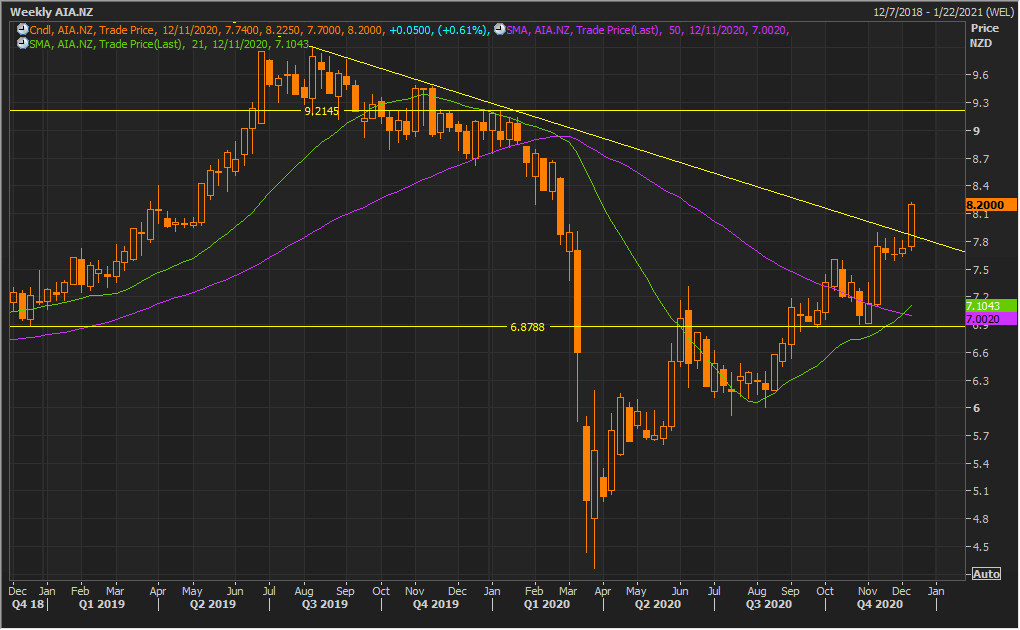
AIA's prices recently broke the downward trend line and indicating a fresh upside rally in the stock. It also formed a golden crossover between 21-period and 50-period SMA on the weekly chart, further supporting the upward movement. Now the next major resistance level is at NZ$9.20 and the support level for the stock is NZ$6.88.
Thus, we give a "Hold" recommendation on the stock at the current price of NZ$8.200 per share, up by 0.61% on December 10, 2020.
3) Air New Zealand Limited (Recommendation: Hold, Potential Upside: Mid Single-Digit) (M-Cap: NZ$2.077 Billion)
About the company
Air New Zealand (NZX: AIR) operates the global network which provides passenger as well as cargo services to, from and within NZ to ~17 million passengers a year.
Outlook
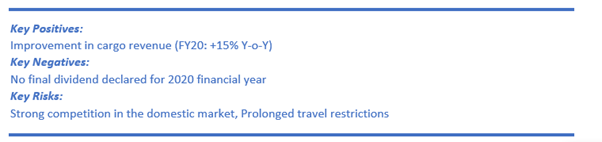
Air New Zealand has announced 2020 result and has also affirmed the unprecedented effect of coronavirus pandemic on the business as well as the global aviation industry after extensive travel restrictions. AIR reported a loss before other significant items and taxation amounting to $87 million for 2020 financial year, as compared to the earnings of $387 million in the previous year. The company released its databook, where it mentioned the competitive advantages. Some of them are resilient core domestic business, focused towards sustainable cost improvements as well as investment-grade financial strength.
Valuation Methodology: EV/EBITDA Based Relative Valuation (Illustrative)
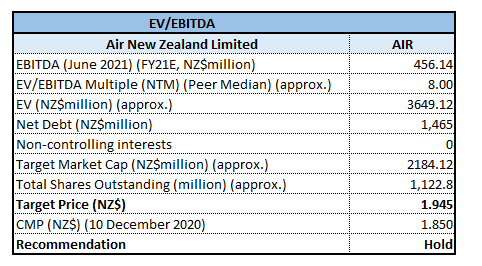
EV/EBITDA Based Relative Valuation (Source: Refinitiv (Thomson Reuters))
Note: All forecasted figures and peers have been taken from Thomson Reuters, NTM-Next Twelve Months
Technical Overview:
Weekly Chart:
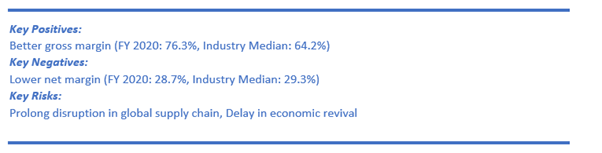
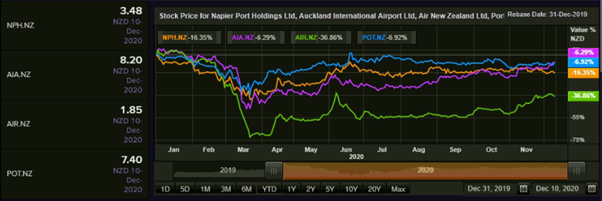
AIR's prices recently broke the major resistance level of NZ$1.94 and prices are sustaining around the breakout level. Prices are also sustaining above 21-period and 50-period SMA on the weekly chart, further supporting the upward movement. Now the next major resistance level is at NZ$2.30 and the support level for the stock is NZ$1.39.
We have applied EV/EBITDA based relative valuation (on an illustrative basis) and the target price reflects a rise of mid single-digit (in % terms).
Thus, we give a “Hold” recommendation on the stock at the current price of NZ$1.850 per share, down by 1.86% on December 10, 2020.
4) Port of Tauranga Ltd (Recommendation: Buy, Potential Upside: Low Double-Digit) (M-Cap: NZ$5.033 Billion, Gross Dividend Yield: 2.379%)
About the company
Port of Tauranga (NZX: POT) is the natural gateway to and from international markets for several businesses of New Zealand.
Outlook:
The company posted net profit after tax amounting to $90.0 million on 24.8 Mn tonnes of trade. Despite the ongoing disruption due to Covid-19 pandemic, container volumes rose 1.5% to 1,251,741 TEUs for the year to June 30, 2020. The company’s Board declared final dividend amounting to 6.4 cps. The company is well-positioned because of its track record of robust capital discipline, conservative balance sheet as well as capacity headroom. However, short as well as medium-term impacts of pandemic are uncertain. The company’s track record reflects robust credit rating, and it is well-placed to weather the storm of Covid-19. Considering the 1Q performance, and notwithstanding significant market changes, the company is expecting full-year earnings to be in the range of $86 million and $93 million.
The company is the long-run infrastructure company, and it would be pursuing capacity expansion as well as greater efficiencies, to avoid bottlenecks and congestion that is currently being witnessed in Upper North Island supply chain. The company possesses a demonstrable track record as well as a very strong A- credit rating which was renewed last month by Standard & Poor’s.
Valuation Methodology: EV/Sales Based Relative Valuation (Illustrative)
.png)
EV/Sales Based Relative Valuation (Source: Refinitiv (Thomson Reuters))
Note: All forecasted figures and peers have been taken from Thomson Reuters, NTM-Next Twelve Months
Technical Overview:
Weekly Chart
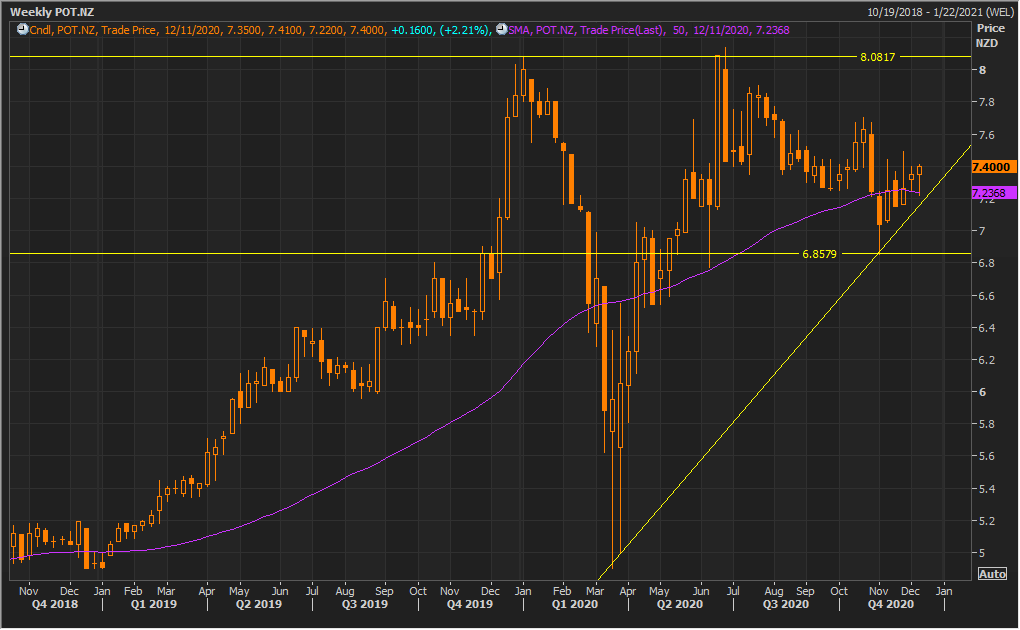
POT prices are trading in a primary bullish trend. Prices are continuously taking support from upward trendline support levels. Prices are currently trading above 50-period moving average which further support the price action of the stock. The immediate support levels of the stock is NZ$ 6.85 and immediate resistance level is NZ$ 8.08.
We have applied EV/Sales based relative valuation (on an illustrative basis) and the target price reflects a rise of low double-digit (in % terms).
Disclaimer
Kalkine New Zealand Limited is authorised to provide class advice only. The information on this site does not take into account any of your investment objectives, financial situation or needs. Before you make a decision about whether to acquire a financial product, you should obtain the Product Disclosure Statement from the product issuer. You should consider the appropriateness of advice taking into account your own objectives, financial situation and needs and seek independent financial advice before making any financial decisions.
Past performance is not a reliable indicator of future performance.
 Please wait processing your request...