
 AU
AU
 UK
UK
 CA
CA
 US
US
 IND
IND

 NZ
NZ

With the presence of ambitious and scalable firms, which are targeting global problems with market-leading solutions, the technology sector of New Zealand provides significant investment opportunities. As per the report by Ministry of Business, Innovation and Employment (2017 Edition), foreign investment in early-stage technology companies increased 239% with NZ technology sector witnessing record capital raising of $1.0 billion in the year 2016. In the same year, technology sector growth was noted across every NZ region with the sector generating $6.9 billion in the offshore revenues. The sub-sectors that bagged the highest growth were FinTech and Digital Media.
New Zealand’s technology sector in a nutshell:
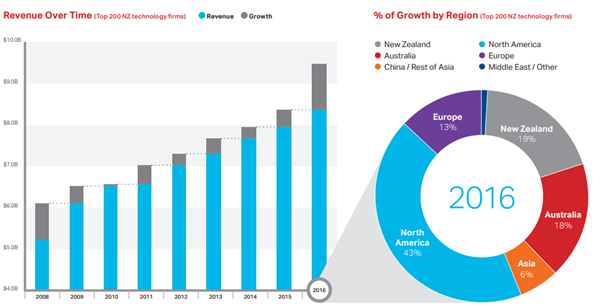
FIG. 1: Sustained and Strong Revenue Growth (Source: Ministry of Business, Innovation and Employment)
Increasing Role of Technology Sector Towards New Zealand’s Economic Growth
The technology sector is vital to New Zealand primarily because 1) It contributes significantly towards GDP growth and job creation, and 2) It is export-intensive, and technology inputs support several other sectors to add value to their exports. According to the report by New Zealand Institute of Economic Research (or NZIER), technology sector happens to be a dynamic as well as growing part of NZ economy, as the sector features increased levels of innovation, connectedness, and expenditure on Research & Development. The combined technology sector accounted for an estimated 8% of the GDP in 2015, made a contribution of 9% towards exports, and employed approximately 5% of the total workforce. The ICT sector accounted for 6.2% of the GDP, while it employed approximately 55,000 people in 2015. ICT exports amounted to $1.7 billion in 2014. Notably, high-tech manufacturing made a contribution of 1.8% of GDP as well as employed approximately 44,000 people.
Technology Exports Underpin New Zealand’s Future Growth
The ability of businesses to sell goods and services to overseas customers is critical for the broader economic growth and to maintain competition in the global markets. Equally, imported technology goods are crucial inputs for the wider domestic technology sector.
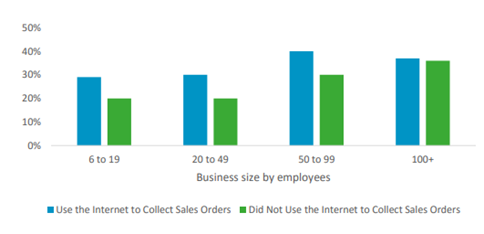
FIG. 2: Internet Sales and Exports – By Business Size (Source: NZIER)
How New Zealand’s Tech Sector Lays Foundation for Other Industries?
New Zealand’s technology sector lays the groundwork of growth for several sectors, resulting in broader economic growth.
The deployments towards New Zealand technology sector is on the rise backed by many emerging technology companies. Such companies support other emerging industries, thereby contributing to the overall economic growth.
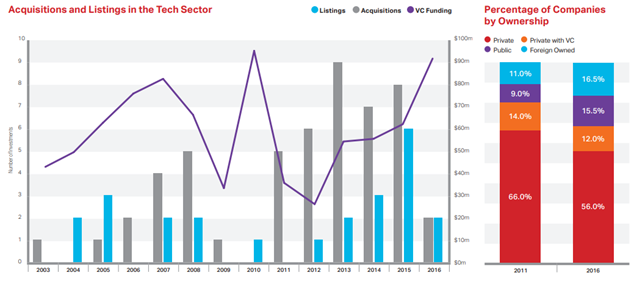
FIG. 3: Intensifying Investors’ Activity (Source: Ministry of Business, Innovation and Employment)
Sectors Basing Technology at the Forefront to Boost Growth Prospects
Technology has become the backbone of the broader NZ economy as it helps in the growth of other sectors as well. With increased investment in technologies from global investors, the sector is all set to boost growth prospects. Well-established ecosystem helps growth in NZ's technology industry primarily because of Regional Development Agencies, Government Policy, Fair Tax Environment and Collaborative Working Spaces. Below are three exemplary sectors that are set to benefit as innovation, diversity and growth are demonstrated in diversified ways.
With increased deployments in New Zealand’s technology space and adoption of technological tools (like Machine learning, Robotics, etc.) by some leading industries, the sector is poised to witness strong growth and could prove to be a resilient one.
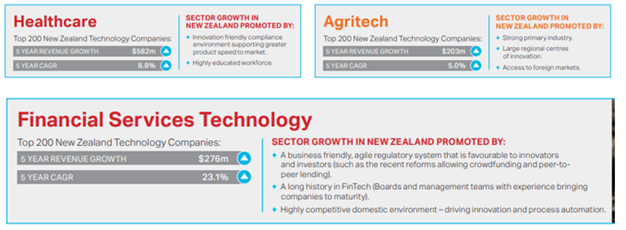
FIG. 4: Adoption of Technology (Source: Ministry of Business, Innovation and Employment)
New Zealand’s Technology Sector: The Road Ahead
As per Productivity Commission Report, the Government has committed to raising New Zealand’s R&D expenditure to 2% of GDP over 10 years. Nonetheless, the country is fast adapting itself to innovations that take place in the technology sector. International Data Corporation (IDC), New Zealand has made some predictions for New Zealand IT industry. IDC expects that the maturity and growth of the digital economy will manifest in expanding digital developer communities, open innovation ecosystems, hyper-agile applications deployment technologies and a more diverse cloud services world.
IDC’s predictions are as follows:
Growing digitization and increased use of information and communication technology across the economy will help generate employment and this will benefit the broader economic growth and improve the future of technology space. Several global industry leaders prefer New Zealand as a base for their operations, thereby, creating opportunities for global investments. New Zealand possesses stable Government policies which will, in turn, encourage them to invest more in technology sectors.
With a broad understanding of the technology space in New Zealand, it’s time to look at some companies in this sector (GTK, SKO, ERD, VGL).
1. Gentrack Group Limited (NZX: GTK) (Recommendation: Buy, Potential Upside: Lower Double-Digit) (M-Cap: ~NZ$139.08 Million, Gross Dividend Yield: 7.610%)
Business Description: Gentrack Group Limited (NZX: GTK) provides essential software for essential services, pairing powerful platforms with deep market knowledge to help utilities and airports to lower service costs, foster innovation and confidently navigate market reform.
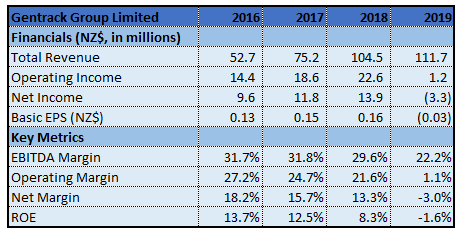
Key Metrics (Source: Refinitiv (Thomson Reuters))
Outlook: The company has a strong balance sheet with no net debt and contractually recurring revenue that continues to provide a strong foundation for the business at this time of significant uncertainty. The company has withdrawn its full year guidance, however, it has confirmed half year EBITDA guidance in between NZ$2 million to NZ$3 million.
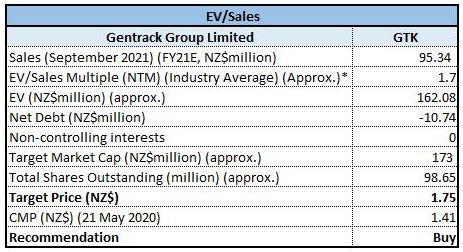
EV/Sales Based Relative Valuation (Source: Refinitiv (Thomson Reuters)) (Illustrative)
* Potential impact of COVID-19 to ongoing projects and sales pipeline has been factored in.
Valuation: As part of the company’s business continuity plans (or BCP) due to COVID-19, GTK has undertaken detailed planning activities throughout its global operations. Moreover, its robust balance sheet position might help the company to sail through difficult times. We have applied P/E Based Relative Valuation (on an illustrative basis) and the target price reflects a growth of lower double-digit (in % terms).
2. Serko Limited (NZX: SKO) (Recommendation: Buy) (Potential Upside: Lower Double-Digit) (M-Cap: ~NZ$268.04 Million)
Business Description: Serko Limited (NZX: SKO) happens to be a story of travel technology innovation. Zeno is the company’s next generation travel management application, which uses intelligent technology, predictive workflows as well as global travel marketplace to transform business travel.
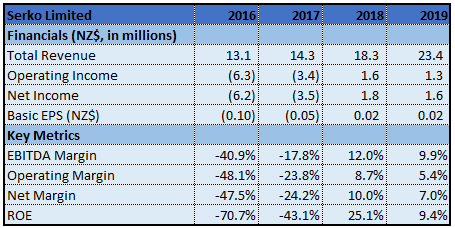
Key Metrics (Source: Refinitiv (Thomson Reuters))
Outlook: Business travel disruption due to Covid-19 has significantly impacted travel transactional revenue, however, the company is in a strong cash balance position following its capital raising in October 2019. The company’s cash balance remains strong at $42 million as at 31st March 2020. The company currently does not have any debt facilities and does not consider it is necessary to obtain any debt funding.
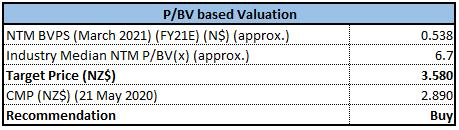
P/BV Based Relative Valuation (Source: Refinitiv (Thomson Reuters)) (Illustrative)
Valuation: The company has also implemented an immediate cost reduction program that removed non-essential expenditure and scaled down operating expenses, such as cost of sales and hosting, in proportion to reduced customer activity and lower transaction volumes. We have applied P/BV Based Relative Valuation (on an illustrative basis) and the target price reflects a growth of lower double-digit (in % terms).
3. EROAD Limited (NZX: ERD) (Recommendation: Buy, Potential Upside: Lower Double-Digit) (M-Cap: ~NZ$173.42 Million)
Business Description: EROAD Limited (NZX: ERD) develops technology solutions that handle vehicle fleets, improve driver safety, support regulatory compliance, and reduce costs associated with driving.
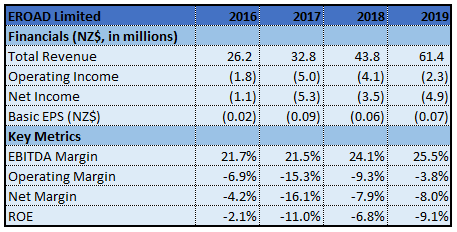
Key Metrics (Source: Refinitiv (Thomson Reuters))
Outlook: The company’s outlook for FY20 is unchanged despite COVID-19 pandemic. However, there has been some delay in finalising contracts with customers, and there has been a short-term impact on new unit growth since tight government restrictions have been implemented globally. Since 27th March, the company has sold 430 units to essential businesses across New Zealand, North America, and Australia. The company is in a strong financial position, with $135 million of future contracted income and an average remaining contract length of 2 years.
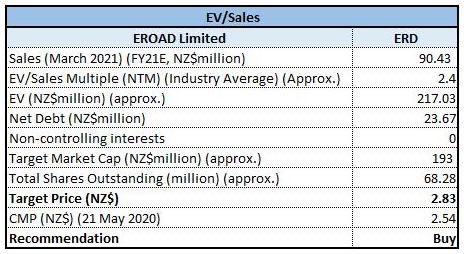
EV/Sales Based Relative Valuation (Source: Refinitiv (Thomson Reuters)) (Illustrative)
Valuation: Its customer base is diverse across regions, business size and industry. A combination of positive contribution to operating cash flow from the New Zealand and North American businesses, together with the recent increase in banking facilities to $60 million, means it has sufficient headroom to support anticipated ongoing organic growth. We have applied EV/Sales Based Relative Valuation (on an illustrative basis) and the target price suggests a growth of lower double-digit (in % terms).
4. Vista Group International Limited (NZX: VGL) (Recommendation: Buy, Potential Upside: Lower Double-Digit) (M-Cap: ~NZ$326.91 Million, Gross Dividend Yield: 1.096%)
Business Description: Vista Group International Limited (NZX: VGL) provides software and additional technology solutions across the global film industry sectors of distribution, exhibition, and consumer.
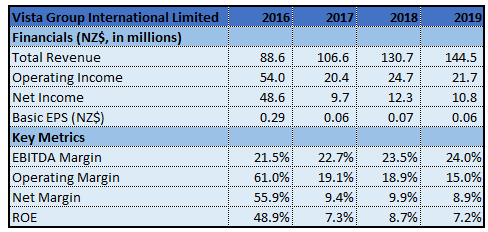
Key Metrics (Source: Refinitiv (Thomson Reuters))
Outlook: The impact of COVID-19 on the film industry globally has been substantial with cinemas in many countries temporarily closing. However, as per the release dated March 24, 2020, Vista Group companies serving the studio segment of the film industry- MACCS, Powster, and Numero- have so far not seen significant impact to their business.
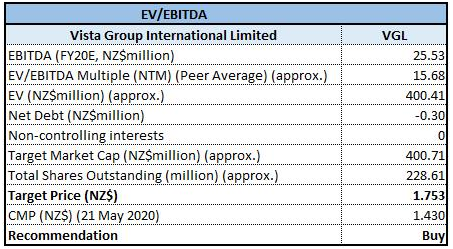
EV/EBITDA Based Relative Valuation (Source: Refinitiv (Thomson Reuters)) (Illustrative)
Valuation: The company is focused towards long-term sustainable success of its business. It has been implementing initiatives in order to sustain the robust balance sheet position with particular emphasis towards cash. VGL’s revenues have grown between FY 2016- FY 2019 and, therefore, it can be said that its revenue-generation capabilities might help in further strengthening its financial footing. We have applied EV/EBITDA Based Relative Valuation (on an illustrative basis) and the target price reflects a growth of lower double-digit (in % terms).
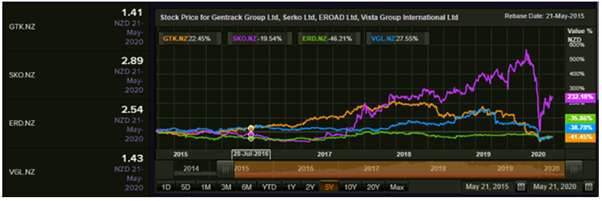
Comparative Price Chart (Source: Refinitiv (Thomson Reuters))
Disclaimer
Kalkine New Zealand Limited is authorised to provide class advice only. The information on this site does not take into account any of your investment objectives, financial situation or needs. Before you make a decision about whether to acquire a financial product, you should obtain the Product Disclosure Statement from the product issuer. You should consider the appropriateness of advice taking into account your own objectives, financial situation and needs and seek independent financial advice before making any financial decisions.
Past performance is not a reliable indicator of future performance.
 Please wait processing your request...