
 AU
AU
 UK
UK
 CA
CA
 US
US
 IND
IND

 NZ
NZ

Company Overview: Power & Renewable Energy company, Meridian Energy Limited (NZX: MEL) is involved in the business of generation, trading, and retailing of electricity, and the sale of complementary products and services. The Company operates through three segments: Wholesale, Retail, and International. The Wholesale segment includes activity associated with its New Zealand generation of electricity and its sales into the wholesale electricity market, purchase of electricity, and development of renewable electricity generation opportunities. The Retail segment includes activity associated with retailing of electricity and complementary products through its two brands: Meridian and Powershop in New Zealand. The International segment includes activity associated with its generation of electricity and sale into the wholesale electricity market, retailing of electricity through the Powershop brand in Australia, and licensing of the Powershop platform in the United Kingdom. The Company supplies electricity to power homes, businesses and farms.

MEL Details
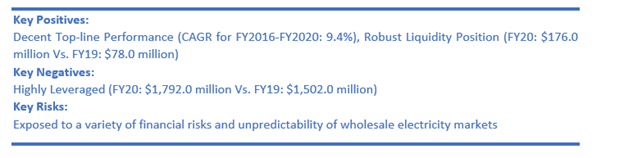
Meridian Energy Limited is New Zealand's largest electricity company which is into electricity generation and retailing the same. Notably, the Government retains 51% ownership of Meridian. MEL is the only New Zealand electricity company with a customer and asset base diversified throughout different countries. The company generates 100% electricity through renewable sources. The market capitalisation of the company stood at ~$14.5 billion on February 15, 2021.
Results Performance (Year ended 30 June 2020)
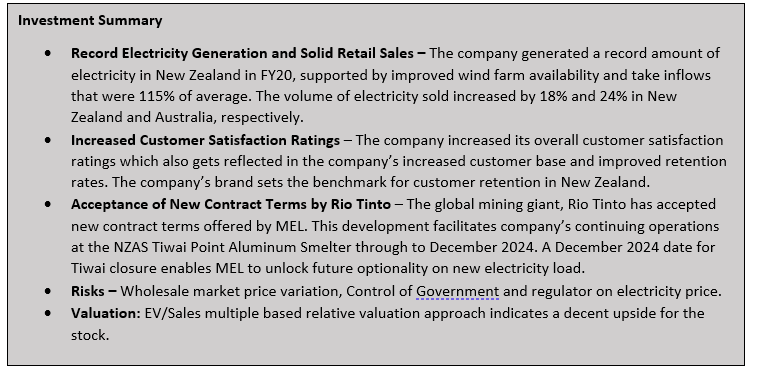
Group’s EBITDAF for the full-year period stood at $854 million, an increase of 2% on the previous year, mainly due to increased retail performance in both New Zealand and Australia. On the back of improved wind farm availability and lake inflows that were 115% of average, MEL generated a record amount of electricity in New Zealand. There was an increase of 18% and 24% in the volume of electricity sold to customers in New Zealand and Australia, respectively. Net profit after tax for the period decreased by 48%, whereas underlying net profit after tax for the period declined by 5%.
The company increased ordinary dividends by around 3% in FY20.
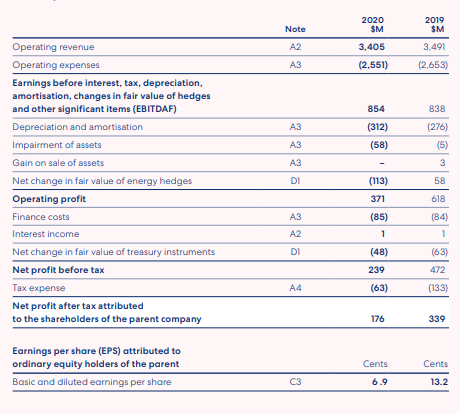
Income Statement (Source: Company Reports)
Operational Performance for December 2020:
National hydro storage from the start of December month till the date 18 January 2021, decreased from 95% to 79% of the historical average. North Island storage and South Island storage stood at 117% and 72% of average, respectively. Total inflows in the month stood at 80% of the historical average.
As per market data, national electricity demand in November was 0.9% lower than the same month last year. December month was dry and mild for most of New Zealand with near-average temperatures for most of the country. Much of the country experienced rainfall well below average, including western parts of the South Island.
New Zealand retail sales volumes in December was 8.9% higher than the same period last year.
The company’s sales in December increased in most segments: SME segment reported growth of 22.0%, followed by corporate (+15.7%), residential (+8.8%), and large business (+8.3%). However, Agricultural volumes were 6.3% lower than the same month in the previous year.
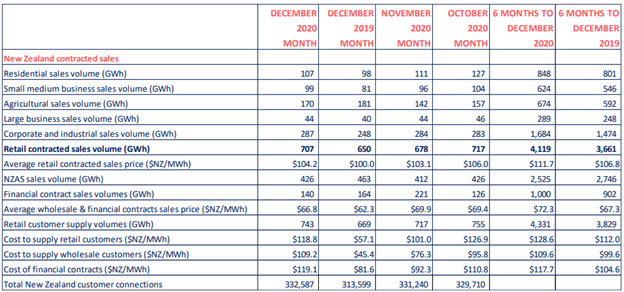
Key Data for New Zealand Market (Source: Company Reports)
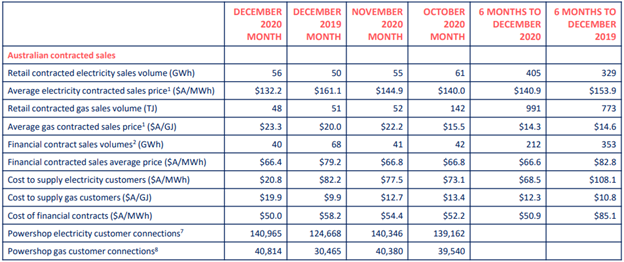
Key Data for Australian Market (Source: Company Reports)
Top 10 Shareholders: The top 10 shareholders have been highlighted in the table, which together forms around 62.76% of the total shareholding.
Exhibit 4: Top 10 Shareholders
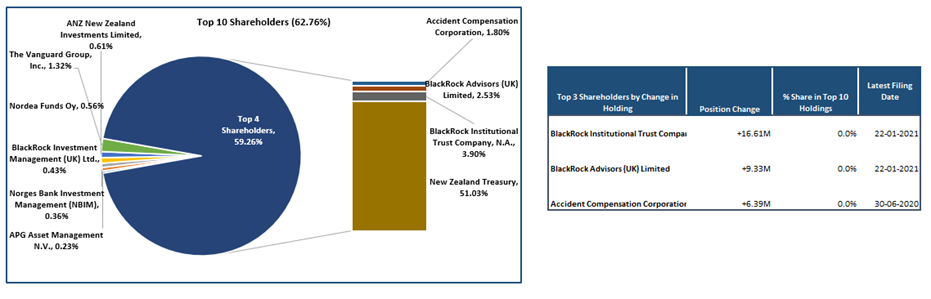
(Source: Refinitiv (Thomson Reuters)), Analysis by Kalkine Group
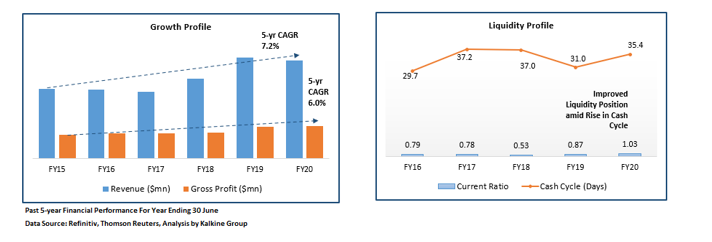
A Quick Look at Key Metrics: The company’s gross margin for FY20 stood at 32.7%, better than the FY19 result of 31.1%, implying an improvement in the operational efficiency of the company. Current ratio for FY20 stood at 1.03x, better than the industry median of 0.52x, implying that the company possesses better capabilities to meet the short-term obligations than the peer group.
Exhibit 5: Key Metrics
Recent Update:
The company on 11 February 2021 announced that it would release its interim results for the six months ended 31 December 2020 on 24 February 2021.
In the earlier update of 28 January 2021, the company stated that its CEO of Meridian Energy Australia and Powershop Australia, Jason Stein will step down from his role from mid-2021. This was due to the ongoing impacts of Covid on travel and personal arrangements, which didn’t allow Mr. Stein to relocate with his family from New Zealand to Australia.
As per the release of 14 January 2021, Rio Tinto has accepted new contract terms offered by MEL, to continue to operate the NZAS1 Tiwai Point Aluminium Smelter through to December 2024. This agreement stands effective from 14 January 2021, with terms such as 400MW with only terminal FM termination rights; 172MW with an NZAS 6-month termination right2 (available from 1 January 2022); pricing is confidential; no electricity price linkages to aluminium pricing; no CPI-linked electricity price increases; force majeure provisions reflect shortened contract term; and Meridian has NZAS contract support from Contact.
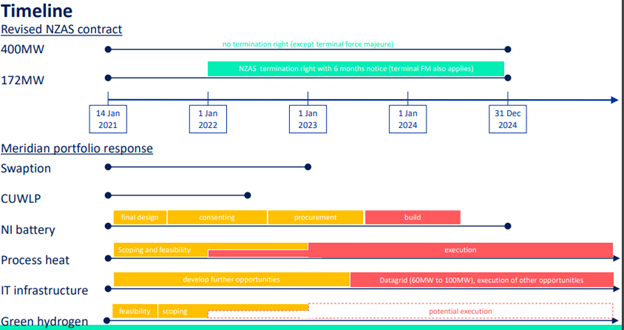
Key Data (Source: Company Reports)
Outlook:
A December 2024 date for Tiwai closure enables MEL to unlock future optionality on new electricity load. With this development, the operational constraints on the HVDC that the company was experiencing appears to be solved before Tiwai closure. The development has also helped the company in terms of re-considering balance sheet flexibility and the timing of Harapaki wind farm build. Further, the recent launch of the Green Finance Programme will support the company’s sustainability efforts.
As the market is gearing up to emission challenges, there is going to be increased renewable generation and transmission assets required to power growth in the number of electric vehicles and the electrification of stationary energy uses.
Thus, the outlook for companies in renewable energy in general and MEL, in particular, appears positive as the company’s brand has the reputation of setting the benchmark for customer retention in New Zealand.
Valuation Methodology: EV/Sales Based Relative Valuation (Illustrative)
.png)
Technical Overview:
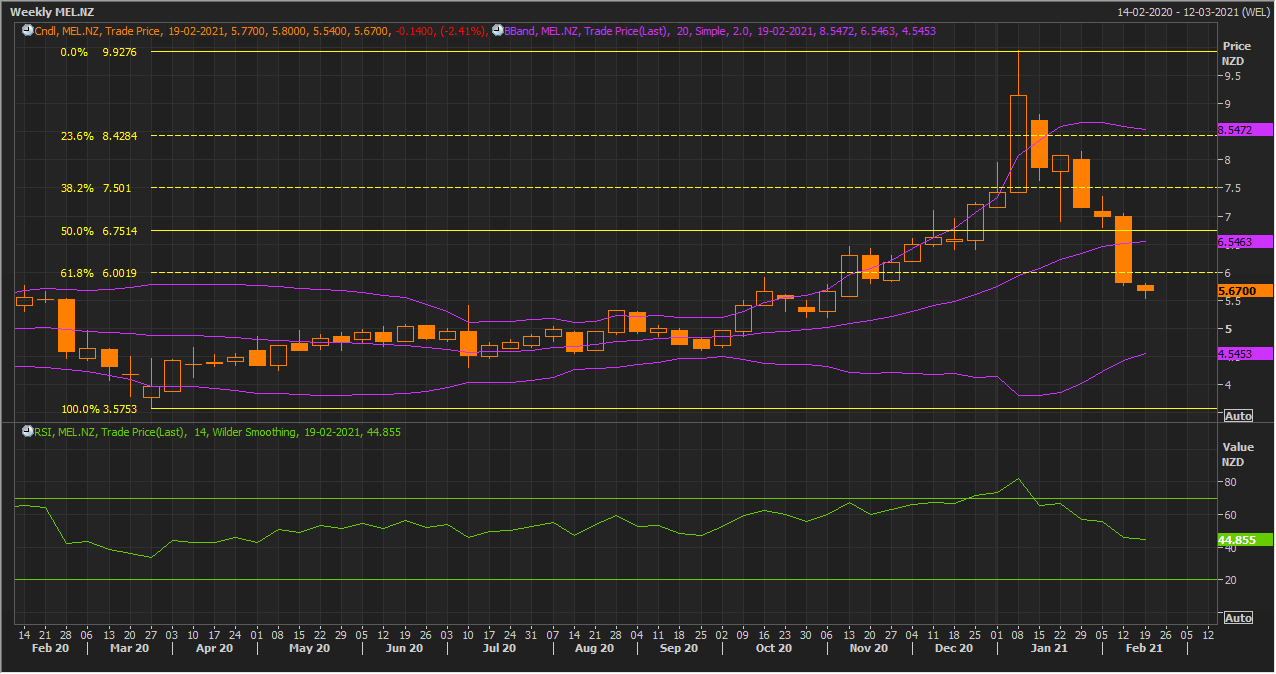
Weekly Chart–
Source: Refinitiv (Thomson Reuters)
Note: Purple colour lines are Bollinger Bands® with the upper band suggesting overbought status while the lower band oversold status, and yellow lines are Fibonacci retracement lines which measure price rebound and backtrack. https://www.bollingerbands.com/
The stock from its high of $9.94 has retraced beyond 61.8% level of $6.00 and has given close at $5.67 on the first trading session of the ongoing week but forming a ‘Hammer’ on the chart which could be towards bullish reversal of the trend. The technical indicator RSI with a reading around 45 suggests neutral to up momentum for the stock.
Going forward, the stock may have resistance around 20 periods SMA of $6.55 whereas support could be around $5.50.
Stock Recommendation:
Operational performance of December 2020 suggests electricity sales increasing in almost all segments barring agriculture. Retail sales volume has increased by 8.9% over the same period last year. We expect the continuation of the increasing trend of electricity sales and volume in the upcoming years with business activities returning to new normal.
We have valued the stock using EV/Sales multiple based relative valuation (on an illustrative basis) and have arrived at the target price with the potential upside of low double-digit (in % terms). We have applied a slight discount to the peer median EV/Revenue (NTM Trading multiple) considering the risks associated with the operations and highly leveraged position which could impact margins moving forward.
Hence, we give a “Buy” recommendation on the stock at the current market price of $5.670 per share, down by 2.41% on February 15, 2021.
.png)
MEL Daily Technical Chart (Source: Refinitiv (Thomson Reuters))
Disclaimer
Kalkine New Zealand Limited is authorised to provide class advice only. The information on this site does not take into account any of your investment objectives, financial situation or needs. Before you make a decision about whether to acquire a financial product, you should obtain the Product Disclosure Statement from the product issuer. You should consider the appropriateness of advice taking into account your own objectives, financial situation and needs and seek independent financial advice before making any financial decisions.
Past performance is not a reliable indicator of future performance.
 Please wait processing your request...