
 AU
AU
 UK
UK
 CA
CA
 US
US
 IND
IND

 NZ
NZ

Company Overview: Meridian Energy Limited (NZX: MEL) is involved in the business of generation, trading and retailing of electricity, and the sale of complementary products and services. It is a NZ power company which generates electricity via 100% renewable sources – wind, water as well as sun.
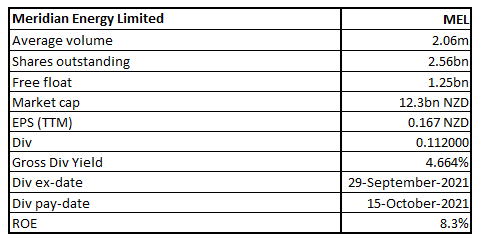
MEL Details
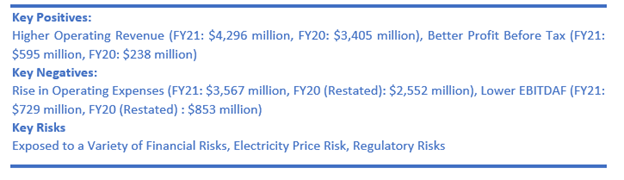
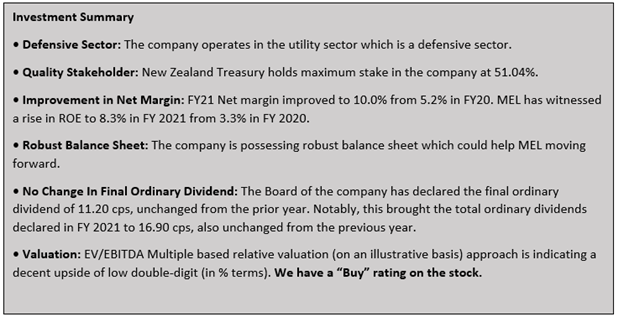
Meridian Energy Limited is New Zealand's power company. Notably, the NZ Government retains 51% ownership of Meridian. MEL is the only New Zealand electricity company with a customer and asset base diversified throughout different countries. The company generates 100% electricity through renewable sources. The market capitalisation of the company stood at ~$12.3 billion on 18th October 2021.
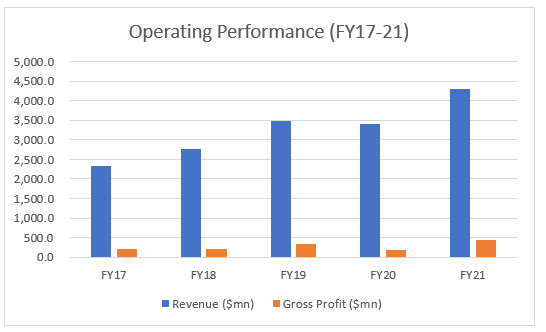
Looking at the past performance over FY17 to FY21, topline and bottomline of the company grew with a compounded annual growth rate (CAGR) of 16.65% and 20.95%, respectively. Total revenue of the company improved from $2,320.0 million in FY17 to $4,296.0 million in FY21. Net Income of the company improved from $200.0 million in FY17 to $428.0 million in FY21.
Exhibit 1: Operating Performance
Source: Company Reports, Analysis by Kalkine Group
Results Performance (FY21 Ended 30 June 2021)
Exhibit 2: Income Statement
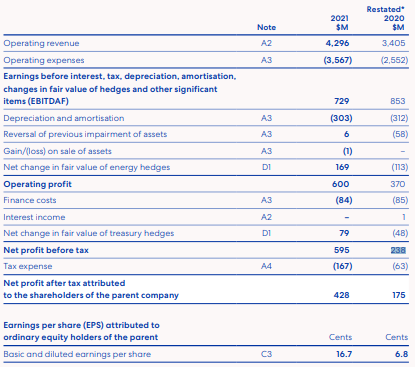
Key Data (Source: Company Reports)
Operational Performance for August 2021:
Rise in National Hydro Storage: National hydro storage from the start of August month till the date of 10th September 2021 increased from 103% to 126% of historical average. North Island storage increased to 83% and South Island storage increased to 139% of average by 10th September 2021. Total monthly inflows were 161% of historical average.
National electricity demand down 0.3% YoY: As per market data, national electricity demand in August 2021 was 0.3% lower than the same month last year. This was due to more stringent lockdowns in the month as compared to previous corresponding period.
SME Reported Highest Growth: Compared to August 2020, there was increase in the segment sales (residential +14.2%), (small medium business +18.8%) and (corporate +17.2%). Large business volumes were -10.3% lower and agricultural volumes were -5.0% than August 2020.
Exhibit 3: Key Operational Data
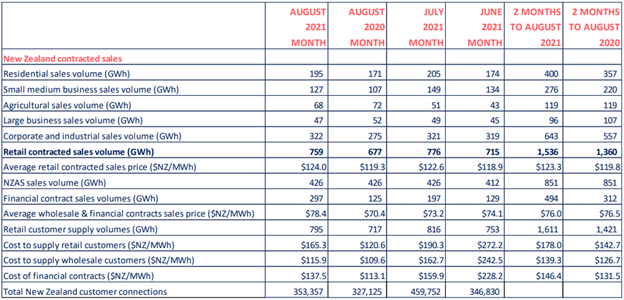
Key Data for New Zealand Market (Source: Company Reports)
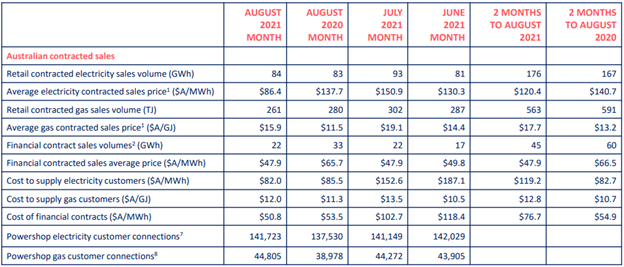
Key Data for Australian Market (Source: Company Reports)
Top 10 Shareholders: The top 10 shareholders have been highlighted in the table, which together forms around 59.51% of the total shareholding. New Zealand Treasury and BlackRock Institutional Trust Company, N.A. are holding maximum stake in the company at 51.04% and 2.04%, respectively, as provided in the table below:
Exhibit 4: Top 10 Shareholders
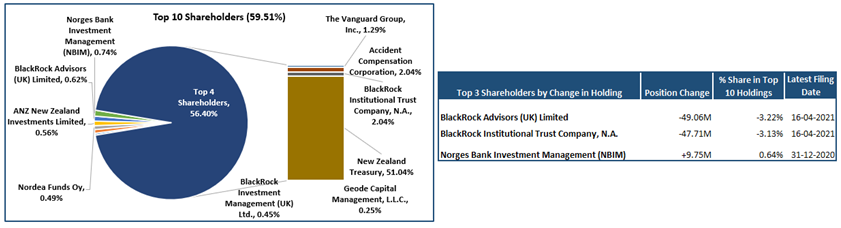
Source: Analysis by Kalkine Group
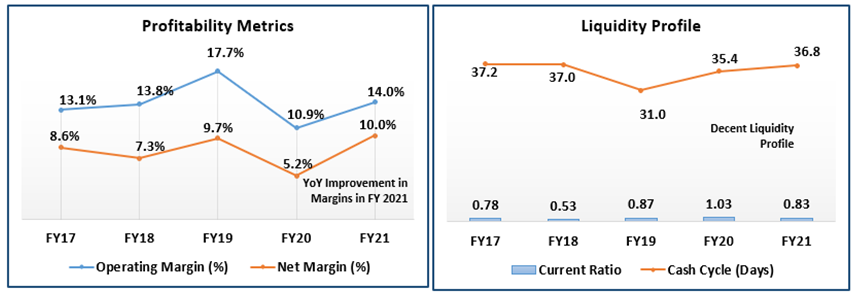
A Quick Look at Key Metrics: The company’s operating margin and net margin for FY21 stood at 14.0% and 10.0%, better than the FY20 result of 10.9% and 5.2%, respectively, implying improvement in the operational efficiency of the company. Its ROE for FY21 stood at 8.3%, better than the FY20 result of 3.3%. Its cash cycle for FY21 stood at 36.8 days, lower than the industry median of 63.6 days, implying that the company managed its asset-liability balances in an efficient manner, than its peer group.
Exhibit 5: Key Metrics
Source: Analysis by Kalkine Group
Recent Update:
Outlook:
The company’s balance sheet is resilient, which can be understood from the fact that S&P Global Ratings reaffirmed Meridian’s corporate credit rating as BBB+/Stable/A-2. In New Zealand, Powershop won the Canstar and Consumer New Zealand awards for customer satisfaction and trust, and over in Australia Powershop was recognised once again by Canstar Blue, Finder and Roy Morgan for customer satisfaction.
Key Risks:
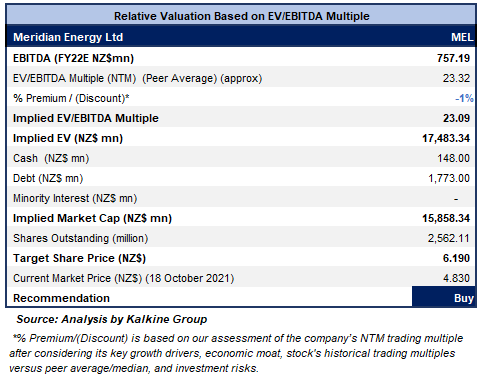
Valuation Methodology: EV/EBITDA Multiple Based Relative Valuation (Illustrative)
Technical Overview:
Chart:
Source: REFINITIV
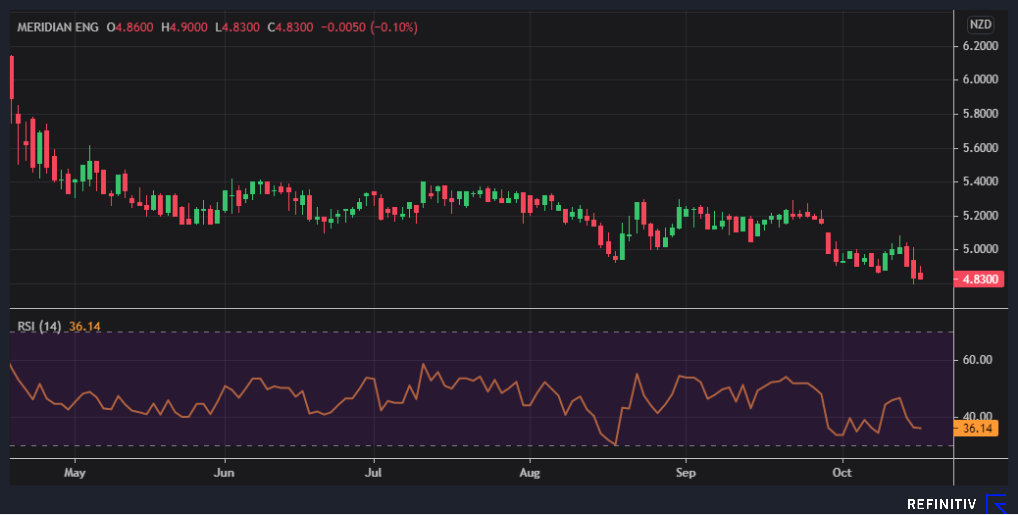
Note: Orange Color Line Reflects RSI (14-Period)
Stock Recommendation:
The stock of MEL witnessed a decline of ~17.8% in 6 months and ~34.9% in 9 months. It has made a 52-week low and high of $4.8 and $9.94, respectively.
The stock has been valued using EV/EBITDA multiple based illustrative relative valuation method and the target price reflects that there might be a rise of low double-digit (in percentage terms). A discount has been applied to EV/EBITDA Multiple (NTM) (Peer Average) considering lower EBITDAF in FY 2021 on the YoY basis. However, its balance sheet is resilient which could help moving forward.
Hence, we give a “Buy” recommendation on the stock at the current market price of $4.830 per share, down by 0.10% on 18th October 2021.
Note 1: The reference data in this report has been partly sourced from REFINITIV.
Note 2: Investment decisions should be made depending on the investors’ appetite on upside potential, risks, holding duration, and any previous holdings. Investors can consider exiting from the stock if the Target Price mentioned as per the analysis has been achieved and subject to the factors discussed above alongside support levels provided.
Technical Indicators Defined:-
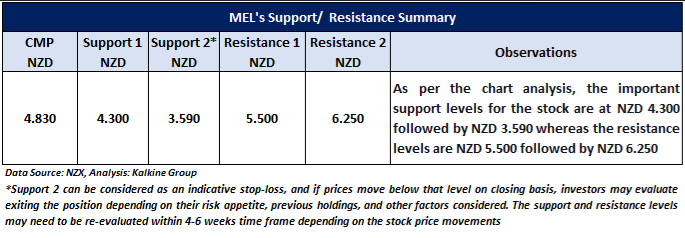
Support: A level where-in the stock prices tend to find support if they are falling, and downtrend may take a pause backed by demand or buying interest.
Resistance: A level where-in the stock prices tend to find resistance when they are rising, and uptrend may take a pause due to profit booking or selling interest.
Stop-loss: It is a level to protect further losses in case of unfavourable movement in the stock prices
Disclaimer
Kalkine New Zealand Limited is authorised to provide general advice only. The information on this website does not take into account any of your investment objectives, financial situation or needs. Before you make a decision about whether to acquire a financial product, you should obtain the Product Disclosure Statement from the product issuer. You should consider the appropriateness of advice taking into account your own objectives, financial situation and needs and seek independent financial advice before making any financial decisions.
Past performance is not a reliable indicator of future performance.
 Please wait processing your request...