
 AU
AU
 UK
UK
 CA
CA
 US
US
 IND
IND

 NZ
NZ

Company Overview: Power & Renewable Energy company, Meridian Energy Limited (NZX: MEL) is New Zealand’s largest electricity company, generating 100% electricity from renewable sources. It is involved in the business of generation, trading and retailing of electricity, and the sale of complementary products and services. The Company operates through three segments: Wholesale, Retail and International.
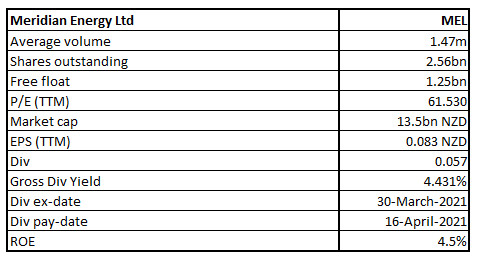
MEL Details
.png)
Meridian Energy Limited is New Zealand's largest electricity company. Notably, the Government retains 51% ownership of Meridian. The company generates 100% electricity through renewable sources. The market capitalisation of the company stood at ~$13.5 billion on August 23, 2021.
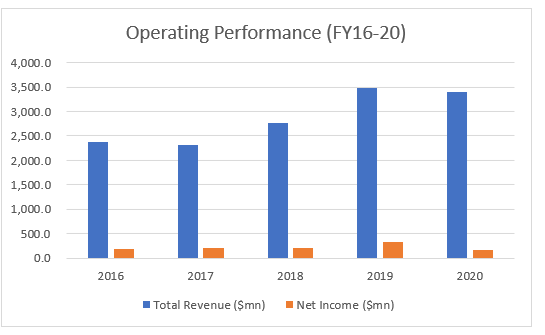
Looking at the past performance over FY16 to FY20, the topline of the company grew with a compounded annual growth rate (CAGR) of 9.42%. Total revenue of the company improved from $2,375.0 million in FY16 to $3,405.0 million in FY20.
Exhibit 1: Operating Performance
Source: Company Reports, Analysis by Kalkine Group
Results Performance (Half-Year ended 31 December 2020)
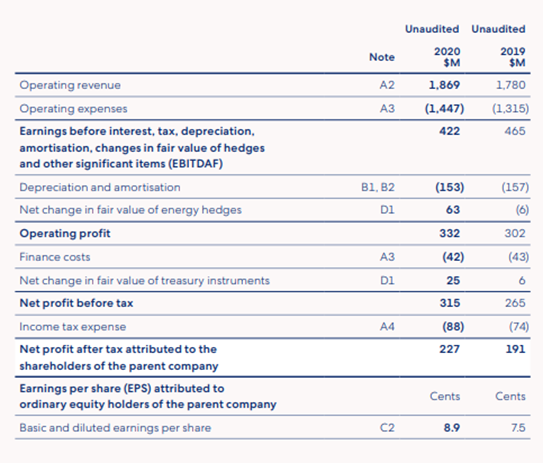
A Decent Operating Performance: The company’s revenue from continuing operations for the first half period of FY21 stood at $1,869 million, an increase of 5.0% on the previous corresponding period (pcp) on the back of customer and sales volume growth across all segments. However, it reported a 9.4% decline in its EBITDAF to $422 million, which can be attributed to lower New Zealand hydro generation and lower market prices in Australia.
NPAT up 19% YoY: Total net profit for the period stood at $227 million, an increase of 19% on pcp, as a result of positive changes in the value of hedge instruments. However, underlying net profit after tax (after adjusting changes in fair values of hedging instruments, and tax effect above adjustment) for the period declined by 15.2% YoY to $156 million. Net tangible assets per share for the period stood at $1.87, as compared to $1.97 in the pcp.
Interim Dividend at 5.70 cps: The Board of Directors declared an interim dividend of 5.70 cps (86% imputed). No final decision has been arrived on the dividend reinvestment plan.
Exhibit 2: Income Statement
(Source: Company Reports)
Results Performance (FY20 ended 30 June 2020)
Strong Operating Performance: Group’s EBITDAF for the full year period, stood at $854 million, an increase of 2% on the previous year, mainly due to Increased retail performance in both New Zealand and Australia. On the back of improved wind farm availability and lake inflows that were 115% of average, MEL generated a record amount of electricity in New Zealand. There was an increase in the volume of electricity sold to customers by 18% in New Zealand and 24% in Australia. Net profit after tax for the period decreased by 48% to $176 million, whereas underlying net profit after tax (removing fair value movements) for the period declined by 5% to $317 million from $333 million in the previous year. There was an increase in ordinary dividends in FY20 by around 3%.
The period witnessed significant development with Powershop New Zealand being named as Energy Retailer of the Year at the Deloitte Energy Excellence Awards, and MEL came out on top of the major retailers in Consumer New Zealand’s power satisfaction survey.
Operational Performance for July 2021:
Total monthly inflows up 156% of Historical Average: National hydro storage from the start of July month till the date 11 August 2021, increased from 92% to 103% of the historical average. North Island storage increased to 72% and South Island storage increased to 111% of average by 11 August 2021. Total monthly inflows were 156% of the historical average.
National electricity demands up 0.7% YoY: As per market data, national electricity demand in July 2021 was 0.7% higher than the same month last year. The month was unseasonably warm with temperatures above average for much of the country. Rainfall was mixed, including above average rainfall in the South Island.
Retail Sales Volume up by 13.6%: The company reported an increase of 13.6% in retail sales volume in the month of July against the same month last year.
SME Reported Highest Growth: As per sales data, the small medium business reported growth of +31.4%, followed by corporate (+13.9%), residential (+10.3%), and agricultural (+9.4%). However, the large business volumes were -10.0% lower than July 2020.
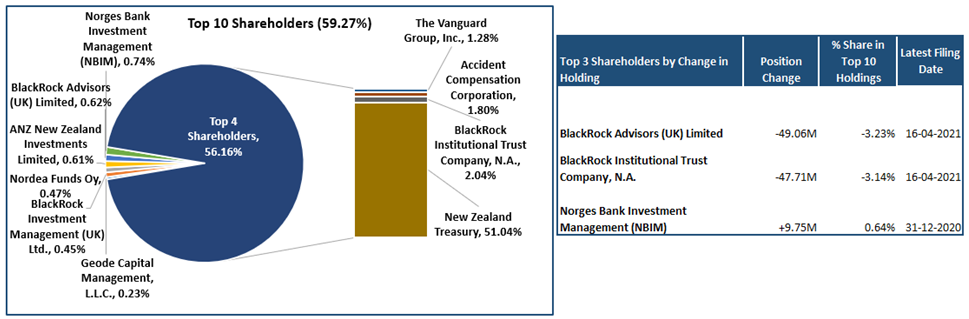
Top 10 Shareholders: The top 10 shareholders have been highlighted in the pie chart, which together forms around 59.27% of the total shareholding. New Zealand Treasury and BlackRock Institutional Trust Company, N.A. are holding a maximum stake in the company at 51.04% and 2.04%, respectively, as provided in the table below:
Exhibit 3: Top 10 Shareholders
Source: Analysis by Kalkine Group
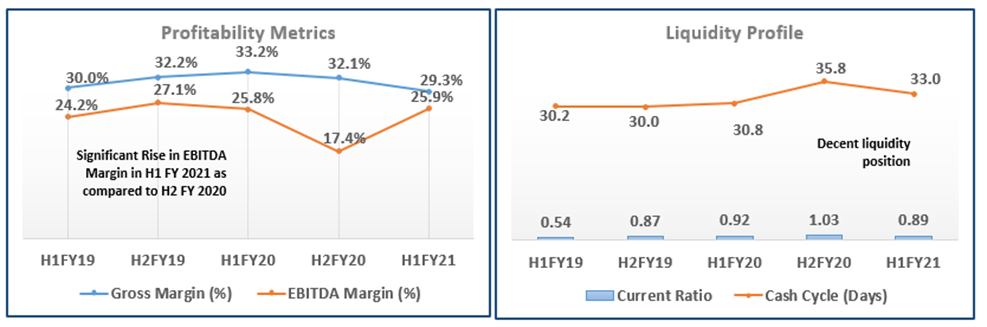
A Quick Look at Key Metrics: The company has recorded an improvement in its EBITDA and net margins over H1FY19 to H1FY21. However, there was a sharp recovery in its margins from a dip in H2FY20 to H1FY21. The current ratio, having witnessed a continued improvement over H1FY19 to H2FY20, marginally fell to 0.89x in H1FY21 whereas the cash cycle in H1FY21 improved to 33.0 days against 35.8 days in H2FY20, thereby, reflecting marginal improvement in liquidity.
Exhibit 4: Key Metrics
Source: Analysis by Kalkine Group
Recent Update:
On 17th August 2021, the company accepted the decision of the Electricity Authority (EA) to correct the December 2019 Undesirable Trading Situation (UTS). This decision relates to the floods of December 2019 when hydro generators were managing record breaking inflows and spills past hydro power stations was inevitable.
Outlook:
Wind Farm Construction to Commence Soon: MEL will soon begin construction of a new $395 million wind farm in Hawke’s Bay, boosting New Zealand’s ability to take action on climate change and accelerating the transformation of the economy to clean energy sources. The Harapaki Wind Farm will be New Zealand’s second-largest wind farm with 41 turbines generating 176 MW of renewable energy, enough to power over 70,000 average households. The construction will take around three years and is expected to create 260 new jobs.
Rio Tinto Extends Planned Smelting Closure: Additionally, the company has reached an agreement with its largest customer, Rio Tinto, who would now be extending the planned closure period for the Tiwai Point Aluminium Smelter in Southland from August 2021 to December 2024. The additional four years of smelter operation will be invaluable to the Southland region as it allows time to create new business opportunities and new jobs for Southlanders.
FY21 Guidance: For FY21, the company expects its capital expenditure to be in the range of NZ$70 million to NZ$80 million. Operating cost in FY21 is expected in the middle of the NZ$261 million to NZ$266 million range.
The company plans to release its FY21 results on 25th August 2021.
Key Risks:
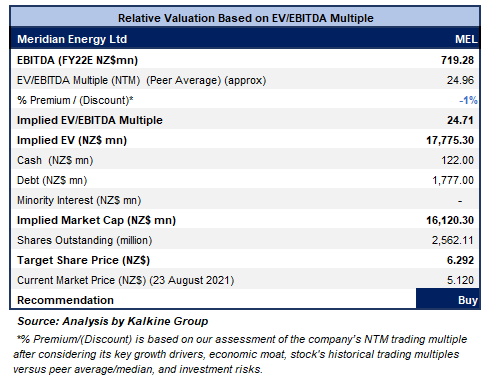
Valuation Methodology: EV/EBITDA Multiple Based Relative Valuation (Illustrative)
Technical Overview:
Chart:
_(1).png)
Source: REFINITIV
Note: Purple Color Line Reflects RSI (14-Period)
Stock Recommendation:
Standard & Poor’s Global Ratings has revised its credit rating outlook for Meridian Energy Limited (MEL) to BBB+/Stable from BBB+/Negative, reflecting their view that Rio Tinto’s decision to continue operations at its NZAS smelter until at least 31 December 2024, eases previously forecast pressure on earnings and energy margins. At the same time, Standard & Poor’s affirmed Meridian’s ‘BBB+’ long-term issuer credit rating and ‘A2’ short- term issuer credit rating.
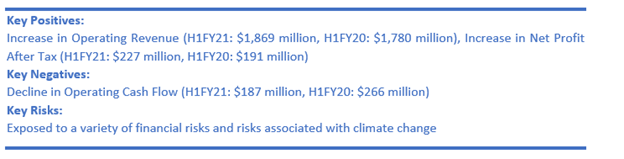
The stock has been valued using EV/EBITDA multiple based illustrative relative valuation method and the target price reflects that there might be a rise of low double-digit (in percentage terms). A discount has been applied to EV/EBITDA Multiple (NTM) (Peer Average) considering decline in operating cash flow in H1 FY 2021 on the YoY basis as well as risks associated.
Hence, we give a “Buy” recommendation on the stock at the current market price of $5.120 per share (New Zealand Time: 11:38 am (GMT +12)) on August 23, 2021.
Note 1: The reference data in this report has been partly sourced from REFINITIV.
Note 2: Investment decisions should be made depending on the investors’ appetite on upside potential, risks, holding duration, and any previous holdings. Investors can consider exiting from the stock if the Target Price mentioned as per the analysis has been achieved and subject to the factors discussed above alongside support levels provided.
Technical Indicators Defined:-
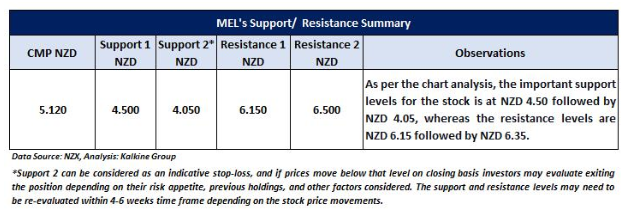
Support: A level where-in the stock prices tend to find support if they are falling, and downtrend may take a pause backed by demand or buying interest.
Resistance: A level where-in the stock prices tend to find resistance when they are rising, and uptrend may take a pause due to profit booking or selling interest.
Stop-loss: It is a level to protect further losses in case of unfavourable movement in the stock prices.
Disclaimer
Kalkine New Zealand Limited is authorised to provide class advice only. The information on this site does not take into account any of your investment objectives, financial situation or needs. Before you make a decision about whether to acquire a financial product, you should obtain the Product Disclosure Statement from the product issuer. You should consider the appropriateness of advice taking into account your own objectives, financial situation and needs and seek independent financial advice before making any financial decisions.
Past performance is not a reliable indicator of future performance.
 Please wait processing your request...