
 AU
AU
 UK
UK
 CA
CA
 US
US
 IND
IND

 NZ
NZ

I. Sector Landscape and Outlook
New Zealand’s broadcasting and digital media sector plays a very crucial role in enabling a well-informed democracy through high-quality news coverage. The broadcasting sector consists of free and paid services delivered across television, radio, and digital platforms.
The telecommunication sector is very crucial for the economic growth of a country as it enables greater efficiency and productivity across all sectors. With the increase in interdependencies across sectors, its importance is growing rapidly.
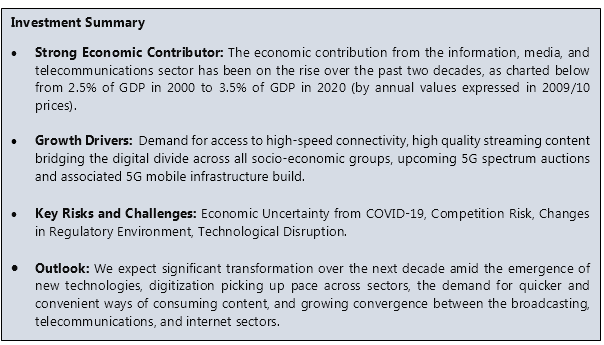
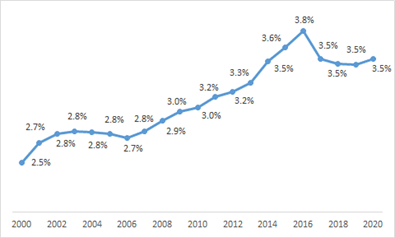
The economic contribution from the information, media, and telecommunications sector has been on the rise over the past two decades, as charted below from 2.5% of GDP in 2000 to 3.5% of GDP in 2020 (by annual values expressed in 2009/10 prices).
Exhibit 1: Information, Media, and Telecommunications % contribution to GDP*
Source: Statistics New Zealand, Chart Created by Kalkine Group
*Note: By annual values based on actual chain-volume series expressed in 2009/10 prices
Both the media and communications sector has witnessed significant transformation due to a shift to digitization. Consumers, too, play a significant role in defining what the industry offers. Changing preferences in the wake of COVID-19 and demand for quicker and more comfortable means of consuming content have compelled these businesses to rethink their business models that are being pursued.
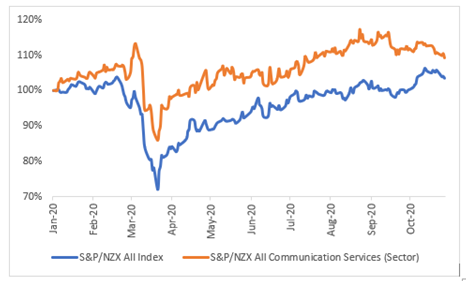
S&P/NZX All Communication Services Outperformed S&P/NZX All Index on YTD by 5.7%
The communications services sector has outperformed NZX all index since the beginning of the year 2020.
Exhibit 2: S&P/NZX All Index versus S&P/NZX All Communication Services Index*
Source: SP Global, *3rd January 2020 – 29th October 2020; Chart Created by Kalkine Group
Importance of New Zealand’s Screen Industry
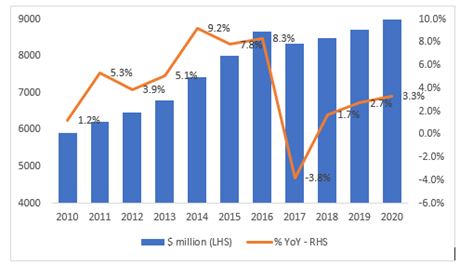
The economic contribution from the screen industry benefits the economy through activities related to inter alia movies, television, online production, and software-based entertainment and has spilled over effects on industries such as tourism, arts, and culture. As charted below, the annual revenue (in $ million) from the information, media, and telecommunications industry has been growing consistently and reached $8,996 million in 2020.
Exhibit 3: Information, Media, and Telecommunications % growth over the past decade*
Source: Statistics New Zealand, Chart Created by Kalkine Group
*Note: By annual values based on actual chain-volume series expressed in 2009/10 prices
In 2015, the screen industry contributed $1.015 billion to the GDP of the country, which was up by 2.8% Y-o-Y. The industry is estimated to have directly contributed $6.04 billion to GDP from 2010 to 2015. The screen industry also supports growth in high skill, high tech jobs in the ICT category and increases the diversity of exports and strengthens the international brand.
Government Supports Media Industry Through Tough Times
The Government has announced a suite of initiatives valued at $50 million that has been developed with the media industry to help the industry to get through the COVID-19 pandemic. This package is about freeing up cash in the short term to assist the industry get through the immediate crisis and dramatic drop in advertising revenue experienced since the start of COVID Alert Level 4.
The media sector is only the third sector, after primary health care and aviation, to receive a specific pool of funding over and above the wage subsidy to help it get through the COVID-19 crisis. This support reflects the essential role media play at this time in delivering access to reliable news coverage and keeping New Zealanders connected while in the lockdown.
Challenges Faced by New Zealand’s Media Sector
As the country’s population becomes more diverse, its broadcasting sector needs to respond accordingly. Domestic media companies are required to be innovative and resilient as they adapt to a changing environment and strive to stand out in an increasingly competitive market. It is also very important that during these times of disruption, the media companies continue to deliver robust independent news and media coverage to New Zealanders without restrictions.
The Māori media sector has a history of over 30 years of contribution and achievement. If the sector is to keep delivering on its purpose of providing unique, relevant, and accessible content it needs to anticipate audience trends that demand for greater diversity and authenticity.
Importance of New Zealand’s Telecommunications Industry
New Zealand is experiencing the fastest fibre offtake in the developed world which is providing a platform for other digital services on a global scale. There has been an increased demand for mobile services and the internet. Data demand has been on the rise across the board.
Coverage for both fixed lines and mobile services in rural and urban regions is quite high although some remote rural areas do not have good mobile coverage. The Telecommunication Service Obligation (TSO) ensures voice calls and dial-up internet, and fax services are available to almost all. It is being ensured that 98% of fibre is rolled out across the country.
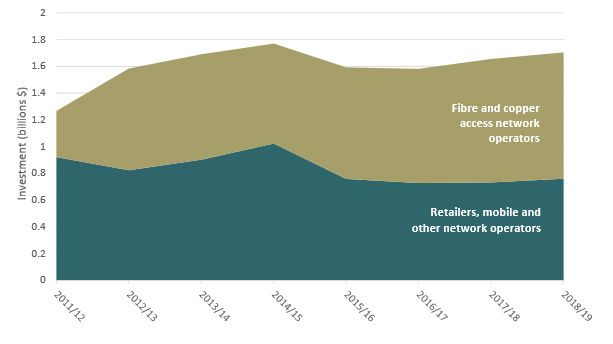
However, there have been concerns about the speed of the internet as it is behind OECD averages and can be improved with the help of Ultra-Fast Broadband (UFB) and Rural Broadband Initiatives (RBI) programmes. These programmes contribute to the significant investment being made in this sector by both the private and public sectors, which also includes extending mobile coverage and introducing 4G services in the recent past and now 5G services.
Thus, access to world-class connectivity may result in better access to streaming content, bringing more global entertainment, news, sport, and business services, bridging the digital divide across all socio-economic groups. The telecommunication industry is likely to go through a huge change with the expected competition of the government-sponsored fibre build and the upcoming 5G spectrum auctions and associated 5G mobile infrastructure build.
Exhibit 4: Growing Investment in Telecommunications Sector
Source: Annual Telecommunications Monitoring Report 2019
Country’s Broadband Performed Well During COVID-19 Lockdown
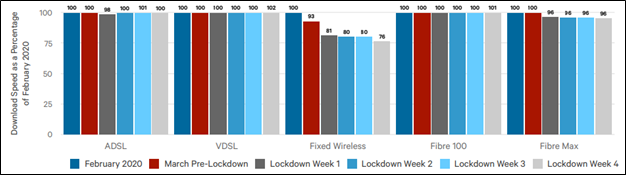
The Commerce Commission’s latest Measuring Broadband New Zealand report shows that on average, copper and fibre broadband connections experienced no significant decrease in download speeds during lockdown, despite unprecedented demand on broadband networks.
As per Telecommunications Commissioner, Dr Stephen Gale, a huge increase in the number of New Zealanders staying connected, working, and learning from home caused heavy demand on broadband networks during the lockdown period.
Telecommunications providers reported record levels of online activity. But despite that increased copper and fibre 100 plans continued to perform well, with average download speeds unaffected. Average download speeds for fixed wireless decreased by about 25 percent and average download speeds for the fastest plan, fibre max, decreased by about 4 percent.
Exhibit 5: Download Speed by Plan since February 2020, Indexed to February 2020
Source: MBNZ Autumn 2020 report
Opportunities in Telecommunications Sector
Infrastructure funds, pension funds, and government funds are assigning high valuation multiples to telecommunications infrastructure assets such as mobile towers, data centers, submarine cable, and fibre infrastructure.
The next wave of transactions is likely to continue among small ISPs and largely about the infrastructure of big telecom companies within the country. The continued expansion of the ultra-fast broadband and rural broadband initiatives should provide some room for upselling as ISPs migrate legacy copper connections towards fibre. Operators are also shifting their focus towards 5G services and will continue to monitor spectrum plans laid out by the government and will strategize their deployments to maximize the returns on their investment.
Outlook
The Broadcasting and Telecommunication sector in New Zealand is experiencing significant change, driven by digital technology. Digital technology allows material that was once the domain of television and radio to reach through a PC screen, mobile, or personal digital assistant. As a result, there is a growing convergence between the broadcasting, telecommunications, and internet sectors.
Because of the continuous rise in competition, media companies must always look for ways to develop advanced strategies for bigger customer attention. For example, marketing is expected to be led by greater penetration of smart televisions with Over the Top (OTT) television capability. Also, increased use of mobile internet, faster connections, app innovation, and convenience offered by smartphones are some other factors offering potential growth opportunities in the sector.
II. Investment theme and stocks under discussion (NZM, SKT, VTL, and TLS)
Apart from the sector-specific factors, we have also analyzed four NZX-listed companies operating in the media and communications sector. This report covers their insights, outlook, performance and potential as expected to be delivered in the near to medium term.
1. NZME Limited (NZX: NZM) (Recommendation: Buy, Potential Upside: Low Double-Digit), (M-Cap: ~NZ$123.83 Million, Dividend Yield: 4.76%)
About the Company
NZME Limited is a New Zealand based integrated media company, with a portfolio of market-leading radio, newspaper, digital and magazine titles, with a customer base of 3.3 million Kiwis.
Recent Operational Update
NZME’s Newstalk ZB has increased its overall audience by about 74,000 listeners in the latest survey by GfK Commercial Radio Audience, while music network ZM now has the most listeners in the key audience groups of 25-44 year old and 25-54 year old throughout the country. Newstalk ZB and ZM have increased their Breakfast audiences and are now the two most popular commercial breakfast radio networks across New Zealand’s major radio markets.
Outlook
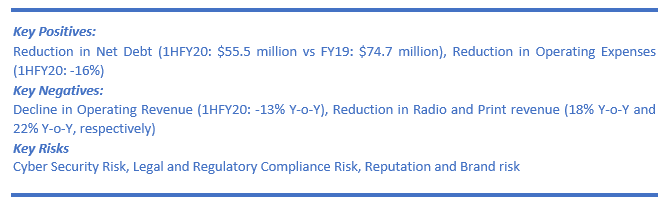
In 3QFY20, the company’s total advertising revenue is expected to decline by 16% Y-o-Y and considering the current market situation, the company expects to deliver operating EBITDA of $60 million to $63 million. This represents a growth of about 18% to 24%. Based on constant progress in economic conditions, Covid-19 recovery, enhanced revenue trends and stable cost reductions, the company expects profit growth in 2021.
Valuation Methodology: P/E multiple-based relative valuation method (Illustrative)
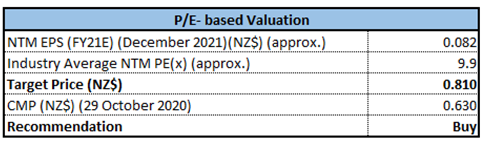
P/E multiple-based relative valuation method (Source: Refinitiv (Thomson Reuters))
Note: All forecasted figures and peers have been taken from Thomson Reuters, NTM-Next Twelve Months
We have applied P/E multiple-based relative valuation method (on an illustrative basis) and the target price reflects a potential upside in low double-digit (in %).
Considering the aforesaid facts, its robust cost reduction measures, positive outlook, and current trading levels, we give a “Buy” rating on the stock at the current market price of NZ$0.63 as on the close of 29th October 2020.
2. Sky Network Television Limited (NZX: SKT) (Recommendation: Buy, Potential Upside: Low Double-Digit), (M-Cap: ~NZ$258.45 Million, Dividend Yield: 0.69%)
About the Company
Sky Network Television Limited is New Zealand’s leading digital multi-media business that provides sport and entertainment media services in New Zealand and overseas.
Outlook
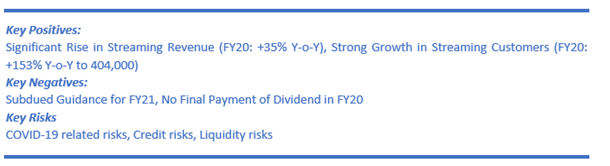
For FY21, the company is expecting to report total revenue of $660 million to $700 million, subject to no adverse change in operating conditions. EBITDA is expected to be between $125 million to $140 million and NPAT is expected in the range of $10 million to $20 million. The company has taken various steps in renegotiating its banking facilities and has strengthened its balance sheet through raising capital.
The company has also approved terms with Spark New Zealand Limited to offer Sky Sport Now in a bundle with Spark Sport from 16 November 2020. The initial term of the agreement is up to six months and the terms of the agreement are commercial and confidential.
The streaming sports bundle will offer Sky Sport Now and Spark Sport to eligible Spark customers and the details of the offer will be announced by Spark.
Valuation Methodology: P/E multiple-based relative valuation method (Illustrative)
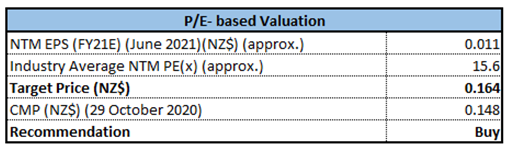
P/E multiple-based relative valuation method (Source: Refinitiv (Thomson Reuters))
Note: All forecasted figures and peers have been taken from Thomson Reuters, NTM-Next Twelve Months
We have applied P/E multiple-based relative valuation method (on an illustrative basis) and the target price reflects a potential upside in low double-digit (in %).
Considering the aforesaid facts, its positive FY21 results outlook, and current trading levels, we give a “Buy” rating on the stock at the current market price of NZ$0.148 as on the close of 29th October 2020.
3. Vital Limited (NZX: VTL) (Recommendation: Hold, Potential Upside: Low Double-Digit), (M-Cap: ~NZ$32.28 Million, Dividend Yield: 4.4%)
About the company
Vital Limited is the provider of fundamental nationwide infrastructure as well as communication services that are Vital to New Zealand. The company has been offering seamless, connected, integrated communications and coverage in New Zealand’s most remote locations for more than 25 years.
Outlook
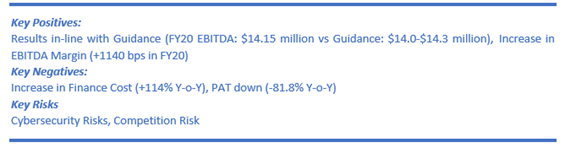
The company has successfully implemented its Business Continuity Plan and that as a provider of essential services, it was fully operational during the lockdown period. As a provider of critical nationwide communications, the company’s services were essential and were on the list of lifeline utilities. The company’s 24/7 network operations centre was open across many sites to ensure segregation for staff.
Technical Overview:
Weekly Chart:
Source: Refinitiv (Thomson Reuters)
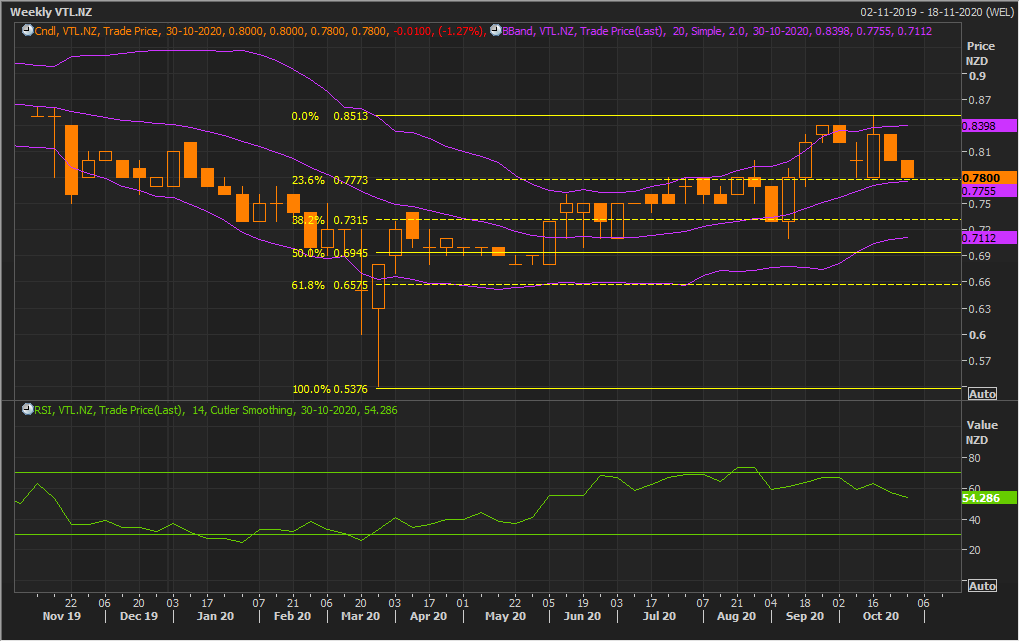
Note: Purple colour lines are Bollinger Bands* with the upper band suggesting overbought status while the lower band oversold status, and yellow lines are Fibonacci retracement lines which measure price rebound and backtrack. https://www.bollingerbands.com/
The stock has given a lower close for the ongoing week at $0.78 which is marginally above the crucial level of $0.77 as provided by the converging point of the 23.6% retracement level and 20 periods SMA. Like in the past, the level of $0.77 is held firmly as support then we can see a rebound in prices from here. However, the technical indicator RSI with 54 reading and a curve at the end pointing down suggests a softening of bullish momentum for the stock.
Going forward, the stock may have resistance around the previous high of $0.85 whereas support could be around $0.77.
Hence, we give a “Hold” recommendation at the current price of NZ$0.78 per share as on the close of 29th October 2020.
4. Telstra Corporation Limited (Recommendation: Buy, Potential Upside: Low Double-Digit), (M-Cap: ~NZ$34.49 Billion, Dividend Yield: 5.38%)
About the Company
Telstra Corporation Limited (NZX: TLS) is a telecommunications and technology company that offers a full range of communications services and competing in all telecommunications markets.
Outlook
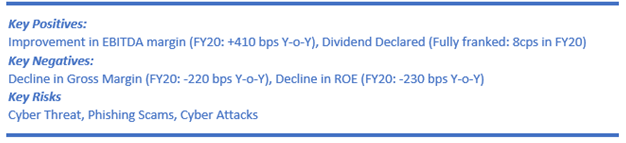
For FY21, the company’s total income is expected to be in the range of $23.2 billion to $25.1 billion, underlying EBITDA in the range of $6.5 billion to $7.0 billion and free cash flow after operating lease payments of $2.8 billion to $3.3 billion. The guidance for FY21 underlying EBITDA has considered the negative impact from the COVID-19 pandemic of about $400 million.
Valuation Methodology: P/E multiple-based relative valuation method (Illustrative)
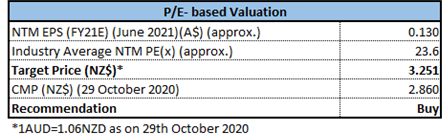
P/E multiple-based relative valuation method (Source: Refinitiv (Thomson Reuters))
Note: All forecasted figures and peers have been taken from Thomson Reuters, NTM-Next Twelve Months
We have applied P/E multiple-based relative valuation method (on an illustrative basis) and the target price reflects a potential upside in low double-digit (in %).
Considering the aforesaid facts, its positive FY21 results outlook, potential upside, and current trading levels, we give a “Buy” rating on the stock at the current market price of NZ$2.86 per share as on the close of 29th October 2020.
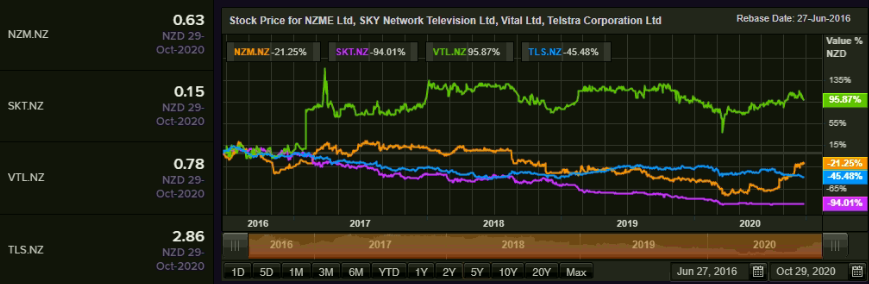
Comparative Daily Technical Chart (Source: Refinitiv (Thomson Reuters))
Disclaimer
Kalkine New Zealand Limited is authorised to provide class advice only. The information on this site does not take into account any of your investment objectives, financial situation or needs. Before you make a decision about whether to acquire a financial product, you should obtain the Product Disclosure Statement from the product issuer. You should consider the appropriateness of advice taking into account your own objectives, financial situation and needs and seek independent financial advice before making any financial decisions.
Past performance is not a reliable indicator of future performance.
 Please wait processing your request...