
 AU
AU
 UK
UK
 CA
CA
 US
US
 IND
IND

 NZ
NZ

Company Overview:
Genesis Energy Limited (NZX: GNE) is a NZ-owned energy company. Contact Energy Limited (NZX: CEN) is an NZ-based energy generator and retailer.
Kalkine’s Sector Report covers the Investment Highlights, Key Financial Metrics, Risks, Outlook, Technical Analysis along with the Valuation, Target Price, and Recommendation on the stock.
1. Sector Landscape and Outlook
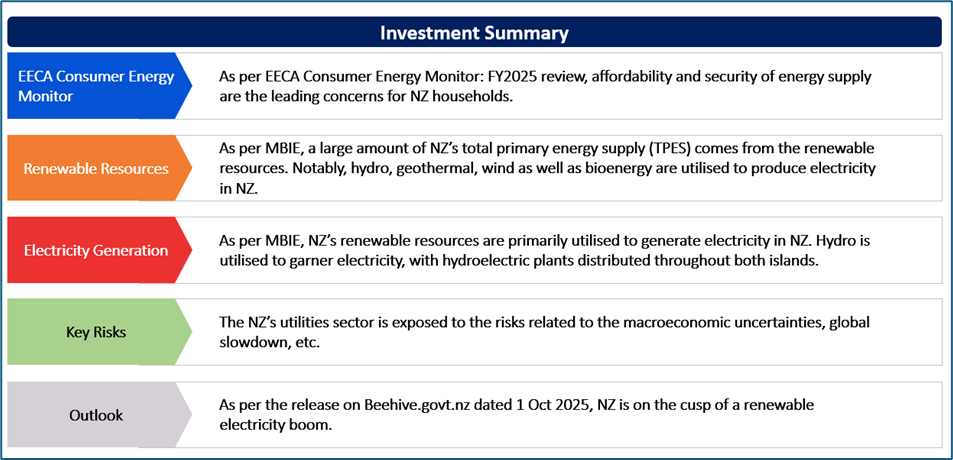
As per EECA Consumer Energy Monitor: FY2025 review, affordability and security of energy supply are the leading concerns for NZ households. Notably, more than three quarters of New Zealanders (76%) opine that it is critical to invest more into renewable electricity generation, whereas just over half (54%) believe having a sufficient supply of fossil fuels as critical. With respect to the current trends, ~15% of households have switched electricity providers over the past 12 months, with little change over the year, demonstrating plenty of latent potential for New Zealanders to shop around for the better plans.
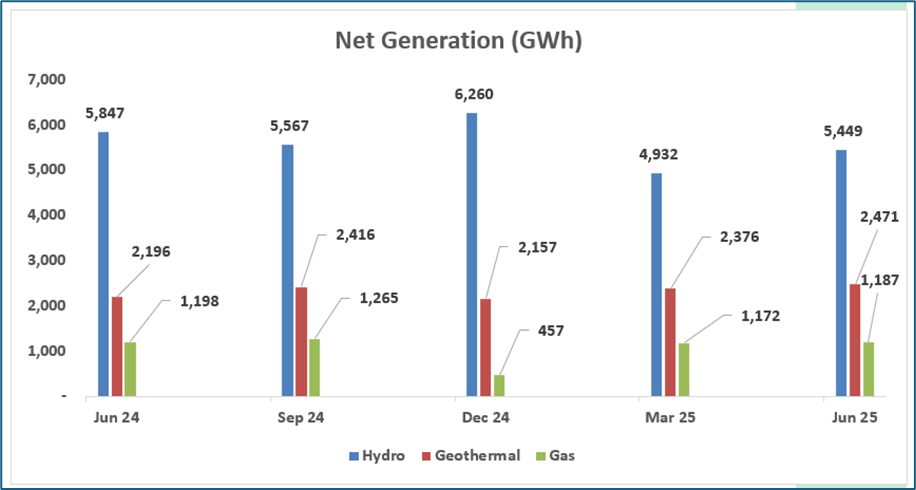
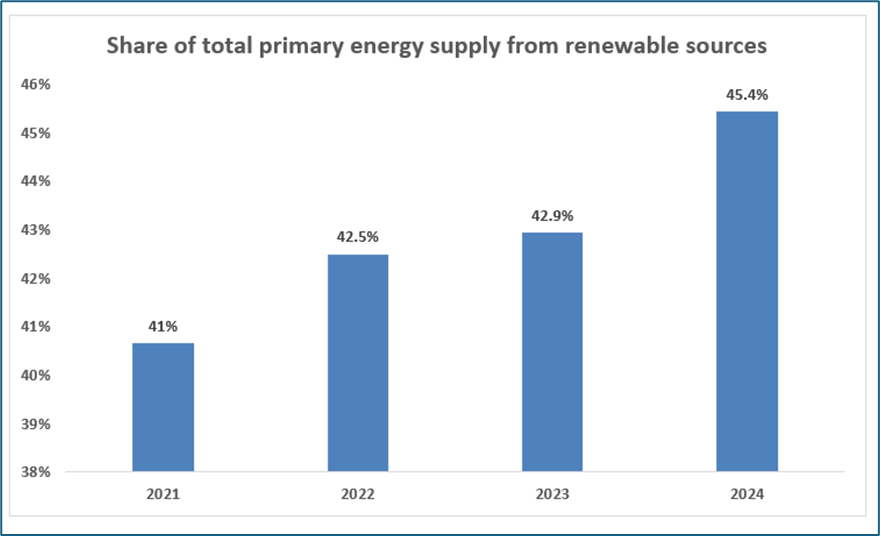
As per MBIE, a large amount of NZ’s total primary energy supply (TPES) comes from the renewable resources. Notably, hydro, geothermal, wind as well as bioenergy are utilised to produce electricity in NZ. NZ is a country which is rich in the geothermal resources. The geothermal energy is the fuel type with the largest contribution to the TPES.
Exhibit 1: Net Generation (GWh)
Data Source: This work is owned by the Ministry of Business, Innovation and Employment on behalf of the Crown which are licensed for reuse under the Creative Commons Attribution 4.0 International Licence; Chart Created by Kalkine Group
Electricity Generation
As per MBIE, NZ’s renewable resources are primarily utilised to generate electricity in NZ. Hydro is utilised to garner electricity, with hydroelectric plants distributed throughout both islands. The largest plants, regarding capacity, are found in the South Island. Notably, wind is also utilised to garner electricity, with the largest wind farms found in the North Island. With respect to the Direct use, the geothermal is utilised directly in industrial processes (like drying milk powder or timber), heating greenhouses as well as for residential and commercial heating.
The direct use of renewable energy rose by 4.07% from 32.5 PJ in 2023 to 33.8 PJ in 2024. This was mainly because of a 6.17% rise in industrial sector direct use of renewable energy from 21.4 PJ in 2023 to 22.7 PJ in 2024.
Exhibit 2: Share of Total Primary Energy Supply from Renewable Sources
Data Source: This work is owned by the Ministry of Business, Innovation and Employment on behalf of the Crown which are licensed for reuse under the Creative Commons Attribution 4.0 International Licence; Chart Created by Kalkine Group
Current Trends in NZ’s Energy Future
As per the release on Beehive.govt.nz dated 1 Oct 2025, the Government assured the power companies in which it possesses a majority shareholder that capital remains available to help investment in the critical electricity infrastructure. Notably, the energy powers every part of the economy, from households to high-value industries, and would be determining the ability to compete in the global economy.
Key Risks and Challenges:
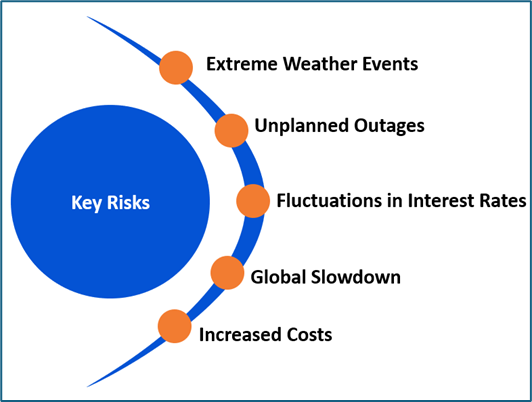
As per RBNZ’s release dated 8th October, the slow growth in disposable incomes as well as house prices is impacting the economic activity, but reduced interest rates have been supporting the recovery in consumption. Also, the limited access to domestic energy sources and increased energy prices are likely to have impacted the manufacturing more generally. Overall, the NZ’s utilities sector is exposed to the risks related to the macroeconomic uncertainties, global slowdown, etc.
Exhibit 3. Key Risks in Utilities Sector:
Source: - Analysis: Kalkine Group
Outlook:
As per the release on Beehive.govt.nz dated 1 Oct 2025, NZ is on the cusp of a renewable electricity boom. Notably, more new generation remains commissioned over the previous 18 months than in the previous 15 years because of the work to knock down regulatory barriers. The Government’s Energy Package remains focused on investing in security of supply and building better markets to improve affordability. With respect to the security of supply, it includes launching the formal procurement process for an LNG import facility, removing barriers to ramp up the delivery of renewable energy via Electrify NZ, etc.
With respect to building better markets, it includes developing options to reduce policy risk for investors in new energy projects, like the $200 Mn set aside for co-investment in gas fields through Budget 2025, developing new rules, in consultation with industry, to make sure that the lack of dry year back-up supply doesn’t re-emerge.
Apart from the sector-specific factors, an analysis on 2 NZX-listed companies is provided. This report covers their insights, outlook, performance and potential as expected to be delivered in the near to medium term.
1) Genesis Energy Limited (NZX: GNE) (Recommendation: Hold, Potential Upside: Low Double-Digit) (M-Cap: NZD 7 Bn, Annual Dividend Yield: ~8.04%)
Business Description:
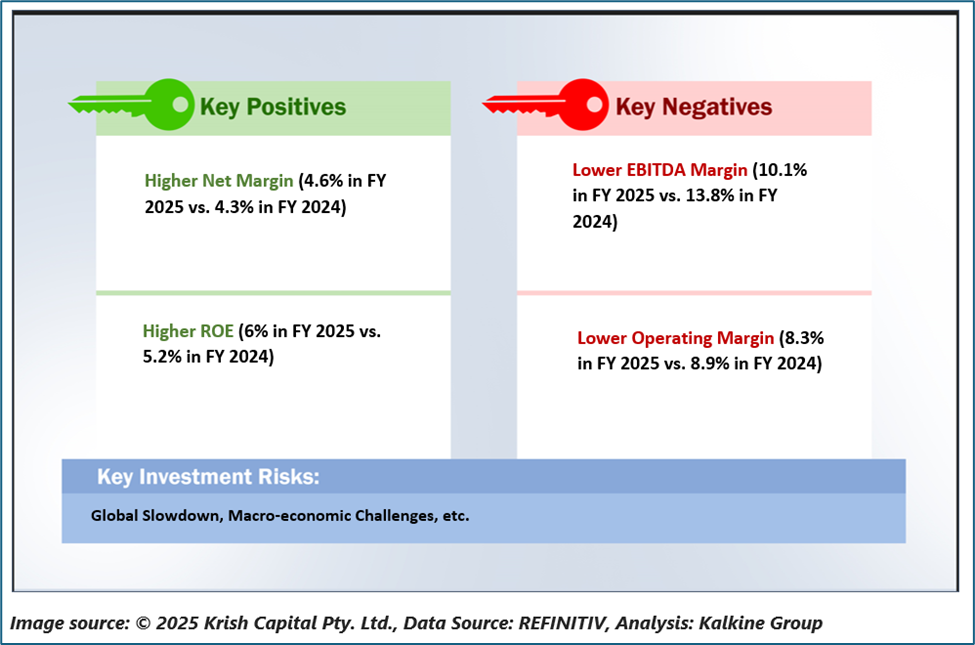
Genesis Energy Limited (NZX: GNE) is an energy generator and retailer supplying electricity, natural gas and liquefied petroleum gas (LPG) to customers in New Zealand.
Outlook:
GNE is committed to delivering the balanced yield-plus-growth strategy, maintaining a BBB+ credit rating, and investing towards renewables, flexible generation as well as digital infrastructure to help NZ’s energy transition. For FY 2026, the normalised EBITDAF is expected between $430 million - $460 million.
Technical Overview:
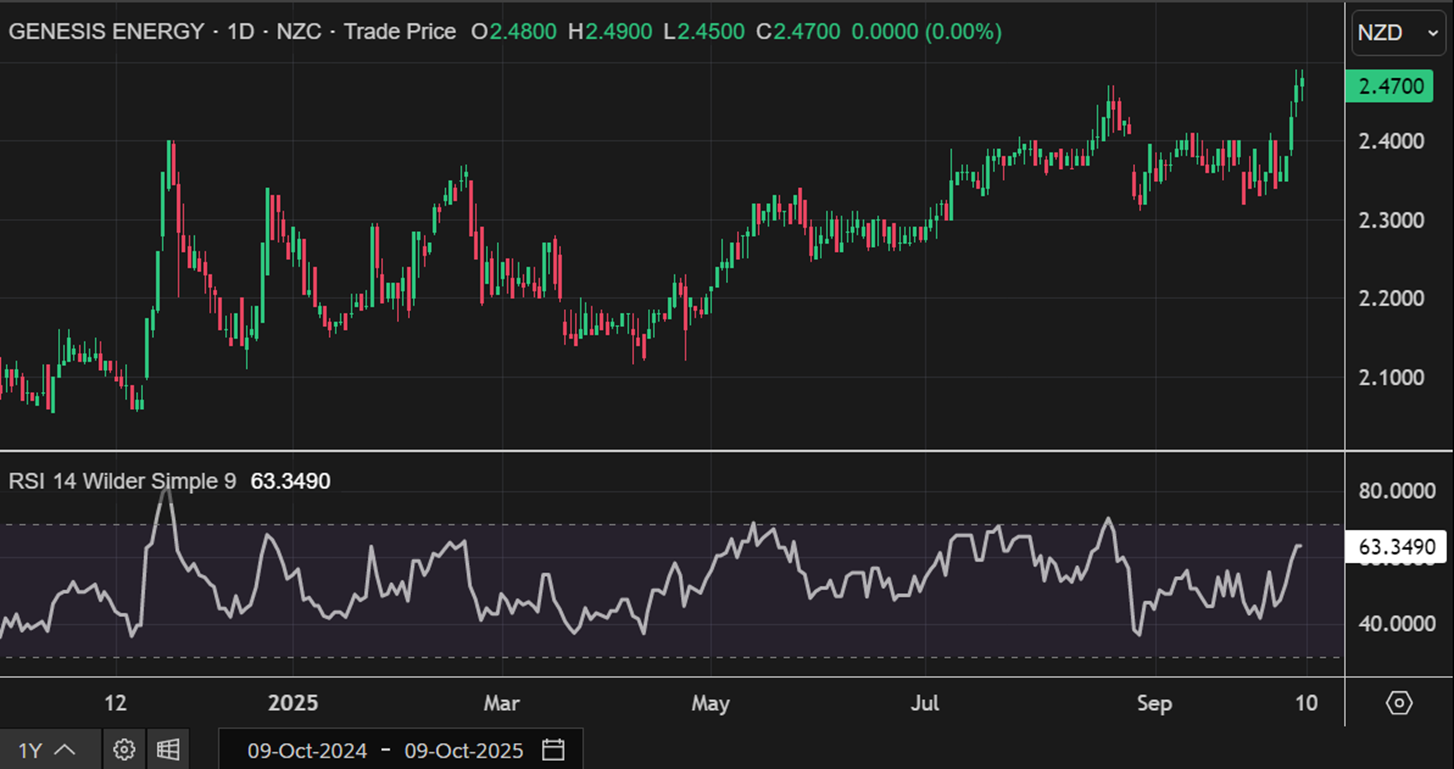
GNE Daily Technical Chart, Data Source: REFINITIV
Technical Commentary:
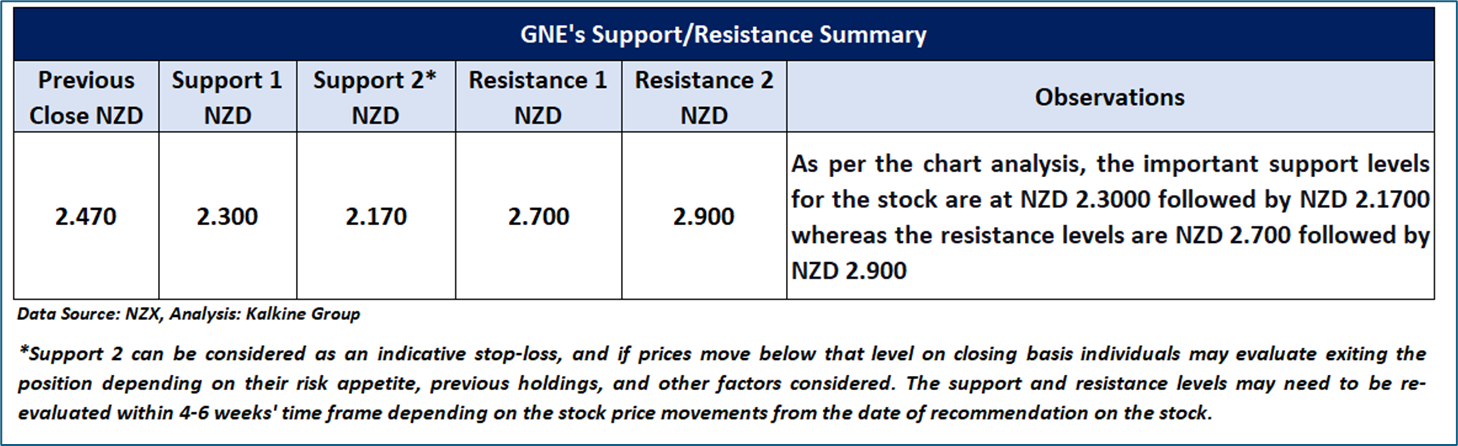
On the daily chart, GNE’s stock price broke above the upper boundary of a trading range, indicating a positive bias. Additionally, the momentum oscillator RSI (14-period) is heading north from its midpoint, adding more evidence to the previous analysis. Prices are trading above both 21-day and 50-day SMAs, which might act as dynamic support levels for the stock; in contrast, the stock’s previous high may serve as a resistance level. A significant support level for the stock is positioned at NZD 2.3, while critical resistance level is located at NZD 2.7
Fundamental Valuation
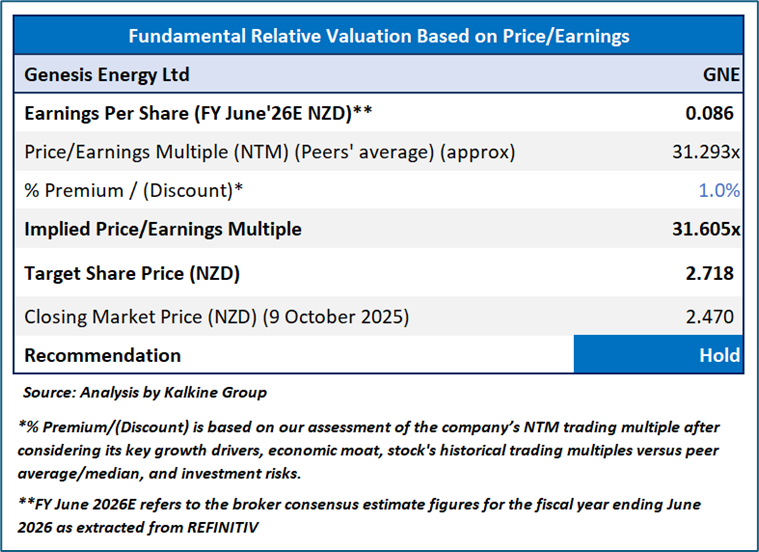
P/E Based Relative Valuation
Stock Recommendation
Considering the facts above, a ‘Hold’ recommendation on the stock has been provided at the closing market price of NZD 2.47 per share as on 9 October 2025.
2) Contact Energy Limited (Recommendation: Buy, Potential Upside: Low Double-Digit) (M-Cap: NZD 8.9 Bn, Annual Dividend Yield: 5.48%)
Business Description:
Contact Energy Limited (NZX: CEN) is an NZ-based energy generator and retailer. The segments include Wholesale and Retail.
Outlook:
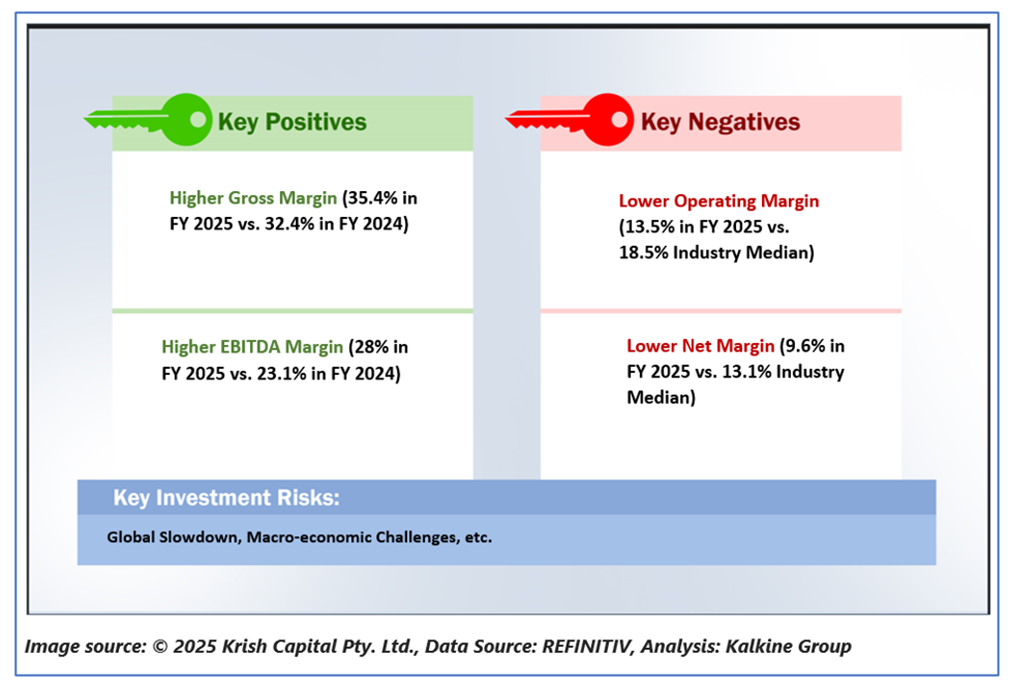
In line with the strategy to be a leader in the decarbonisation of NZ, CEN remains a major contributor to the energy investment, having committed over $2 Bn to building the critical energy infrastructure NZ needs. CEN would continue to deliver the new renewable electricity projects as well as innovative supply arrangements which are required to support the energy transition in NZ.
Technical Overview:
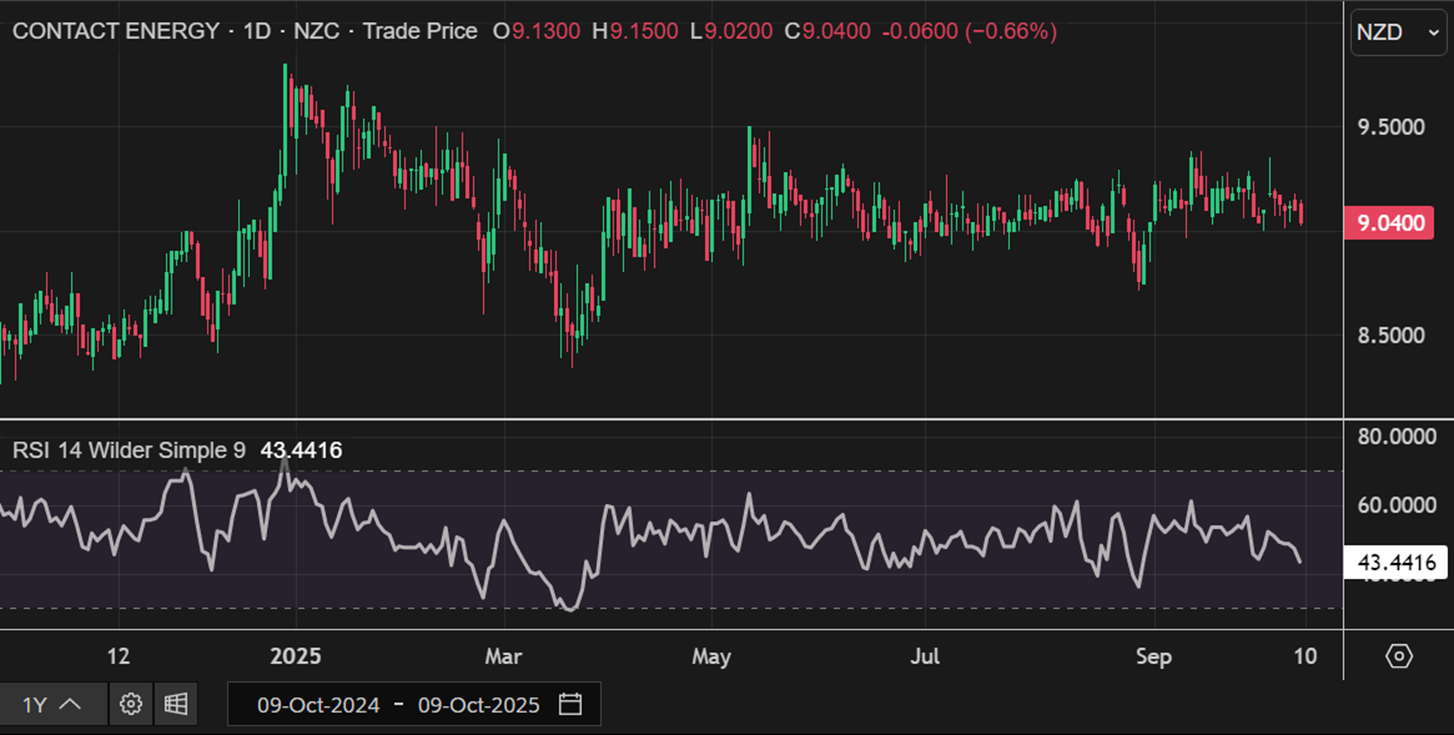
CEN Daily Technical Chart, Data Source: REFINITIV
Technical Commentary
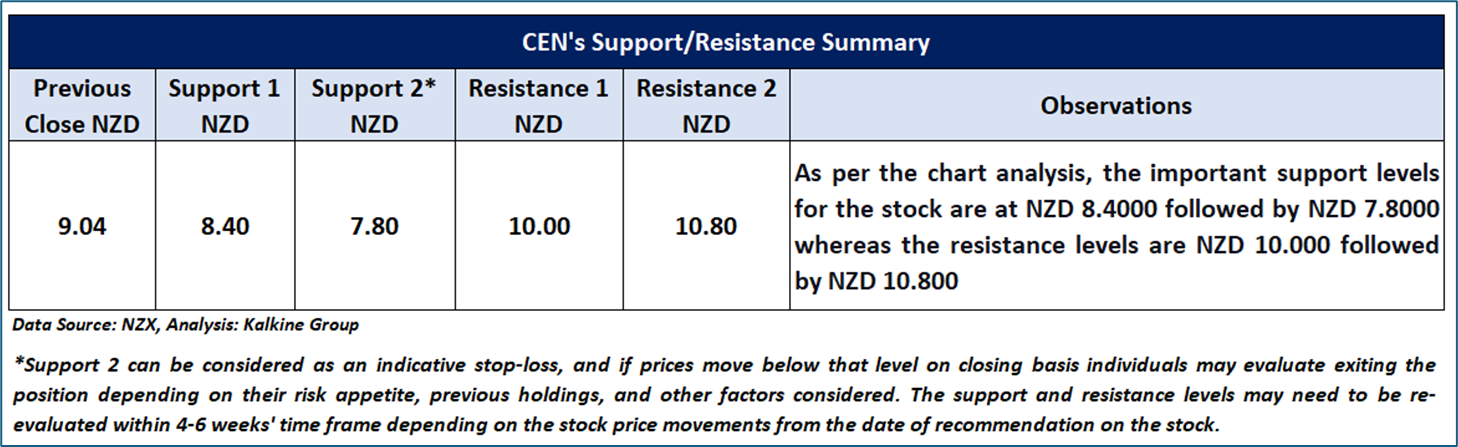
On the daily chart, CEN’s stock price is developing a trading range characterized by a symmetrical triangle, suggesting that the current sideways period in the stock might continue to persist in the near future. Moreover, the momentum oscillator RSI (14-period) is hovering around its midpoint, providing further support to the previous observation. Prices are trading between its previous peak and trough, which might function as resistance and support levels for the stock, respectively. A significant support level for the stock is positioned at NZD 8.4, while critical resistance level is located at NZD 10
P/E Based Relative Valuation
Stock Recommendation
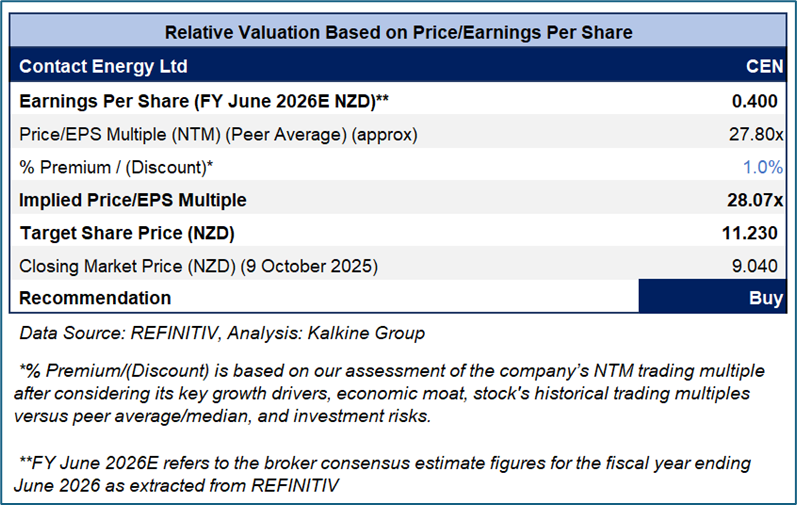
Considering the aforementioned factors, a “Buy” rating is given on the stock at the closing market price of NZD 9.04 per share, down by 0.66% as on 9 October 2025.
Markets are trading in a highly volatile zone currently due to certain macro-economic issues and geopolitical tensions prevailing. Therefore, it is prudent to follow a cautious approach while investing.
Note 1: Past performance is neither an indicator nor a guarantee of future performance.
Note 2: The reference date for all price data, currency, technical indicators, support, and resistance levels is 9 October 2025. The reference data in this report has been partly sourced from REFINITIV.
Note 3: Investment decisions should be made depending on an individual's appetite for upside potential, risks, holding duration, and any previous holdings. An 'Exit' from the stock can be considered if the Target Price mentioned as per the Valuation and or the technical levels provided has been achieved and is subject to the factors discussed above.
Note 4: Kalkine reports are prepared based on the stock prices captured either from REFINITIV or Trading View. Typically, REFINITIV or Trading View may reflect stock prices with a delay which could be a lag of 25-30 minutes. There can be no assurance that future results or events will be consistent with the information provided in the report. The information is subject to change without any prior notice.
Technical Indicators Defined: -
Support: A level at which the stock prices tend to find support if they are falling, and a downtrend may take a pause backed by demand or buying interest. Support 1 refers to the nearby support level for the stock and if the price breaches the level, then Support 2 may act as the crucial support level for the stock.
Resistance: A level at which the stock prices tend to find resistance when they are rising, and an uptrend may take a pause due to profit booking or selling interest. Resistance 1 refers to the nearby resistance level for the stock and if the price surpasses the level, then Resistance 2 may act as the crucial resistance level for the stock.
Stop-loss: It is a level to protect further losses in case of unfavourable movement in the stock prices.
Disclaimer This report has been issued by Kalkine New Zealand Limited (FSP691351) (NZBN:9429047678101) (“Kalkine”). Kalkine is a Financial Advice Provider (“FAP”) and is authorised by a Class 1 Financial Advice Provider Licence issued by Financial Markets Authority (“FMA”) to provide financial advice. Kalkine provides only general financial advice through its research reports following a person becoming a member. The reports contain buy/sell/hold and other recommendations in relation to equity securities, managed funds and other managed investment schemes and other financial advice products. The recommendations and opinions in this report and on Kalkine website do not take into account any of your investment objectives, financial situation or needs. Before you make a decision about whether to acquire a financial product, you should obtain the Product Disclosure Statement from the product issuer. You should consider the appropriateness of advice taking into account your own objectives, financial situation and needs and seek independent financial advice before making any financial decisions. If you act on the advice in the research reports, you may have to pay fees, expenses or other amounts (but not to Kalkine). Further information about the complaints and dispute resolution process, as well as information about Kalkine’s duties are available on Kalkine’s website. Please read our Financial Advice Provider (FAP) disclosure statement and Complaints Handling Guide, which are available on the website.
Past performance is not a reliable indicator of future performance.
 Please wait processing your request...