
 AU
AU
 UK
UK
 CA
CA
 US
US
 IND
IND

 NZ
NZ

Company Overview:
Chatham Rock Phosphate Limited (NZX: CRP) is an exploration and development company focused towards becoming a diversified phosphate developer and trader. Genesis Energy Limited (NZX: GNE) is a NZ-owned energy company.
Kalkine’s Sector Report covers the Investment Highlights, Key Financial Metrics, Risks, Outlook, Technical Analysis along with the Valuation, Target Price, and Recommendation on the stock.
1. Sector Landscape and Outlook
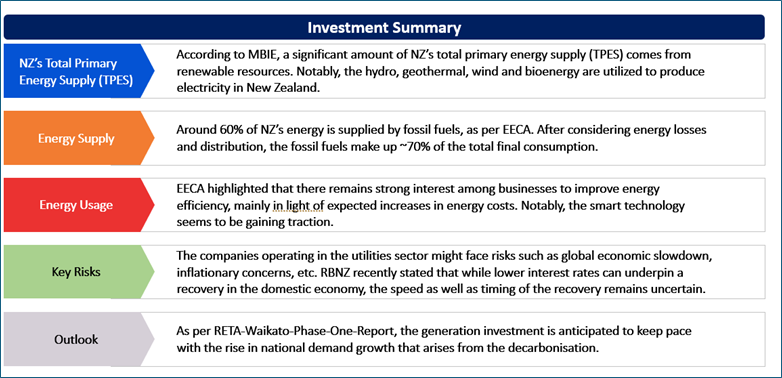
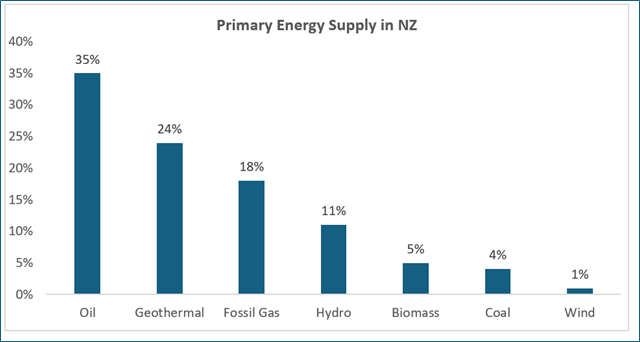
According to MBIE, a significant amount of NZ’s total primary energy supply (TPES) comes from renewable resources. Notably, the hydro, geothermal, wind and bioenergy are utilised to produce electricity in New Zealand. NZ is a country that is rich in geothermal resources due to many volcanic areas, and faults and tectonic features. Geothermal energy is a fuel type possessing the largest contribution to the TPES, but electricity generated from geothermal energy is a much lower proportion. Since geothermal fluid happens to be much lower in temperature as compared to steam produced by coal or a gas boiler, the transformation efficiency to electricity remains much lower. The efficiency is ~15%, and for this reason geothermal energy supplies less than a fifth of NZ’s electricity even though it contributes to more than half of the renewable energy supply.
Around 60% of NZ’s energy is supplied by fossil fuels, as per EECA. After considering energy losses and distribution, the fossil fuels make up ~70% of the total final consumption. This includes petrol and diesel for vehicles, coal and gas for industrial boilers as well as household gas and LPG.
Exhibit 1: Primary Energy Supply in New Zealand
Data Source: This work is owned by the Ministry of Business, Innovation and Employment on behalf of the Crown which are licensed for reuse under the Creative Commons Attribution 4.0 International Licence; Chart Created by Kalkine Group
How NZ Businesses Use Energy
EECA mentioned that energy remains on businesses’ minds and 61% believes that energy security and supply remain an important risk. Furthermore, CEOs of some of the largest companies continue to see energy as their top domestic concern. That being said, 86% of businesses see the cost of operating and 85% see cash flow as the most important risks. EECA highlighted that there remains strong interest among businesses to improve energy efficiency, mainly in light of expected increases in energy costs. Notably, the smart technology seems to be gaining traction.
Biofuel’s Critical Role in Waikato’s Renewable Energy Shift
A new report from EECA (Energy Efficiency and Conservation Authority) highlighted that switching to biofuel and electricity can be more affordable for many Waikato businesses than sticking with fossil fuels, which makes the transition to renewable energy not just environmentally, but economically, desirable. The Waikato Regional Energy Transition Accelerator (RETA) report mentions up to 92% of the region’s industrial heat needs – from dairy to meat, and commercial sectors – can be powered by local biomass. The dairy sector alone makes up for the majority of the region’s fossil fuel use, providing an opportunity for change.
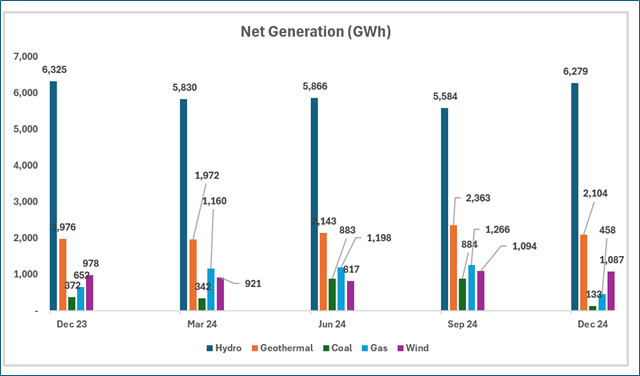
Notably, the majority of industrial electricity demand comes from the wood, pulp, paper and printing sectors as well as the basic metals sectors, with the Tiwai Point aluminium smelter being considered as the largest single user of electricity in the country. The commercial sectors consume approximately a quarter of NZ’s electricity demand.
Exhibit 2: Quarterly Electricity Generation (Net Generation) (GWh)
Data Source: This work is owned by the Ministry of Business, Innovation and Employment on behalf of the Crown which are licensed for reuse under the Creative Commons Attribution 4.0 International Licence; Chart Created by Kalkine Group
Key Risks and Challenges:
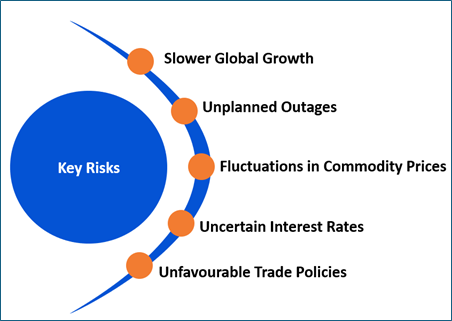
The companies operating in the utilities sector might face risks such as global economic slowdown, inflationary concerns, etc. RBNZ recently stated that while lower interest rates can underpin a recovery in the domestic economy, the speed as well as timing of the recovery remains uncertain. Notably, the tighter international financial conditions provided downside risks to global growth, mainly for the countries possessing increased debt levels or fixed exchange rate regimes.
Exhibit 3. Key Risks in Utilities Sector:
Source: - Analysis: Kalkine Group
Outlook:
EECA stated that investing in energy efficiency and demand-reduction technologies can meet 15% of today’s energy demands, cutting ~$110 Mn in new infrastructure costs for electricity and biomass. The Waikato Regional Energy Transition Accelerator (RETA) report highlighted that it is commercially favourable for businesses that switch to renewable energy or invest in demand-reduction technologies over the upcoming five years. Although there is an initial capital investment, the long-term savings – apart from higher productivity and streamlined operations – would be offsetting the upfront costs.
As per RETA-Waikato-Phase-One-Report, the generation investment is anticipated to keep pace with the rise in national demand growth that arises from the decarbonisation. This can result in modest increases in electricity prices for process heat consumers over the upcoming 15 years. The forecasts obtained by EECA from EnergyLink expects the wholesale and retail component of electricity charges increasing from ~10c/kWh in 2026 to 11c/kWh in 2040 (in real terms). Notably, the figures are annual averages. Typically, commercial and industrial retail prices tend to vary throughout the year (implying the underlying supply and demand for electricity). Therefore, some sectors, like dairy, would effectively pay a lower price than this. This is because their demand is weighted towards periods of the year having lower retail prices.
Apart from the sector-specific factors, an analysis on two NZX-listed companies is provided. This report covers their insights, outlook, performance and potential as expected to be delivered in the near to medium term.
1) Chatham Rock Phosphate Limited (Recommendation: Speculative Buy, Potential Upside: Low Double-Digit) (M-Cap: NZD 10.07 million)
Business Description:
Chatham Rock Phosphate Limited (NZX: CRP) is an exploration and development company focused towards becoming a diversified phosphate developer and trader.
Outlook:
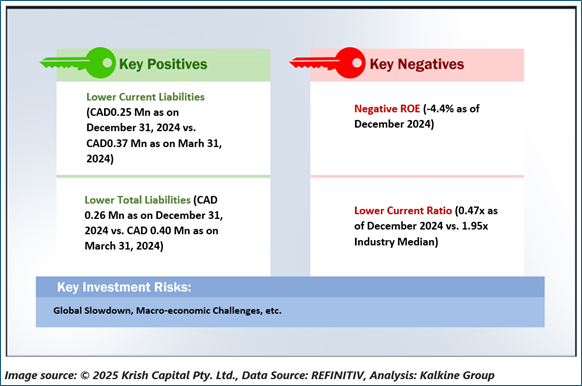
CRP has closed its private placement of Units by issuing a total of 1,599,152 Units at a price of CA$0.07 (NZ$0.086 and AU$0.078) per Unit. This led to the gross proceeds of CA$111,940 (NZ$137,527 or AU$124,733). The funds would be utilised for completion of the permitting process for the Avenir Makatea onshore phosphate project in French Polynesia, the first steps in a Fast Track reapplication for a Marine (Environmental) Consent on the Chatham Rise and general working capital. The company is confident that its phosphate deposit positions it in a robust position globally to deliver an essential ingredient to the agriculture industry, where the demand for food is a growth market in turbulent economic times.
Technical Overview:
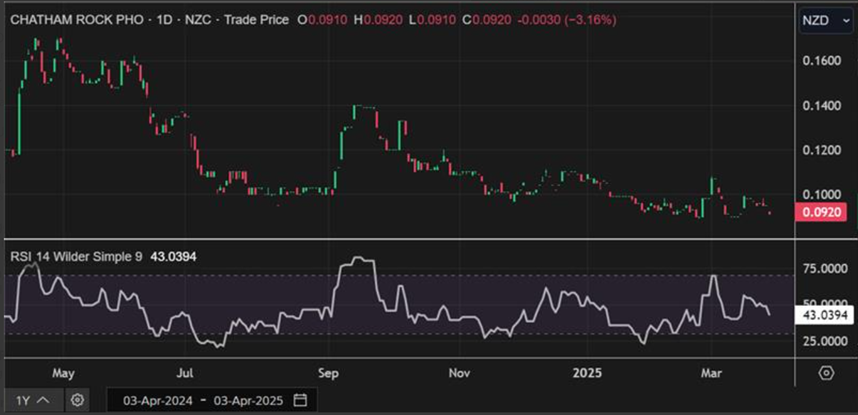
CRP Daily Technical Chart, Data Source: REFINITIV
Technical Commentary:
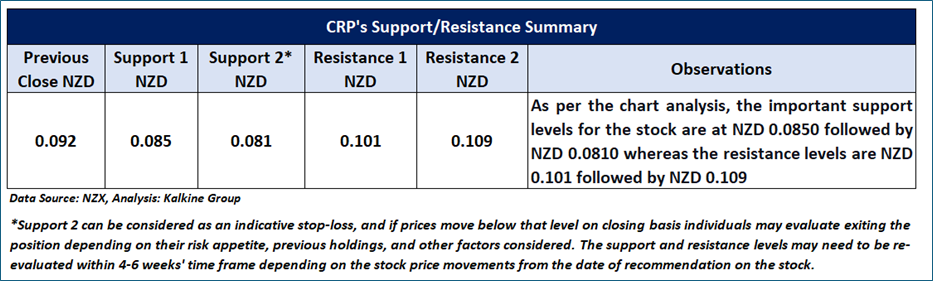
While undergoing a downtrend, CRP’s stock prices are approaching a significant support established by the 2023 low, anticipating a potential minor rally. Moreover, the momentum oscillator RSI (14-period) is forming multiple bottom divergences in relations to prices, adding further evidence to the mentioned recommendation. Prices are trading between its previous peak and trough, which might function resistance and support levels for the stock, respectively. A significant support level for the stock is positioned at NZD 0.085, while critical resistance level is located at NZD 0.101.
Stock Recommendation
Considering the facts above, a ‘Speculative Buy’ recommendation on the stock has been provided at the closing market price of NZD 0.092 per share, down by 3.16% as on 3rd April 2025.
2) Genesis Energy Limited (Recommendation: Hold, Potential Upside: Low Double-Digit) (M-Cap: NZD 3 Bn, Annual Dividend Yield: 9%)
Business Description:
Genesis Energy Limited (NZX: GNE) is a New Zealand-based diversified energy company.
Outlook:
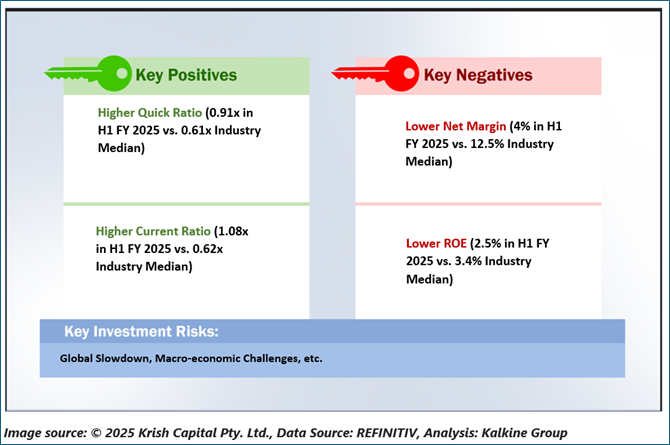
For FY 2025, the company is expecting EBITDAF of ~$460 Mn. Notably, FY 2025 capital expenditure is expected to be between $130 Mn - $140 Mn, with spend profile adjusted for select projects to manage affordability. GNE’s renewable generation pathway is focused on solar development because of speed to market, lower capital costs as well as overall improving economics. Notably, the flexible assets, fuels and market products support the requirement for peaking and firming capacity in the growing renewable energy market.
Technical Overview:
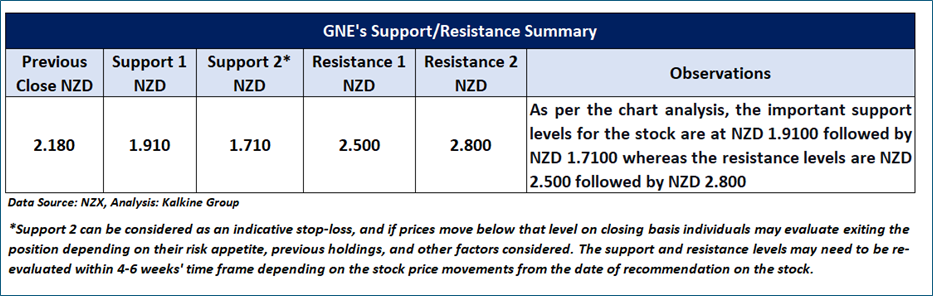
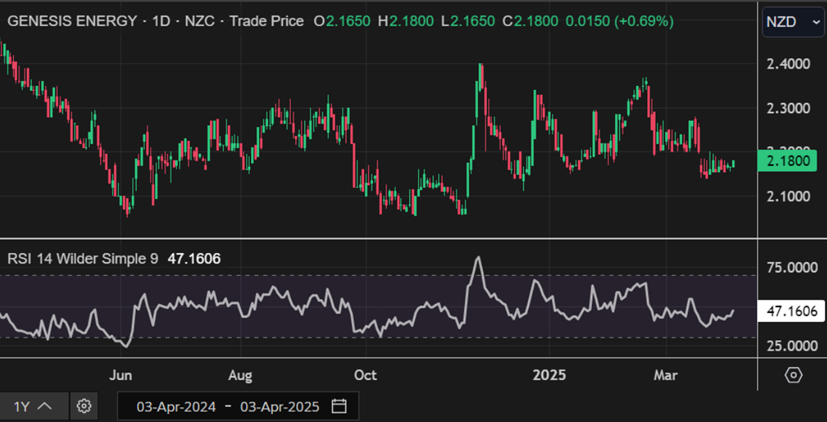
GNE Daily Technical Chart, Data Source: REFINITIV
Technical Commentary
On the daily chart, GNE’s stock prices are forming a trading range characterized by lower highs and higher lows, suggesting that the sideways period in the stock might continue to persist in the near future. Moreover, the momentum oscillator RSI (14-period) is trading near its midpoint, providing further support to the previous observation. Prices are trading between its previous peak and trough, which might function resistance and support levels for the stock, respectively. A significant support level for the stock is positioned at NZD 1.91, while critical resistance level is located at NZD 2.5.
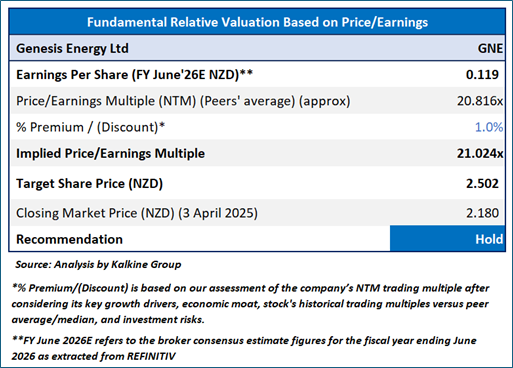
P/E Based Relative Valuation
Stock Recommendation
Considering the aforementioned factors, a “Hold” rating is given on the stock at the closing market price of NZD 2.18 per share, up by 0.69% as on 3 April 2025.
Markets are trading in a highly volatile zone currently due to certain macro-economic issues and geopolitical tensions prevailing. Therefore, it is prudent to follow a cautious approach while investing.
Note 1: Past performance is neither an indicator nor a guarantee of future performance.
Note 2: The reference date for all price data, currency, technical indicators, support, and resistance levels is 3 April 2025. The reference data in this report has been partly sourced from REFINITIV.
Note 3: Investment decisions should be made depending on an individual's appetite for upside potential, risks, holding duration, and any previous holdings. An 'Exit' from the stock can be considered if the Target Price mentioned as per the Valuation and or the technical levels provided has been achieved and is subject to the factors discussed above.
Note 4: Kalkine reports are prepared based on the stock prices captured either from REFINITIV or Trading View. Typically, REFINITIV or Trading View may reflect stock prices with a delay which could be a lag of 25-30 minutes. There can be no assurance that future results or events will be consistent with the information provided in the report. The information is subject to change without any prior notice.
Technical Indicators Defined: -
Support: A level at which the stock prices tend to find support if they are falling, and a downtrend may take a pause backed by demand or buying interest. Support 1 refers to the nearby support level for the stock and if the price breaches the level, then Support 2 may act as the crucial support level for the stock.
Resistance: A level at which the stock prices tend to find resistance when they are rising, and an uptrend may take a pause due to profit booking or selling interest. Resistance 1 refers to the nearby resistance level for the stock and if the price surpasses the level, then Resistance 2 may act as the crucial resistance level for the stock.
Stop-loss: It is a level to protect further losses in case of unfavourable movement in the stock prices.
Disclaimer This report has been issued by Kalkine New Zealand Limited (FSP691351) (NZBN:9429047678101) (“Kalkine”). Kalkine is a Financial Advice Provider (“FAP”) and is authorised by a Class 1 Financial Advice Provider Licence issued by Financial Markets Authority (“FMA”) to provide financial advice. Kalkine provides only general financial advice through its research reports following a person becoming a member. The reports contain buy/sell/hold and other recommendations in relation to equity securities, managed funds and other managed investment schemes and other financial advice products. The recommendations and opinions in this report and on Kalkine website do not take into account any of your investment objectives, financial situation or needs. Before you make a decision about whether to acquire a financial product, you should obtain the Product Disclosure Statement from the product issuer. You should consider the appropriateness of advice taking into account your own objectives, financial situation and needs and seek independent financial advice before making any financial decisions. If you act on the advice in the research reports, you may have to pay fees, expenses or other amounts (but not to Kalkine). Further information about the complaints and dispute resolution process, as well as information about Kalkine’s duties are available on Kalkine’s website. Please read our Financial Advice Provider (FAP) disclosure statement and Complaints Handling Guide, which are available on the website.
Past performance is not a reliable indicator of future performance.
 Please wait processing your request...