
 AU
AU
 UK
UK
 CA
CA
 US
US
 IND
IND

 NZ
NZ

Company Overview:
Move Logistics Group Limited (NZX: MOV) is one of NZ’s largest private domestic freight and logistics platforms, with a nationwide network of branches, depots and warehouses. AoFrio Limited (NZX: AOF) develops Internet of Things (IoT) solutions, and manufactures, markets, and sells energy efficient motors and IoT hardware to the F&B markets.
Kalkine’s Sector Report covers the Key Financial Metrics, Risks, Outlook, Technical Analysis along with the Valuation, Target Price, and Recommendation on the stock.
Sector Landscape and Outlook
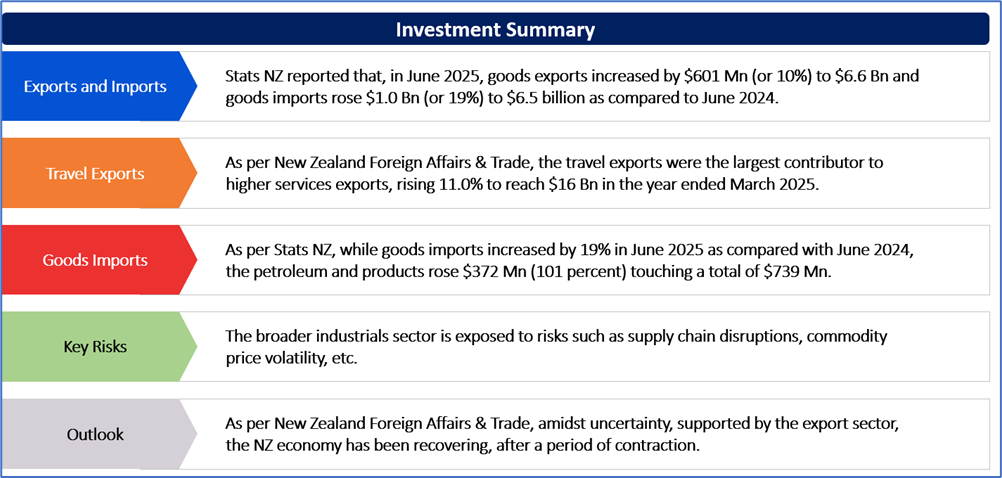
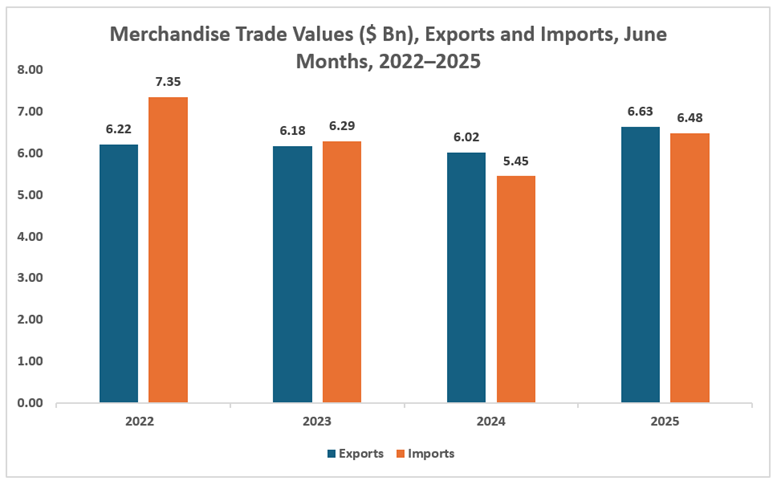
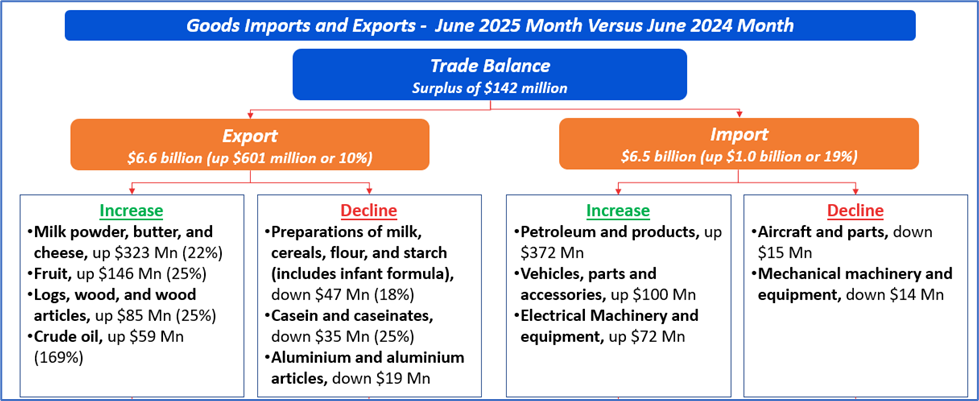
Stats NZ reported that, in June 2025, goods exports increased by $601 Mn (or 10%) to $6.6 Bn and goods imports rose $1.0 Bn (or 19%) to $6.5 billion as compared to June 2024. The monthly trade balance was a surplus of $142 Mn. With respect to exports, fruit exports amounted to $738 Mn in June 2025, reflecting a rise of 25% (or $146 Mn) as compared to June 2024, while milk powder, butter, and cheese increased $323 Mn (or 22%) to $1.8 Bn.
Talking about China, total exports increased $151 Mn (or 11%), and the largest increases were witnessed in milk powder, butter, and cheese (up $167 million), logs, wood, and wood articles (up $71 million), and fruit (up $44 million). With respect to Australia, total exports rose $108 Mn (or 16%). The largest increases were crude oil (up $55 Mn), mechanical machinery and equipment (up $26 Mn), and precious metals, jewellery, and coins (up $18 Mn).
Exhibit 1: Merchandise Trade Values ($ Bn) (Exports and Imports) June Months, 2022–2025
Data Source: This work is based on/includes Stats NZ’s data which are licensed by Stats NZ for reuse under the Creative Commons Attribution 4.0 International Licence; Chart Created by Kalkine Group
New Zealand Exports Demonstrate Resilience and Growth
As per New Zealand Foreign Affairs & Trade, there has been a positive performance for the broader export sector and exports increased 7.4% to touch $105 Bn for the year to March 2025. This export success has been driving economic growth and has narrowed the trade deficit. Furthermore, the travel exports were the largest contributor to higher services exports, rising 11.0% to reach $16 Bn in the year ended March 2025. Notably, the increased spending per visitor pushed travel export revenue above pre-COVID levels for the first time. The overseas travel arrivals increased 137,000 to 3.3 Mn in the year ended March 2025.
Goods Imports Increased $1.0 Bn
As per Stats NZ, while goods imports increased by 19% in June 2025 as compared with June 2024, the petroleum and products rose $372 Mn (101 percent) touching a total of $739 Mn. Also, the imports of vehicles, parts, and accessories increased $100 Mn (or 13%), resulting in the total of $874 Mn. Leading the rise were vehicles for the transport of goods, which increased $66 Mn (or 45%) and public transit vehicles (up $27 million).
With respect to China, the total imports increased $111 Mn (or 9.1%) and the largest increases were vehicles, parts, and accessories (up $51 million), mechanical machinery and equipment (up $23 million), and electrical machinery and equipment (up $23 million).
Exhibit 2: Goods Imports and Exports
Data Source: This work is based on/includes Stats NZ’s data which are licensed by Stats NZ for reuse under the Creative Commons Attribution 4.0 International Licence; Chart Created by Kalkine Group
Key Risks and Challenges:
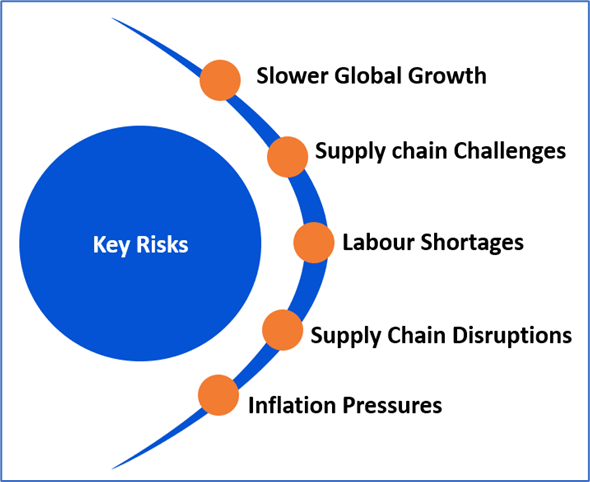
RBNZ recently stated that the tariffs can make global supply chains less efficient and could increase the cost of imports. Therefore, tariffs might add to the inflation pressures in the US. But for NZ, the main impact is expected to be weaker global growth, which can impact demand for its exports and lower import prices. Overall, the broader industrials sector is exposed to risks such as supply chain disruptions, commodity price volatility, etc.
Exhibit 3: Key Risks in Industrials Sector:
Source: Analysis by Kalkine Group
Outlook:
RBNZ, in the release dated 09 July 2025, stated that the annual consumers price index inflation is within the Monetary Policy Committee’s 1% - 3% target band. The pace of recovery in domestic consumption as well as investment is weak, demonstrating increased caution amidst global policy shocks and uncertainty. That being said, RBNZ believes that the strong export prices and recent monetary policy easing can support the economic recovery.
On balance, higher protectionism can result in less inflationary pressure for NZ. While tariffs could be inflationary in the US, forecasts for inflation in China and emerging Asia were lowered recently. As per New Zealand Foreign Affairs & Trade, amidst uncertainty, supported by the export sector, the NZ economy has been recovering, after a period of contraction.
Apart from the sector-specific factors, an analysis on 2 NZX-listed companies is provided. This report covers their insights, outlook, performance and potential as expected to be delivered in the near to medium term.
1) AoFrio Limited (Recommendation: Speculative Buy, Potential Upside: Low Double-Digit) (M-Cap: NZD 39.08 Mn)
Business Description:
AoFrio Limited (NZX: AOF) is a leading provider of Internet of Things (IoT) solutions and energy-efficient motors to the food and beverage industry around the world.
Outlook:
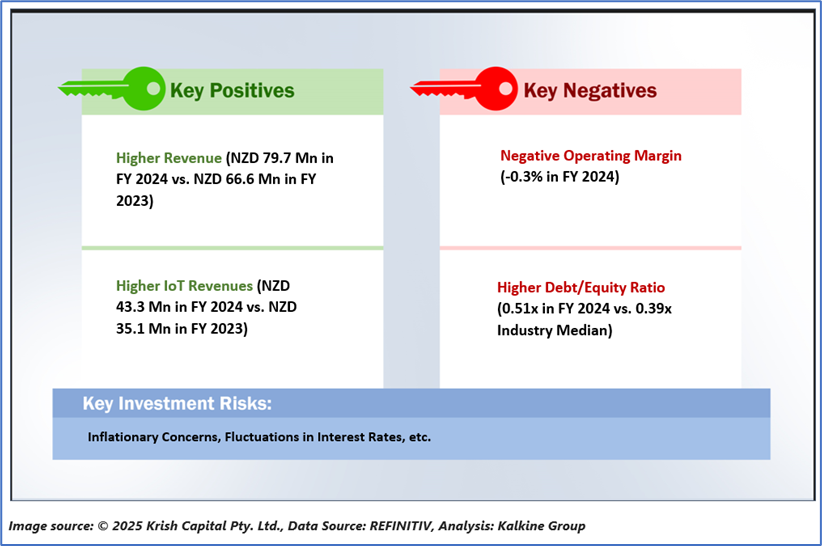
AOF secured its first significant food retail order in March after the completion of a proof-of-concept trial. This order includes the recurring SaaS revenue under the multi-year contract. AOF continues to work on other significant opportunities in this segment. For FY 2025, the company is expecting revenue of $85 million - $95 million.
Technical Overview:
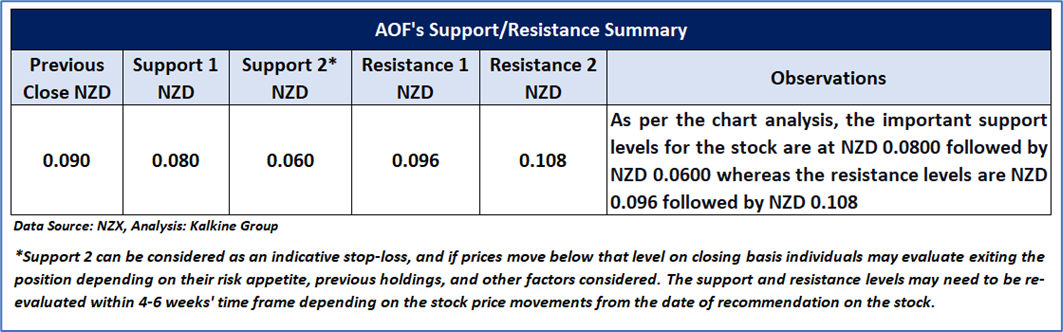
On the daily chart, AOF’s stock prices are forming a trading range characterized by a descending triangle pattern, suggesting that the current sideways period in the stock might continue to persist in the near future. Moreover, the momentum oscillator RSI (14-period) is hovering near its midpoint, adding further evidence to the previous observation. Prices are trading between its previous peak and trough, which might function as resistance and support levels for the stock, respectively. A significant support level for the stock is positioned at NZD 0.080, while critical resistance level is located at NZD 0.096.
Technical Commentary:
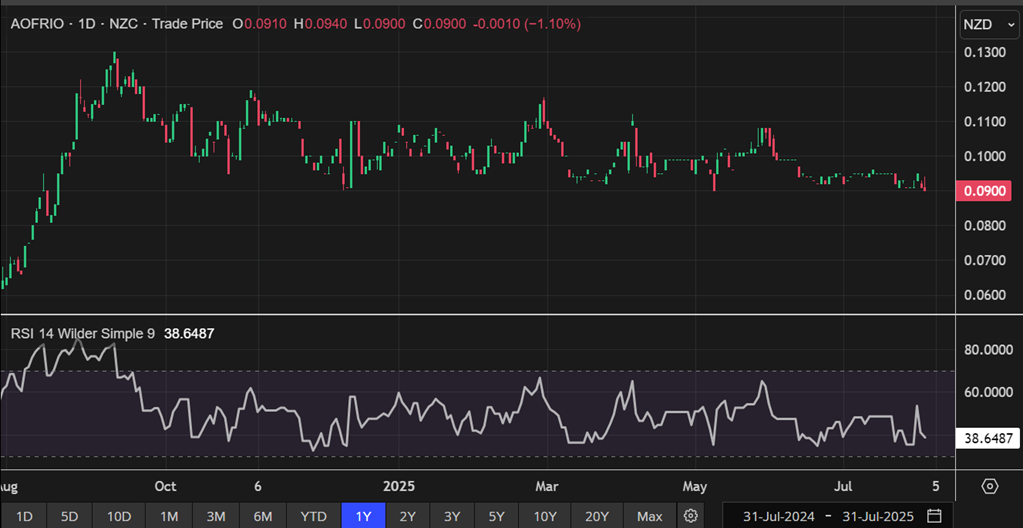
AOF Daily Technical Chart, Data Source: REFINITIV
Stock Recommendation
Considering the aforementioned factors, a ‘Speculative Buy’ rating is given on the stock at the closing market price of NZD 0.09 per share, down by 1.10% as on 31st July 2025.
2) Move Logistics Group Limited (Recommendation: Hold, Potential Upside: Low Double-Digit) (M-Cap: NZD 24.8 million)
Business Description:
Move Logistics Group Limited (NZX: MOV) is one of NZ’s largest private domestic freight and logistics platforms, with a nationwide network of branches, depots and warehouses.
Outlook:
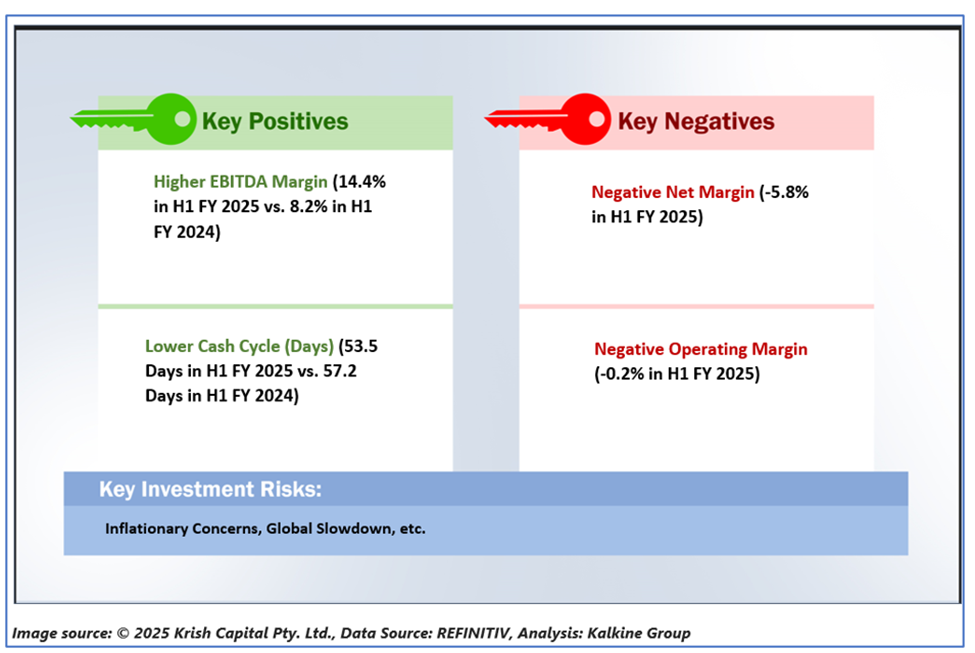
MOV stated that the foundations and practices developed under the Accelerate transformation programme have been embedded in its business. With 1 year remaining, the company has been moving from cost out to the value creation. The focus towards gross margin has been creating robust platform for future performance, and the full benefits of the cost out programme is expected to be realised in FY 2026.
Technical Overview:
MOV Daily Technical Chart, Data Source: REFINITIV
Technical Commentary
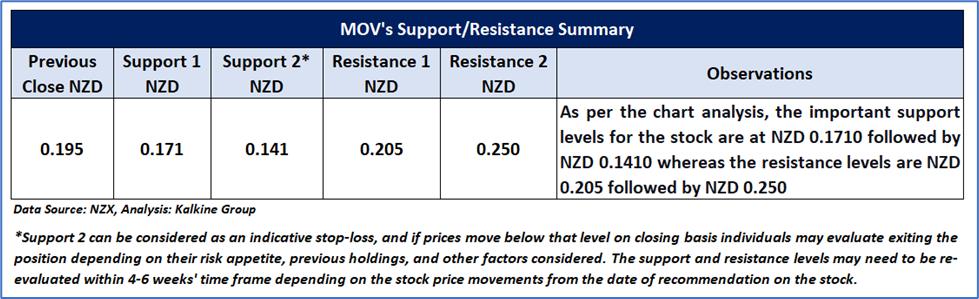
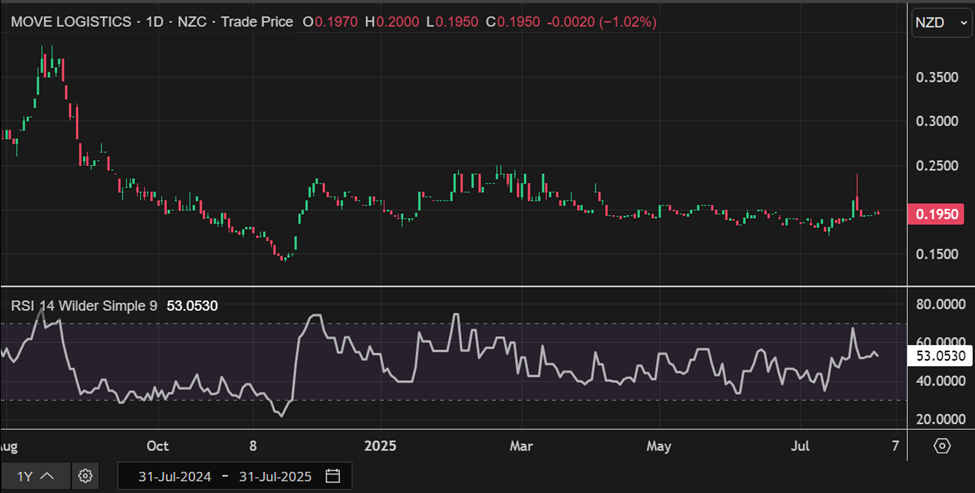
On the daily chart, MOV’s stock prices are forming a trading range characterized by identical highs and lows, suggesting that the sideways period on the stock might continue to persist in the near future. Moreover, the momentum oscillator RSI (14-period) is oscillating around the midpoint, adding further evidence to the previous analysis. Prices are trading between previous peak and trough, which might serve as resistance and support levels for the stock, respectively. A significant support level for the stock is positioned at NZD 0.171, while critical resistance level is located at NZD 0.205.
Stock Recommendation
Considering the aforementioned factors, a ‘Hold’ rating is given on the stock at the closing market price of NZD 0.195 per share, down by 1.02% as on 31 July 2025.
Markets are trading in a highly volatile zone currently due to certain macro-economic issues and geopolitical tensions prevailing. Therefore, it is prudent to follow a cautious approach while investing.
Note 1: Past performance is neither an indicator nor a guarantee of future performance.
Note 2: The reference date for all price data, currency, technical indicators, support, and resistance levels is July 31, 2025. The reference data in this report has been partly sourced from REFINITIV.
Note 3: Investment decisions should be made depending on an individual's appetite for upside potential, risks, holding duration, and any previous holdings. An 'Exit' from the stock can be considered if the Target Price mentioned as per the Valuation and or the technical levels provided has been achieved and is subject to the factors discussed above.
Note 4: Annual Dividend Yield is on a Trailing Twelve Month (TTM1) basis and are subject to change based on factors such as company performance, stock price changes, etc.
Note 5: Kalkine reports are prepared based on the stock prices captured either from REFINITIV or Trading View. Typically, REFINITIV or Trading View may reflect stock prices with a delay which could be a lag of 25-30 minutes. There can be no assurance that future results or events will be consistent with the information provided in the report. The information is subject to change without any prior notice.
Technical Indicators Defined: -
Support: A level at which the stock prices tend to find support if they are falling, and a downtrend may take a pause backed by demand or buying interest. Support 1 refers to the nearby support level for the stock and if the price breaches the level, then Support 2 may act as the crucial support level for the stock.
Resistance: A level at which the stock prices tend to find resistance when they are rising, and an uptrend may take a pause due to profit booking or selling interest. Resistance 1 refers to the nearby resistance level for the stock and if the price surpasses the level, then Resistance 2 may act as the crucial resistance level for the stock.
Stop-loss: It is a level to protect further losses in case of unfavourable movement in the stock prices.
Disclaimer This report has been issued by Kalkine New Zealand Limited (FSP691351) (NZBN:9429047678101) (“Kalkine”). Kalkine is a Financial Advice Provider (“FAP”) and is authorised by a Class 1 Financial Advice Provider Licence issued by Financial Markets Authority (“FMA”) to provide financial advice. Kalkine provides only general financial advice through its research reports following a person becoming a member. The reports contain buy/sell/hold and other recommendations in relation to equity securities, managed funds and other managed investment schemes and other financial advice products. The recommendations and opinions in this report and on Kalkine website do not take into account any of your investment objectives, financial situation or needs. Before you make a decision about whether to acquire a financial product, you should obtain the Product Disclosure Statement from the product issuer. You should consider the appropriateness of advice taking into account your own objectives, financial situation and needs and seek independent financial advice before making any financial decisions. If you act on the advice in the research reports, you may have to pay fees, expenses or other amounts (but not to Kalkine). Further information about the complaints and dispute resolution process, as well as information about Kalkine’s duties are available on Kalkine’s website. Please read our Financial Advice Provider (FAP) disclosure statement and Complaints Handling Guide, which are available on the website.
Past performance is not a reliable indicator of future performance.
 Please wait processing your request...