
 AU
AU
 UK
UK
 CA
CA
 US
US
 IND
IND

 NZ
NZ

This report is an updated report published on 15th May 2025 at 5:42 PM (GMT +12))
Overview:
ANZ Group Holdings Limited (NZX: ANZ) is a non-operating holding company. Its divisions include Australia Retail, Australia Commercial, Institutional, New Zealand, Suncorp Bank, Pacific, and Group Center. Heartland Group Holdings Limited (NZX: HGH) is the financial services group with operations in New Zealand and Australia.
Kalkine’s Sector Report covers the Key Financial Metrics, Risks, Outlook, Technical Analysis along with the Valuation, Target Price, and Recommendation on the stock.
Sector Landscape and Outlook
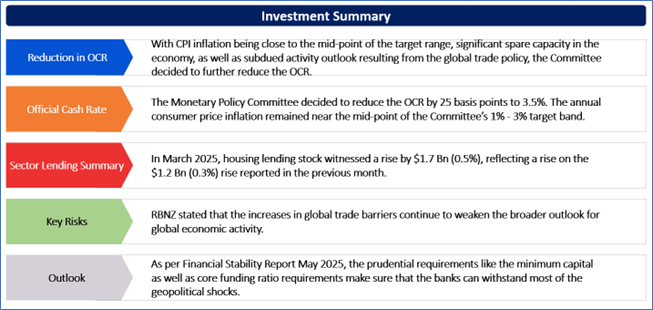
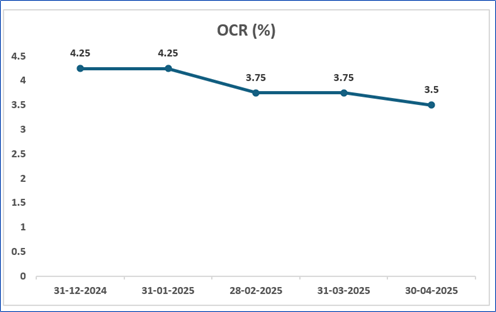
The Monetary Policy Committee decided to reduce the OCR by 25 basis points to 3.5%. The annual consumer price inflation remained near the mid-point of the Committee’s 1% - 3% target band. The companies’ inflation expectations as well as core inflation remain consistent with inflation remaining at target over the medium term. RBNZ stated that higher-than-expected export prices as well as reduced exchange rate aided primary sector incomes as well as overall economic growth. Notably, the monetary restraint has removed at pace and the household spending as well as residential investment remained weak.
With CPI inflation being close to the mid-point of the target range, significant spare capacity in the economy, as well as subdued activity outlook resulting from the global trade policy, the Committee decided to further reduce the OCR. Overall, the global policy response is expected to be an important consideration in tracking the implications of higher tariffs for medium-term inflation in NZ.
Exhibit 1: OCR (%)
Data Source: This work is based on/includes rbnz data which are licensed by rbnz.govt.nz for reuse under the Creative Commons Attribution 4.0 International Licence; Chart Created by Kalkine Group
Sector Lending Summary – Banks & NBLIs (March 2025)
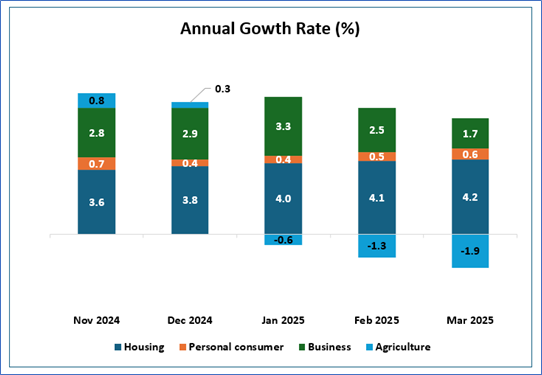
In March 2025, housing lending stock witnessed a rise by $1.7 Bn (0.5%), reflecting a rise on the $1.2 Bn (0.3%) rise reported in the previous month. The annual growth rate witnessed a rise from 4.1% to 4.2%, reflecting the highest annual growth rate since December 2022. The personal consumer lending stock declined by $47 Mn (or 0.3%) in March 2025. This was mainly because of the bank sector. The annual growth rate witnessed a rise from 0.5% to 0.6% in March 2025.
In March 2025, the business lending stock encountered a decline of $758 Mn (or 0.5%) with the annual growth rate declining from 2.5% to 1.7%. The monthly decline was mainly because of $927 Mn (or 0.7%) decrease in the bank sector, with the NBLI sector witnessing a $169 Mn (or 1.8%) rise in March 2025.
Exhibit 2: Sector Lending - Annual Growth Rate) (%)
Data Source: This work is based on/includes rbnz data which are licensed by rbnz.govt.nz for reuse under the Creative Commons Attribution 4.0 International Licence; Chart Created by Kalkine Group
Seasonally Adjusted Total Billings in NZ Increased YoY
In March 2025, the seasonally adjusted total billings in NZ amounted to $4.5 Bn. Annually, this reflects an increase of 0.8% from March 2024. The seasonally adjusted domestic billings on NZ issued cards stood at $3.9 Bn in March 2025, reflecting a rise of 0.8% from February 2025, and up 1.8% from March 2024. The overseas billings on NZ issued cards amounted to $644 Mn in March-25, reflecting a decline of 16.8% from February 2025. Annually, there was an increase of 5.8% from March 2024.
The unadjusted total credit card advances fell by 0.8% month-on-month and stood at $6.1 Bn in March 2025. After the seasonal adjustment, the total advances outstanding amounted to $6.1 Bn, reflecting a decline of 2.1% as compared to March 2024.
Key Risks and Challenges:
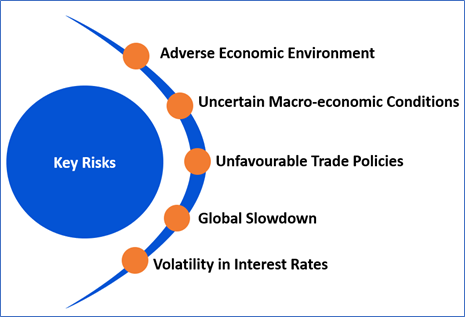
RBNZ stated that the increases in global trade barriers continue to weaken the broader outlook for global economic activity. Such developments result in downside risks to the outlook for economic activity and inflation in NZ. Furthermore, the trade diversion effects can result in reduced prices of NZ’s imports, with some global exports targeted by tariffs being redirected to NZ market. Also, reduced global oil prices can also reduce the NZ import prices.
Exhibit 3. Key Risks in Financial Sector:
Source: Analysis by Kalkine Group
Outlook:
As per RBNZ, the recent declines in interest rates as well as increased export earnings can support broader economic growth. The pace of growth is projected to be modest, with potential GDP growth being restricted by ongoing weakness in productivity growth and low net immigration. RBZN also added that the recent decline in the NZ dollar can limit the immediate effect of lower global demand for NZ exports. Notably, reduced oil prices can also support the domestic consumption and production.
As per Financial Stability Report May 2025, the prudential requirements like the minimum capital as well as core funding ratio requirements make sure that the banks can withstand most of the geopolitical shocks. However, the economic growth is projected to increase this year as reduced interest rates and stronger agricultural export prices help the demand trends. As per the report, the housing market is soft, but demand can witness a rise because of reduced interest rates.
Apart from the sector-specific factors, an analysis on 2 NZX-listed companies is provided. This report covers their insights, outlook, performance and potential as expected to be delivered in the near to medium term.
1) ANZ Group Holdings Limited (Recommendation: Buy, Potential Upside: Low Double-Digit) (M-Cap: NZD 93.4 billion, Annual Dividend Yield (TTM)1: 3.10%)
Business Description:
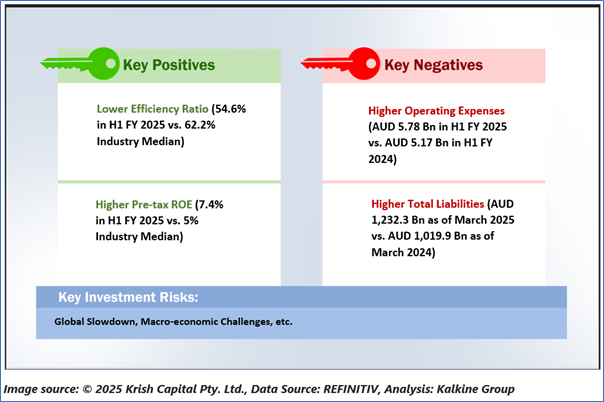
ANZ Group Holdings Limited (NZX: ANZ) is a non-operating holding company. Its divisions include Australia Retail, Australia Commercial, Institutional, New Zealand, Suncorp Bank, Pacific, and Group Center.
Outlook:
With respect to the priorities, ANZ is focused on growing the dual platforms, supporting the long-term competitive advantage. ANZ New Zealand is in a robust position to support the country’s housing, business as well as trading needs as the broader economy navigates the global macro-economic challenges. In a competitive market, ANZ NZ lending witnessed a rise of 1.2% as banks were struggling for market share. Also, the customer deposits rose 3.5%.
Technical Overview:
Technical Commentary
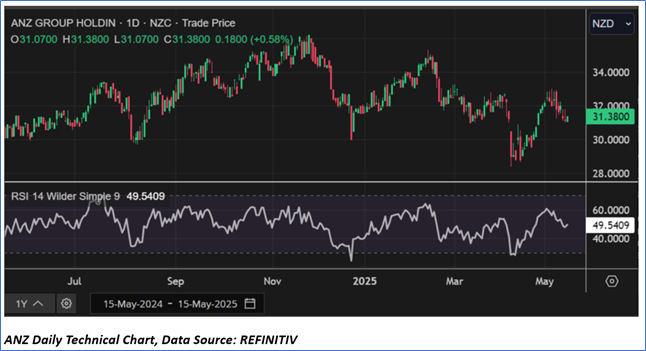
On the daily chart, ANZ is trading above a downward-sloping trendline support zone, suggesting a potential shift in trend. The 14-period Relative Strength Index (RSI) is recovering from lower levels, currently reading around 50.29, indicating neutral-to-strengthening momentum. Additionally, the stock is trading above its 21-period Simple Moving Average (SMA), which now acts as dynamic support, reinforcing the underlying bullish bias.
P/BV Based Relative Valuation
Stock Recommendation
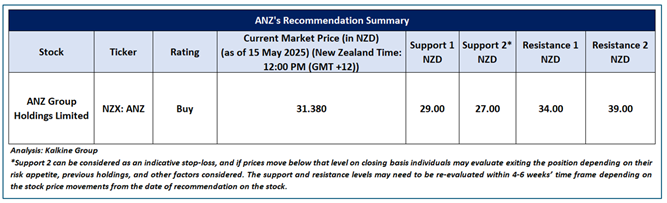
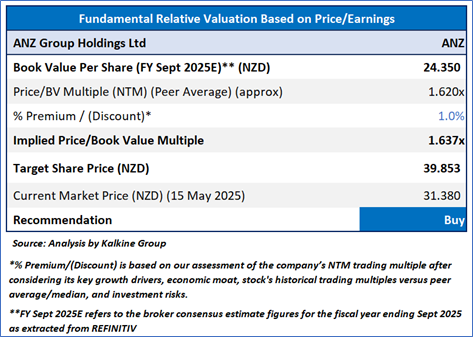
Considering the facts above, a ‘Buy’ recommendation on the stock has been provided at the current market price of NZD 31.380 per share (New Zealand Time: 12:00 PM (GMT +12)) as on 15th May 2025.
2) Heartland Group Holdings Limited (Recommendation: Buy, Potential Upside: Low Double-Digit) (M-Cap: NZD 789.6 Mn, Annual Dividend Yield (TTM)1: ~8.26%)
Business Description:
Heartland Group Holdings Limited (NZX: HGH) is the financial services group with operations in New Zealand and Australia.
Outlook:
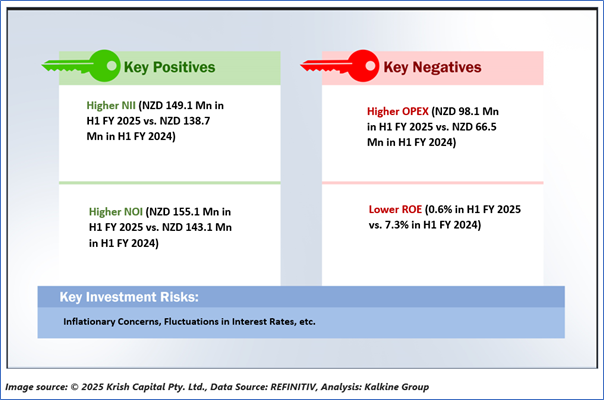
HGH is on track to achieve NPAT on an underlying basis for FY 2025 of at least $45 Mn. The company is focused on sustainable, profitable growth, and witnessed strong gross finance receivables growth in Reverse Mortgages and Livestock Finance in NZ and Australia. Also, the asset quality improvements are now visible in Heartland Bank’s Motor Finance portfolio. The early recovery efforts for the Motor Finance loans written off in Feb 2025 have surpassed the expectations.
Technical Overview:
Fundamental Valuation
P/BV Based Relative Valuation
Technical Commentary
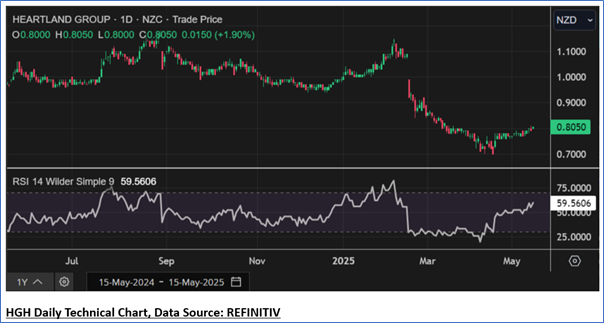
On the daily chart, HGH is trading above a horizontal trendline support zone, indicating underlying buying interest and price stability. The 14-period Relative Strength Index (RSI) is currently at 67.48, reflecting strong bullish momentum without being overbought. Additionally, the stock is holding above the 21-period Simple Moving Average (SMA), which acts as dynamic support and reinforces the upward trend.
Stock Recommendation
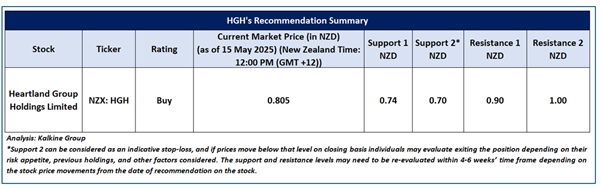
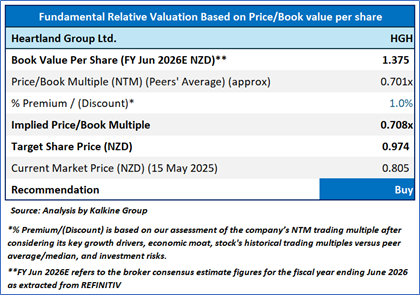
Considering the facts above, a ‘Buy’ recommendation on the stock has been provided at the current market price of NZD 0.805 per share (New Zealand Time: 12:00 PM (GMT +12)) as on 15th May 2025.
Note 1: Past performance is not a reliable indicator of future performance.
Note 2: The reference date for all price data, currency, technical indicators, support, and resistance levels is May 15, 2025. The reference data in this report has been partly sourced from REFINITIV.
Note 3: Investment decisions should be made depending on an individual's appetite for upside potential, risks, holding duration, and any previous holdings. An 'Exit' from the stock can be considered if the Target Price mentioned as per the Valuation and or the technical levels provided has been achieved and is subject to the factors discussed above.
Note 4: Annual Dividend Yield is on a Trailing Twelve Month (TTM1) basis and are subject to change based on factors such as company performance, stock price changes, etc.
Note 5: Kalkine reports are prepared based on the stock prices captured either from REFINITIV or Trading View. Typically, REFINITIV or Trading View may reflect stock prices with a delay which could be a lag of 25-30 minutes. There can be no assurance that future results or events will be consistent with the information provided in the report. The information is subject to change without any prior notice.
Technical Indicators Defined: -
Support: A level at which the stock prices tend to find support if they are falling, and a downtrend may take a pause backed by demand or buying interest. Support 1 refers to the nearby support level for the stock and if the price breaches the level, then Support 2 may act as the crucial support level for the stock.
Resistance: A level at which the stock prices tend to find resistance when they are rising, and an uptrend may take a pause due to profit booking or selling interest. Resistance 1 refers to the nearby resistance level for the stock and if the price surpasses the level, then Resistance 2 may act as the crucial resistance level for the stock.
Stop-loss: It is a level to protect further losses in case of unfavourable movement in the stock prices.
Disclaimer This report has been issued by Kalkine New Zealand Limited (FSP691351) (NZBN:9429047678101) (“Kalkine”). Kalkine is a Financial Advice Provider (“FAP”) and is authorised by a Class 1 Financial Advice Provider Licence issued by Financial Markets Authority (“FMA”) to provide financial advice. Kalkine provides only general financial advice through its research reports following a person becoming a member. The reports contain buy/sell/hold and other recommendations in relation to equity securities, managed funds and other managed investment schemes and other financial advice products. The recommendations and opinions in this report and on Kalkine website do not take into account any of your investment objectives, financial situation or needs. Before you make a decision about whether to acquire a financial product, you should obtain the Product Disclosure Statement from the product issuer. You should consider the appropriateness of advice taking into account your own objectives, financial situation and needs and seek independent financial advice before making any financial decisions. If you act on the advice in the research reports, you may have to pay fees, expenses or other amounts (but not to Kalkine). Further information about the complaints and dispute resolution process, as well as information about Kalkine’s duties are available on Kalkine’s website. Please read our Financial Advice Provider (FAP) disclosure statement and Complaints Handling Guide, which are available on the website.
Past performance is not a reliable indicator of future performance.
 Please wait processing your request...