
 AU
AU
 UK
UK
 CA
CA
 US
US
 IND
IND

 NZ
NZ

Overview:
ANZ Group Holdings Limited (NZX: ANZ) is a non-operating holding company. Its divisions include Australia Retail, Australia Commercial, Institutional, New Zealand, Suncorp Bank, Pacific, and Group Center. General Capital Limited (NZX: GEN) is a New Zealand-based financial services company. The principal activities are financial services, and research and advisory services.
Kalkine’s Sector Report covers the Key Financial Metrics, Risks, Outlook, Technical Analysis along with the Valuation, Target Price, and Recommendation on the stock.
Sector Landscape and Outlook
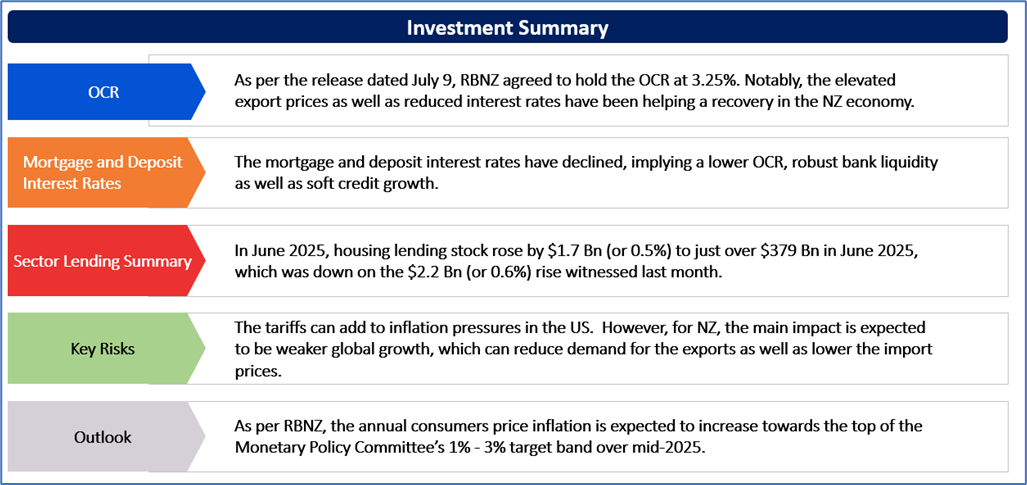
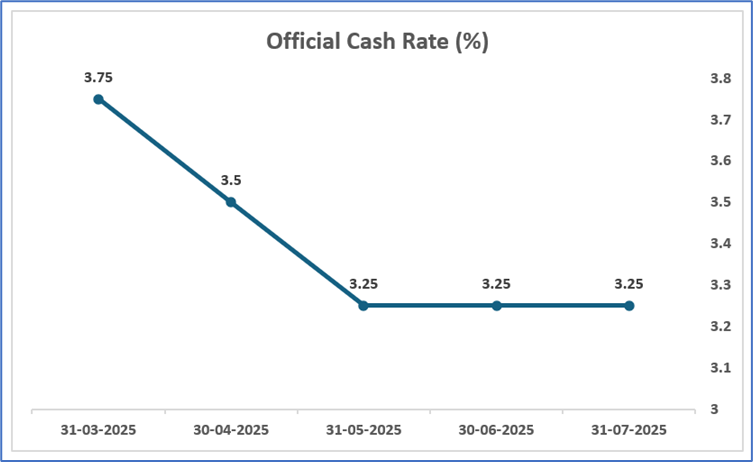
As per the release dated July 9, RBNZ agreed to hold the OCR at 3.25%. Notably, the elevated export prices as well as reduced interest rates have been helping a recovery in the NZ economy. However, increased global policy uncertainty and tariffs can reduce the global economic growth. This would likely slow the pace of NZ’s economic recovery, reducing the inflation pressures.
The Committee also noted that, despite the global factors, domestic financial conditions have been evolving broadly as projected. The mortgage and deposit interest rates have declined, implying a lower OCR, robust bank liquidity as well as soft credit growth. As per RBNZ, the average interest rate on the stock of mortgages is projected to continue to decline in upcoming quarters as more mortgage holders refix at the lower 1 – 2 year fixed-term interest rates.
Exhibit 1: OCR (%)
Data Source: This work is based on/includes rbnz data which are licensed by rbnz.govt.nz for reuse under the Creative Commons Attribution 4.0 International Licence; Chart Created by Kalkine Group
Sector Lending Summary – Banks & NBLIs (June 2025)
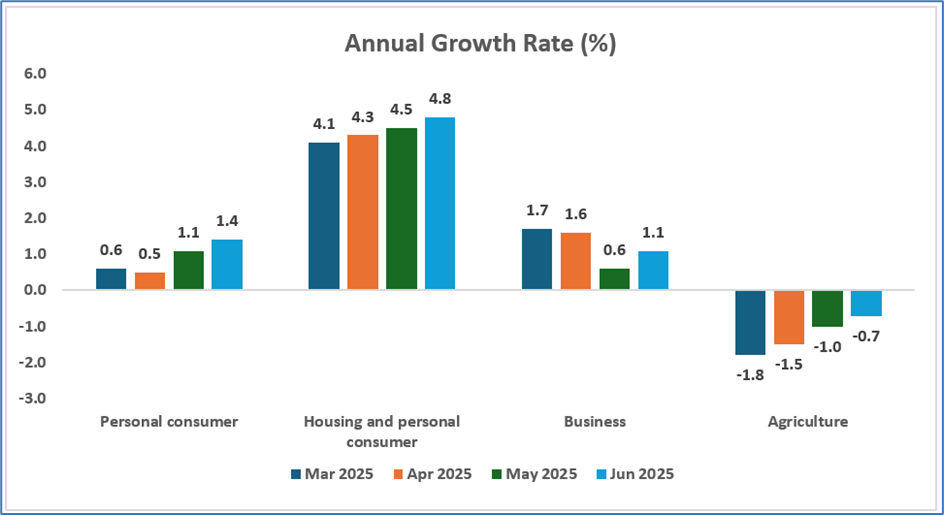
In June 2025, housing lending stock rose by $1.7 Bn (or 0.5%) to just over $379 Bn in June 2025, which was down on the $2.2 Bn (or 0.6%) rise witnessed last month. The annual growth rate increased from 4.7% to 4.9%, marking the highest point since October 2022. The personal consumer lending stock witnessed a rise of $13 Mn (or 0.1%) with the annual growth rate rising from 1.1% to 1.4% in June 2025.
Notably, the monthly increase was because of a $32 Mn (or 0.4%) rise in consumer lending for Non-Bank Lending Institutions (NBLI), which was offset by the $19 Mn (or 0.3%) decline in consumer lending for Banks. The business lending stock rose $260 Mn (or 0.2%), with the annual growth rate increasing from 0.6% to 1.1% in June 2025.
Exhibit 2: Sector Lending Annual Growth Rates (%)
Data Source: This work is based on/includes rbnz data which are licensed by rbnz.govt.nz for reuse under the Creative Commons Attribution 4.0 International Licence; Chart Created by Kalkine Group
Credit Card Summary – June 2025
RBNZ recently released data about credit card summary (June 2025). The seasonally adjusted total billings in NZ decreased to $4.4 Bn in June 2025. Annually, this reflects an increase of 0.9% from June 2024. The seasonally adjusted domestic billings on NZ issued cards amounted to $3.8 Bn in June 2025, down by 1.0% from May 2025, and up 2.0% from June 2024.
Notably, the overseas billings on NZ issued cards stood at $728 Mn in June 2025, up by 5.8% from May 2025. Annually, there was an increase of 8.7% from June 2024. The billings in New Zealand on overseas issued cards fell 8.1% from last month to $402.7 Mn in June 2025. Annually, billings on overseas issued cards declined 7.0%.
Key Risks and Challenges:
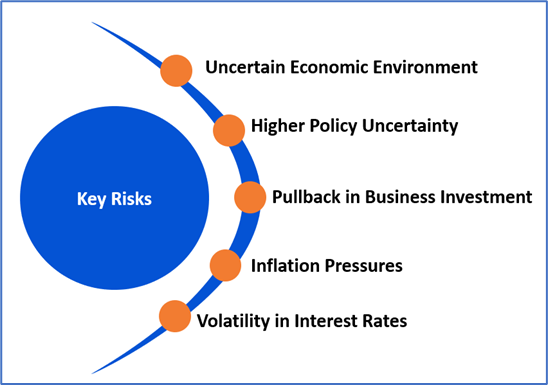
As per RBNZ Chief Economist Paul Conway, the global tariffs as well as economic uncertainty might mean less inflation pressures in NZ as well as a pullback in business investment and household spending. The tariffs can make global supply chains less efficient and can also nudge up the cost of imports. Therefore, the tariffs can add to inflation pressures in the US. However, for NZ, the main impact is expected to be weaker global growth, which can reduce demand for the exports as well as lower the import prices.
Exhibit 3. Key Risks in Financial Sector:
Source: Analysis by Kalkine Group
Outlook:
As per RBNZ, the annual consumers price inflation is expected to increase towards the top of the Monetary Policy Committee’s 1% - 3% target band over mid-2025. However, because of the spare productive capacity in the economy and declining domestic inflation pressures, headline inflation is projected to remain in the band and return to ~2% by early 2026. If medium-term inflation pressures continue to ease as expected, the Committee anticipates to reduce the OCR further.
RBNZ further added that the global growth is projected to slow over H2 FY 2025, reflecting the uncertain consequences of trade protectionism. However, the Committee highlighted that the fiscal expansion in the euro area, the US, and China might counter some of the downside risks. On balance, increased protectionism can result in less inflationary pressure for NZ.
Apart from the sector-specific factors, an analysis on 2 NZX-listed companies is provided. This report covers their insights, outlook, performance and potential as expected to be delivered in the near to medium term.
1) ANZ Group Holdings Limited (Recommendation: Hold, Potential Upside: Low Double-Digit) (M-Cap: NZD 100.9 billion, Annual Dividend Yield (TTM)1: 6.09%)
Business Description:
ANZ Group Holdings Limited (NZX: ANZ) is a non-operating holding company. Its divisions include Australia Retail, Australia Commercial, Institutional, New Zealand, Suncorp Bank, Pacific, and Group Center.
Outlook:
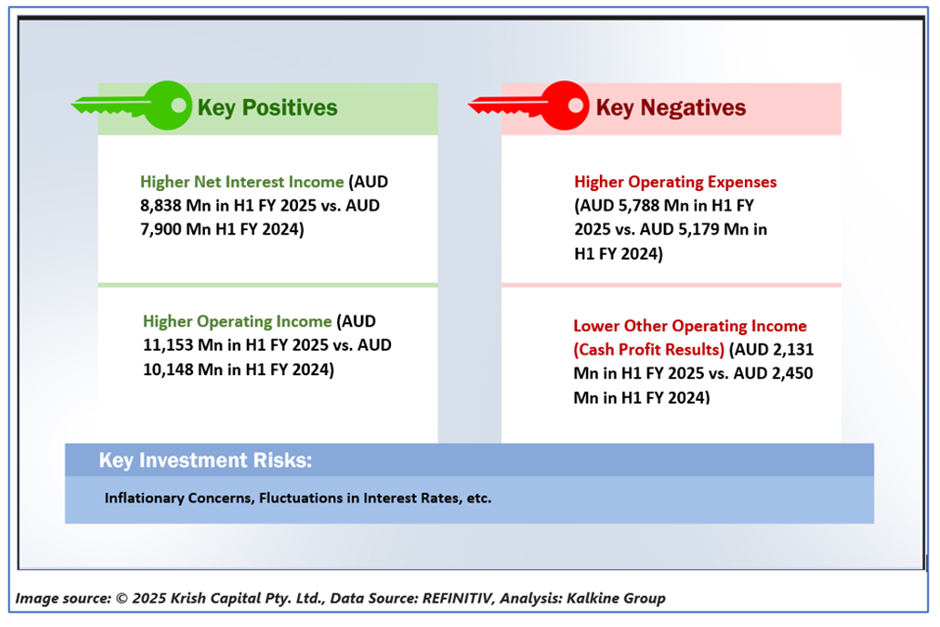
ANZ posted a good result for the half year to 31 March 2025 because of the continued momentum throughout each of its divisions as well as the inclusion of Suncorp Bank. Considering the increased uncertainty in the broader macro environment, ANZ believes that it is appropriate to adopt slightly more conservative capital settings. Notably, the priorities consist of running the Suncorp Bank well as well as deliver the synergies. The completion of the acquisition has been supporting in strengthening its presence in Queensland and bolster the Retail and Commercial businesses for the long term.
Technical Overview:
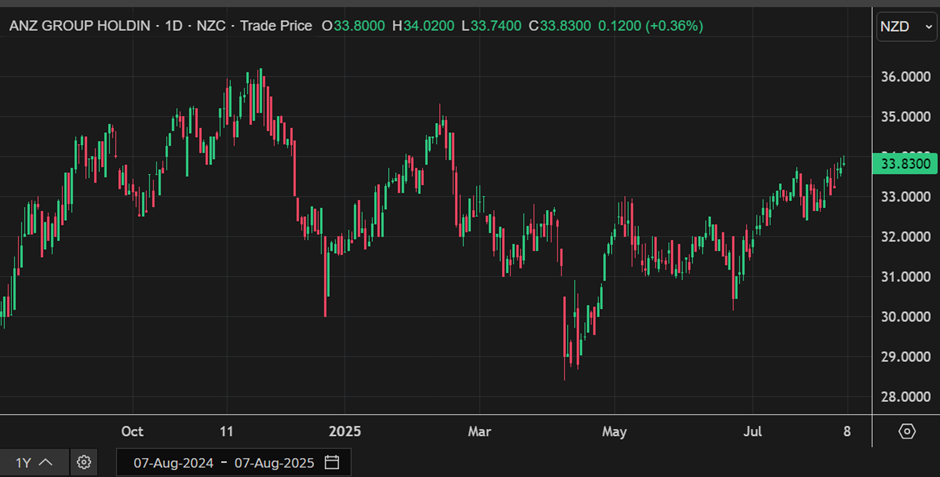
ANZ Daily Technical Chart, Data Source: REFINITIV
Technical Commentary
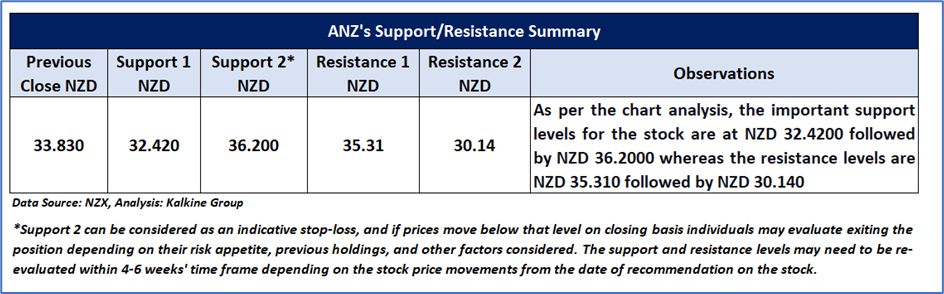
On the daily chart, ANZ’s stock prices broke above an Inverse Head and shoulders pattern, indicating a positive bias. Moreover, the momentum oscillator RSI (14-period) is heading north from its midpoint, providing more support to the previous observation. Prices are trading between its previous peak and trough, which might function as a resistance and support levels for the stock, respectively. A significant support level for the stock is located at NZD 32.42, while critical resistance level is placed at NZD 35.31.
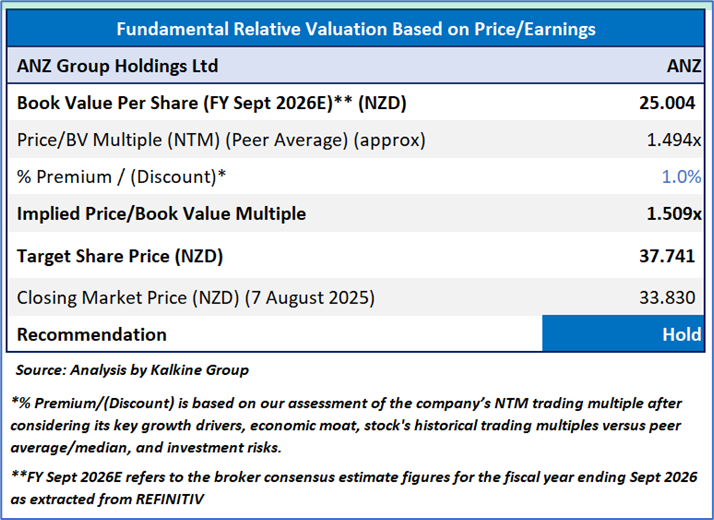
P/BV Based Relative Valuation
Stock Recommendation
Considering the facts above, a ‘Hold’ recommendation on the stock has been provided at the closing market price of NZD 33.830 per share, up by 0.36% as on 7th August 2025.
2) General Capital Limited (Recommendation: Speculative Buy, Potential Upside: Low Double-Digit) (M-Cap: NZD 24.3 Mn, Annual Dividend Yield (TTM)1: ~5.17%)
Business Description:
General Capital Limited (NZX: GEN) is a New Zealand-based financial services company. The principal activities are financial services, and research and advisory services.
Outlook:
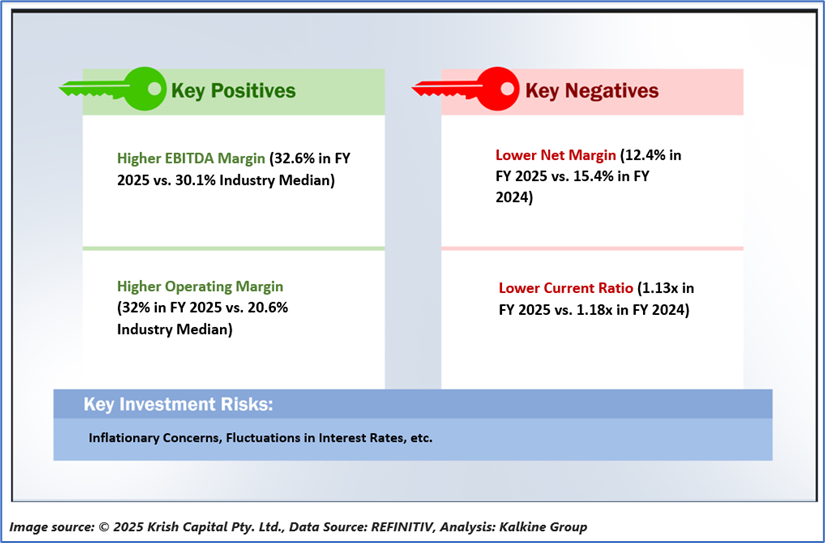
GEN remains resilient and is looking for opportunity amidst challenge. It remains well-capitalised, and in a robust position to pursue the earnings-accretive acquisitions. The company acquired Bridges Financial Services and there are strong growth opportunities throughout both the lending categories. Over the coming year, the company would continue to explore opportunities, including acquisitions, mergers, and takeovers, in order to further strengthen as well as expand the business.
Technical Overview:
Technical Commentary
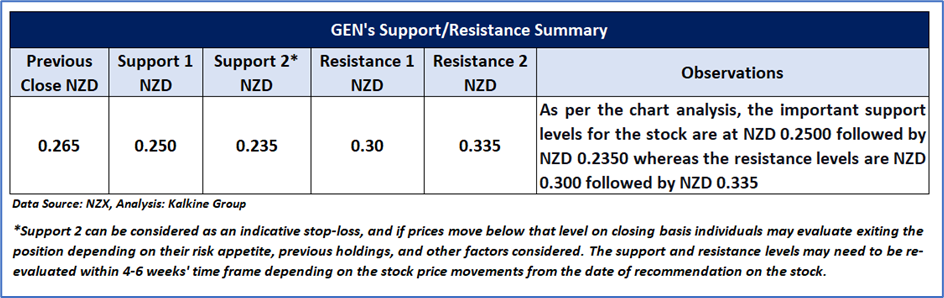
On the daily chart, GEN’s stock prices are forming a trading range characterized by a symmetrical triangle, suggesting that the sideways period in the stock might continue to persist in the near future. Moreover, the momentum oscillator RSI (14-period) is trading near its midpoint, adding further support to the previous observation. Prices are trading between its previous peak and trough, which might function as resistance and support levels for the stock, respectively. A significant support level for the stock is placed at NZD 0.250, while critical resistance level is positioned at NZD 0.300.
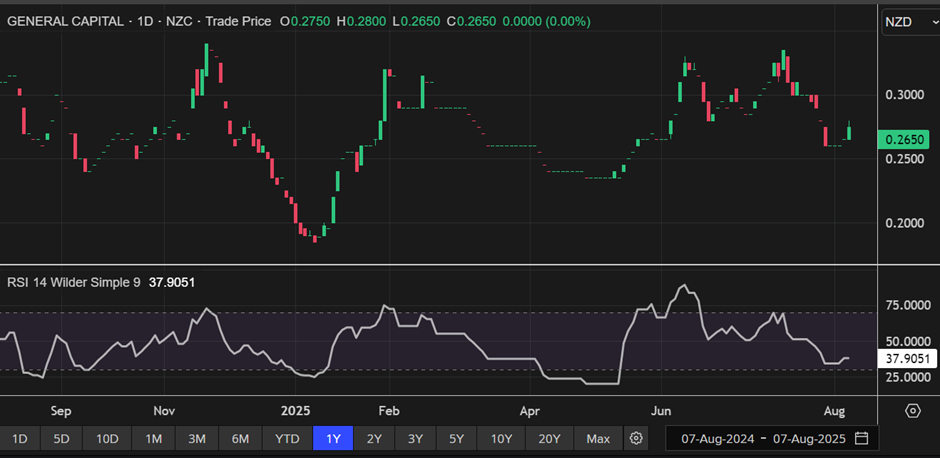
GEN Daily Technical Chart, Data Source: REFINITIV
Stock Recommendation
Considering the facts above, a ‘Speculative Buy’ recommendation on the stock has been provided at the closing market price of $0.265 per share as on 7th August 2025.
Note 1: Past performance is not a reliable indicator of future performance.
Note 2: The reference date for all price data, currency, technical indicators, support, and resistance levels is August 7, 2025. The reference data in this report has been partly sourced from REFINITIV.
Note 3: Investment decisions should be made depending on an individual's appetite for upside potential, risks, holding duration, and any previous holdings. An 'Exit' from the stock can be considered if the Target Price mentioned as per the Valuation and or the technical levels provided has been achieved and is subject to the factors discussed above.
Note 4: Annual Dividend Yield is on a Trailing Twelve Month (TTM1) basis and are subject to change based on factors such as company performance, stock price changes, etc.
Note 5: Kalkine reports are prepared based on the stock prices captured either from REFINITIV or Trading View. Typically, REFINITIV or Trading View may reflect stock prices with a delay which could be a lag of 25-30 minutes. There can be no assurance that future results or events will be consistent with the information provided in the report. The information is subject to change without any prior notice.
Technical Indicators Defined: -
Support: A level at which the stock prices tend to find support if they are falling, and a downtrend may take a pause backed by demand or buying interest. Support 1 refers to the nearby support level for the stock and if the price breaches the level, then Support 2 may act as the crucial support level for the stock.
Resistance: A level at which the stock prices tend to find resistance when they are rising, and an uptrend may take a pause due to profit booking or selling interest. Resistance 1 refers to the nearby resistance level for the stock and if the price surpasses the level, then Resistance 2 may act as the crucial resistance level for the stock.
Stop-loss: It is a level to protect further losses in case of unfavourable movement in the stock prices.
Disclaimer This report has been issued by Kalkine New Zealand Limited (FSP691351) (NZBN:9429047678101) (“Kalkine”). Kalkine is a Financial Advice Provider (“FAP”) and is authorised by a Class 1 Financial Advice Provider Licence issued by Financial Markets Authority (“FMA”) to provide financial advice. Kalkine provides only general financial advice through its research reports following a person becoming a member. The reports contain buy/sell/hold and other recommendations in relation to equity securities, managed funds and other managed investment schemes and other financial advice products. The recommendations and opinions in this report and on Kalkine website do not take into account any of your investment objectives, financial situation or needs. Before you make a decision about whether to acquire a financial product, you should obtain the Product Disclosure Statement from the product issuer. You should consider the appropriateness of advice taking into account your own objectives, financial situation and needs and seek independent financial advice before making any financial decisions. If you act on the advice in the research reports, you may have to pay fees, expenses or other amounts (but not to Kalkine). Further information about the complaints and dispute resolution process, as well as information about Kalkine’s duties are available on Kalkine’s website. Please read our Financial Advice Provider (FAP) disclosure statement and Complaints Handling Guide, which are available on the website.
Past performance is not a reliable indicator of future performance.
 Please wait processing your request...