
 AU
AU
 UK
UK
 CA
CA
 US
US
 IND
IND

 NZ
NZ

I. Sector Landscape and Outlook
Vote Health is the prime source of funding for New Zealand’s health and disability system however ACC is the other prime source of public funding in New Zealand. The funding released by Vote Health has directly been used for the day-to-day operation of strong and equitable public health and disability services provided by the skilled workforce in the communities, hospitals, and other care settings. The Ministry of Health has a crucial responsibility to oversee positive change in the health and disability system.
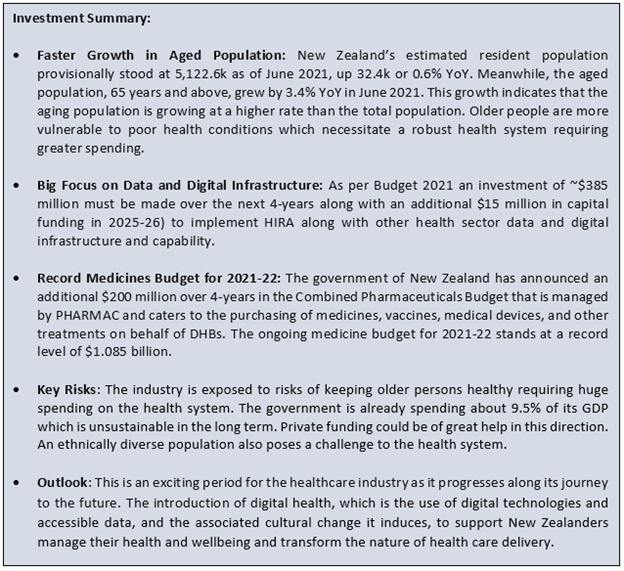
Budget 2021 provides District Health Boards (DHBs) with a funding of $2.7 billion over 4-years, up 4.37% from the existing baseline. This funding will facilitate DHBs to continue providing health services for New Zealand’s increasing and aging population in the face of inflation and other price and volume pressures. In addition, Budget 2021 offers $700 million in capital funding to support both the delivery of new DHB infrastructure projects and preparatory work on other projects.
Aged Population is Growing Faster than Total All Ages
As per Stats.NZ, New Zealand’s estimated resident population provisionally stood at 5,122.6k, comprising of 2,542.6k males and 2,580.0k females, and the median age of males and females was 36.7 and 38.7 years, respectively as of 30 June 2021. Further, New Zealand’s population increased by 32.4k or 0.6% YoY, while estimated natural increase (births minus deaths) stood at 27.7k and estimated net migration (migrant arrivals minus migrant departures) stood at 4.7k.
Meanwhile, the aged population, 65 years and above, grew by 3.4% in June 2021 while the total all-ages population grew by 0.6% in June 2021. This growth indicates that the aging population is growing at a higher rate than the total population, thereby raising the requirement for healthcare facilities and support from government and private sources. Also, it has increased the need for a retirement village with modern amenities at affordable prices.
Exhibit 1: Aging Population Increasing at Higher Rate versus Total All Ages
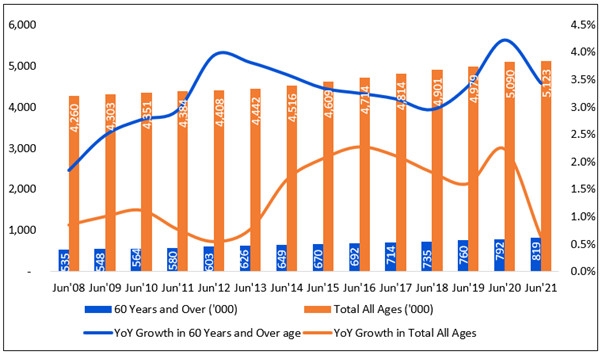
Data Source: This work is based on/includes Stats NZ’s data which are licensed by Stats NZ for reuse under the Creative Commons Attribution 4.0 International Licence; Chart Analysis by Kalkine Group
Government Push for Vaccination of New Zealanders
The Government of New Zealand has rolled out a country-wide plan to vaccinate all New Zealanders as per the availability of vaccination doses. In March-April 2021, the vaccination administered growth rate was in the range of 40-58%, which in July-August 2021, the growth rate is 10-15%. With more and more roll-out of vaccination, the country will eliminate health inequities, direct medical savings by preventing illness, and through indirect economic benefits like educational progress, labor productivity & availability, cognitive development, better income, savings, and investment.
Exhibit 2: Trend in Cumulative Vaccinations Administered – Weekly Basis (As of 15 August 2021)
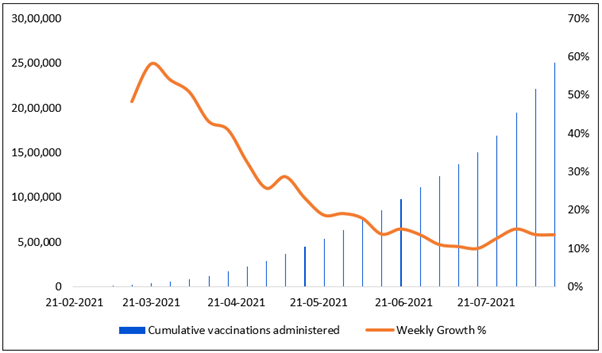
Data Source: budget.govt.nz, Copyright material on the Budget website is protected by copyright owned by the Treasury on behalf of the Crown. It is licensed for re-use under a Creative Commons Attribution 4.0 International Licence; Chart Created by Kalkine Group
Big Focus on Data and Digital Infrastructure
As per the Ministry of Health, the Government in Budget 2021, has made provision of an investment of ~$385 million over the next 4-years alongside an additional $15 million in capital funding in 2025-26 to implement HIRA, formerly known as the National Health Information Platform, along with other health sector data and digital infrastructure and capability. HIRA will develop the experience for patients, service users, and the health and disability sector associates. In addition, up to $116.644 million is expected to be invested over the next 4-years to transform the Health Sector Agreements and Payments systems. These investments into data and digital infrastructure and capability are intended to implement the health system reforms and develop health system performance.
PHARMAC’s Ongoing Medicines Budget for 2021-22 Stood at $1.085 billion.
The government of New Zealand has announced an additional $200 million over 4-years in the Combined Pharmaceutical Budget, which is managed by PHARMAC that caters to the purchasing of medicines, vaccines, medical devices, and other treatments on behalf of DHBs. PHARMAC’s running medicines budget for 2021-22 stands at $1.085 billion.
Index Performance:
The S&P/NZX All Healthcare Index generated a 2-year return of ~78.06% versus ~21.07% by the S&P/NZX 50 Index. Therefore, S&P/NZX All Healthcare Index overperformed S&P/NZX 50 Index by ~56.99% in 2-year.
Exhibit 3: S&P/NZX All Healthcare Index vs S&P/NZX 50 Index
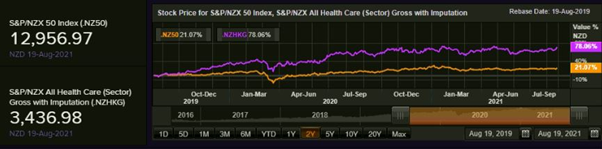
Source: REFINITIV
Key Risks and Challenges:
As per the Ministry of Health, the life expectancy of New Zealanders is longer, and every year, more people are coming in the bracket of those aged over 65 years. This is a good sign for individuals and their families, but simultaneously it means more social and health service facilities to accommodate the increasing number. Dealing with long-term conditions is a particular challenge with an aging population. Dementia is one example, which is expected to increase from about 48,000 in 2011 to about 78,000 in 2026. Obesity is another most common issue and has long-term health and social impacts. Among New Zealand, 10% of children are obese, but the rate is 30% in Pacific children.
Some New Zealanders do not benefit from the health and disability system as much as others. For example, while New Zealanders overall are living a little longer, while Māori and Pacific's peoples still have lower life expectancies. 29% of disabled people rated their health as fair or poor versus 4% of non-disabled people.
Exhibit 4. Key Risks in Healthcare Sector:
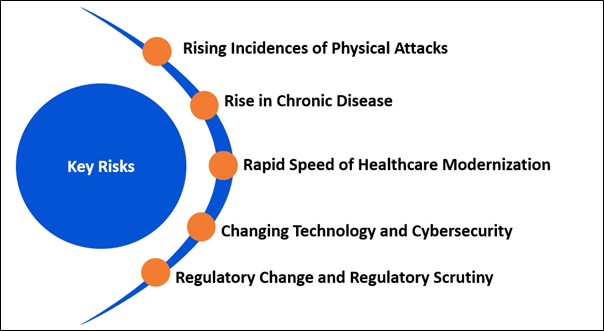
Sources: Analysis by Kalkine Group
Outlook:
With a focus on preventing illness and by making healthy choices easy and better, people can avoid developing long-term health conditions or slow the germination of those conditions. Therefore, universal health services and public health initiatives, as well as tailored approaches for some individuals and population groups, are needed so that everyone can enjoy the same level of service outcomes.
In line with other sectors, the healthcare sector can benefit from the advancements in technology and related infrastructure such as broadband. When routine tasks are automated, skilled staff can focus on what they do best.
In summary, the healthcare system may be functioning well enough today, but it needs to be upgraded as per the industry dynamics. This strategy provides an opportunity for an improvement in the health system and wider social services.
Apart from the sector-specific factors, we have also analysed four NZX-listed companies operating in the same sector. This report covers their insights, outlook, performance and potential as expected to be delivered in the near to medium term.
1) Rua Bioscience Limited (Recommendation: Speculative Buy, Potential Upside: Low Double-Digit) (M-Cap: NZ$58.91 million)
Business Description:
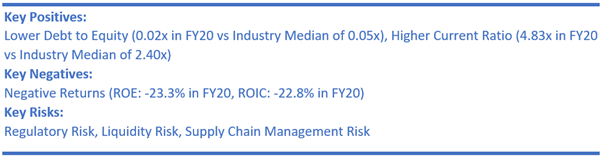
Rua Bioscience Limited (NZX: RUA) is engaged in cannabinoid-derived medicines, targeting export and local markets. The company is aiming and working accordingly for the GMP certification process.
Outlook:
Recently, on 29 June 2021, the company with the University of Waikato has announced a two-year research programme. Recent developments indicate that the company is focused to be one of the leading producers of cannabinoid-derived medicines. Accordingly, it has set a strategic and realistic export plan, with a clear path to revenue. Moreover, the company plans to release its results for FY21 on 30 August 2021.
Daily Price Chart
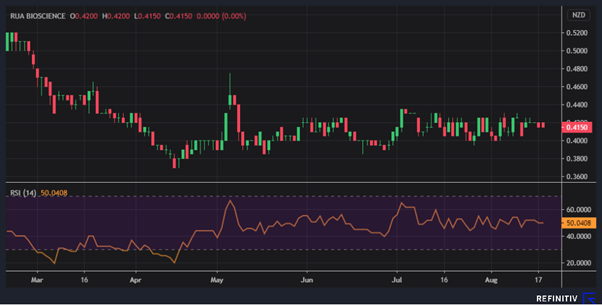
Source: REFINITIV, Note: Orange color line reflects Relative Strength Index (14-Period)
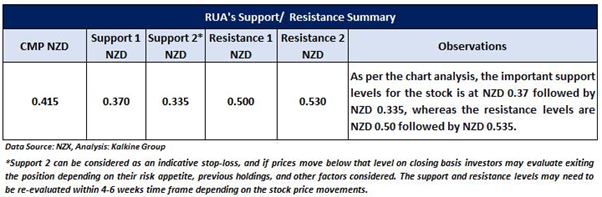
Stock Recommendation
Considering the growing demand for RUA’s product in the market and the possibility of demand from the agritech sector, followed by a focused strategy of the company as well as a strong outlook, we give a “Speculative Buy” recommendation on the stock at the current market price of $0.415 per share, (New Zealand Time: 12:25 PM (GMT +12) on 19th August 2021.
2) TruScreen Group Limited (Recommendation: Speculative Buy, Potential Upside: Low Double-Digit) (M-Cap: NZ$23.22 million)
Business Description:
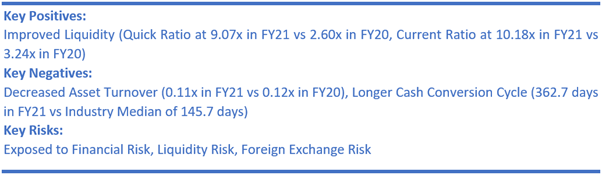
TruScreen Group Limited (NZX: TRU) offers the latest technology for cervical screening and provides real-time, accurate detection of pre-cancerous and cancerous cervical cells that helps to improve the health and wellbeing of women.
Outlook
With a strong sales pipeline, a growing commercial user base, and several key projects reaching finalization, the company anticipates that the Chinese market would grow phenomenally in the next 12-24 months. Further, the company is planning to capitalize on its strong distributor network, especially in Central & Eastern Europe. In Russia, the company is planning substantial clinical evaluations that will cement the way for public and private screening programs.
Daily Price Chart
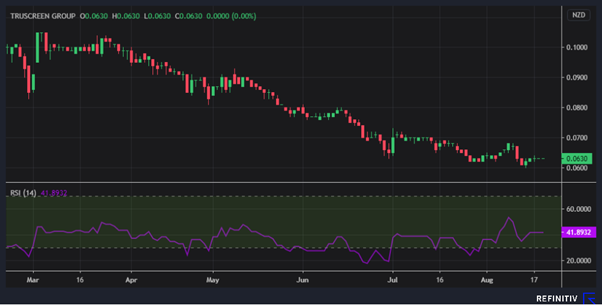
Source: REFINITIV, Note: Purple color line reflects Relative Strength Index (14-Period)
Stock Recommendation
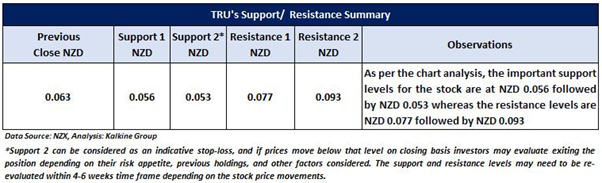
As per the release dated 1 July 2021, the company received its first order from Serbia, Eastern Europe. Further, the cervical cancer screening device achieved product registrations in Czech Republic, Slovakia, and Poland. Moreover, it has also filed product registrations in countries such as Croatia, Slovenia, Macedonia, and Bosnia Herzegovina.
Considering the aforesaid facts, we give a “Speculative Buy” recommendation on the stock at the current market price of $0.063 per share, (New Zealand Time: 11:26 AM (GMT +12) on 19th August 2021.
3) Fisher & Paykel Healthcare Corporation Limited (Recommendation: Hold, Potential Upside: Low Double-Digit) (M-Cap: NZ$19.39 billion, Gross Dividend Yield: 1.588%)
Business Description:
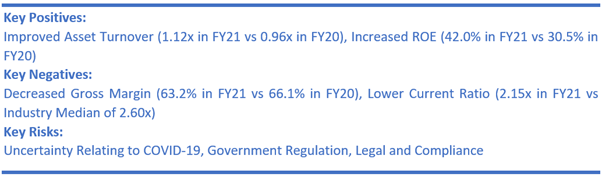
Fisher & Paykel Healthcare Corporation Limited (NZX: FPH) is engaged in designing, manufacturing, and marketing products and systems for acute and chronic respiratory care, surgery, and the treatment of obstructive sleep apnea.
Outlook:
As per the release dated 18 August 2021, the revenue for the first four months stood at $583 million, contributed 74% of revenue from the company’s Hospital product group and 26% from its Homecare product group. In constant currency, revenue for the four months was 2% lower YoY.
Amid continuing impact of COVID-19 on the business, the company is not providing quantitative revenue or earnings guidance for FY22. The company does not expect Hospital hardware revenue to continue at an elevated level for the remainder of FY22. In the Homecare product group, growth in OSA masks is dependent on new patient diagnosis rates, which is expected to be at or above FY21 rates for the remainder of FY22.
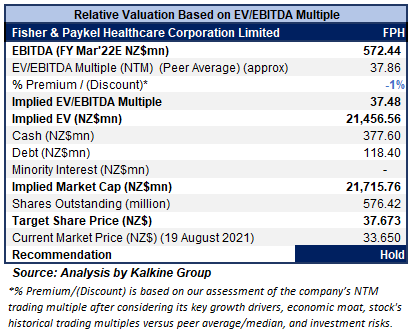
Valuation Methodology: EV/EBITDA Based Relative Valuation (Illustrative)
Daily Price Chart
Source: REFINITIV, Note: Purple color line reflects Relative Strength Index (14-Period)
Stock Recommendation
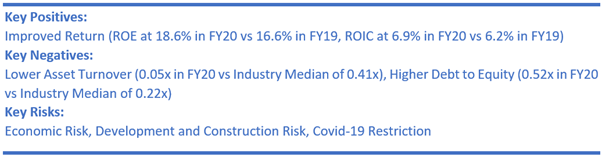
The stock has been valued using an EV/EBITDA multiple based illustrative relative valuation method and arrived at a target price of low double-digit (in percentage terms). The company might trade at a slight discount to its peers’ average, considering higher Debt to Equity of 0.08x in FY21 versus an industry median of 0.04x and higher bad debt allowance at 2.3% in FY21 versus 1.3% in FY20.
For relative valuation, we have taken peers like Ryman Healthcare Ltd. (RYM.NZ), Arvida Group Ltd. (ARV.NZ), and Cochlear Ltd. (COH.AX).
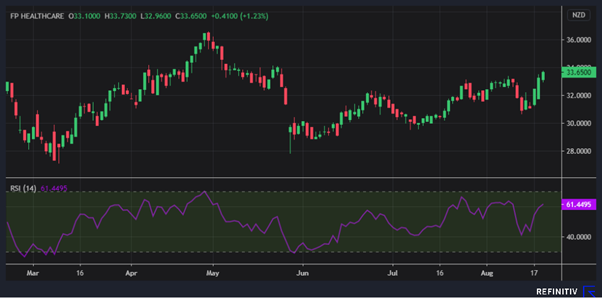
Considering the aforesaid facts, we give a “Hold” recommendation on the stock at the current market price of $33.65 per share, up 1.23% on 19th August 2021.
4) Summerset Group Holdings Limited (Recommendation: Hold, Potential Upside: Low Double-Digit) (M-Cap: NZ$3.02 billion, Gross Dividend Yield: 0.994%)
Business Description:
Summerset Group Holdings Limited (NZX: SUM) has grown to become one of the leading operators in the retirement village and aged care sector in New Zealand. Currently, it has 29 retirement villages in the country.
Outlook
For Q2FY21, the company reported 270 sales, comprising 154 new sales and 116 resales. Therefore, the total sales stood at 545 for the six months to 30 June. As per the management, the demand continues to be strong for both new sales and resales. The company is realizing good diversification of sales across the country with 70% of new sales coming from four villages: Casebrook (Christchurch), Ellerslie (Auckland), Rototuna (Hamilton), and Te Awa (Napier).
Moreover, the company has pre-sold all independent living units being delivered in Q3FY21 at the Bell Block (New Plymouth), Hobsonville (Auckland), and Te Awa villages, as well as 80% of those available at Rototuna. Importantly, the biggest delivery in Q3FY21 would be the $54 million, 10,500m2 main building at Avonhead (Christchurch).
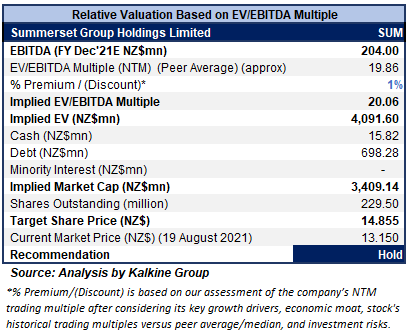
Valuation Methodology: EV/EBITDA Based Relative Valuation (Illustrative)
Daily Price Chart
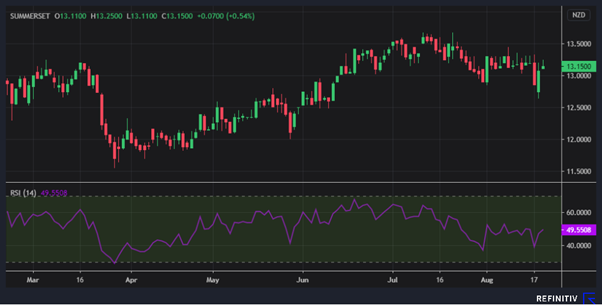
Source: REFINITIV, Note: Purple color line reflects Relative Strength Index (14-Period)
Stock Recommendation
The stock has been valued using an EV/EBITDA multiple based illustrative relative valuation method and arrived at a target price of low double-digit (in percentage terms). The company might trade at a slight premium to its peers’ average, considering strong sales and pre-sale of home loaded with care centre and a state-of-the-art memory care centre, as well as resident amenities such as a swimming pool, gym, and café.
For the purposes of relative valuation, we have taken peers such as Ryman Healthcare Ltd. (RYM.NZ), Arvida Group Ltd. (ARV.NZ), EBOS Group Ltd. (EBO.NZ), to name a few.
Considering the aforesaid facts, we give a “Hold” recommendation on the stock at the current market price of $13.15 per share, up 0.54% on 19th August 2021.
Note 1: The reference data in this report has been partly sourced from REFINITIV.
Note 2: Investment decisions should be made depending on the investors’ appetite on upside potential, risks, holding duration, and any previous holdings. Investors can consider exiting from the stock if the Target Price mentioned as per the analysis has been achieved and subject to the factors discussed above alongside support levels provided.
Technical Indicators Defined: -
Support: A level where-in the stock prices tend to find support if they are falling, and downtrend may take a pause backed by demand or buying interest.
Resistance: A level where-in the stock prices tend to find resistance when they are rising, and uptrend may take a pause due to profit booking or selling interest.
Stop-loss: It is a level to protect further losses in case of unfavourable movement in the stock prices.
Disclaimer
Kalkine New Zealand Limited is authorised to provide class advice only. The information on this site does not take into account any of your investment objectives, financial situation or needs. Before you make a decision about whether to acquire a financial product, you should obtain the Product Disclosure Statement from the product issuer. You should consider the appropriateness of advice taking into account your own objectives, financial situation and needs and seek independent financial advice before making any financial decisions.
Past performance is not a reliable indicator of future performance.
 Please wait processing your request...