
 AU
AU
 UK
UK
 CA
CA
 US
US
 IND
IND

 NZ
NZ

I. Sector Landscape and Outlook
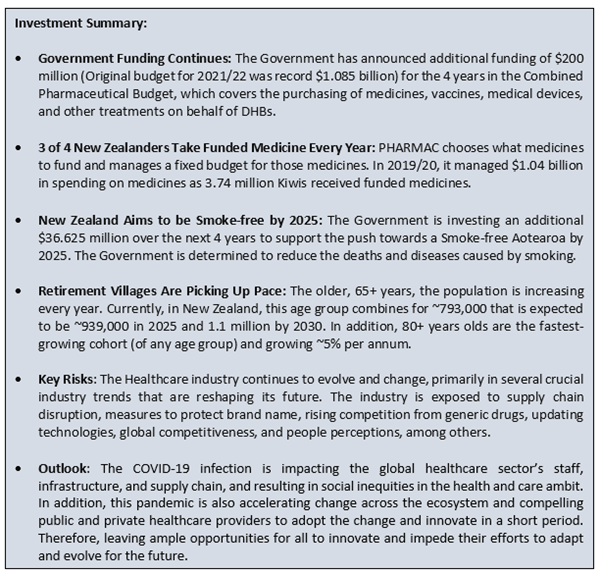
New Zealand receives most of its healthcare funding from Vote Health, followed by ACC public funding. The funding offered by Vote Health directly supports the routine operation of public health and disability services delivered by the skilled workforce in communities, hospitals, and other care settings. Budget 2021 provides District Health Boards (DHBs) with a funding of $2.7 billion for the next 4 years, up 4.37% from the current baseline.
The Government has announced an increase of $200 million (Original budget for 2021/22 was record $1.085 billion) for the next 4 years in the Combined Pharmaceutical Budget, which covers the purchasing of medicines, vaccines, medical devices, and other treatments on behalf of DHBs. Further, the Government announced an investment of ~$385 million over the next 4 years to implement HIRA and other health sector data and digital infrastructure and capability. HIRA will optimize the experience for patients, service users, and the health and disability sector workforce.
Exhibit 1: Increasing Trend in Aging Population in Recent Quarters
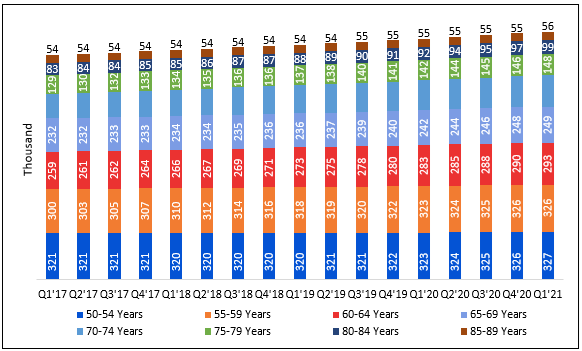
Data Source: stats.govt.nz, Chart Created by Kalkine Group
3 of 4 New Zealanders Take Funded Medicine Every Year
PHARMAC chooses what medicines to fund and manages a fixed budget for those medicines. In 2019/20, it managed $1.04 billion in spending on medicines as 3.74 million Kiwis received funded medicines.
Meanwhile, New Zealand is planning to keep a check on medicine expenditure over time. PHARMAC has avoided $9.3 billion in net medicine costs, with the gap between estimated expenditure and actual expenditure indicating how much money the health system would have had to spend on medicines if PHARMAC was not monitoring and controlling the costs.
Exhibit 2: Trend in Estimated Spending and Actual Spending in Net Drug over 2010-2020
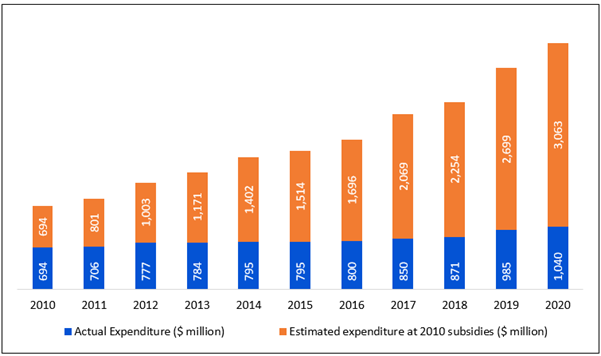
Data Source: pharmac.govt.nz, Chart Created by Kalkine Group
New Zealand Aims to be Smoke-free by 2025
The Government is investing an additional $36.625 million over the next 4 years to support the push towards a Smoke-free Aotearoa 2025. The Government is determined to reduce the deaths and diseases caused by smoking by providing care to children from exposure to tobacco marketing and promotion, controlling and cutting the supply of, and demand for tobacco, and providing the best possible support for quitting. Moreover, this objective is expected to be achieved when daily smoking prevalence must fall to 10% and the Māori and Pacific rates should have halved from their 2011 levels.
Exhibit 3: Trend in Key Indicators in Health Sphere
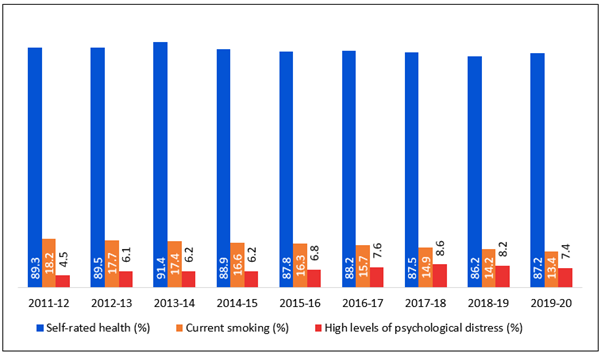
Data Source: minhealthnz, Chart Created by Kalkine Group
Highlights on Obesity and GP Cost
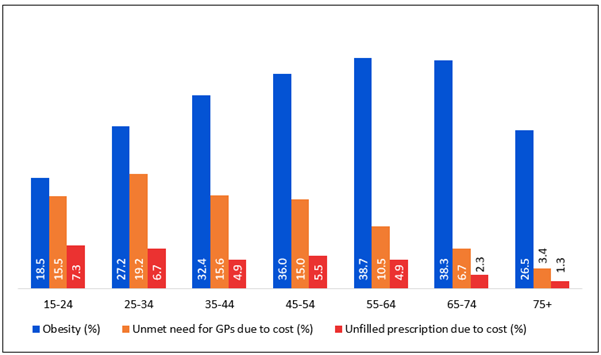
Māori populations were 1.8x as likely to be obese as non-Māori, and Pacific adults were 2.3x as likely to be obese as non-Pacific adults, post modifying for age and gender. As per the ethnic group, the prevalence was greater in the Pacific (63.4%), followed by Māori (47.9%), European/Other (29.3%), and Asian adults (15.9%). Meanwhile, in FY 2020 more than 1 in 5 Māori adults (20.5%) had not visited a GP due to cost pressure. Further, 16% of Pacific adults had not visited a GP due to cost pressure. Meanwhile, Pacific and Māori adults were 2.7x and 2.8x as likely as non-Pacific and non-Māori adults, respectively, to not have taken a prescription due to cost, after modifying for age and gender.
Exhibit 4: Percentage of Adults Who Were Obese, by Age in 2019/20
Data Source: minhealthnz, Chart Created by Kalkine Group
Retirement Villages Are Picking Up Pace
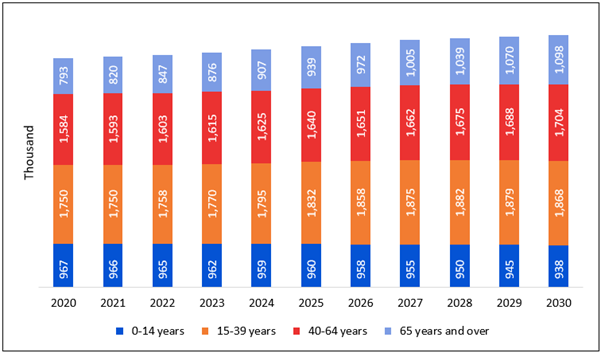
In New Zealand, the older (65+ years) population is increasing every year. Currently, in New Zealand, this age group combines for ~793,000 that is expected to be ~939,000 in 2025 and 1.1 million by 2030. In addition, 80+ years olds are the fastest-growing cohort (of any age group) and growing ~5% per annum (Ministry of Social Development 2001). This indicates the changing structure of the population, as well as the doubling of the 65+ age group, is expected to impact all aspects of society.
According to the New Zealand Law Commission (1999), a retirement village is a purpose-built complex of residential units with access to a range of ancillary facilities planned specifically for the comfort and convenience of the residents. Most retirement villages have between 40 and 170 homes (two-thirds have less than 80 homes) for independent living. The people who occupy these places are 70+ years of age, and the majority are widowed. Further, 80% of residents have a license-to-occupy agreement with the owners of the village, 10% own their homes outright, and the remaining share a variety of lease agreements.
Exhibit 5: Rising Population, Especially in 65+ Years Age Category
Data Source: stats.govt.nz, Chart Created by Kalkine Group
Index Performance:
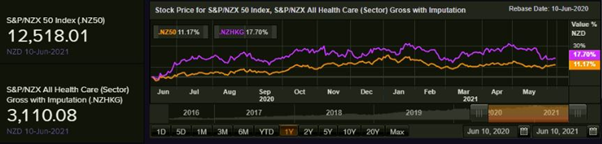
The S&P/NZX All Health Care (Sector) Index generated a 1-year return of ~17.70% versus ~11.17% by the S&P/NZX 50 Index. Therefore, NZX All Health Care Index overperformed NZX50 Index by ~6.53% in a 1-year period.
Exhibit 6: S&P/NZX All Health Care (Sector) vs S&P/NZX50 Index
Source: REFINITIV
Key Risks and Challenges:
New Zealand's increasing and changing elderly population is producing challenges for policy development. The older population is growing the demand for health care, support services, and housing, and making personal financial planning the prime focus. Saving initiatives that include KiwiSaver, have encouraged large numbers of the younger workforce to initiate financial preparation for their retirement. However, the ability to plan for retirement could be impacted by life events, such as ill-health, divorce, child-rearing, or job loss.
Further, providing medical technology and pharmaceutical advancement as per the latest technology and know-how to older New Zealanders is a growing challenge as the dynamics of the sector are very competitive and demanding. However, if kept in place, these developments provide confidence, assertiveness, and activeness than previous older generations. Moreover, improvements in health and reduction in the incidence of disability could offset around a third of the extra health costs of an aging population.
Elder abuse and neglect are complex issues for elderly people, requiring a range of responses to keep older people safe. Research suggests that, when elder abuse occurs, 79% of the time those connected to the abuse are family members.
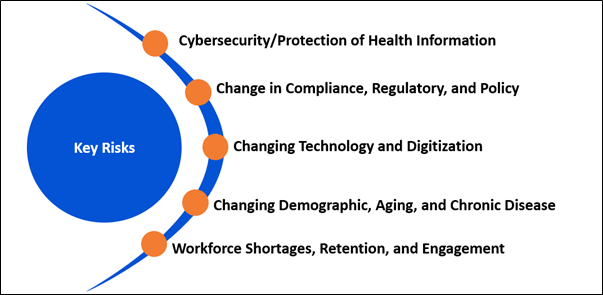
Exhibit 7. Key Risks in Health Care Sector:
Sources: Analysis by Kalkine Group
Outlook:
New Zealand Budget 2021 has funded several initiatives from the COVID-19 Response and Recovery Fund (CRRF) to augment recovery and rebuild from COVID-19. The government has budgeted a core $3.8 billion operating requirement in Budget 2021. In addition, the CRRF retains a $5.1 billion buffer to respond to future resurgences of COVID-19.
Further, the government is investing $4.7 billion in Health that includes additional funding for PHARMAC, as well as the transition to a new health system and establishment of a Māori Health Authority. In line with this, the government is supporting DHBs by investing $2.7 billion in operations to improve complete health for all New Zealanders through the health and disability services provided by District Health Boards (DHBs). This will facilitate DHBs to extend its health services for New Zealand’s increasing and changing population in the face of inflation and other pressures.
Meanwhile, the government has allotted $700 million capital for District Health Board to prioritise capital projects within the health sector. This will boost the delivery of safe and appropriate healthcare by offering facilities, infrastructure and technology that can meet demand.
In addition, the government’s infrastructure investment totals $57.3 billion over the next five years, and, to boost housing supply, it is investing $3.8 billion in a Housing Acceleration Fund. The government already had a record $42 billion of infrastructure investment in progress over the next four years in roads and rail, schools and hospitals, housing, and energy generation.
Apart from the sector-specific factors, we have also analysed four NZX-listed companies operating in the same sector. This report covers their insights, outlook, performance and potential as expected to be delivered in the near to medium term.
1) Summerset Group Holdings Limited (Recommendation: Hold, Potential Upside: Low Double-Digit) (M-Cap: NZ$2.89 billion, Gross Dividend Yield: 1.028%)
Business Description:
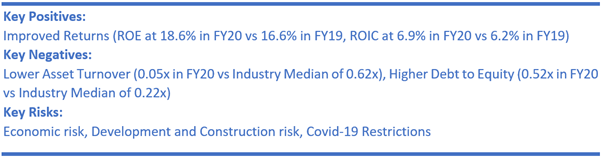
Summerset Group Holdings Limited (NZX: SUM) opened its first retirement village in 1997 and since then it has grown to become one of the country's leading operators in the retirement village and aged care sector. Currently, it has 29 retirement villages in the country.
Outlook:
For the first quarter ended 31 March 2021, the company reported 275 sales, comprising 148 new sales and 127 resales. In addition, the waitlist is up 24% YoY, and 8% QoQ, indicating strong demand for the company’s villages. This was backed up by the top village new sales for Q1, which were in Rototuna (Hamilton) and Casebrook (Christchurch) villages as well as were 31 and 26 sales, respectively.
Further, the pre-sales for Q2FY21 kicks in with a robust start, with all villas being delivered in the second quarter at Kenepuru (Wellington) and Bell Block (New Plymouth) pre-sold. Importantly, the company is building a good pipeline of new builds to come, comprising a $170 million village in Prebbleton.
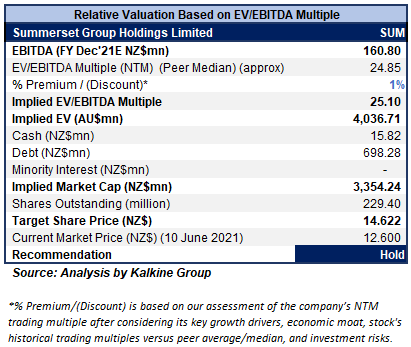
Valuation Methodology: EV/EBITDA Based Relative Valuation (Illustrative)
Stock Recommendation
We have applied EV/EBITDA based relative valuation (on an illustrative basis) and the target price reflects a rise of low double-digit (in % terms). We have applied a slight premium to EV/EBITDA Multiple (NTM) (Peer Average) considering the village in Prebbleton is expected to comprise over 290 independent homes, and a full continuum of care, including serviced apartments and care rooms, as well as a memory care centre for residents living with dementia. For the purposes of relative valuation, we have taken peers such as Ryman Healthcare Ltd (RYM.NZ), Arvida Group Ltd (ARV.NZ), Fisher & Paykel Healthcare Corporation Ltd (FPH.NZ), to name a few.
Considering the aforesaid facts, we give a “Hold” recommendation on the stock at the current market price of $12.60 per share, down 0.40% on 10th June 2021.
2) Ryman Healthcare Limited (Recommendation: Buy, Potential Upside: Low Double-Digit) (M-Cap: NZ$6.59 billion, Gross Dividend Yield: 1.736%)
Business Description:
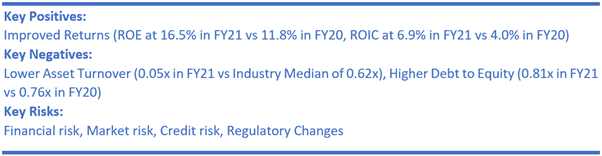
The business of Ryman Healthcare Limited (NZX: RYM) hovers around caring for elderly people and building critical healthcare infrastructure with quality options.
Outlook
In December 2020, the company achieved its long-term target of opening five villages in Victoria. Further, it has another six villages in the pipeline in Australia. Moreover, its development pipeline of 25 new villages is expected to provide homes for over 6,800 residents that would generate forecasted capital proceeds of $5.3 billion and recurring income of $420 million, subject to market demand and consenting outcomes.
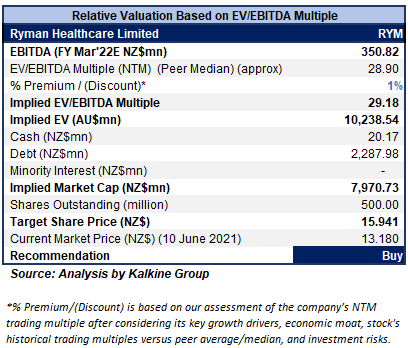
Valuation Methodology: EV/EBITDA Based Relative Valuation (Illustrative)
Stock Recommendation
We have applied EV/EBITDA based relative valuation (on an illustrative basis) and the target price reflects a rise of low double-digit (in % terms). We have applied a slight premium to EV/EBITDA Multiple (NTM) (Peer Average) considering a strong net margin of 92.8% in FY21 vs 62.4% in FY20 and decent operational capabilities that could help the company in navigating unfavourable conditions.
For the purposes of relative valuation, we have taken peers such as Summerset Group Holdings Ltd (SUM.NZ), Arvida Group Ltd (ARV.NZ), Fisher & Paykel Healthcare Corporation Ltd (FPH.NZ), to name a few.
Considering the aforesaid facts, we give a “Buy” recommendation on the stock at the current market price of $13.18 per share, up 2.17% on 10th June 2021.
3) Arvida Group Limited (Recommendation: Hold, Potential Upside: Low Double-Digit) (M-Cap: NZ$982.60 million, Gross Dividend Yield: 2.940%)
Business Description:
Arvida Group Limited (NZX: ARV) offers retirement living accommodation and aged care services to over 4,950 residents.
Outlook
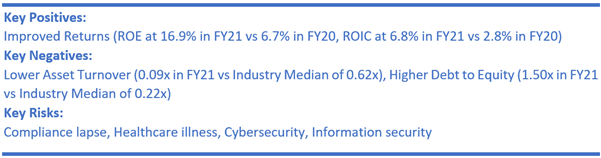
Broadly, the company has 1,324 units under development pipeline as of 31 March 2021. In addition, it is closely monitoring acquisition and divestment opportunities and the market for prime land remains competitive. Notably, the residential housing market extends to outperform.
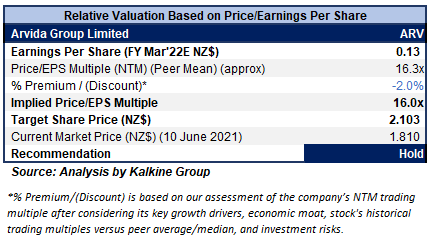
Valuation Methodology: Price/Earnings Per Share Based Relative Valuation (Illustrative)
Stock Recommendation
Considering the aforesaid facts, we have valued the stock using a P/E multiple-based illustrative relative valuation and have arrived at a target price that reflects a rise of low double-digit (in % terms). We believe the company can trade at a slight discount to its peer P/E (NTM Trading multiple) considering that the sector funding model continues to pressure on care margins, followed by workforce limitations with extended border closures and nurse pay disparity between public and private sectors.
For the purposes of relative valuation, we have taken peers like Ryman Healthcare Ltd (RYM.NZ), Summerset Group Holdings Ltd (SUM.NZ), and Oceania Healthcare Ltd (OCA.NZ).
Considering the aforesaid facts, we give a “Hold” recommendation on the stock at the current market price of $1.81 per share, down 0.55% on 10th June 2021.
4) Rua Bioscience Limited (Recommendation: Speculative Buy, Potential Upside: Low Double-Digit) (M-Cap: NZ$58.91 million)
Business Description:
Rua Bioscience Limited (NZX: RUA) is aiming to get EU GMP-Certification and it is an exporter of bioactive extracts and products.
Outlook
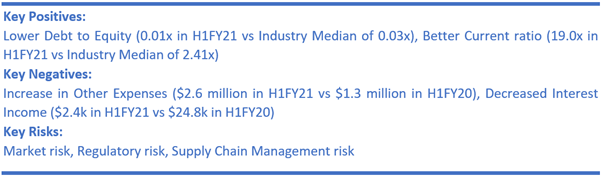
The company raised $20 million through IPO and the proceeds have been deployed across strategic priority areas aiming towards initial sales and revenue. Further, the company is focused to be a leading producer of cannabinoid-derived medicines and, to reach this aim, the company has set a strategic and realistic export strategy, with a clear path to revenue. Despite COVID-19 related circumstances, the company is optimistic to meet its operational goals.
Technical Overview:
Weekly Chart
Source: Refinitiv
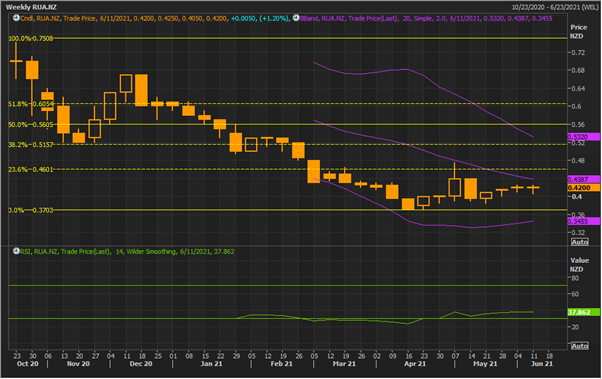
Note: Purple colour lines are Bollinger Bands® with the upper band suggesting overbought status while the lower band oversold status, and yellow lines are Fibonacci retracement lines which measure price rebound and backtrack. https://www.bollingerbands.com/
The stock has been trending up while experiencing a low volatility and giving a ‘Doji’ close each week in the past three weeks including that of the ongoing week. The technical indicator RSI with a reading around 38 and a curve at the end pointing flat to up, suggests gaining of positive momentum.
Going forward, the stock may have resistance around $0.48 whereas support could be around the previous low of $0.37.
Stock Recommendation
Considering current trading levels, focused export and sales, and a strong outlook, we give a “Speculative Buy” recommendation on the stock at the current market price of $0.420 per share, up 1.20% on 10th June 2021.
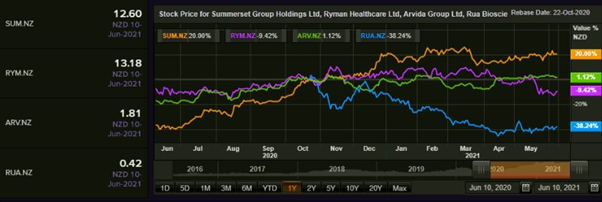
Comparative Price Chart (Source: REFINITIV)
Note 1: The reference data in this report has been partly sourced from REFINITIV.
Note 2: Investment decisions should be made depending on the investors’ appetite on upside potential, risks, holding duration, and any previous holdings. Investors can consider exiting from the stock if the Target Price mentioned as per the analysis has been achieved and subject to the factors discussed above alongside support levels provided.
Technical Indicators Defined: -
Support: A level where-in the stock prices tend to find support if they are falling, and downtrend may take a pause backed by demand or buying interest.
Resistance: A level where-in the stock prices tend to find resistance when they are rising, and uptrend may take a pause due to profit booking or selling interest.
Disclaimer
Kalkine New Zealand Limited is authorised to provide class advice only. The information on this site does not take into account any of your investment objectives, financial situation or needs. Before you make a decision about whether to acquire a financial product, you should obtain the Product Disclosure Statement from the product issuer. You should consider the appropriateness of advice taking into account your own objectives, financial situation and needs and seek independent financial advice before making any financial decisions.
Past performance is not a reliable indicator of future performance.
 Please wait processing your request...