
 AU
AU
 UK
UK
 CA
CA
 US
US
 IND
IND

 NZ
NZ

I. Sector Landscape and Outlook
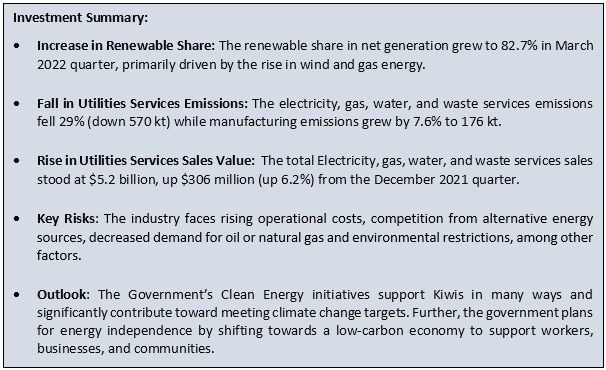
As per the Ministry of Business, Innovation and Employment (MBIE), technological transformation, changing consumer preferences and demands are driving the role of energy in the domestic and international market. Electric vehicles (EVs) and Plug-in Hybrids accounted for 20% of new passenger car sales in March-April 2022. Roughly 57,000 EVs and Hybrid cars were registered under the clean car scheme, indicating a rise of 56% YoY. EVs contributed 2% of the vehicle fleet by the end of 2021, and it is expected that 90% of electricity will be generated from renewable sources by 2025. As per the Ministry for the Environment, the Climate Change Response Act (CCRA) targets (i) net-zero emissions of all GHG other than biogenic methane by 2050 and (ii) a 24-47% reduction below 2017 biogenic methane emissions by 2050.
Increase in Renewable Share in Net Generation in March 2022 Quarter
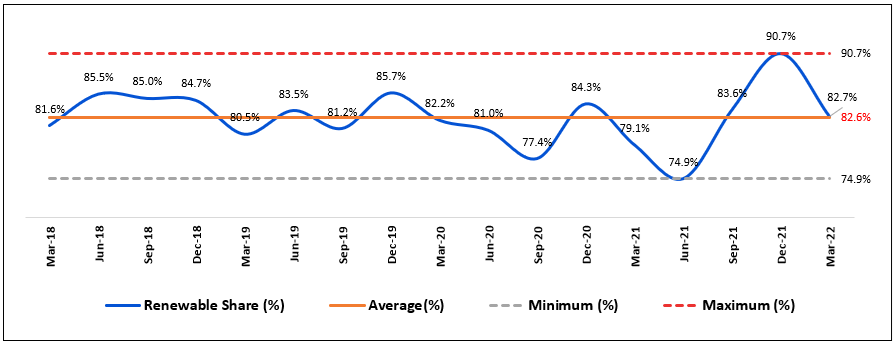
As per MBIE, the renewable share in net generation grew to 82.7% in March 2022 quarter from 79.1% in March 2021 quarter, primarily driven by a double-digit rise in Wind energy (up 21.2%) and gas energy (up 19.8%). This growth in net generation was also supported by the increase in solar energy (up 10.1%) and hydro energy (up 5.3%). However, oil contribution towards net generation fell significantly (down 67.6%), followed by coal (down 57.0%). The rise in renewable energy in the net generation is primarily led by government policies attributable to the common goal of clean energy. Meanwhile, the elevated Oil and Gas, as well as energy prices, are mounting pressure on the renewable industry, making renewables even more competitive.
Exhibit 1: Trend in Renewable Share (%) in Net Generation Since March 2018 Quarter
Data Source: This work is owned by the Ministry of Business, Innovation and Employment on behalf of the Crown which are licensed for reuse under the Creative Commons Attribution 4.0 International Licence; Chart Created by Kalkine Group
Fall in Electricity, Gas, Water, And Waste Services Emissions
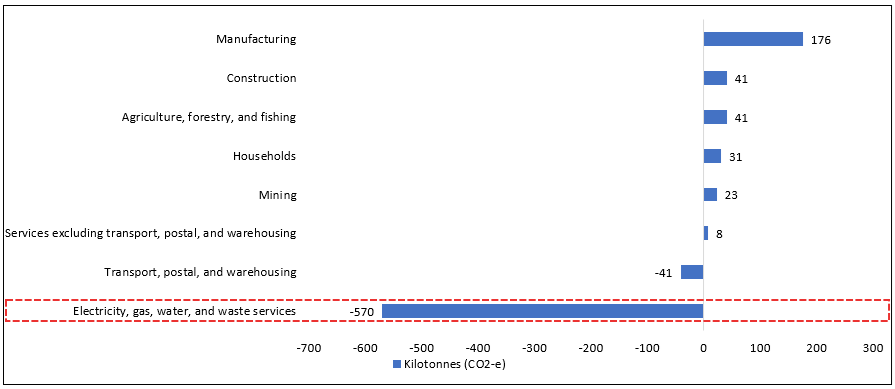
As per Stats.NZ, the total emissions increased 1.1% to 205 kilotonnes (kt), in the December 2021 quarter versus the September 2021 quarter. This coincides with a 3.0% rise in GDP over the same period. The emissions of electricity, gas, water, and waste services fell 29% (down 570 kt), while manufacturing emissions grew by 7.6% to 176 kt.
Exhibit 2: Emissions (kilotonnes CO₂-e) by industry and household, seasonally adjusted, September 2021–December 2021 quarters
Data Source: This work is based on/includes Stats NZ’s data which are licensed by Stats NZ for reuse under the Creative Commons Attribution 4.0 International Licence; table Created by Kalkine Group
Rise in Electricity, Gas, Water, and Waste Services Sales Value in March 2022 Quarter
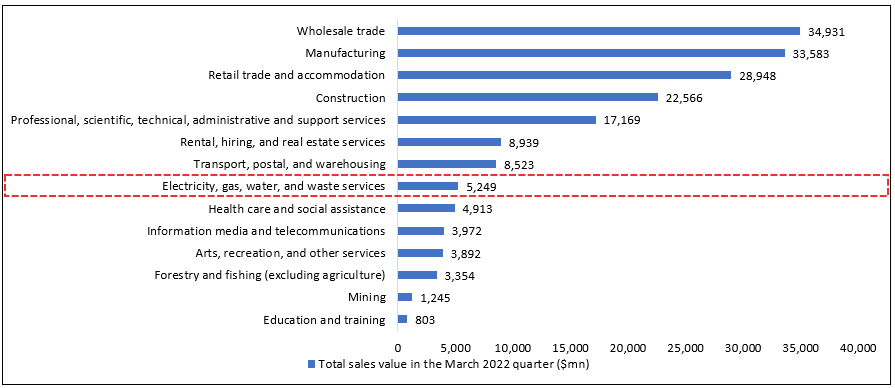
As per Ststs.NZ, the total electricity, gas, water, and waste services sales stood at $5.2 billion, up $306 million (up 6.2%) from the December 2021 quarter, where the actual purchases decreased by $199 million (down 5.6%), and salaries and wages increased $39 million (up 8.6%) in the March 2022 quarter compared with the March 2021 quarter.
Exhibit 3: Business Financial Data for March 2022 quarter
Data Source: This work is based on/includes Stats NZ’s data which are licensed by Stats NZ for reuse under the Creative Commons Attribution 4.0 International Licence; table Created by Kalkine Group
Index Performance:
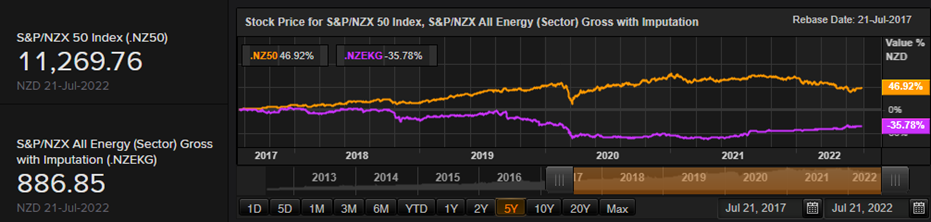
The S&P/NZX All Energy (Sector) Index generated a 5-year return of ~46.92% versus ~-35.78% by the S&P/NZX 50 Index. Therefore, NZX All Energy Index overperformed NZX50 Index by ~82.70% in 5-year.
Exhibit 4: S&P/NZX All Energy (Sector) vs S&P/NZX50 Index
Source: REFINITIV
Key Risks and Challenges:
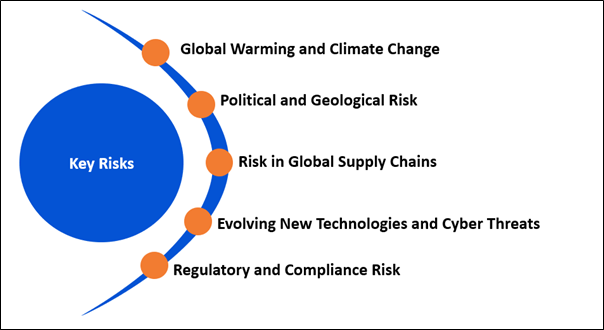
The government and private players are working on low-carbon electricity systems that are a very complex collaboration of different technologies with multiple functions to ensure reliable supply. Further, the uncertainty over the available elements used in generating electricity implies an option value associated with choosing between future non-fossil-fuel generation and fossil fuel technologies. Further, the power sector is also exposed to climate change like rising water temperature, air temperature, and frequency/intensity of droughts are likely to impact generation efficiency, hydropower generation and nuclear power plants.
Exhibit 5. Key Risks in Utilities Sector:
Source: Analysis by Kalkine Group
Outlook:
As per the ‘Wellbeing Budget 2022’, released in May 2022, the government is focussing on energy independence by shifting its focus on low-carbon economy to provide strength to workers, businesses, and communities. Further, it has established a new Climate Emergency Response Fund. The primary investments are:
Budget 2022 will offer $678 million to expand the Government Investment in Decarbonising Industry Fund (GIDI). Also, the budget has allocated $764 million towards the ‘Energy and Industry sector’, primarily for industrial decarbonization initiatives and efforts to support the broader energy transition, a way towards the direction of energy independence. This includes support for businesses to shift to cleaner energy to reduce costs and emissions and take steps to strengthen the transition to a renewable electricity system.
Apart from the sector-specific factors, we have also analysed three NZX-listed companies operating in the same sector. This report covers their insights, outlook, performance and potential as expected to be delivered in the near to medium term.
1) Genesis Energy Limited (Recommendation: Buy, Potential Upside: Low Double-Digit) (M-Cap: NZ$2.98 billion, Annual Dividend Yield (TTM)1: 8.08%)
Genesis Energy Limited (NZX: GNE) is an energy company involved in generating electricity, retailing and trading energy, and developing and procuring fuel services.
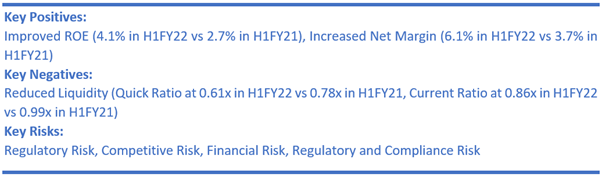
Outlook
The focus will be on the Future-gen strategy by signing additional power purchase contracts for wind and geothermal generation and a joint venture contract with FRV Australia. The company has guided FY22 EBITDAF to stay between $430-$440 million, subject to hydrological conditions, gas availability, material events, one-off expense or other unforeseeable circumstances.
On 20 July 2022, the company released its Q4FY22 performance report and stated an increase in customer satisfaction, loyalty through the quarter, and growing customer numbers by 3,400.
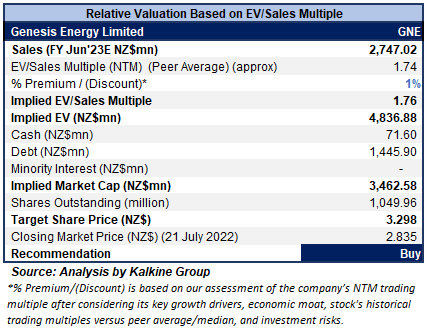
Valuation Methodology: EV/Sales Based Relative Valuation (Illustrative)
Technical Overview:
Daily Price Chart
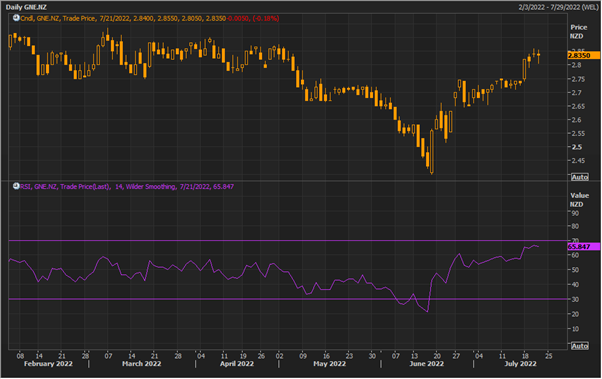
Source: REFINITIV, Note: Purple color line reflects Relative Strength Index (14-Period)
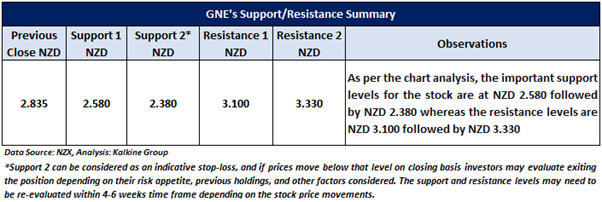
Stock Recommendation
The stock has been valued using an EV/Sales multiple-based illustrative relative valuation, and the target price so arrived reflects a rise of low double-digit (in % terms). A slight premium has been applied to EV/Sales Multiple (NTM) (Peer Average), considering its future growth strategies and decent outlook.
Considering the aforementioned factors, we recommend a ‘Buy’ rating on the stock at the closing market price of $2.835 per share, down 0.18% as of 21 July 2022.
2) Manawa Energy Limited (Recommendation: Buy, Potential Upside: Low Double-Digit) (M-Cap: NZ$1.89 billion, Annual Dividend Yield (TTM)1: 7.51%)
Business Description:
Manawa Energy Limited (NZX: MNW) is Aotearoa, New Zealand’s largest independent electricity generator and renewables developer, with an overall installed capacity of 498MW.
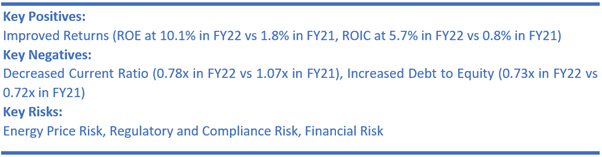
Outlook
The company has over 30 new solar and wind development projects under active consideration, including four solar projects in the feasibility stage. The company anticipates EBITDAF in the $140-$160 million range and capital expenditure to stay within the ambit of $45-$55 million for FY23.
On 21 July 2022, the company announced that the Annual Meeting will be held on 12 August 2022.
On 20 July 2022, the company announced that Deion Campbell joined its Board, effective 20 July 2022.
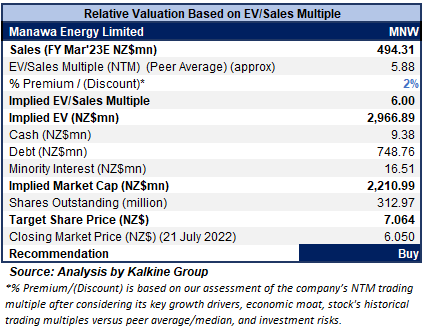
Valuation Methodology: EV/Sales Based Relative Valuation (Illustrative)
Technical Overview:
Daily Price Chart
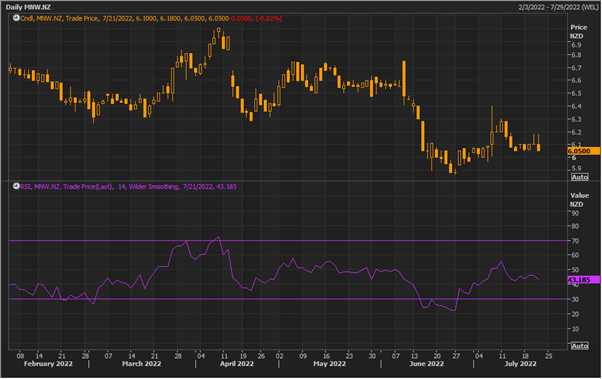
Source: REFINITIV, Note: Purple color line reflects Relative Strength Index (14-Period)
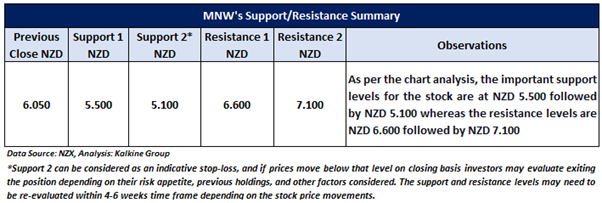
Stock Recommendation:
The stock has been valued using an EV/Sales multiple-based illustrative relative valuation, and the target price so arrived reflects a rise of low double-digit (in % terms). A slight premium has been applied to EV/Sales Multiple (NTM) (Peer Average), considering the strong financial performance in FY22, as well as decent outlook.
Considering the aforementioned factors, we recommend a ‘Buy’ rating on the stock at the closing market price of $6.05 per share, down 0.82% as of 21 July 2022.
3) Meridian Energy Limited (Recommendation: Hold, Potential Upside: Low Double-Digit) (M-Cap: NZ$12.63 billion, Annual Dividend Yield (TTM)1: 4.72%)
Business Description:
Meridian Energy Limited (NZX: MEL) is engaged in generating 100% renewable energy from renewable sources - wind, water, and sun. It supplies electricity to its customers from the electricity grid, which combines electricity supplied from renewable and non-renewable sources.
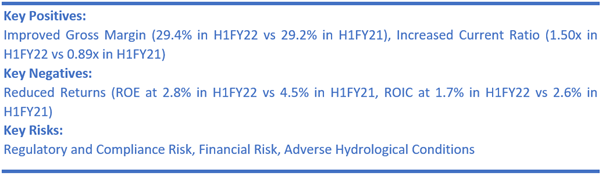
Outlook
The company has been vigorously working to increase its renewable development pipeline, which includes the development of Ruākākā Energy Park. It has identified four potential partners for the next phase of the Southern Green Hydrogen project. It is assessing proposals to develop the production and export facility in Southland.
On 15 July 2022, the company released its monthly operating report for June 2022. As per the report, June 2022 monthly total inflows were 144% of historical average and Waitaki catchment water storage at the end of June 2022 was 78% of historical average.
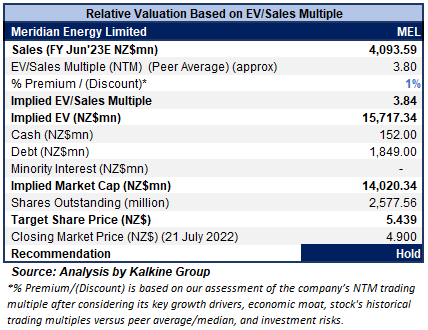
Valuation Methodology: EV/Sales Based Relative Valuation (Illustrative)
Technical Overview:
Daily Price Chart
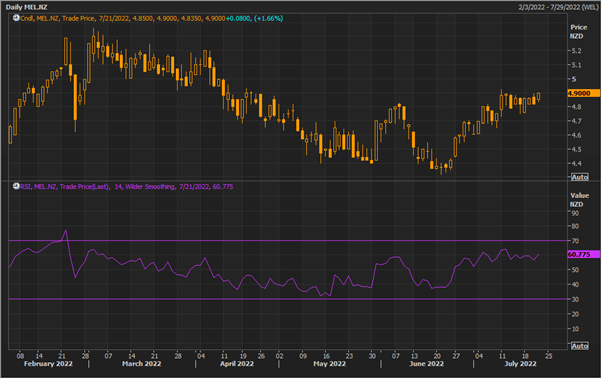
Source: REFINITIV, Note: Purple color line reflects Relative Strength Index (14-Period)

Stock Recommendation:
The stock has been valued using an EV/Sales multiple-based illustrative relative valuation, and the target price so arrived reflects a rise of low double-digit (in % terms). A slight premium has been applied to EV/Sales Multiple (NTM) (Peer Average), considering the continued growth in retail sales volumes, and focus on renewable development pipeline.
Considering the aforementioned factors, we recommend a ‘Hold’ rating on the stock at the closing market price of $4.90 per share, up 1.66% as of 21 July 2022.
Markets are trading in a highly volatile zone currently due to certain macro-economic issues and geopolitical tensions prevailing. Therefore, it is prudent to follow a cautious approach while investing.
Note 1: Past performance is not a reliable indicator of future performance.
Note 2: The reference date for all price data, currency, technical indicators, support, and resistance levels is July 21, 2022. The reference data in this report has been partly sourced from REFINITIV.
Note 3: Investment decisions should be made depending on an individual's appetite for upside potential, risks, holding duration, and any previous holdings. An 'Exit' from the stock can be considered if the Target Price mentioned as per the Valuation and or the technical levels provided has been achieved and is subject to the factors discussed above.
Note 4: Annual Dividend Yield is on a Trailing Twelve Month (TTM1) basis and are subject to change based on factors such as company performance, stock price changes, etc.
Technical Indicators Defined: -
Support: A level at which the stock prices tend to find support if they are falling, and downtrend may take a pause backed by demand or buying interest.
Resistance: A level at which the stock prices tend to find resistance when they are rising, and uptrend may take a pause due to profit booking or selling interest.
Stop-loss: In general, it is a level to protect further losses in case of any unfavourable movement in the stock prices.
Disclaimer
Kalkine New Zealand Limited is authorised to provide general advice only. The information on this website does not take into account any of your investment objectives, financial situation or needs. Before you make a decision about whether to acquire a financial product, you should obtain the Product Disclosure Statement from the product issuer. You should consider the appropriateness of advice taking into account your own objectives, financial situation and needs and seek independent financial advice before making any financial decisions.
Past performance is not a reliable indicator of future performance.
 Please wait processing your request...