
 AU
AU
 UK
UK
 CA
CA
 US
US
 IND
IND

 NZ
NZ

I. Sector Landscape and Outlook
As per the Government Policy Statement on land transport (GPS), the government has strategized four key challenges: preventing deaths and serious injuries, decarbonization, better transport choices and improving freight connections. Prioritizing these elements would accelerate growth in infrastructure and related sectors, thereby resulting in a buoyant economy. Meanwhile, the government has announced a crown infrastructure investment of $57.3 billion for the next four years. The government has already recorded $42 billion of infrastructure investment in progress for roads and rail, schools and hospitals, housing, and energy generation.
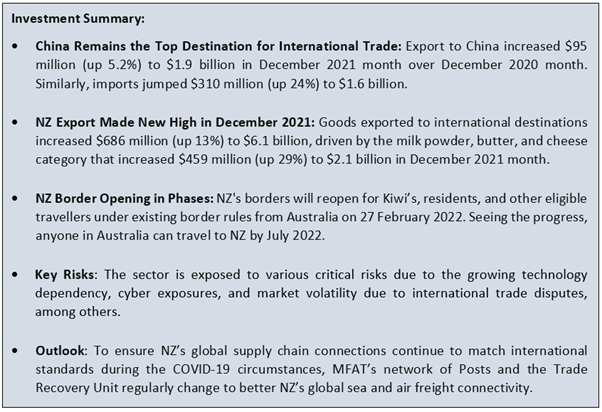
Further, the government of NZ plans to open borders in phases. As per the release dated 15 February 2022, NZ's borders will reopen for Kiwi’s and residents and other eligible travellers under existing border settings from Australia on 27 February 2022. Seeing the progress, anyone in Australia can travel to NZ by July 2022.
NZ Export Made New High of $6.1 Billion in December 2021 Month
As per Stats.NZ, goods exported to international destinations increased $686 million (up 13%) to $6.1 billion. In comparison, goods imported grew $1.2 billion (up 23%) to $6.5 billion, resulting in a monthly trade deficit of $477 million in December 2021 month over December 2020 month. The milk powder butter drove the high pace of the export and cheese category that increased $459 million (up 29%) to $2.1 billion in December 2021. The value in December 2021 was the highest on record for any month for exports of this commodity group.
Exhibit 1: Overseas Merchandise Trade of December 2021
.png)
Data Source: This work is based on/includes Stats NZ’s data which are licensed by Stats NZ for reuse under the Creative Commons Attribution 4.0 International Licence; Chart Created by Kalkine Group
China continues to be a Hot Destination for International Trade
As per Stats.NZ, export to China increased $95 million (up 5.2%) to $1.9 billion in December 2021 month over December 2020 month, driven by high demand for milk powder (up $58 million) and beef (up $55 million). However, fish, crustaceans, and molluscs decreased $37 million (52%). Similarly, import jumped $310 million (up 24%) to $1.6 billion, driven by high demand for mechanical machinery and equipment (up $54 million), iron and steel, and articles (up $41 million), and vehicles, parts, and accessories (up $38 million).
Exhibit 2: Seasonally Adjusted Total Exports and Imports, Quarterly Values ($ million)
.png)
Data Source: This work is based on/includes Stats NZ’s data which are licensed by Stats NZ for reuse under the Creative Commons Attribution 4.0 International Licence; Chart Created by Kalkine Group
Government’s Funding for Transport Sector to Improve Connectivity
As per the ‘Wellbeing Budget 2021, released by Treasury.govt.nz, the government has allotted $2.0 billion for the Transport sector. The funding is for three Rail initiatives to purchase 60 new locomotives and 1,900 new wagons and support the National Land Transport Fund. This would restore the rail network and offer working capital requirements for KiwiRail to ensure the maintenance of core freight, tourism, property, and ICT assets. In addition, the government has parked $1.3 billion as an operating and capital fund.
Index Performance:
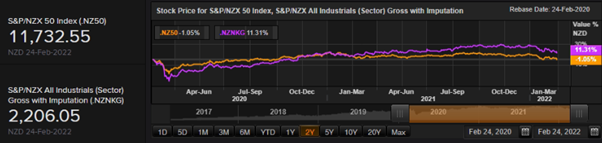
The S&P/NZX All Industrials (Sector) Index generated a 2-year return of ~11.31% versus ~-1.05% by the S&P/NZX 50 Index. Therefore, NZX All Industrials Index overperformed NZX50 Index by ~12.36% in 2-year.
Exhibit 3: S&P/NZX All Industrials (Sector) vs S&P/NZX50 Index
Source: REFINITIV
Key Risks and Challenges:
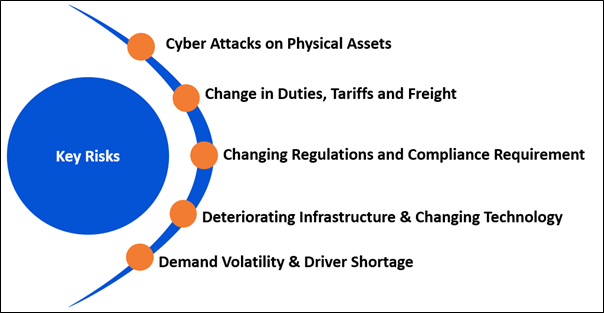
The pandemic created boundaries for the industrial sector. Supply chains were interrupted, rail, road, and air cargo service providers battled to transit essential goods, labor shortages became relentless, and factories and warehouses closed or mirrored operational challenges. Further, the world, including NZ, is experiencing the impacts of climate change (like more frequent severe storm events, flooding, and coastal inundation) on the transport network. Being ready to cover this risk requires the systematic coordination and collaboration of multiple stakeholders in the supply chain.
Exhibit 4. Key Risks in Industrials Sector:
Sources: Analysis by Kalkine Group
Outlook:
The current congestion in domestic and international ports and ongoing availability issues for empty containers impact the reliability, consistency, and price of shipping. However, the sudden rise in global consumer demand concerning COVID-19 circumstances has resulted in increased and peaked demand for shipping services and equipment across both vessels and port infrastructure.
Also, the airfreight capacity remains minimized due to restricted global passenger travel. However, as per the NZ government, from 21 February 2022, all visa holders who are vaccinated for international travel can travel to Australia without a travel exemption. From 13 March 2022, the border opens to Kiwi’s and other eligible travellers from anywhere in the world. The NZ border reopens from 12 April 2022 for temporary work, and student visa holders currently outside NZ provided the travellers meet their visa requirements.
Apart from the sector-specific factors, we have also analysed four NZX-listed companies operating in the same sector. This report covers their insights, outlook, performance and potential as expected to be delivered in the near to medium term.
Markets are trading in a highly volatile zone currently due to certain macro-economic issues and geopolitical tensions prevailing. Therefore, it is prudent to follow a cautious approach while making investment decisions.
1) Auckland International Airport Limited (Recommendation: Buy, Potential Upside: Low Double-Digit) (M-Cap: NZ$10.13 billion)
Business Description:
Started in 1966, Auckland International Airport (NZX: AIA) is the operator of New Zealand’s major and busiest airport.
Outlook
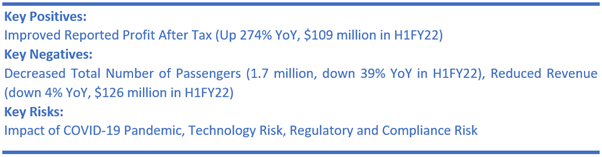
Despite COVID-19 related circumstances in the domestic and international market, the company is providing earnings forecast for FY22 of an underlying loss after tax in the range of $25-$50 million. Further, the capital expenditure is anticipated to be between $250-$300 million for FY22. The company has reached an agreement with correspondence banks to lower the new EBITDA-based interest coverage covenants agreed in August last year for the duration between June 2022 and June 2024.
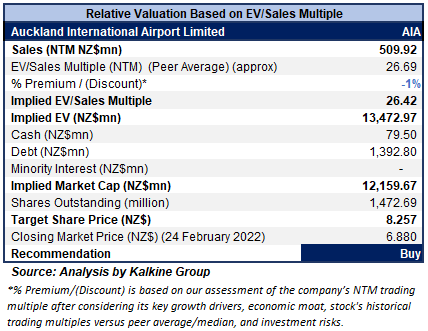
Valuation Methodology: EV/Sales Multiple Based Relative Valuation (Illustrative)
Technical Overview:
Daily Price Chart
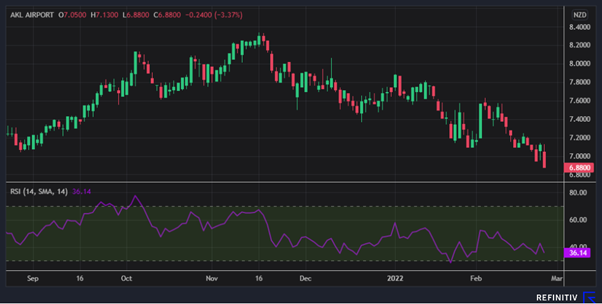
Source: REFINITIV, Note: Purple color line reflects Relative Strength Index (14-Period)
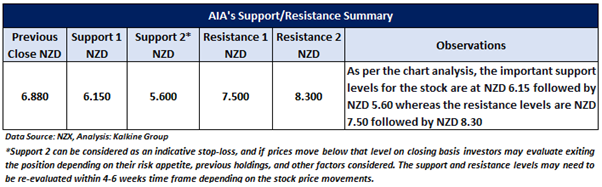
Stock Recommendation
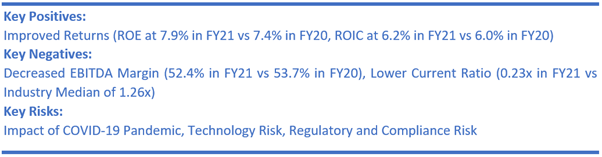
The stock has been valued using an EV/Sales multiple-based illustrative relative valuation, and the target price so arrived reflects a rise of low double-digit (in % terms). A slight discount has been applied to EV/Sales Multiple (NTM) (Peer Average), considering ongoing domestic and international travel restriction.
Considering the facts above and the recent update, we give a “Buy” recommendation on the stock at the closing market price of NZ$6.88 per share, down 3.37% as of 24th February 2022.
2) Port of Tauranga Limited (Recommendation: Buy, Potential Upside: Low Double-Digit) (M-Cap: NZ$4.18 billion, Gross Dividend Yield: 2.976%)
Business Description:
Port of Tauranga Limited (NZX: POT) is New Zealand’s largest port and international freight gateway. The location of the port is central to key export commodity sources.
Outlook
The company mentioned that international shipping capacity is in hot demand as well as the costs for the shippers have skyrocketed. Within this context, POT proved to be robust as well as resilient. POT’s diversity of cargoes provides resilience in terms of revenue, and its long-term freight agreements with the key customers give certainty of the cargo volumes.
Valuation Methodology: EV/Sales Multiple Based Relative Valuation (Illustrative)

Technical Overview:
Daily Price Chart
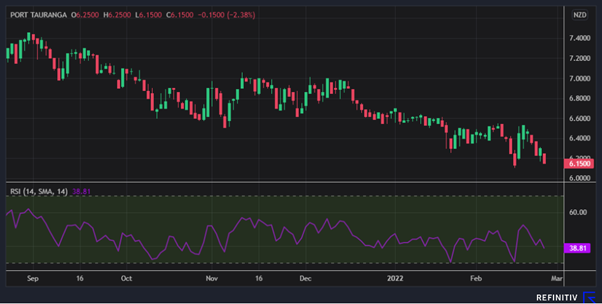
Source: REFINITIV, Note: Purple color line reflects Relative Strength Index (14-Period)
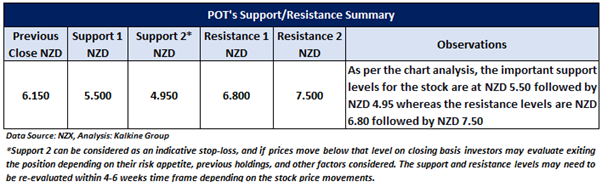
Stock Recommendation
The stock has been valued using an EV/Sales multiple-based illustrative relative valuation, and the target price so arrived reflects a rise of low double-digit (in % terms). A slight premium has been applied to EV/Sales Multiple (NTM) (Peer Average), considering POT’s diversity of cargoes as well as decent outlook.
Considering the facts above and the recent update, we give a “Buy” recommendation on the stock at the closing market price of NZ$6.15 per share, down 2.38% as of 24th February 2022.
3) Move Logistics Group Limited (Recommendation: Speculative Buy, Potential Upside: Low Double-Digit) (M-Cap: NZ$159.39 million)
Business Description:
Move Logistics Group Limited (NZX: MOV) is among the leading domestic freight and logistics players in New Zealand. It is engaged in providing freight transporting and warehousing services. It also coordinates offshore freight movements through international alliances.
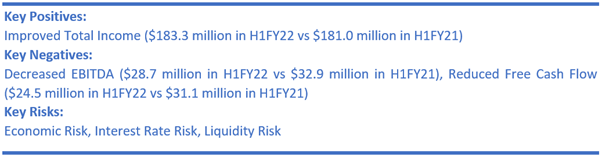
Outlook
The company anticipates sectoral and economic disruption to continue for the rest of FY22. Further, it forecasts elevated inflation levels and higher interest rates to persist; hence the company could raise freight rates to nullify rising costs wherever possible. Driver shortages continue to disrupt the business, and it is expected that the loosening of border restrictions would attract skilled drivers to enter the country.
The company anticipates moving ahead with a two-year strategic plan to better margins and grow the business. The positive recovery experienced in Q2FY22 is expected to extend toH2FY22, with initiatives positioning the company to take advantage of market opportunities.
Technical Overview:
Daily Price Chart
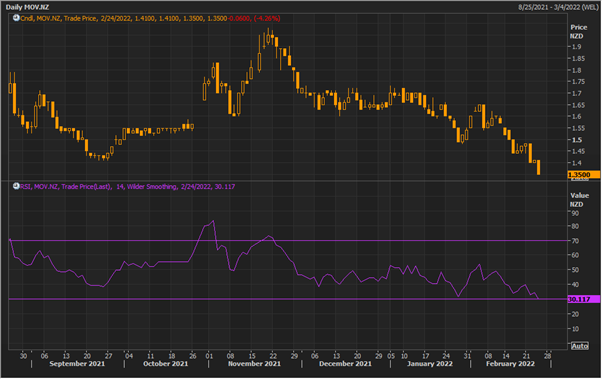
Source: REFINITIV, Note: Purple color line reflects Relative Strength Index (14-Period)
Stock Recommendation
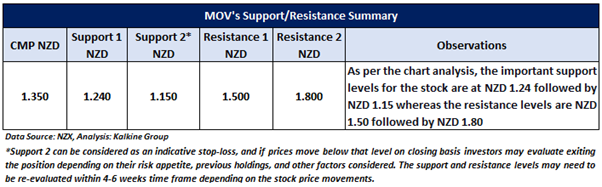
Considering the facts above, we give a “Speculative Buy” recommendation on the stock at the current market price of $1.35 per share as of 24th February 2022 (New Zealand Time: 4:37 PM (GMT +12)).
4) Napier Port Holdings Limited (Recommendation: Hold, Potential Upside: Low Double-Digit) (M-Cap: NZ$597.88 million, Gross Dividend Yield: 3.415%)
Business Description:
Napier Port Holdings Limited (NZX: NPH) is New Zealand’s fourth-largest port by container volume. It is the main gateway for Hawke’s Bay and lower North Island’s exports.
Outlook
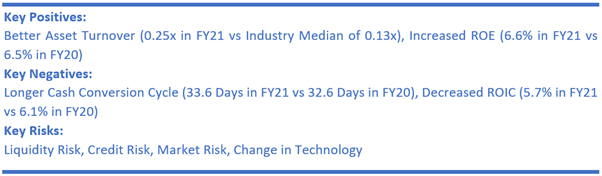
As per the base, the volume forecast for log exports in FY22 will be in-line with FY2021. The company is looking forward to delivering its strategic capital investments in FY22, including the earlier than contracted completion of 6 Wharf in 2HFY22. It expects them to contribute to the group's new financial year. Considering this contribution, the base-case forecast for log volumes, and assuming a continuation of current market conditions, the underlying result from operating activities is expected to increase by ~10% in FY22.
Valuation Methodology: EV/Sales Multiple Based Relative Valuation (Illustrative)
Technical Overview:
Daily Price Chart
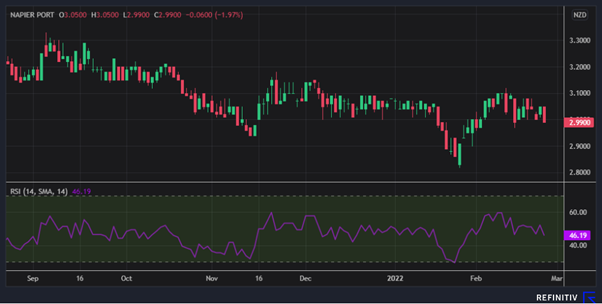
Source: REFINITIV, Note: Purple color line reflects Relative Strength Index (14-Period)
Stock Recommendation:
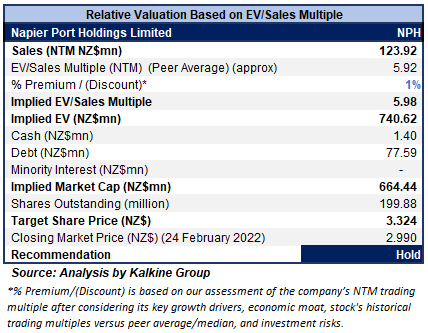
The stock has been valued using EV/Sales based relative valuation (on an illustrative basis), and the target price reflects a rise of low double-digit (in % terms). A premium has been applied to EV/Sales Multiple (NTM) (Peer Average), considering the diversity of trades that passes across NHP’s wharves and protects the company from container-based supply chain and COVID-19 disruptions.
Considering the facts above and a decent outlook, we give a “Hold” recommendation on the stock at the closing market price of NZ$2.99 per share, down by 1.97% as of 24th February 2022.
Note 1: The reference data in this report has been partly sourced from REFINITIV.
Note 2: Investment decisions should be made depending on the investors’ appetite on upside potential, risks, holding duration, and any previous holdings. Investors can consider exiting from the stock if the Target Price mentioned as per the analysis has been achieved and subject to the factors discussed above alongside support levels provided.
Technical Indicators Defined: -
Support: A level where-in the stock prices tend to find support if they are falling, and downtrend may take a pause backed by demand or buying interest.
Resistance: A level where-in the stock prices tend to find resistance when they are rising, and uptrend may take a pause due to profit booking or selling interest.
Stop-loss: It is a level to protect further losses in case of unfavourable movement in the stock prices.
Disclaimer
Kalkine New Zealand Limited is authorised to provide general advice only. The information on this website does not take into account any of your investment objectives, financial situation or needs. Before you make a decision about whether to acquire a financial product, you should obtain the Product Disclosure Statement from the product issuer. You should consider the appropriateness of advice taking into account your own objectives, financial situation and needs and seek independent financial advice before making any financial decisions.
Past performance is not a reliable indicator of future performance.
 Please wait processing your request...