
 AU
AU
 UK
UK
 CA
CA
 US
US
 IND
IND

 NZ
NZ


I. Sector Landscape and Outlook
As per the Ministry of Business, Innovation & Employment, the government plans a market study on supermarkets. It identified some discrepancy in the bargaining power of supermarkets and suppliers that is shifting prices unreasonably low for suppliers, which could impact investment in innovation and quality. However, this difference benefits consumers, but it is uncertain how much of this is passed onto consumers, with the cost of food comprising 17% of household weekly expenses.
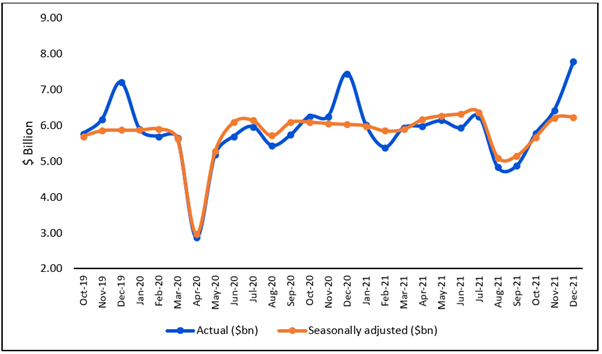
Rising Trend Continues in Electronic Card Transactions in December 2021 Quarter
As per Stats.NZ, the electronic card transactions relating to spending in the retail industries increased 7.5% ($1.2 billion) in December 2021 quarter versus September 2021 quarter. Also, the spending in the core retail industries grew 6.5% QoQ ($898 million). As per the spending by category, the durables, increased $795 million (19.2%), apparel, increased $158 million (20.5%), motor vehicles (excluding fuel), up $135 million (27.8%), fuel, up $128 million (8.5%), and consumables, down $169 million (2.3%).
The total value of electronic card spending, comprising the two non-retail categories (services and other non-retail) grew by $1.4 billion (6.9%) compared with the September 2021 quarter.
Exhibit 1: Trend in Retail Card Spending ($), Monthly, October 2019–December 2021
Data Source: This work is based on/includes Stats NZ’s data which are licensed by Stats NZ for reuse under the Creative Commons Attribution 4.0 International Licence; Chart Analysis by Kalkine Group
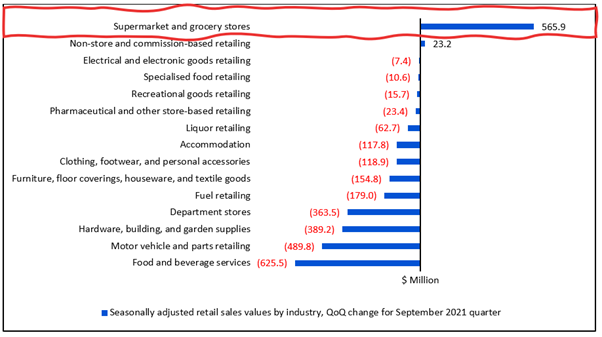
Supermarket and Grocery Stores Had the Biggest Rise in the September 2021 Quarter
As per Stats.NZ, supermarket and grocery stores had the biggest sales values in the retail trade survey for the September 2021 quarter. The industry increased 10% ($566 million), followed by non-store and commission-based retailing, which increased 4.2% ($23 million) in the September 2021 quarter versus the June 2021 quarter. Similarly, in terms of sales volume, the supermarket and grocery stores increased 7.5%, followed by non-store and commission-based retailing that increased 2.5% in the September 2021 quarter versus the June 2021 quarter.
Stock Values Increased: The largest growth came from motor vehicle and parts retailing, increasing 29% ($472 million) in September 2021 quarter versus the June 2021 quarter, followed by hardware, building, and garden supplies that grew by 18% ($210 million).
Exhibit 2: Seasonally Adjusted Retail Sales Values, QoQ Change for September 2021 Quarter
Data Source: This work is based on/includes Stats NZ’s data which are licensed by Stats NZ for reuse under the Creative Commons Attribution 4.0 International Licence; Chart Analysis by Kalkine Group
Rising Trend in Takeaways and Eating Out
Every three years, Stats.NZ compute how much the average NZ spends on food and those shifts in food preferences. Over a quarter (~27%) of the food budget is spent on restaurants and ready-to-eat meals in 2020, including burgers and takeaway coffee, among other things. This share has increased slightly from 26% recorded in 2017. However, spending on fruit and vegetables has decreased to 13% in 2020 of the food baskets versus 15% in 2017. The Auckland region spends most of its food budget on restaurants meals and takeaways (~32%).
Index Performance:
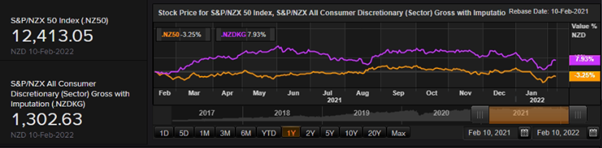
The S&P/NZX All Consumer Discretionary Index generated a 1-year return of ~7.93% versus ~-3.25% by the S&P/NZX 50 Index. Therefore, S&P/NZX All Consumer Discretionary Index overperformed S&P/NZX 50 Index by ~11.18% in 1-year.
Exhibit 3: S&P/NZX All Consumer Discretionary Index vs S&P/NZX 50 Index
Source: REFINITIV
Key Risks and Challenges:
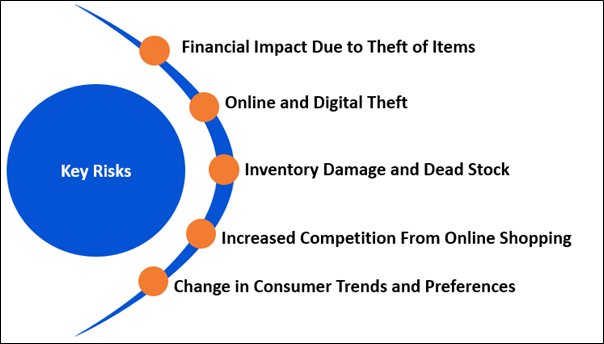
As per COMCOM, the retail market is exposed to an expected rise in prices in the future if some suppliers plan to exit the market, thereby reducing competition between the remaining suppliers. Meanwhile, the consumers could benefit from private label products through reduced prices and multiple choice. This will favour private label products in the short term, but there is a risk that the rise of private labels could crowd out supplier branded products. This may lead to a loss of consumer choice and higher prices in the longer term.
Exhibit 4. Key Risks in Consumer Discretionary Sector:
Sources: Analysis by Kalkine Group
Outlook:
Total billings in NZ stood at $4.5 billion during December 2021 before seasonal adjustment and seasonally adjusted total billings stood at $3.8 billion, up 0.2% from November 2021, and up 1.2% from December 2020. This indicates growing confidence and strengthening economy towards growth. As per Stats.NZ, the NZ households saved over $3.8 billion in September 2021 quarter, led by a 6.3% slide in household spending due to COVID-19 alert level restrictions during the quarter. Households spent ~$3 billion in September 2021 quarter versus the March and June 2021 quarters. Spending decreased primarily on services and durable items, including restaurant meals, accommodation, clothing, motor vehicles, and furniture. The fall indicates stability and correction in the spending pattern that could grow with the direction of economic growth in the country.
Apart from the sector-specific factors, we have also analysed four NZX-listed companies operating in the same sector. This report covers their insights, outlook, performance and potential as expected to be delivered in the near to medium term.
1) The Warehouse Group Limited (Recommendation: Buy, Potential Upside: Low Double-Digit) (M-Cap: NZ$1.14 billion, Gross Dividend Yield: 15.36%)
Business Description:
The Warehouse Group Limited (NZX: WHS) has evolved from a single The Warehouse store to become one of the largest retailing groups in NZ.
Outlook:
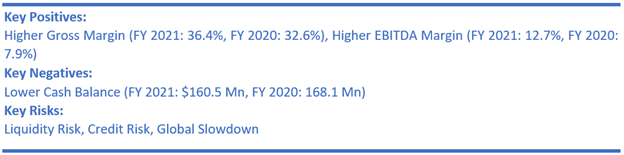
The company’s robust shipping as well as stock management controls have managed inventory levels and the company has ensured availability of key continuity as well as seasonal lines for customers. WHS is well positioned for the remainder of summer as well as Back to School trading periods. Based on the actual sales for the first 5 months of FY 2022, the company is anticipating Adjusted NPAT for HY 2022 to surpass $40 Mn. This compares to $111 Mn in HY 2021 and $46.2 Mn in HY 2020.
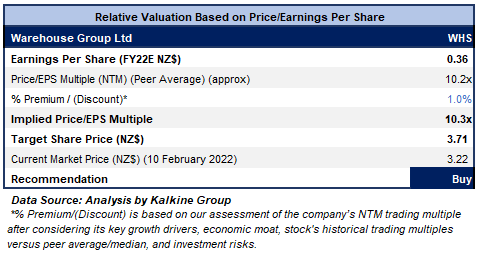
Valuation Methodology: Price/Earnings Per Share Based Relative Valuation (Illustrative)
Technical Overview:
Daily Price Chart
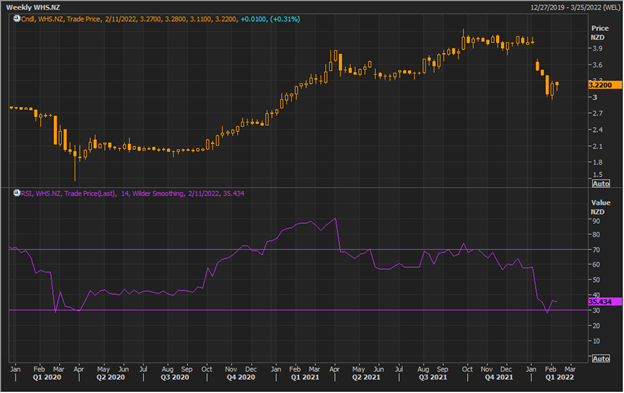
Source: REFINITIV, Note: Purple color line reflects Relative Strength Index (14-Period)
Stock Recommendation
The stock has been valued using Price/EPS multiple based relative valuation (on an illustrative basis) and the target price so arrived reflects a rise of low double-digit (in % terms). Accordingly, a slight premium has been applied to Price/EPS Multiple (NTM) (Peer Average) considering the decent outlook as well as its market position.
Considering the facts above, we give a “Buy” recommendation on the stock at the current market price of $3.22 per share as of 10th February 2022 (New Zealand Time: 5:16 PM (GMT +12)).
2) Burger Fuel Group Limited (Recommendation: Speculative Buy, Potential Upside: Low Double-Digit) (M-Cap: NZ$17.62 million)
Business Description:
Burger Fuel Group Limited (NZX: BFG) is in the business of restaurant sector and operates 3 brands: Shake Out, BurgerFuel and Winner Winner.
Outlook:
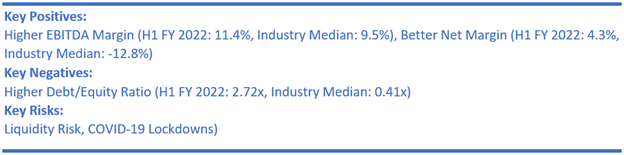
BurgerFuel brand has proved to be robust throughout the pandemic alert levels. There are expectations that it would remain stable as well as would continue to deliver a robust performance for the group. Additionally, BFG is maintaining robust cash reserves and would continue to review any opportunities for development of current brands. Recently, the company witnessed increased sales across the system (royalty income) as well as additional sales revenue from the opening of the company owned Winner Winner store in Takapuna.
Technical Overview:
Daily Price Chart
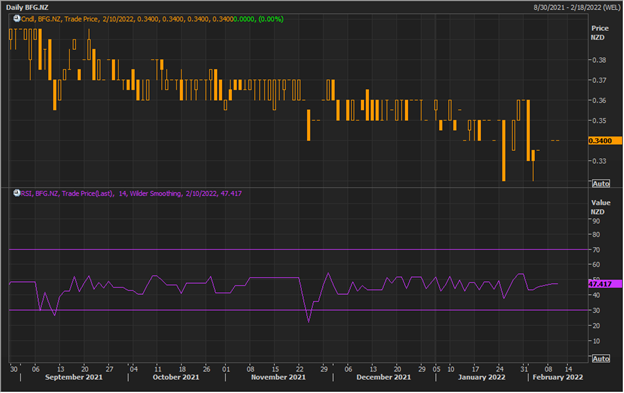
Source: REFINITIV, Note: Purple color line reflects Relative Strength Index (14-Period)
Stock Recommendation
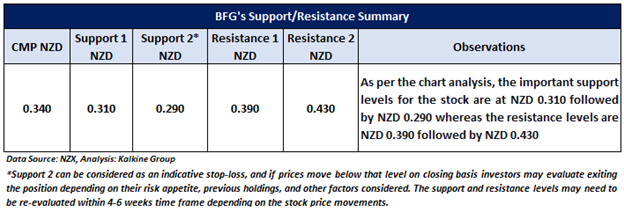
Considering the facts above, we give a “Speculative Buy” recommendation on the stock at the current market price of $0.34 per share as of 10th February 2022 (New Zealand Time: 12:25 PM (GMT +12)).
3) Restaurant Brands New Zealand Ltd (Recommendation: Hold, Potential Upside: Low Double-Digit) (M-Cap: NZ$1.87 billion)
Business Description:
Restaurant Brands New Zealand Ltd (NZX: RBD) is the corporate franchisee which specialises in managing multi-site branded food retail chains.
Outlook:
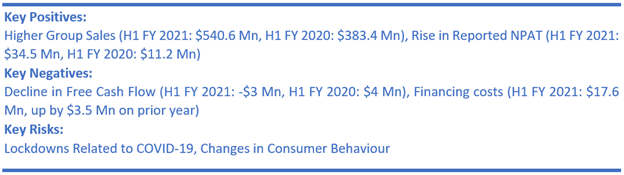
RBD responded strongly to pandemic’s continuing impact on the business in all the markets, despite challenging trading environment, government-mandated restrictions as well as changes in the consumer behaviour. As a result, RBD achieved the long-standing goal of $1 Bn in annual sales, with solid foundations for the further sales growth in all the 4 regions in place. It would be releasing the annual trading results for the year to 31st December 2021 on 28th February 2022.
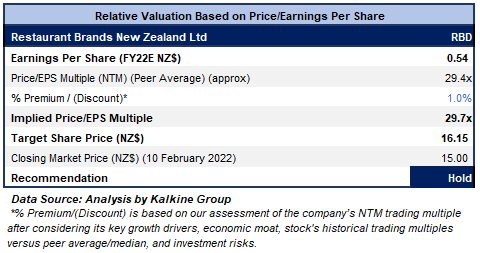
Valuation Methodology: Price/Earnings Per Share Based Relative Valuation (Illustrative)
Technical Overview:
Daily Price Chart
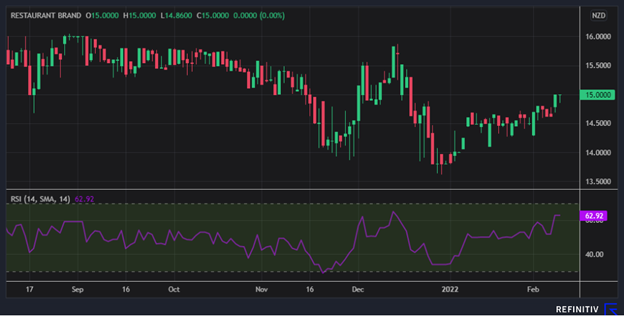
Source: REFINITIV, Note: Purple color line reflects Relative Strength Index (14-Period)
Stock Recommendation
RBD’s total sales for the year ended 31st December 2021 amounted to $1,068.2 million, an increase of $175.9 million (or 19.7%) from 2020. Around $100 million of the increase was because of additional 8 months trading this year from the California acquisition.
The stock has been valued using Price/EPS multiple based relative valuation (on an illustrative basis) and the target price so arrived reflects a rise of higher single-digit (in % terms). Accordingly, a slight premium has been applied to Price/EPS Multiple (NTM) (Peer Average) considering decent outlook as well as RBD’s robust response to the pandemic.
Considering the facts above, we give a “Hold” recommendation on the stock at the closing market price of $15.00 per share as of 10th February 2022.
4) Turners Automotive Group Limited (Recommendation: Hold, Potential Upside: Low Double-Digit) (M-Cap: NZ$368.38 million, Gross Dividend Yield: 7.024%)
Business Description:
Turners Automotive Group Limited (NZX: TRA) was formed through the 2014 merger of NZ's largest vehicle and machinery retailer, Turners Auctions, as well as leading consumer finance and insurance business, Dorchester Pacific.
Outlook:
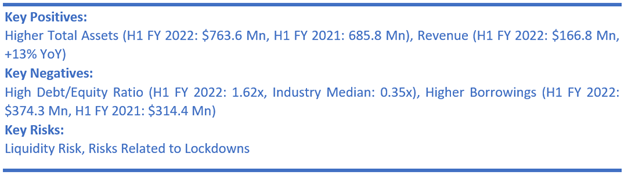
Based on the particularly strong Q1 as well as robust trading following the L4 lockdown, TRA is anticipating FY 2022 NPBT in the range of $40 Mn and $42 Mn. On that basis and with the dividend payout policy of 60-70% of NPAT, it is expecting full-year fully imputed dividends of atleast 22 cps. The company is developing its competitive moat which is positioning it for robust performance in FY 2023 and FY 2024.
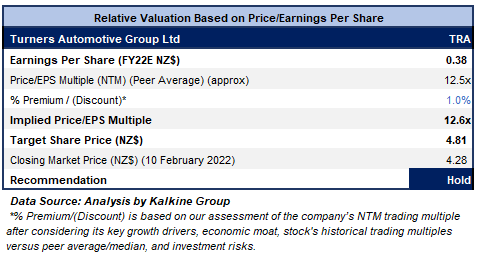
Valuation Methodology: Price/Earnings Per Share Based Relative Valuation (Illustrative)
Technical Overview:
Daily Price Chart
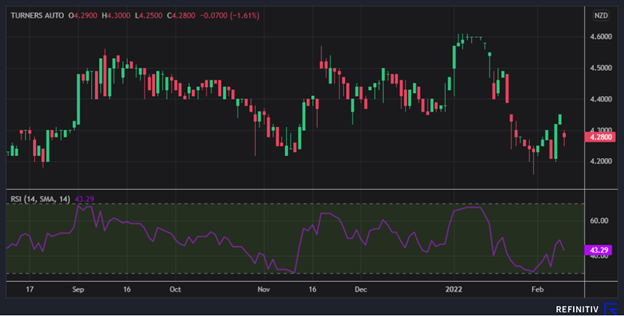
Source: REFINITIV, Note: Purple color line reflects Relative Strength Index (14-Period)
Stock Recommendation
TRA’s conviction levels for exceeding the medium-term target for FY 2024 of $45 million NPBT target are very high. TRA would be revisiting the FY 2024 target at the year end.
The stock has been valued using Price/EPS multiple based relative valuation (on an illustrative basis) and the target price so arrived reflects a rise of lower double-digit (in % terms). Accordingly, a slight premium has been applied to Price/EPS Multiple (NTM) (Peer Average) considering robust Q1 as well as guidance.
Considering the facts above, we give a “Hold” recommendation on the stock at the closing market price of $4.28 per share, down 1.61% as of 10th February 2022.
Note 1: The reference data in this report has been partly sourced from REFINITIV.
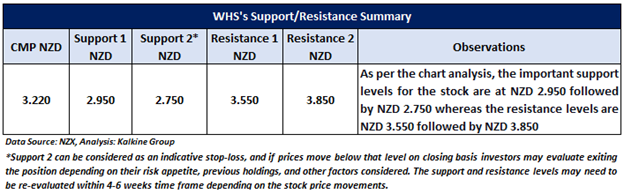
Note 2: Investment decisions should be made depending on the investors’ appetite on upside potential, risks, holding duration, and any previous holdings. Investors can consider exiting from the stock if the Target Price mentioned as per the analysis has been achieved and subject to the factors discussed above alongside support levels provided.
Technical Indicators Defined: -
Support: A level where-in the stock prices tend to find support if they are falling, and downtrend may take a pause backed by demand or buying interest.
Resistance: A level where-in the stock prices tend to find resistance when they are rising, and uptrend may take a pause due to profit booking or selling interest.
Stop-loss: It is a level to protect further losses in case of unfavourable movement in the stock prices.
Disclaimer
Kalkine New Zealand Limited is authorised to provide general advice only. The information on this website does not take into account any of your investment objectives, financial situation or needs. Before you make a decision about whether to acquire a financial product, you should obtain the Product Disclosure Statement from the product issuer. You should consider the appropriateness of advice taking into account your own objectives, financial situation and needs and seek independent financial advice before making any financial decisions.
Past performance is not a reliable indicator of future performance.
 Please wait processing your request...