
 AU
AU
 UK
UK
 CA
CA
 US
US
 IND
IND

 NZ
NZ

Company Overview:
KMD Brands Limited (NZX: KMD) is a global outdoor, lifestyle as well as sports company. The company is a designer, marketer, retailer and wholesaler of apparel, footwear and equipment for surfing and the outdoors. Briscoe Group Limited (NZX: BGP) is the holding company for the retail stores Briscoes Homeware and Rebel Sport, which are located throughout NZ.
Kalkine’s Sector Report covers the Key Financial Metrics, Risks, Outlook, Technical Analysis along with the Valuation, Target Price, and Recommendation on the stock.
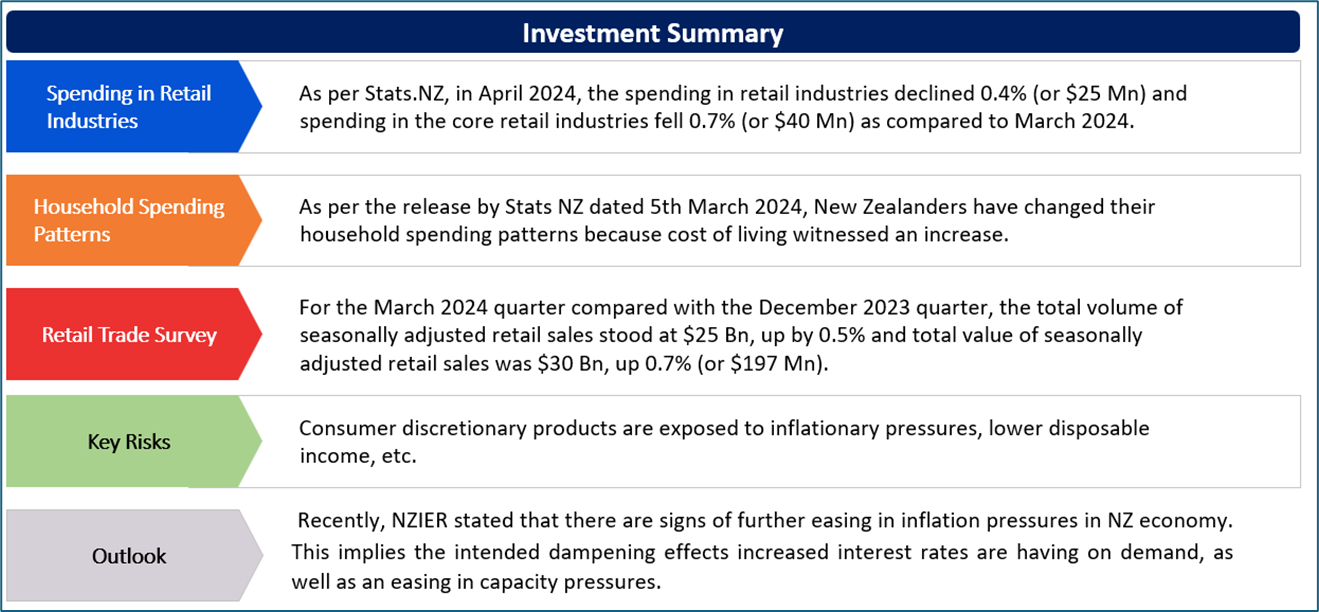
As per Stats.NZ, in April 2024, the spending in retail industries declined 0.4% (or $25 Mn) and spending in the core retail industries fell 0.7% (or $40 Mn) as compared to March 2024. Talking about the retail spending category, motor vehicles (excluding fuel), witnessed a fall of $1.0 Mn (or 0.5%) and apparel was down by $5.7 Mn (or 1.7%). Notably, hospitality declined $5.6 Mn (or 0.4%), fuel was down by $6.1 Mn (or 1.1%), consumables was down $9.0 Mn (or 0.3%) and durables was fell by $11 Mn (or 0.7%).
The non-retail (excluding services) category witnessed a rise of $47 Mn (or 2.2%) from March 2024. This category consists of medical and other health care, postal and courier delivery, travel and tour arrangement, and other non-retail industries. The total value of electronic card spending, which includes 2 non-retail categories (services and other non-retail), rose from March 2024, up by $85 Mn (or 0.9%).
In actual terms, cardholders made 160 Mn transactions throughout all the industries in April 2024, with an average value of $55 per transaction. The total amount spent using electronic cards stood at $8.8 Bn.
Exhibit 1: Percentage change in seasonally adjusted card transactions value by industry, March 2024–April 2024
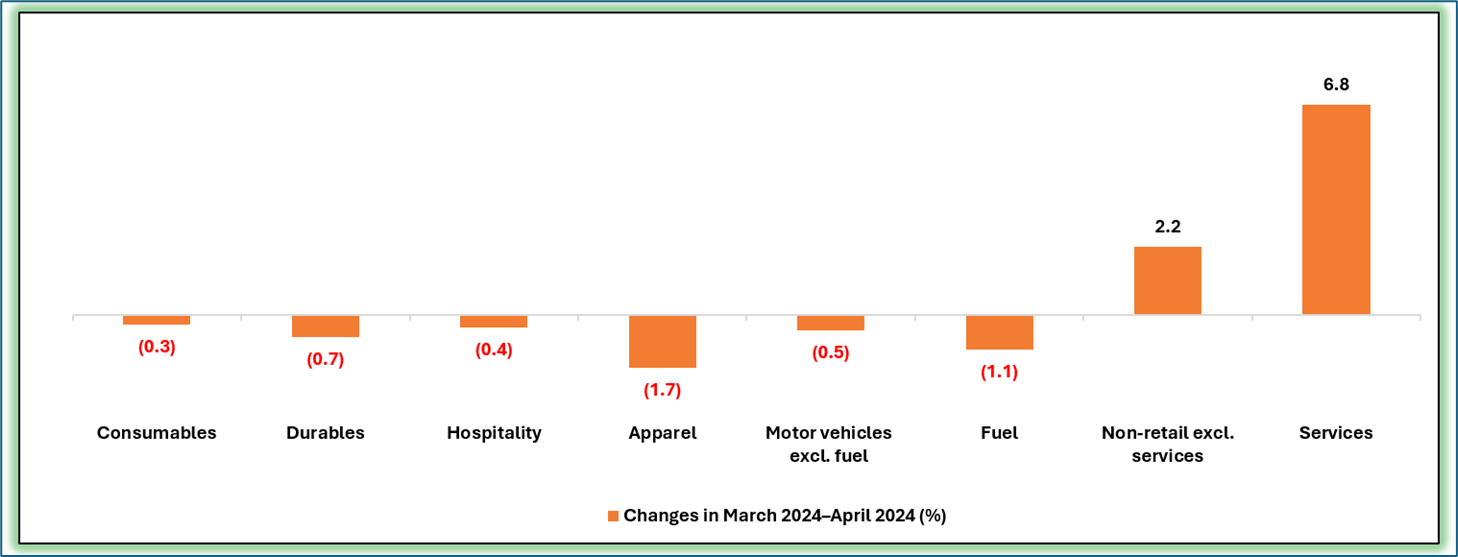
Data Source: This work is based on/includes Stats NZ’s data which are licensed by Stats NZ for reuse under the Creative Commons Attribution 4.0 International Licence; Chart Created by Kalkine Group
Shift in Spending Patterns
As per the release by Stats NZ dated 5th March 2024, New Zealanders have changed their household spending patterns because cost of living witnessed an increase. The rise in total household expenditure between 2019 and 2023 reflects higher cost of living witnessed by New Zealanders, because of global events like COVID-19 pandemic as well as extreme weather events.
As the proportion of total net household expenditure, recreation as well as culture fell to 8.3% in the year ended June 2023 (down from 9.6%). The proportion of expenditure spent on communication fell to 2.5% of total net household expenditure (down from 2.9%).
Retail Trade Survey: March 2024 Quarter
For the March 2024 quarter compared with the December 2023 quarter, the total volume of seasonally adjusted retail sales stood at $25 Bn, up by 0.5% and total value of seasonally adjusted retail sales was $30 Bn, up 0.7% (or $197 Mn). The total value of actual retail sales stood at $30 Bn, up by 0.6% (or $193 Mn) as compared to March 2023 quarter. The total value of actual stock as at 31 March 2024 stood at $9.4 Bn, down 3.7% ($357 Mn) as compared to 31 March 2023.
As per Stats NZ, 9 out of 15 industries had higher seasonally adjusted sales volumes in the March 2024 quarter as compared to December 2023 quarter. By industry, hardware, building, and garden supplies declined 2.8% and food and beverage services rose 2.2%.
Exhibit 2: Total retail trade sales ($ Bn), Volumes, March 2023–March 2024 Quarters
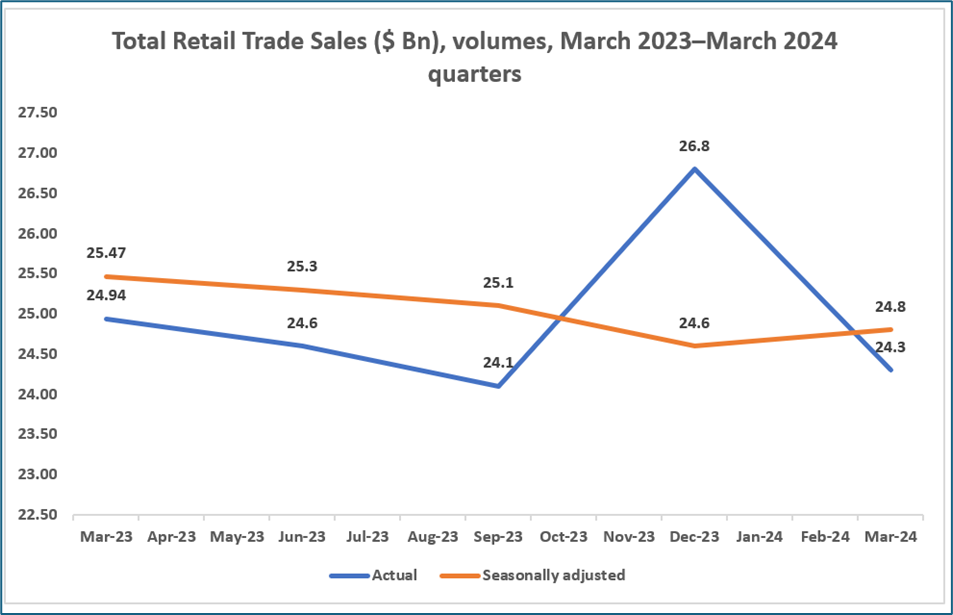
Data Source: This work is based on/includes Stats NZ’s data which are licensed by Stats NZ for reuse under the Creative Commons Attribution 4.0 International Licence; Chart Created by Kalkine Group
Key Risks and Challenges:
The consumer discretionary market is exposed to increased competition from domestic as well as international tech- e-commerce companies, launch of brands and stores. Notably, higher labour shortages, global macro-economic slowdown, and increased inflationary concerns are some of the additional risks.
The Consumer discretionary industry is cyclical in nature. Therefore, change in the consumer behaviour, shift in the spending patterns and lower disposable income could impact the overall discretionary sector.
Exhibit 3. Key Risks in Retail & Consumer Sector:
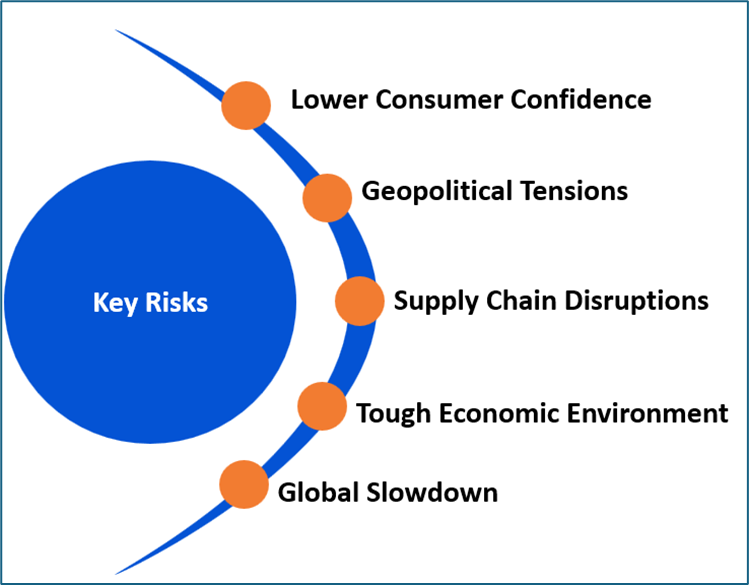
Source: Analysis by Kalkine Group
Outlook:
Recently, NZIER (or New Zealand Institute of Economic Research) stated that there are signs of further easing in inflation pressures in NZ economy. This implies the intended dampening effects increased interest rates are having on demand, as well as an easing in capacity pressures. In particular, there was a remarkable turnaround in labour shortages in the past year. Net migration recovered strongly with the reopening of international borders, as firms bring in workers from overseas borders.
The companies are positive about hiring even though there are concerns regarding softening of demand. The resilience of labour market raised concerns regarding the upside risks to NZ inflation outlook. In particular, the slight pick-up in the unemployment rate reflects there could be less slack in the labour market than initially anticipated. The critical question for RBNZ is whether the easing in inflation is occurring at the fast enough pace to get annual CPI inflation back to within 1% - 3% inflation target band.
NZIER is anticipating a cautious approach from RBNZ as it assesses lag effects of the monetary policy tightening it has undertaken. Since several households are facing significantly increased mortgage repayments as their fixed-term mortgage rates come up for repricing, there are expectations that demand slowdown would be driving further decrease in inflation.
Apart from the sector-specific factors, an analysis on two NZX-listed companies is provided. This report covers their insights, outlook, performance and potential as expected to be delivered in the near to medium term.
1) KMD Brands Limited (Recommendation: Buy, Potential Upside: Low Double-Digit) (M-Cap: NZD 313.13 Mn, Annual Dividend Yield (TTM)1: 13.64%)
Business Description:
KMD Brands Limited (NZX: KMD) is a global outdoor, lifestyle as well as sports company. The company is a designer, marketer, retailer and wholesaler of apparel, footwear and equipment for surfing and the outdoors.
Outlook:
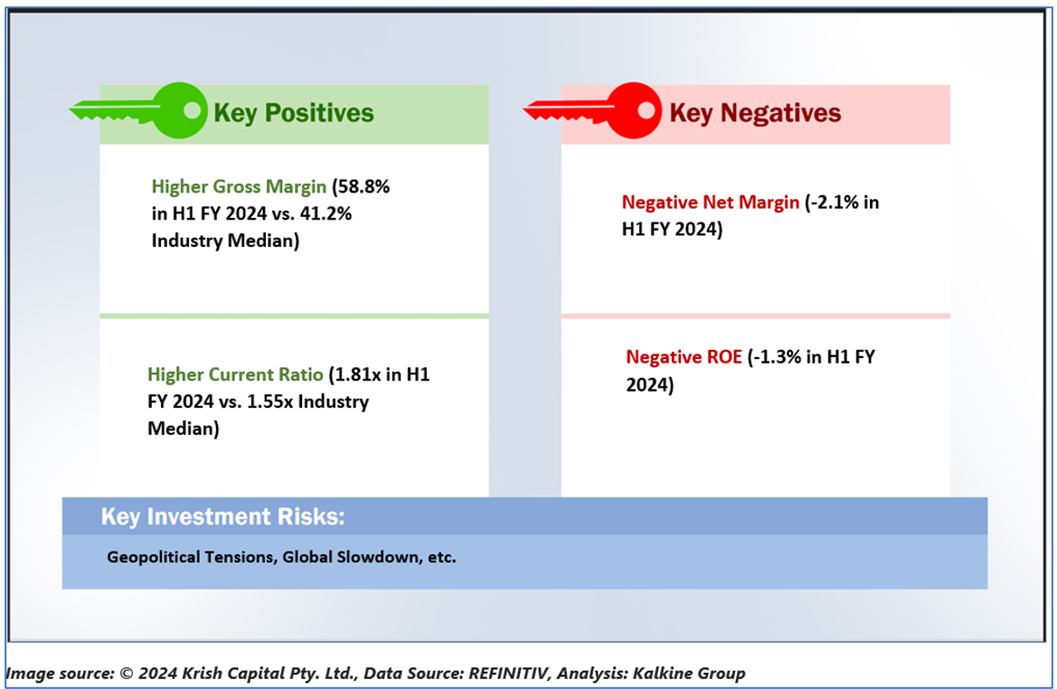
At 31 January 2024, the Group had the net debt position of $96.2 million with funding headroom of ~$190 Mn. The inventory was well positioned, $5 Mn below January 2023 as well as net working capital was $18 Mn below January 2023 despite lower sales. Notably, improving Kathmandu sales performance is the company’s immediate priority. The company is expecting the wholesale customer inventory reduction cycle to end this financial year, providing the company with more positive FY 2025 outlook in the wholesale channel for Rip Curl and Oboz.
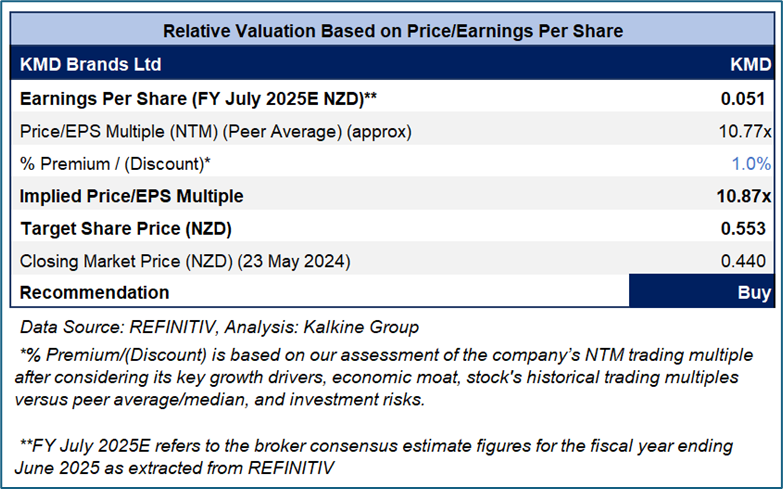
Valuation Methodology: Price/Earnings Per Share Based Relative Valuation (Illustrative)
Technical Overview:
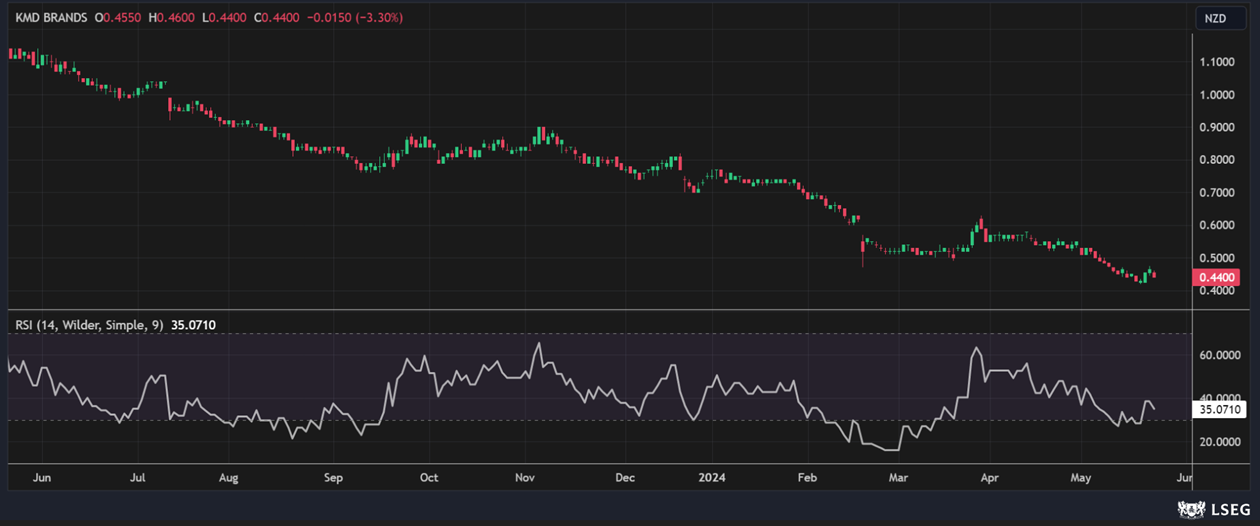
KMD Daily Technical Chart, Data Source: REFINITIV
Technical Commentary:
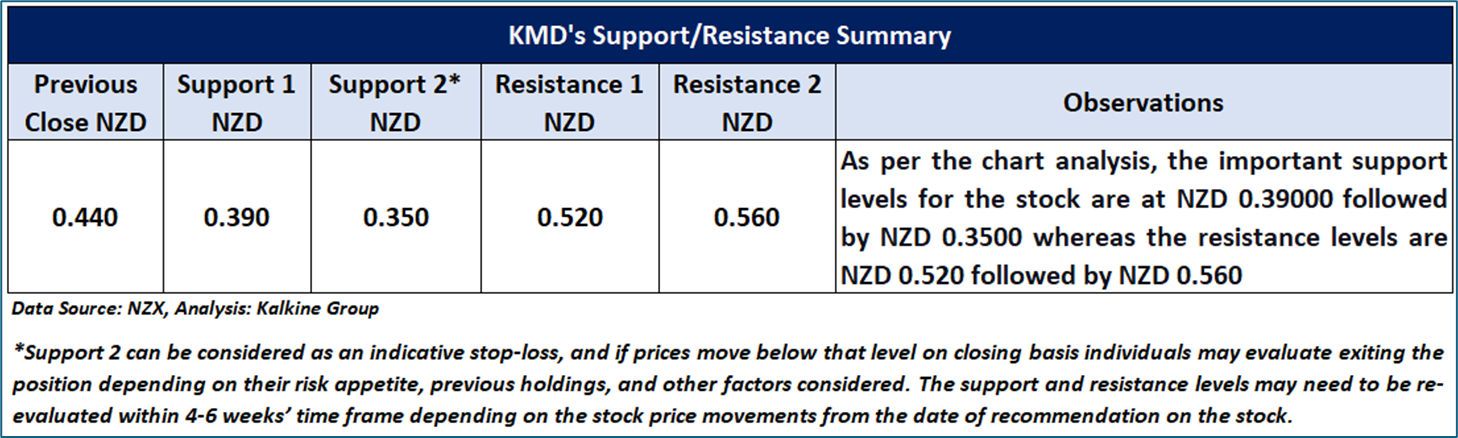
While experiencing a downtrend, KMD’s stock prices are forming a descending wedge pattern, suggesting that the downside momentum in stock has been halting. Moreover, the momentum oscillator RSI (14-period) is forming a bottom divergence in relation to prices, adding further evidence for the mentioned recommendation. Prices are trading between the pattern’s upper and lower boundaries, which might function as dynamic resistance and support levels for the stock, respectively. An important support level for the stock is placed at NZD 0.390, while key resistance level is situated at NZD 0.520.
Stock Recommendation
Considering the facts above, a ‘Buy’ recommendation on the stock has been provided at the closing market price of NZD 0.440 per share, down by 3.30% as on 23 May 2024.
2) Briscoe Group Limited (Recommendation: Buy, Potential Upside: Low Double-Digit) (M-Cap: NZD 957.9 million, Annual Dividend Yield: 9.37%)
Business Description:
Briscoe Group Limited (NZX: BGP) operates via 2 segments: Homeware and Sporting goods.
Outlook:
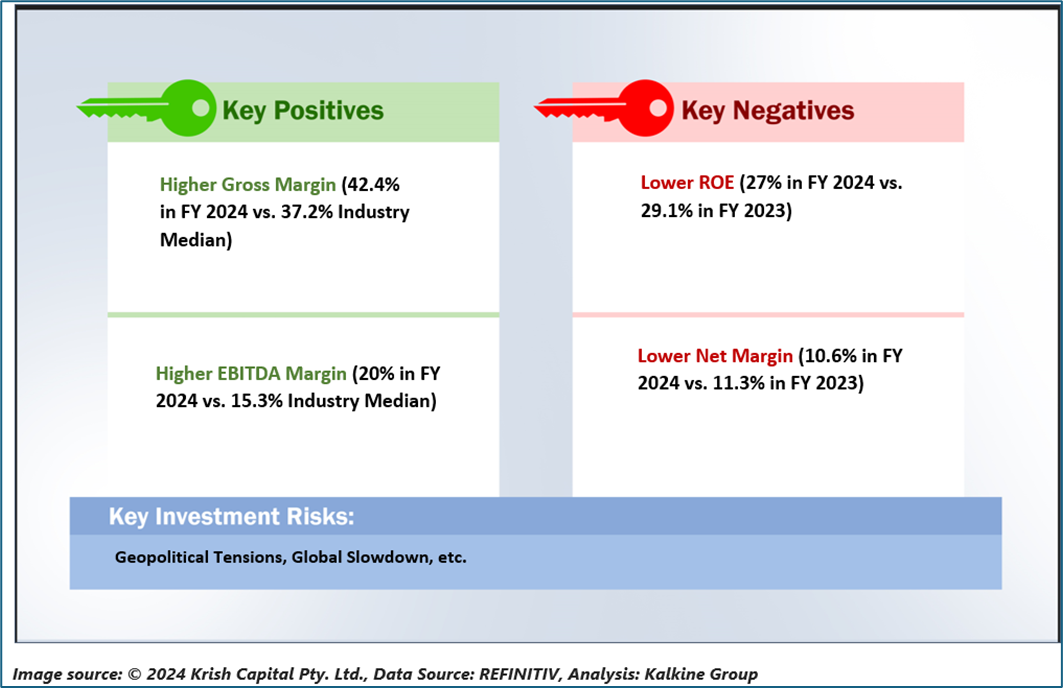
BGP mentioned that inventory continues to be well-controlled and finished the quarter (1st quarter) around 8% lower throughout segments than the prior year. Through maintaining the focus towards constructing, executing and analysing promotions, as well as attention to controlling costs, BGP’s bottom-line net profit after tax (or NPAT) for the first quarter would be in line with the same time of the previous year.
Fundamental Valuation
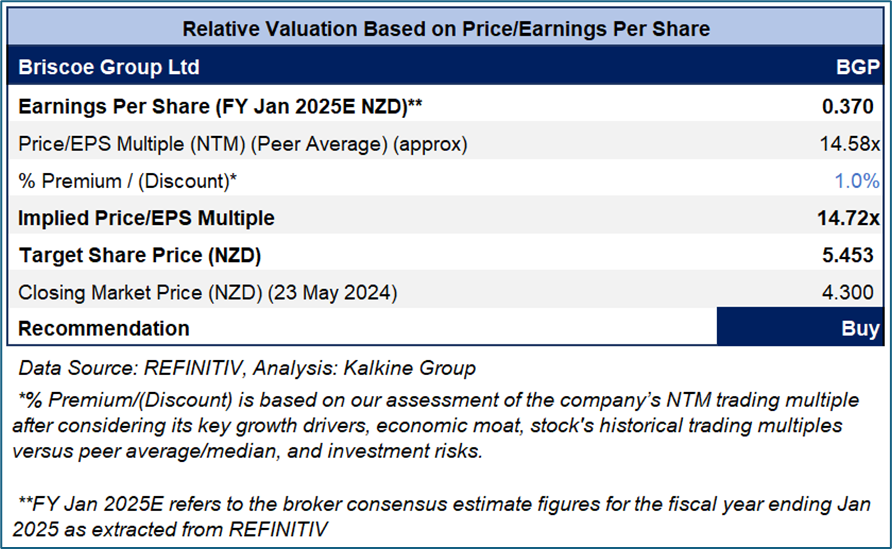
Price/EPS Based Relative Valuation
Technical Overview:
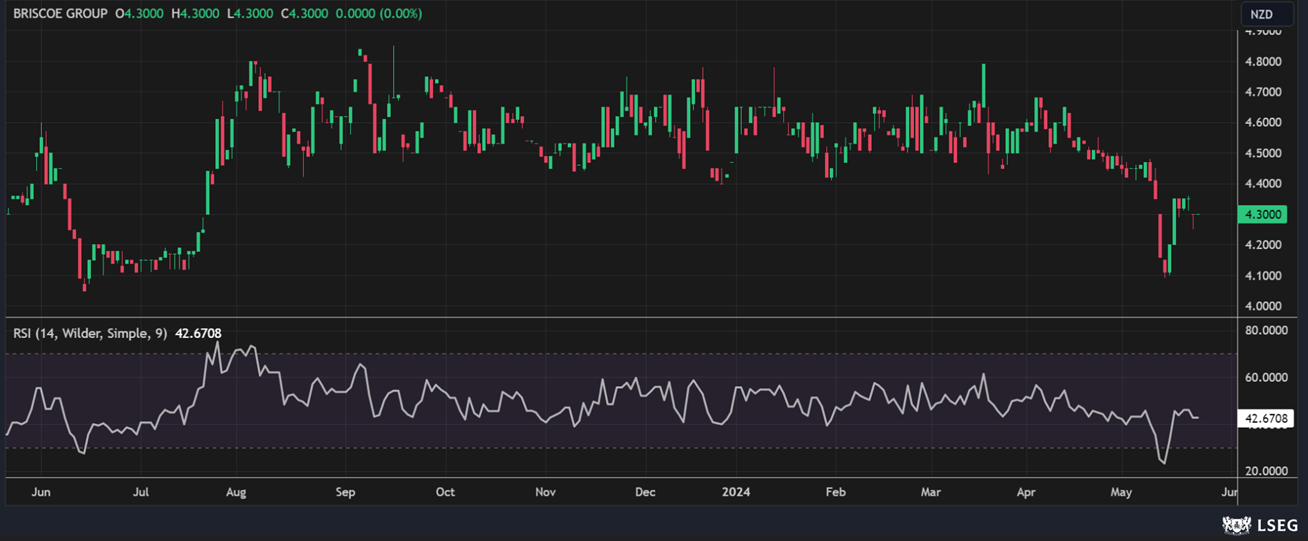
BGP Daily Technical Chart, Data Source: REFINITIV
Technical Commentary:
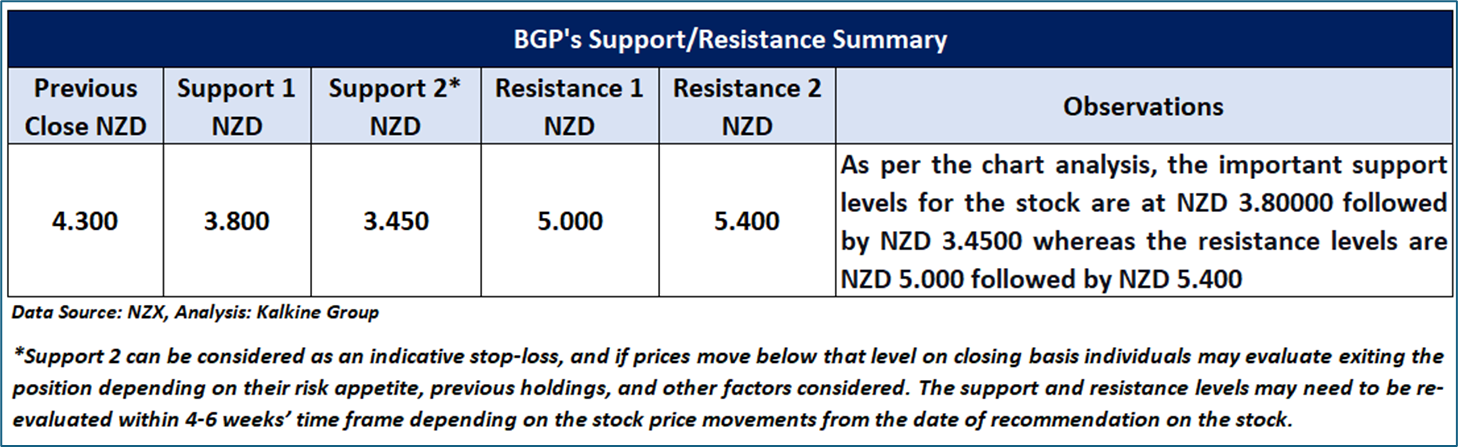
On the daily chart, BGP’s stock prices are rebounding from the lower boundary of a trading range, which might lead the stock to the range’s upper boundary. Moreover, the momentum oscillator RSI (14-period) is bouncing back from its oversold region, adding further evidence for the mentioned recommendation. Prices are trading between its previous peak and trough, which might function as resistance and support levels for the stock, respectively. A significant support level for the stock is positioned at NZD 3.80, while critical resistance level is located at NZD 5.0.
Stock Recommendation
Considering the facts above, a ‘Buy’ recommendation on the stock has been provided at the closing market price of NZD 4.300 per share as on 23 May 2024.
Markets are trading in a highly volatile zone currently due to certain macro-economic issues and geopolitical tensions prevailing. Therefore, it is prudent to follow a cautious approach while investing.
Note 1: Past performance is not a reliable indicator of future performance.
Note 2: The reference date for all price data, currency, technical indicators, support, and resistance levels is May 23, 2024. The reference data in this report has been partly sourced from REFINITIV.
Note 3: Investment decisions should be made depending on an individual's appetite for upside potential, risks, holding duration, and any previous holdings. An 'Exit' from the stock can be considered if the Target Price mentioned as per the Valuation and or the technical levels provided has been achieved and is subject to the factors discussed above.
Note 4: Annual Dividend Yield is on a Trailing Twelve Month (TTM1) basis and are subject to change based on factors such as company performance, stock price changes, etc.
Technical Indicators Defined: -
Support: A level at which the stock prices tend to find support if they are falling, and a downtrend may take a pause backed by demand or buying interest. Support 1 refers to the nearby support level for the stock and if the price breaches the level, then Support 2 may act as the crucial support level for the stock.
Resistance: A level at which the stock prices tend to find resistance when they are rising, and an uptrend may take a pause due to profit booking or selling interest. Resistance 1 refers to the nearby resistance level for the stock and if the price surpasses the level, then Resistance 2 may act as the crucial resistance level for the stock.
Stop-loss: It is a level to protect further losses in case of unfavourable movement in the stock prices.
Kalkine New Zealand Limited is a Financial Advice Provider (“FAP”) and is authorised by a Class 1 Financial Advice Provider Licence issued by Financial Markets Authority (“FMA”) to provide financial advice. Kalkine provides only general financial advice through its research reports following a person becoming a member. The reports contain buy/sell/hold and other recommendations in relation to equity financial products. The recommendations and opinions [on this website] / [in this report] do not take into account any of your investment objectives, financial situation or needs. Before you make a decision about whether to acquire a financial product, you should obtain the Product Disclosure Statement from the product issuer. You should consider the appropriateness of advice taking into account your own objectives, financial situation and needs and seek independent financial advice before making any financial decisions. If you act on the advice in the research reports, you may have to pay fees, expenses or other amounts (but not to Kalkine). Further information about the complaints and dispute resolution process, as well as information about Kalkine’s duties are available on Kalkine’s website. Please read our Financial Advice Provider (FAP) disclosure statement and Complaints Handling Guide, which are available on the website.
Past performance is not a reliable indicator of future performance.
 Please wait processing your request...