
 AU
AU
 UK
UK
 CA
CA
 US
US
 IND
IND

 NZ
NZ

Company Overview:
Move Logistics Group Limited (NZX: MOV) is the New Zealand-based company, which is engaged in the logistics sector. It operates through five segments: International, Specialist, Freight, Contract Logistics, and Corporate. Metro Performance Glass Limited (NZX: MPG) produces a range of customised glass products that are predominantly used in residential and non-residential construction applications like windows, doors, internal partitions, etc.
Kalkine’s Sector Report covers the Key Financial Metrics, Risks, Outlook, Technical Analysis along with the Valuation, Target Price, and Recommendation on the stock.
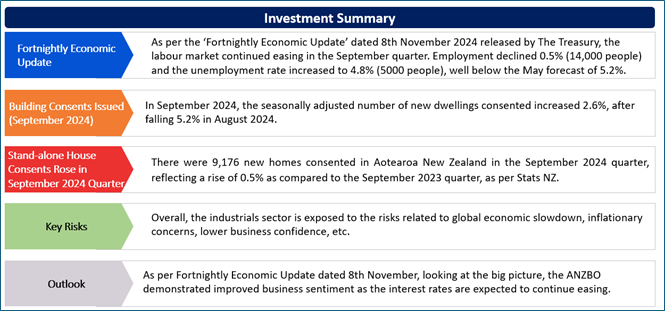
As per the ‘Fortnightly Economic Update’ dated 8th November 2024 released by The Treasury, the labour market continued easing in the September quarter. Employment declined 0.5% (14,000 people) and the unemployment rate increased to 4.8% (5000 people), well below the May forecast of 5.2%. Wage growth also surprised, easing more than anticipated. Alongside a decline in paid hours, weekly gross earnings witnessed a fall of 0.6% in the quarter. The weakness in hours also reinforced other evidence for soft activity during the September quarter.
NZ’s goods export prices continued to climb. As pet the ‘Fortnightly Economic Update,’ the ANZ World Commodity Price Index for October was up 1.4% in the month and 12.8% on the year. The meat and fibre index slipped 0.4% as compared to September but remains up 15.7% on last year. Notably, lamb prices have firmed in recent months, but the global market remains fragile. In Australia, government electricity subsidies as well as lower petrol prices limited the consumer price increases to 0.2% in the September quarter, and the annual inflation rate declined to 2.8%, inside the RBA’s 2-3% target range.
Building Consents Issued: September 2024
On 1st November 2024, Stats NZ released data about building consents issued (September 2024). In September 2024, the seasonally adjusted number of new dwellings consented increased 2.6%, after falling 5.2% in August 2024 and, during the year ended September 2024, the actual number of new dwellings consented was 33,677, down by 17% from the year ended September 2023. The annual value of non-residential building work consented stood at $9.1 Bn, down by 6.4% from the year ended September 2023.
In September 2024, there were 2,943 new dwellings consented, comprising 1,378 stand-alone houses, 1,091 townhouses, flats, and units, 277 apartments and 197 retirement village units. The seasonally adjusted number of new stand-alone houses consented declined 0.5%, after falling 9.2% in August 2024.
Exhibit 1: New Dwellings Consented (Monthly)
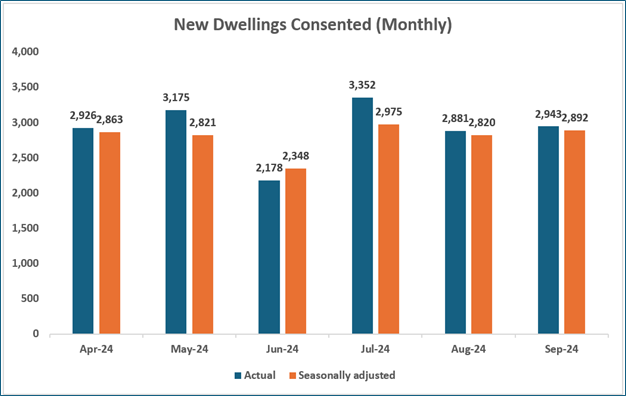
Data Source: This work is based on/includes Stats NZ’s data which are licensed by Stats NZ for reuse under the Creative Commons Attribution 4.0 International Licence; Chart Created by Kalkine Group
Stand-alone House Consents Rose in September 2024 Quarter
There were 9,176 new homes consented in Aotearoa New Zealand in the September 2024 quarter, reflecting a rise of 0.5% as compared to the September 2023 quarter, as per Stats NZ. In the September 2024 quarter, there were 4,485 stand-alone houses consented, a rise of 24% as compared with the September 2023 quarter. There were 4,691 multi-unit homes consented, down by 15% over the same period. Of the multi-unit homes consented during the September 2024 quarter, there were 3,561 townhouses, flats, and units (a decline of 20% as compared with the September 2023 quarter), 706 retirement village units (up by 49%) and 424 apartments (down 28%).
There were 33,677 new homes consented in the year ended September 2024, demonstrating a fall of 17% as compared with the year ended September 2023.
Exhibit 2: New Homes Consented, 12-month Rolling Totals, April 2024–September 2024
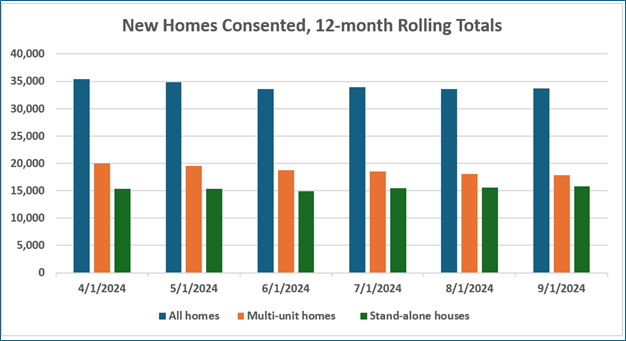
Data Source: This work is based on/includes Stats NZ’s data which are licensed by Stats NZ for reuse under the Creative Commons Attribution 4.0 International Licence; Chart Created by Kalkine Group
Key Risks
The election of Donald Trump as the US president might bring policy change throughout trade, fiscal, immigration, regulatory and foreign dimensions, but the actual policies, their timing, and interaction are unclear. Notably, the prospective tariffs on imports pose material downside risk to global growth, especially China.
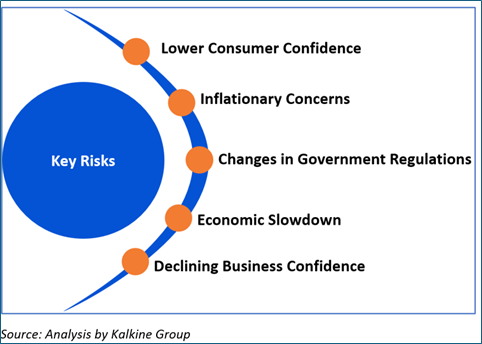
Overall, the industrials sector is exposed to the risks related to global economic slowdown, inflationary concerns, geopolitical tensions, etc. Recently, RBNZ stated that geopolitical risk might disrupt international trade, weaken domestic demand as well as lead to financial market volatility. This in turn might result in increased loan defaults, raise funding costs, and increase cyber risks for financial institutions.
Exhibit 3. Key Risks in Industrials Sector:
Outlook:
As per Fortnightly Economic Update dated 8th November, the labour market outturn was consistent with the October ANZ Business Outlook (or ANZBO) which witnessed current employment levels down on a year ago and wage increases steady. The employment intentions for the year ahead increased further into positive territory, reflecting some labour market pick up from mid-2025.
Looking at the big picture, the ANZBO demonstrated improved business sentiment as the interest rates are expected to continue easing. Overall, the business confidence increased further, at the same time as pessimism around current activity receded modestly as well as activity expectations were less contractionary. Notably, the expected costs for coming months continue to ease, which remains a promising outturn for inflation.
Notably, there are signs that residential construction is nearing its trough. Consistent with another lift in ANZBO’s residential construction intentions measure, the new residential building consents increased 2.6% in September and now sit ~34,000 for the year ended September.
Apart from the sector-specific factors, an analysis on 2 NZX-listed companies is provided. This report covers their insights, outlook, performance and potential as expected to be delivered in the near to medium term.
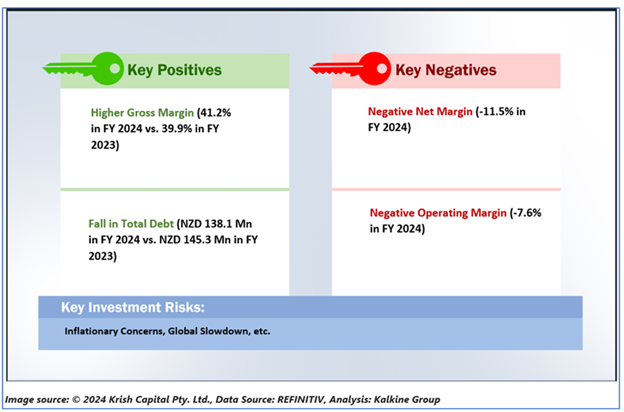
1) Metro Performance Glass Limited (Recommendation: Speculative Buy, Potential Upside: Low Double-Digit) (M-Cap: NZD 9.26 million)
Business Description:
Metro Performance Glass Limited (NZX: MPG) produces a range of customised glass products which are predominantly utilised in residential and non-residential construction applications.
Outlook:
AGG has continued its steadily improving performance in Australia, notwithstanding the market headwinds. Adapting some of the operational processes which have been so successful in Australia is the source of confidence for MPG’s planned improvements in NZ. MPG is optimistic that Cowes Bay has recognised the capability of Metro’s people throughout NZ and Australia and the opportunities for Metro to profitably grow by supporting the customers.
Technical Overview:
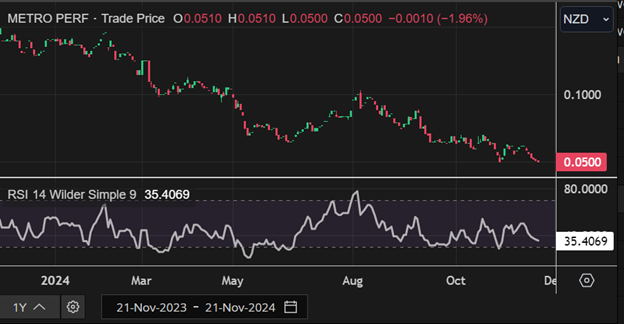
MPG Daily Technical Chart, Data Source: REFINITIV
Technical Commentary
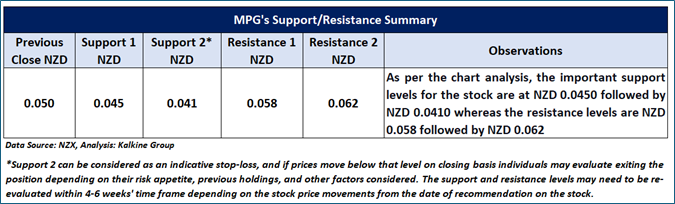
On the daily chart, MPG’s stock prices are experiencing a downtrend characterized by lower lows and lower highs, indicating a negative bias. Moreover, the stock recently penetrated a significant support established by the trough in June 2024, providing more support to the mentioned recommendation. Prices are trading below both the trend-following indicators 21-period and 50-period SMAs, which might function as dynamic resistance levels for the stock; in contrast, the stock’s nearest round level may act as a sentimental support. A significant support level for the stock is placed at NZD 0.045, while critical resistance level is located at NZD 0.058.
Stock Recommendation
Considering the aforementioned factors, a ‘Speculative Buy’ rating is given on the stock at the closing market price of NZD 0.05 per share, down by 1.96% as on November 21, 2024.
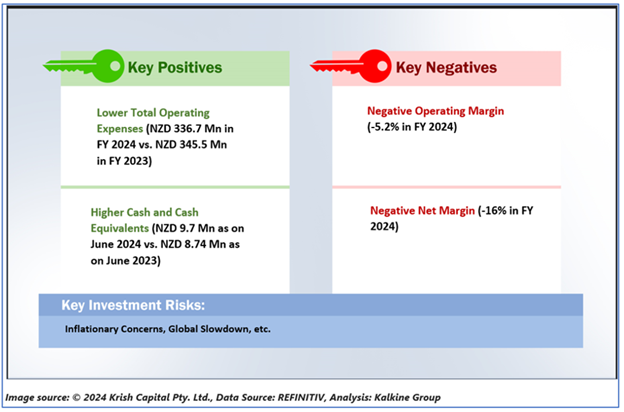
2) Move Logistics Group Limited (Recommendation: Speculative Buy, Potential Upside: Low Double-Digit) (M-Cap: NZD 18.6 Mn)
Business Description:
Move Logistics Group Limited (NZX: MOV) is a New Zealand-based company, which is engaged in domestic freight and logistics business.
Outlook:
In order to recalibrate the business, MOV’s focus is firmly towards reducing costs, right sizing the business, and continuing to deliver excellent customer service, while retaining the ability to meet demand when the economy improves. The company is also focusing towards driving profitable revenue growth. This would mainly come from offering more of the services to existing customers and bringing new customers on board. Its trans-Tasman shipping offer is opening new revenue opportunities, both for shipping as well as landside.
Technical Overview:
MOV Daily Technical Chart, Data Source: REFINITIV
Technical Commentary
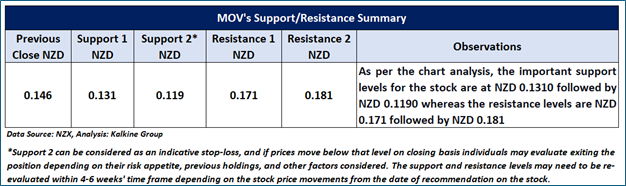
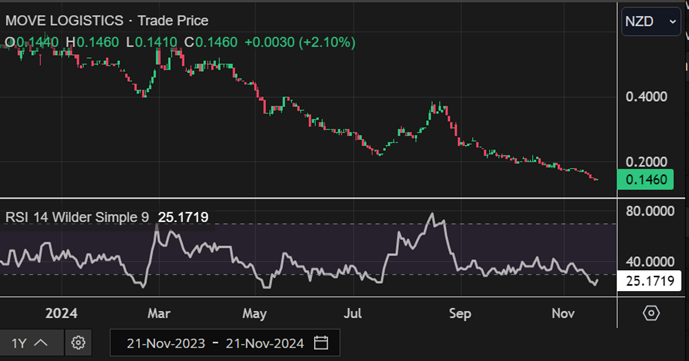
On the daily chart, MOV’s stock prices are undergoing a downtrend characterized by lower lows and lower highs, indicating a negative bias. Moreover, the momentum oscillator RSI (14-period) is heading southward from its midpoint, adding further evidence to the previous analysis. Prices are trading below both trend following indicators 21-period and 50-period SMA, which might serve as dynamic resistance level for the stock; in contrast, the stock’s nearest round level might act as a support. A significant support level for the stock is positioned at NZD 0.131, while critical resistance level is located at NZD 0.171.
Stock Recommendation
Considering the aforementioned factors, a ‘Speculative Buy’ rating is given on the stock at the closing market price of NZD 0.146 per share, up by 2.10% as on 21 November 2024
Markets are trading in a highly volatile zone currently due to certain macro-economic issues and geopolitical tensions prevailing. Therefore, it is prudent to follow a cautious approach while investing.
Note 1: Past performance is neither an indicator nor a guarantee of future performance.
Note 2: The reference date for all price data, currency, technical indicators, support, and resistance levels is November 21, 2024. The reference data in this report has been partly sourced from REFINITIV.
Note 3: Investment decisions should be made depending on an individual's appetite for upside potential, risks, holding duration, and any previous holdings. An 'Exit' from the stock can be considered if the Target Price mentioned as per the Valuation and or the technical levels provided has been achieved and is subject to the factors discussed above.
Note 4: Annual Dividend Yield is on a Trailing Twelve Month (TTM1) basis and are subject to change based on factors such as company performance, stock price changes, etc.
Technical Indicators Defined: -
Support: A level at which the stock prices tend to find support if they are falling, and a downtrend may take a pause backed by demand or buying interest. Support 1 refers to the nearby support level for the stock and if the price breaches the level, then Support 2 may act as the crucial support level for the stock.
Resistance: A level at which the stock prices tend to find resistance when they are rising, and an uptrend may take a pause due to profit booking or selling interest. Resistance 1 refers to the nearby resistance level for the stock and if the price surpasses the level, then Resistance 2 may act as the crucial resistance level for the stock.
Stop-loss: It is a level to protect further losses in case of unfavourable movement in the stock prices.
Disclaimer This report has been issued by Kalkine New Zealand Limited (FSP691351) (NZBN:9429047678101) (“Kalkine”). Kalkine is a Financial Advice Provider (“FAP”) and is authorised by a Class 1 Financial Advice Provider Licence issued by Financial Markets Authority (“FMA”) to provide financial advice. Kalkine provides only general financial advice through its research reports following a person becoming a member. The reports contain buy/sell/hold and other recommendations in relation to equity securities, managed funds and other managed investment schemes and other financial advice products. The recommendations and opinions in this report and on Kalkine website do not take into account any of your investment objectives, financial situation or needs. Before you make a decision about whether to acquire a financial product, you should obtain the Product Disclosure Statement from the product issuer. You should consider the appropriateness of advice taking into account your own objectives, financial situation and needs and seek independent financial advice before making any financial decisions. If you act on the advice in the research reports, you may have to pay fees, expenses or other amounts (but not to Kalkine). Further information about the complaints and dispute resolution process, as well as information about Kalkine’s duties are available on Kalkine’s website. Please read our Financial Advice Provider (FAP) disclosure statement and Complaints Handling Guide, which are available on the website.
Past performance is not a reliable indicator of future performance.
 Please wait processing your request...