
 AU
AU
 UK
UK
 CA
CA
 US
US
 IND
IND

 NZ
NZ

Company Overview: Air New Zealand Limited (NZX: AIR) is involved in the transportation of passengers and cargo on an integrated network of scheduled airline services within New Zealand and from NZ to outside world. Steel & Tube Holdings Limited (NZX: STU) is one of NZ’s leading providers of steel solutions, including steel products, fastenings, and metal floor decking. Its segments include Distribution and Infrastructure. Kalkine’s Sector Report covers the Key Financial Metrics, Risks, Outlook, Technical Analysis along with the Valuation, Target Price, and Recommendation on the stock.
I. Sector Landscape and Outlook
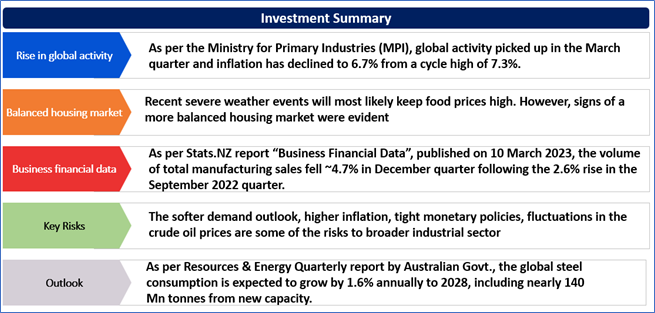
As per the Ministry for Primary Industries (MPI), global activity picked up in the March quarter and inflation has declined to 6.7% from a cycle high of 7.3%. Global disinflation, especially petrol prices, accounted for much of the easing, while measures of domestically generated inflation slowed more modestly. The headline Consumers Price Index (CPI) reflected that prices in the 3 months ended March were 6.7% higher as compared to the same 3 months last year. This was below the recent estimates from the Treasury as well as other forecasters mainly because of lower prices for imported goods and services, or those competing with them (tradables). Notably, lower petrol prices accounted for 0.4 percentage points of the fall in headline inflation.
Recent severe weather events will most likely keep food prices high. However, signs of a more balanced housing market were evident in a slower pace of construction cost inflation, which was up 1.1% in the quarter, slightly above the pre-pandemic average. Global crude oil prices were up USD 7 per barrel in April compared to March, which could slow the decline in inflation if it sustains. The annual inflation is expected to slow to ~6% in the June quarter, mostly led by lower fuel prices.
Insights Of Business Financial Data
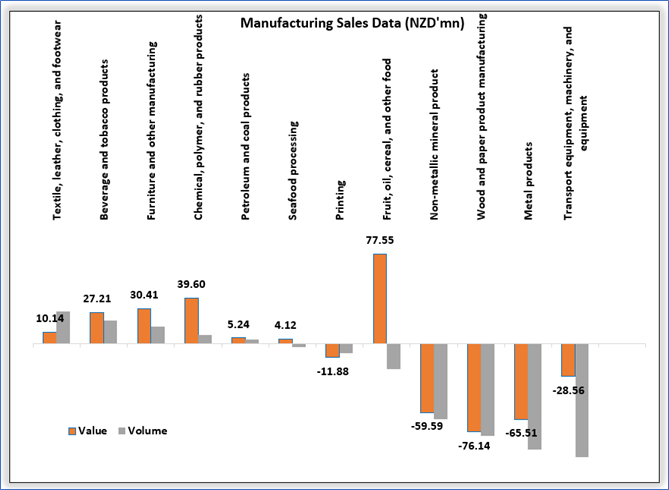
As per Stats.NZ report “Business Financial Data”, published on 10 March 2023, the volume of total manufacturing sales fell by ~4.7% in December quarter following the 2.6% rise in the September 2022 quarter. The value of total manufacturing sales stumbled NZD 133 Mn (0.4%), following NZD 1.6 Bn (5.0%) rise in the September 2022 quarter.
Total sales in Mining category were NZD 1.3 Bn, down NZD 108 Mn (7.7%) from the September 2022 quarter. The sales under construction category was up NZD 1bn (4.3%) from the September 2022 quarter to NZD 25 Bn.
Exhibit 1: Changes in Manufacturing Sales (NZD’ Mn) seasonally adjusted for the September 2022–December 2022 Quarters
Data Source: This work is based on/includes Stats NZ’s data which are licensed by Stats NZ for reuse under the Creative Commons Attribution 4.0 International Licence; Chart Created by Kalkine Group
Shaping Up of International Travel- A Quick Look
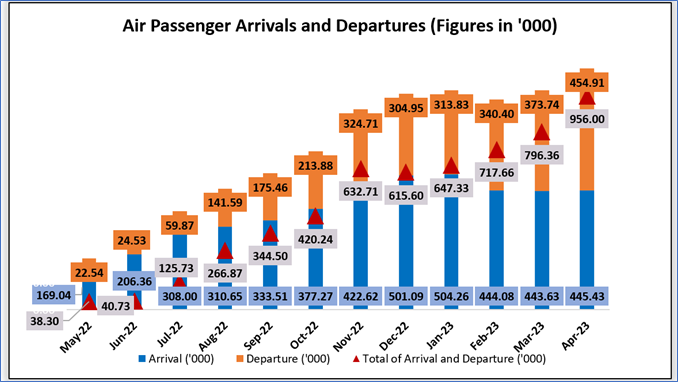
As per stats.govt.nz data released on 10 May 2023, a total of 224,910 overseas visitor arrivals (provisional) have been reported for four weeks ended 16 April 2023, which has increased by 180,390 and shown a growth of 405.2% on pcp basis. Overseas visitor arrivals totalled 266,900 in the month of February 2023, which was up 261,600 from the last year February 2022. The biggest contributors in arrivals were from Australia (up 95,300), United States (up 39,400), United Kingdom (up 27,600). The February 2023 number of overseas visitor arrivals is ~64% of the pre-COVID-19 number of 417,900 in February 2019.
New Zealand-resident traveller arrivals were 157,100 in the February 2023 month, down 77,800 from January 2023 (234,900) but up by 148,500 on pcp basis. The biggest changes were in arrivals from Australia (up 53,700), India (up 15,700) & Fiji (up 7,500). Annually, overseas visitor arrivals were 1.95 Mn in the February 2023, which was up by 1.75 Mn from the last year.
Exhibit: 2 Recovery Continued in International Passengers
Data Source: This work is based on/includes Stats NZ’s data which are licensed by Stats NZ for reuse under the Creative Commons Attribution 4.0 International Licence; Chart Created by Kalkine Group
Index Performance:
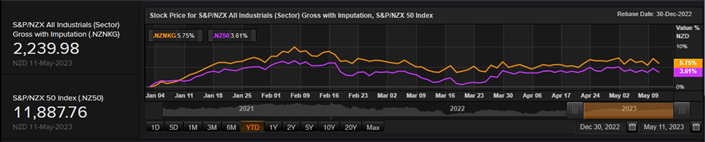
The S&P/NZX All Industrials (Sector) Index generated a YTD return of ~5.75% versus ~3.61% by the S&P/NZX 50 Index. Therefore, NZX All Industrials Index outperformed NZX50 Index by ~2.14%.
Exhibit 3: S&P/NZX All Industrials (Sector) vs S&P/NZX50 Index
Source: REFINITIV
Key Risks and Challenges:
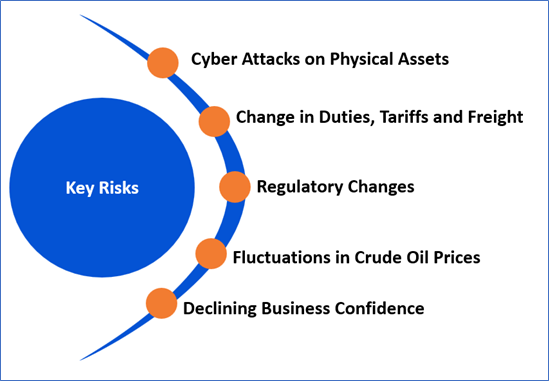
The softer demand outlook, higher inflation, tight monetary policies, fluctuations in the crude oil prices, and weak business confidence, among others, are some of the critical challenges to be faced by the industrials sector. As per the recent Fortnightly Economic Update dated 28 April 2023, house prices were steady in March, supported by an increase in sales as well as declines in some longer-term mortgage rates. However, the annual decline recovered to 13.1% from 14.2% in February. There is also the risk of surging immigration fuelling inflation pressures, particularly through its effect on the housing market. However, the rise in population growth was likely to be temporary as well as followed the period of very weak population growth.
Exhibit 4. Key Risks in Industrials Sector:
Source: Analysis by Kalkine Group
Outlook:
As per mpi.govt.nz release in December 2022, air freight challenges, labour challenges and high fuel costs remain. Notably, export volumes have increased with the return of tourism and growth in food service driving demand in some markets.
As per Resources & Energy Quarterly report by Australian Govt., the global steel consumption is expected to grow by 1.6% annually to 2028, including nearly 140 Mn tonnes from new capacity, which remains planned or underway over the next few years. Even though global economic slowdown is expected to persist in 2023, the reopening of Chinese economy may bolster the global steel demand.
Moreover, the global construction activity edged up as the year turned, and it is forecasted to maintain momentum in 2023. Global manufacturing activity entered the expansionary territory in February 2023 as per the JP Morgan Global Manufacturing PMI reading of 50.0.
Apart from the sector-specific factors, an analysis on 2 NZX-listed companies is provided. This report covers their insights, outlook, performance and potential as expected to be delivered in the near to medium term.
1) Air New Zealand Limited (Recommendation: Buy, Potential Upside: Low Double-Digit) (M-Cap: NZD 2.560 billion)
Business Description:
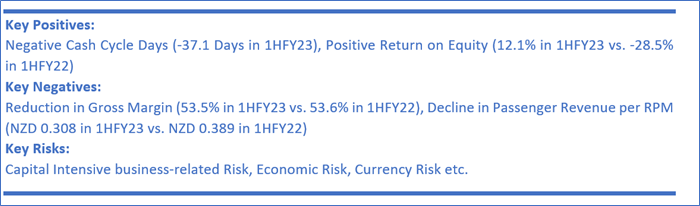
Air New Zealand Limited (NZX: AIR) is involved in the transportation of passengers and cargo on an integrated network of scheduled airline services within New Zealand and from NZ to outside world.
Outlook:
With the ever-increasing demand for both the domestic and international networks, the February guidance remained unchanged, which is 95% of domestic and 80% of international pre-Covid capacity levels across the network. The improving revenue and jet fuel price are anticipated to be partially offset by softer cargo revenues because of increased competitive capacity, particularly in Asia, impacting yields and load factors.
With an average jet fuel price of USD 95 per barrel for rest of the year, the airline increased its earnings before other significant items and taxation guidance to NZD 510mn-NZD 560mn for FY23 vs. prior guidance range of NZD 450mn to NZD 530mn.
Fundamental Valuation:
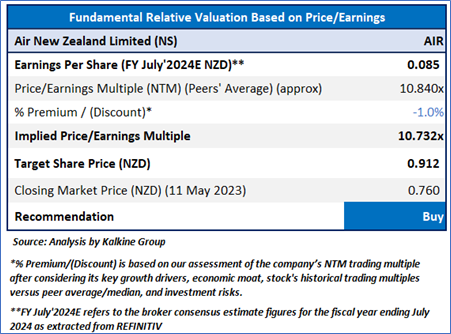
Price/Earnings Multiple Based Relative Valuation
Technical Overview:
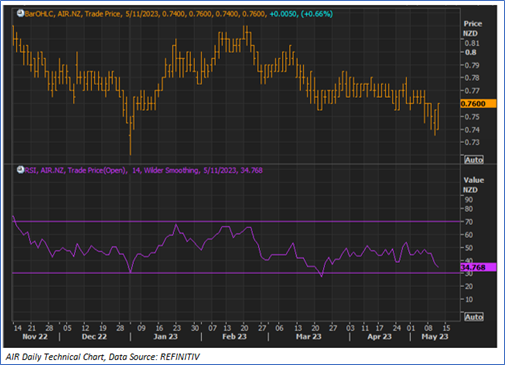
Daily Price Chart
Technical Commentary
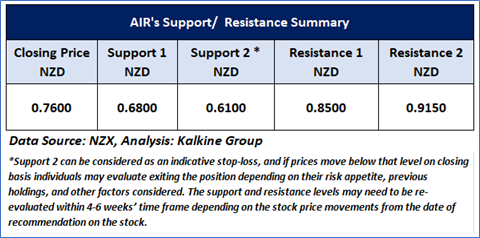
On the daily chart, AIR prices are trading near the horizontal trendline support zone. Moreover, the momentum oscillator RSI (14-period) is showing a reading of ~40.480 level. However, the prices are trading below the trend-following indicators 21-period SMA, which may act as a resistance zone. An important support level for the stock is placed at NZD 0.68 while the key resistance level is placed at NZD 0.85.
Stock Recommendation
Considering the aforementioned factors, a ‘Buy’ rating is given on the stock at the closing market price of NZD 0.760, up by ~0.66% as of 11th May 2023.
2) Steel & Tube Holdings Limited (Recommendation: Buy, Potential Upside: Low Double-Digit) (M-Cap: NZD 858 million, Annual Dividend Yield (TTM)1: 13.823%)
Business Description:
Steel & Tube Holdings Limited (NZX: STU) is one of NZ’s leading providers of steel solutions, including steel products, fastenings, and metal floor decking. Its segments include Distribution and Infrastructure.
Outlook:
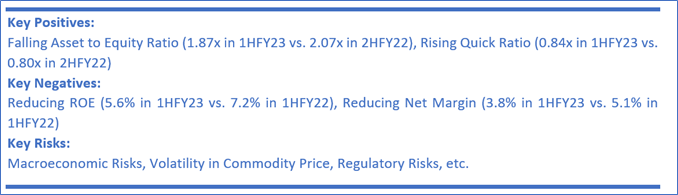
With the expectation of wet weather and tight labour market challenges, the group focuses to grow organically along with smaller M&As. Given the recessionary operating environment, 2HFY23 volumes are anticipated to be ~10%-15% lesser than 1HFY23. The company is forecasting its normalised EBIT of between NZD 28 Mn-NZD 32 Mn and normalised EBITDA of between NZD 48 Mn-NZD 52 Mn.
Fundamental Valuation:
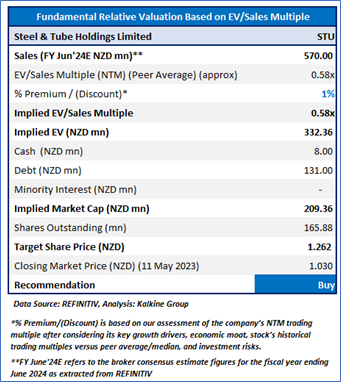
EV/Sales Multiple Based Relative Valuation
Technical Overview:
Daily Price Chart
Technical Commentary
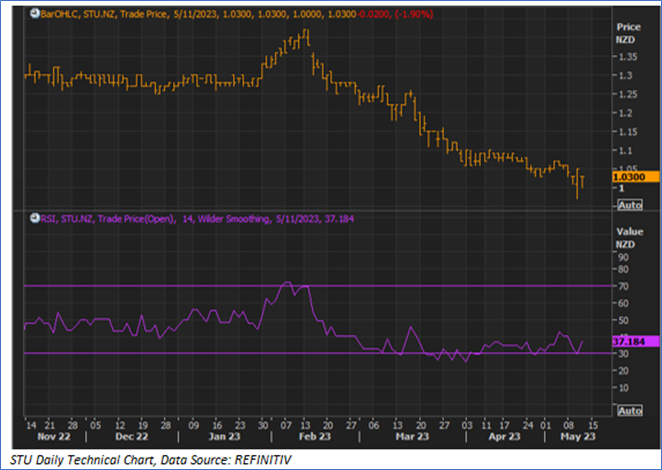
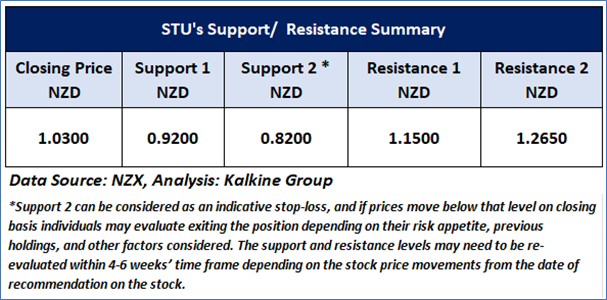
On the daily chart, STU prices are trading above the falling trendline support zone and trading above the trendline. Moreover, the momentum oscillator RSI (14-period) is showing a reading of ~37.184 level. However, the prices are trading below the trend-following indicators 21-period SMA, which may act as a resistance zone. An important support level for the stock is placed at NZD 0.92 while the key resistance level is placed at NZD 1.15.
Stock Recommendation
Given the increasing revenue, well capitalized balance sheet and cashflows to support growth initiatives, a ‘Buy’ recommendation is given on the stock at the closing market price of NZD 1.030, down by 1.90% as of 11 May 2023.
Markets are trading in a highly volatile zone currently due to certain macro-economic issues and geopolitical tensions prevailing. Therefore, it is prudent to follow a cautious approach while investing.
Note 1: Past performance is neither an indicator nor a guarantee of future performance.
Note 2: The reference date for all price data, currency, technical indicators, support, and resistance levels is May 11, 2023. The reference data in this report has been partly sourced from REFINITIV.
Note 3: Investment decisions should be made depending on an individual's appetite for upside potential, risks, holding duration, and any previous holdings. An 'Exit' from the stock can be considered if the Target Price mentioned as per the Valuation and or the technical levels provided has been achieved and is subject to the factors discussed above.
Note 4: Annual Dividend Yield is on a Trailing Twelve Month (TTM1) basis and are subject to change based on factors such as company performance, stock price changes, etc.
Technical Indicators Defined: -
Support: A level at which the stock prices tend to find support if they are falling, and a downtrend may take a pause backed by demand or buying interest. Support 1 refers to the nearby support level for the stock and if the price breaches the level, then Support 2 may act as the crucial support level for the stock.
Resistance: A level at which the stock prices tend to find resistance when they are rising, and an uptrend may take a pause due to profit booking or selling interest. Resistance 1 refers to the nearby resistance level for the stock and if the price surpasses the level, then Resistance 2 may act as the crucial resistance level for the stock.
Stop-loss: It is a level to protect further losses in case of unfavourable movement in the stock prices.
Disclaimer
Kalkine New Zealand Limited is a Financial Advice Provider (“FAP”) and is authorised by a Class 1 Financial Advice Provider Licence issued by Financial Markets Authority (“FMA”) to provide financial advice. Kalkine provides only general financial advice through its research reports following a person becoming a member. The reports contain buy/sell/hold and other recommendations in relation to equity financial products. The recommendations and opinions [on this website] / [in this report] do not take into account any of your investment objectives, financial situation or needs. Before you make a decision about whether to acquire a financial product, you should obtain the Product Disclosure Statement from the product issuer. You should consider the appropriateness of advice taking into account your own objectives, financial situation and needs and seek independent financial advice before making any financial decisions. If you act on the advice in the research reports, you may have to pay fees, expenses or other amounts (but not to Kalkine). Further information about the complaints and dispute resolution process, as well as information about Kalkine’s duties are available on Kalkine’s website. Please read our Financial Advice Provider (FAP) disclosure statement and Complaints Handling Guide, which are available on the website.
Past performance is not a reliable indicator of future performance.
 Please wait processing your request...