
 AU
AU
 UK
UK
 CA
CA
 US
US
 IND
IND

 NZ
NZ

Company Overview:
Sanford Limited (NZX: SAN) is New Zealand's largest and oldest seafood company and the only fully integrated seafood business. Foley Wines Limited (NZX: FWL) is an integrated wine company. It is engaged in producing as well as distributing table wines.
Kalkine’s Sector Report covers the Investment Highlights, Key Financial Metrics, Risks, Outlook, Technical Analysis along with the Valuation, Target Price, and Recommendation on the stock.
1. Sector Landscape and Outlook
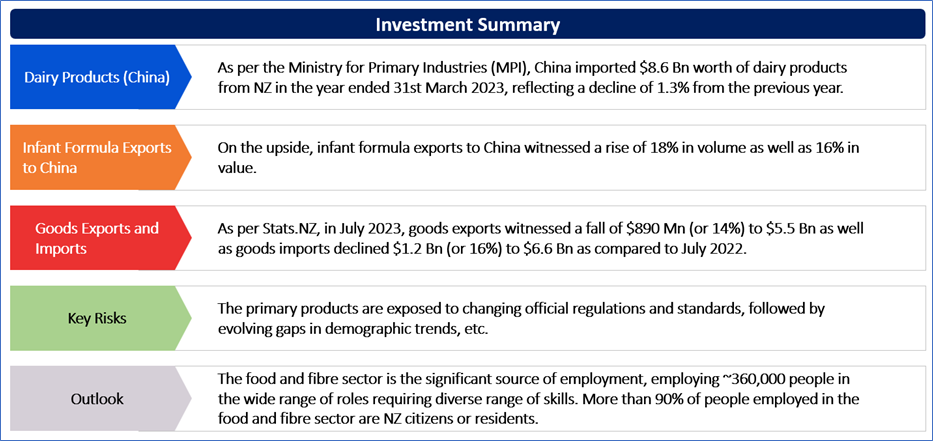
As per the Ministry for Primary Industries (MPI), China imported $8.6 Bn worth of dairy products from NZ in the year ended 31st March 2023, reflecting a decline of 1.3% from the previous year. Although China is NZ’s largest export market, China’s share of NZ’s total dairy export volumes fell to 35% in the year ended 31 March 2023 from 44% in the previous year. Also, China’s share of export revenue witnessed a decline, but by the smaller extent, from 41% to 34%.
On the upside, infant formula exports to China witnessed a rise of 18% in volume as well as 16% in value. This could be partly attributed to the disruption caused to the global infant formula trade by immediate shortfall of infant formula in the US market. Also, it is likely that companies built up infant formula inventory in market before new Chinese standards came into force in the month of February 2023.
Trend in Goods Imports and Exports (July 2023)
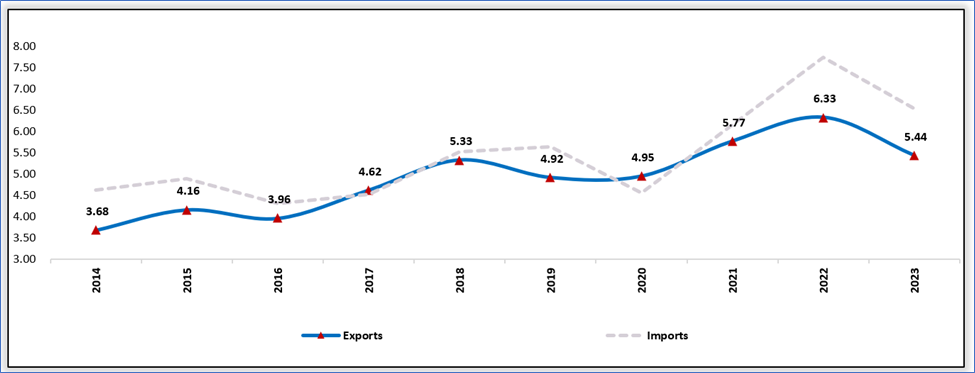
As per Stats.NZ, in July 2023, goods exports witnessed a fall of $890 Mn (or 14%) to $5.5 Bn as well as goods imports declined $1.2 Bn (or 16%) to $6.6 Bn as compared to July 2022. Notably, the monthly trade balance was the deficit of $1.1 Bn. Talking about exports, milk powder, butter, and cheese (the largest export commodity group) witnessed a fall of $350 Mn (or 19%) to $1.5 Bn. Infant formula is included in the preparations of milk, cereals, flour as well as starch exports, which declined $97 Mn (or 44%) to $124 Mn.
With respect to imports, petroleum and products was the leading contributor to the decline in imports in the month of July 2023. Notably, chemical product imports declined $147 Mn (or 66%) to $75 Mn, led by the diagnostic and laboratory reagents, down by $129 Mn (or 90%).
Exhibit 1: Merchandise trade values ($ Bn), exports and imports, July months, 2014-2023
Data Source: This work is based on/includes Stats NZ’s data which are licensed by Stats NZ for reuse under the Creative Commons Attribution 4.0 International Licence; Chart Created by Kalkine Group
Trends in Horticulture Export Revenue
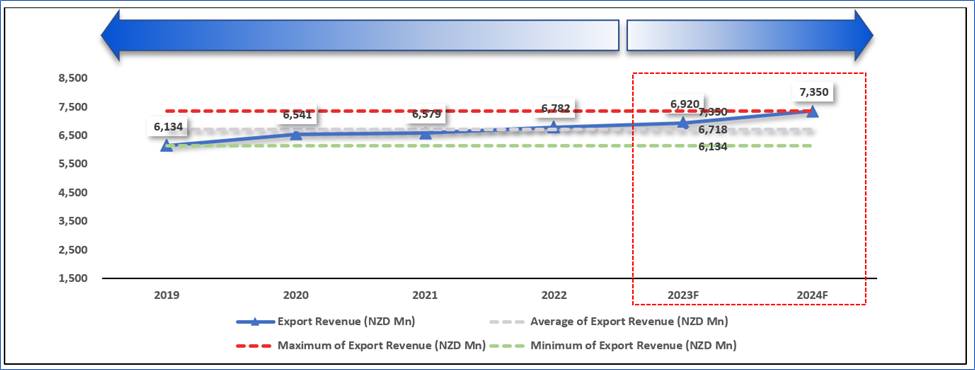
As per MPI, horticulture export revenue is expected to be influenced by the exports of the 2022 wine vintage, which has offset low production as well as exports of kiwifruit, apples, avocados and vegetables. Consumer demand for NZ fresh produce as well as wine is robust strong. Unfavourable climatic conditions along with extreme weather events impacted numerous North Island’s growing regions resulting in lower crop volumes and revenue for growers. Grower profitability might get affected because of reduced incomes and increased input costs. In addition, some growers in the cyclone-hit regions would have significant repairs to fund.
Exhibit 2: Trend in Horticulture Export Revenue 2019–24Forecast (F) (Year to 30 June, NZ$ million)
Data Source: This work is based on/includes the Ministry for Primary Industries data which are licensed under Crown for reuse under the Creative Commons Attribution 4.0 International Licence; Chart Created by Kalkine Group
Seafood Exports Revenue- A Quick Look
As per MPI, the seafood industry has been demonstrating success with the 2nd consecutive year of growth. However, despite the increased prices, the strong rise in input costs, specifically higher than average fuel prices, impacted the profitability for the seafood businesses.
Notably, wild capture export volumes are anticipated to remain relatively stable and the demand is anticipated to rise. This is likely to drive prices as well as revenues in an upward trend, however, not as strongly as in the aquaculture. Looking ahead, the seafood sector is expected to have robust sustainability focus supported by the Seafood Climate Change Adaptation Strategy.
Key Risks and Challenges:
Cyclone Gabrielle struck in the month of February 2023 with significant impacts on the food and fibre sector throughout North Island. The heavy rainfall as well as wind led to slips, damaged roads and flooding, including severe silt and debris deposition in parts of Hawke’s Bay and Gisborne Tairāwhiti.
The total impacts for the food and fibre sector were provisionally estimated at $2.0 Bn–$2.4 Bn. The cyclone impacted processing and manufacturing facilities due to the combination of direct flood damage, being cut off from the power and water supplies and damaged transportation infrastructure impacting the flow of goods. In NZ, food prices rose by more than 12.5% in the 12 months ended April 2023. The impact of Cyclone Gabrielle on the domestic food market, mainly the supply of fruit and vegetables, is the key reason for increased food prices.
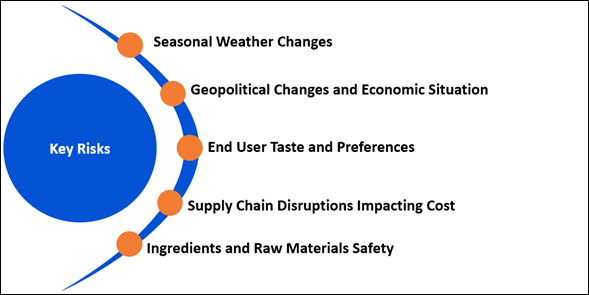
Exhibit 3. Key Risks in Consumer Staples Sector:
Source: Analysis by Kalkine Group
Outlook:
Aftershocks of COVID-19 pandemic from 2020-22, increased inflation, greater geoeconomic fragmentation as well as recent financial sector turbulence are impacting the near and mid-term economic outlook globally and contributing to the subdued outlook. However, the global economy might prove to be more resilient than expected resulting in the softer than expected landing. With the surplus of excess savings from the pandemic years and tight labour markets, household consumption might surpass the projections.
The food and fibre sector is the significant source of employment, employing ~360,000 people in the wide range of roles requiring diverse range of skills. More than 90% of people employed in the food and fibre sector are NZ citizens or residents.
Temporary migrants are critical part of the workforce, mainly for the seasonal activities. Recent changes to the immigration settings would make a difference to address labour as well as skill shortages. The Immigration Rebalance has been enabling access to more migrant workers provided that employers give above the median wage (with Accredited Employer Worker Visa).
Apart from the sector-specific factors, an analysis on three NZX-listed companies is provided. This report covers their insights, outlook, performance and potential as expected to be delivered in the near to medium term.
1) Foley Wines Limited (Recommendation: Speculative Buy, Potential Upside: Low Double-Digit) (M-Cap: NZD 82.17 million, Annual Dividend Yield (TTM)1: 4.45%)
Business Description:
Foley Wines Limited (NZX: FWL) is an integrated wine company. It is engaged in producing as well as distributing table wines.
Outlook:
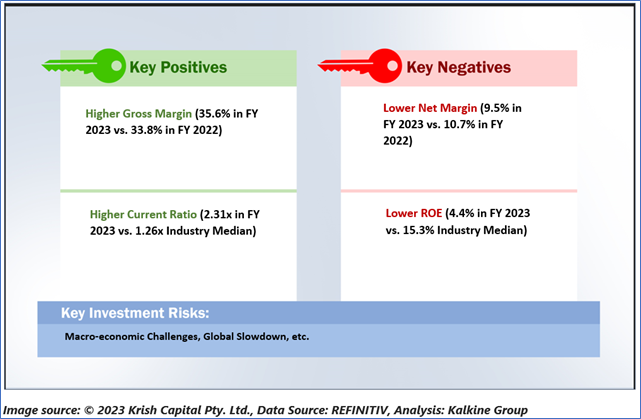
The company has reported record case sales as well as operating profit in FY 2023. It is in good shape and continues its robust growth and investment for the future. FWL also completed the major capital expenditure programmes that would lead to the ability to process more wine with the Grove Mill winery capacity increased to 4,000 tonnes, significant deployment towards vineyard productivity and capacity and the completion of The Runholder in Martinborough.
Technical Overview:
Daily Price Chart
Technical Commentary
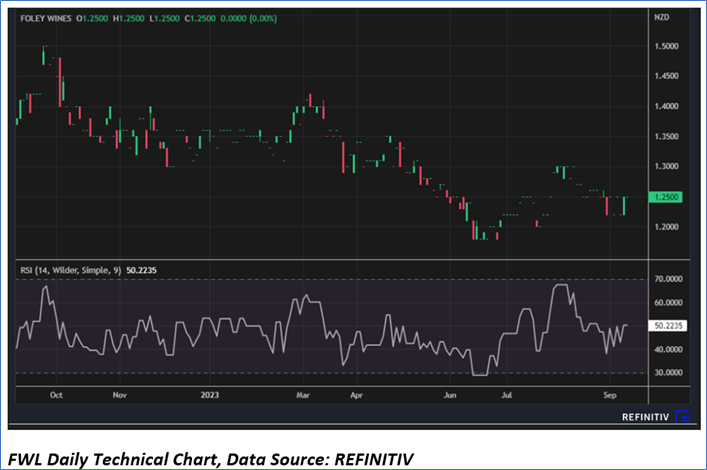
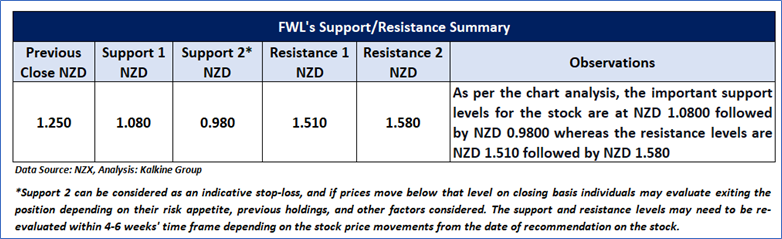
On the daily chart, FWL prices are trading above the falling trendline support zone. Moreover, the momentum oscillator RSI (14-period) is showing a reading of ~50.2235 level. However, the prices are trading below trend-following indicator 21-period SMA, which may act as a resistance level. An important support level for the stock is placed at NZD 1.08 while the key resistance level is placed at NZD 1.51.
Stock Recommendation
Considering the facts above, a ‘Speculative Buy’ recommendation on the stock has been provided at the closing market price of NZD 1.250 per share as on 14th September 2023.
2 ) Sanford Limited (Recommendation: Speculative Buy, Potential Upside: Low Double-Digit) (M-Cap: NZD 376.8 Mn)
Business Description:
Sanford Limited (NZX: SAN) is New Zealand's largest and oldest seafood company and the only fully integrated seafood business.
Outlook:
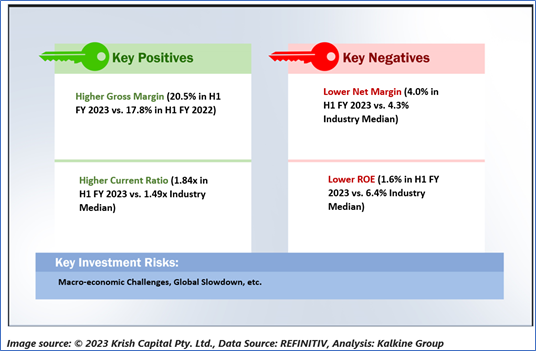
The company has released Q3 FY 2023 update and SAN stated that pricing remained robust for the Salmon division, reflecting a rise of 20.3% on the pcp. The sales volumes remained consistent with the same quarter in FY 2022 as well as with pre-covid sales levels. The company is expecting the Salmon division to continue the momentum into Q4 this year.
The Sanford team is focusing towards optimising the operations in order to take advantage of the favourable seafood market conditions, including robust demand for the products.
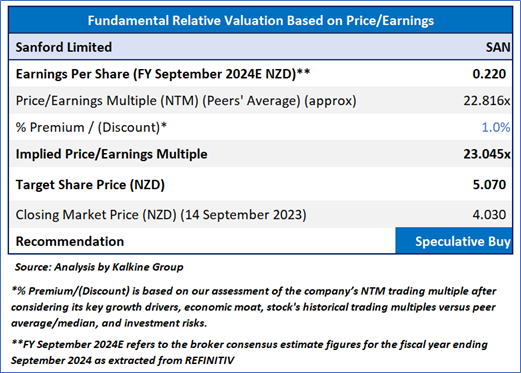
Valuation Methodology: Price/Earnings Per Share Based Relative Valuation (Illustrative)
Technical Overview:
Daily Price Chart
Technical Commentary
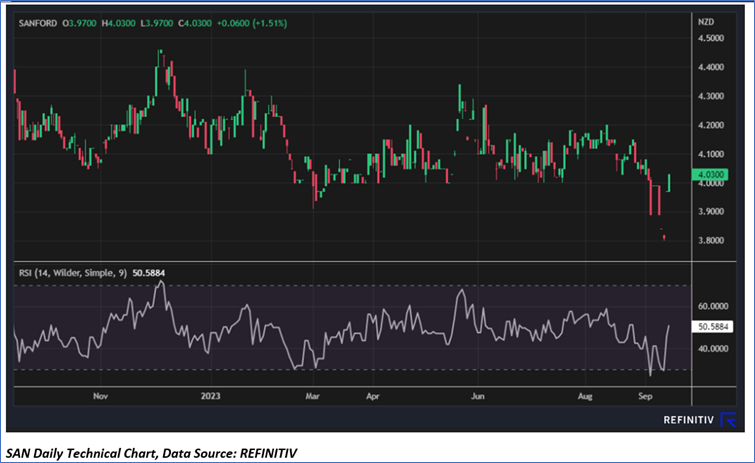
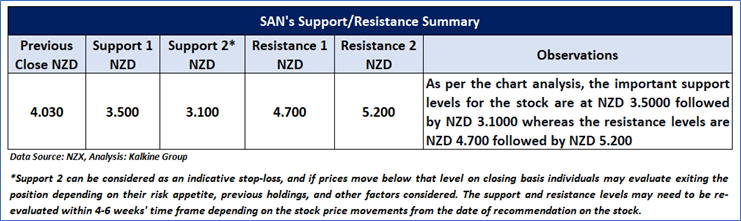
On the daily chart, SAN prices are trading above the horizontal trendline support level. Moreover, the momentum oscillator RSI (14-period) is showing a reading of ~50.5884 level. Further, the prices are trading above the trend-following indicators 21-period SMA, which may act as a support zone. An important support level for the stock is placed at NZD 3.50 while the key resistance level is placed at NZD 4.70.
Stock Recommendation
The stock has been valued using P/E multiple-based illustrative relative valuation, and the target price so arrived reflects a rise of low double-digit (in % terms).
Considering the facts above, a ‘Speculative Buy’ recommendation on the stock has been provided at the closing market price of NZD 4.03 per share, up by 1.51% as on 14th September 2023.
Markets are trading in a highly volatile zone currently due to certain macro-economic issues and geopolitical tensions prevailing. Therefore, it is prudent to follow a cautious approach while investing.
Note 1: Past performance is not a reliable indicator of future performance.
Note 2: The reference date for all price data, currency, technical indicators, support, and resistance levels is September 14, 2023. The reference data in this report has been partly sourced from REFINITIV.
Note 3: Investment decisions should be made depending on an individual's appetite for upside potential, risks, holding duration, and any previous holdings. An 'Exit' from the stock can be considered if the Target Price mentioned as per the Valuation and or the technical levels provided has been achieved and is subject to the factors discussed above.
Note 4: Annual Dividend Yield is on a Trailing Twelve Month (TTM1) basis and are subject to change based on factors such as company performance, stock price changes, etc.
Technical Indicators Defined: -
Support: A level at which the stock prices tend to find support if they are falling, and a downtrend may take a pause backed by demand or buying interest. Support 1 refers to the nearby support level for the stock and if the price breaches the level, then Support 2 may act as the crucial support level for the stock.
Resistance: A level at which the stock prices tend to find resistance when they are rising, and an uptrend may take a pause due to profit booking or selling interest. Resistance 1 refers to the nearby resistance level for the stock and if the price surpasses the level, then Resistance 2 may act as the crucial resistance level for the stock.
Stop-loss: It is a level to protect further losses in case of unfavourable movement in the stock prices.
Disclaimer
Kalkine New Zealand Limited is a Financial Advice Provider (“FAP”) and is authorised by a Class 1 Financial Advice Provider Licence issued by Financial Markets Authority (“FMA”) to provide financial advice. Kalkine provides only general financial advice through its research reports following a person becoming a member. The reports contain buy/sell/hold and other recommendations in relation to equity financial products. The recommendations and opinions [on this website] / [in this report] do not take into account any of your investment objectives, financial situation or needs. Before you make a decision about whether to acquire a financial product, you should obtain the Product Disclosure Statement from the product issuer. You should consider the appropriateness of advice taking into account your own objectives, financial situation and needs and seek independent financial advice before making any financial decisions. If you act on the advice in the research reports, you may have to pay fees, expenses or other amounts (but not to Kalkine). Further information about the complaints and dispute resolution process, as well as information about Kalkine’s duties are available on Kalkine’s website. Please read our Financial Advice Provider (FAP) disclosure statement and Complaints Handling Guide, which are available on the website.
Past performance is not a reliable indicator of future performance.
 Please wait processing your request...