
 AU
AU
 UK
UK
 CA
CA
 US
US
 IND
IND

 NZ
NZ

This report is an updated version of the report published at 5:30 PM (GMT +12)) as on 17 April 2025
Company Overview:
Steel & Tube Holdings Limited (NZX: STU) is one of NZ’s leading providers of steel solutions, allowing access to the widest range of steel products in the market, via nationwide network of distribution centres. Move Logistics Group (NZX: MOV) is one of NZ’s largest private domestic freight and logistics platforms, with a nationwide network of branches, depots and warehouses.
Kalkine’s Sector Report covers the Key Financial Metrics, Risks, Outlook, Technical Analysis along with the Valuation, Target Price, and Recommendation on the stock.
Sector Landscape and Outlook
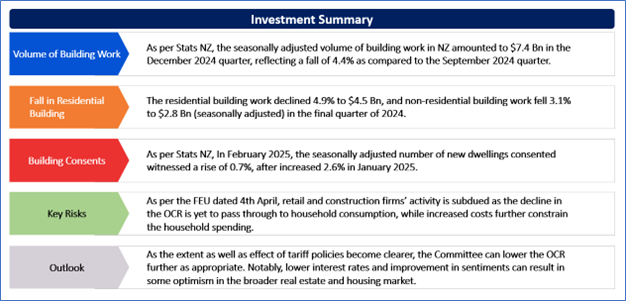
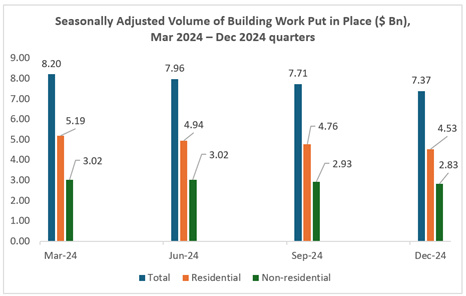
As per Stats NZ, the seasonally adjusted volume of building work in NZ amounted to $7.4 Bn in the December 2024 quarter, reflecting a fall of 4.4% as compared to the September 2024 quarter. There continues to be a downward trend in building activity volume since the most recent peak in the September 2022 quarter. The residential building work declined 4.9% to $4.5 Bn, and non-residential building work fell 3.1% to $2.8 Bn (seasonally adjusted) in the final quarter of 2024. The residential building activity volume touched its lowest level in more than 4 years, in seasonally adjusted terms.
The decline in residential building activity was driven by a decline in new homes consented more than the last two and a half years. The annual number of new homes consented peaked in mid-2022 and continues to decrease since then. Notably, the building consents remain an early indicator of planned building activity. The value of building work put in place stood at $34 Bn in the year ended December 2024, reflecting a fall of 6.4% from the year ended December 2023.
Exhibit 1: Seasonally Adjusted Volume of Building Work Put in Place ($ Bn)
Data Source: This work is based on/includes Stats NZ’s data which are licensed by Stats NZ for reuse under the Creative Commons Attribution 4.0 International Licence; Chart Created by Kalkine Group
Current Housing Market Trends
As per the FEU dated 4th April, NZ firms possessing robust balance sheet are committed to the long-term investment plans. A healthy financial position can guard against short-term variability, enabling companies to take opportunities when identified. Consistent with the housing market data, the insights from construction firms hinted at the gradual improvements to NZ’s housing market since the recent 2023 low.
However, higher housing stock, both on-market and from additions of new developments, has been impacting the residential investment and it is suppressing price growth. While regions such as Taranaki continue to perform stronger than Auckland, there remains a nationwide trend favouring renovation projects over new builds. Since the interest rates have eased, housing developers have witnessed a rise in enquiries nationwide.
Building Consents Issued (February 2025)
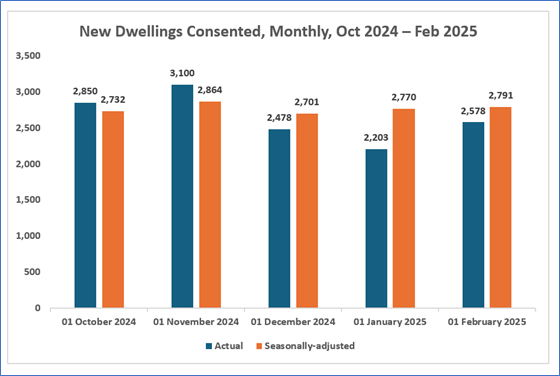
As per Stats NZ, In February 2025, the seasonally adjusted number of new dwellings consented witnessed a rise of 0.7%, after increased 2.6% in January 2025. In the year ended February 2025, the actual number of new dwellings consented stood at 33,595, down 7.4% from the year ended February 2024. The annual value of non-residential building work consented amounted to $8.8 Bn, reflecting a fall of 11% from the year ended February 2024.
In February 2025, there were 2,578 new dwellings consented, which comprise 1,191 stand-alone houses, 1,177 townhouses, flats, and units, 110 apartments, and 100 retirement village units. In the year ended February 2025, the non-residential building consents stood at $8.8 Bn, down by 11% from the year ended February 2024.
Exhibit 2: New Dwellings Consented, Monthly
Data Source: This work is based on/includes Stats NZ’s data which are licensed by Stats NZ for reuse under the Creative Commons Attribution 4.0 International Licence; Chart Created by Kalkine Group
Key Risks and Challenges:
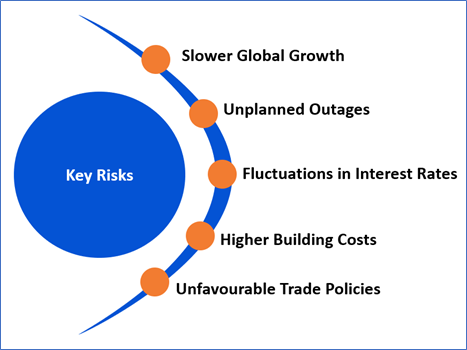
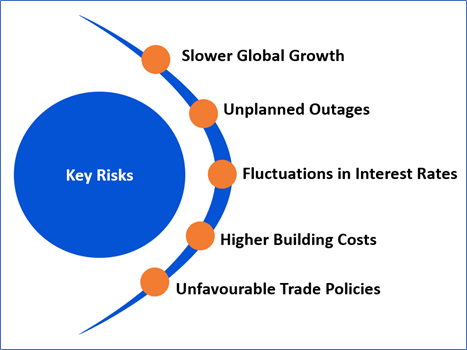
As per the FEU dated 4th April, retail and construction firms’ activity is subdued as the decline in the OCR is yet to pass through to household consumption, while increased costs further constrain the household spending. Also, RBNZ stated that the recently announced tariffs in the United States, retaliation from several trading partners as well as increased geoeconomic uncertainty would have a negative impact on global growth. Therefore, the NZ industrials sector is exposed to global macro-economic slowdown, volatility in rates, etc.
Exhibit 3: Key Risks in Industrials Sector:
Source: Analysis by Kalkine Group
Outlook:
As per RBNZ, the monetary restraint has been removed at pace, and household spending as well as residential investment remained weak. As the extent as well as effect of tariff policies become clearer, the Committee can lower the OCR further as appropriate. Notably, lower interest rates and improvement in sentiments can result in some optimism in the broader real estate and housing market. That being said, RBNZ stated that future policy decisions would be determined by the outlook for inflationary pressure over the medium term.
The firms’ inflation expectations as well as core inflation remain consistent with inflation remaining at target in the medium term. The global policy response remains critical in gauging the implications of higher tariffs for medium-term inflation in NZ. An easing in fiscal as well as monetary policy in the trading partners can mitigate some of the anticipated downturn in global economic activity. The Committee highlighted that fiscal policy was eased in China and Europe recently. Overall, structural reforms, trade, and industrial policy responses can offset some of the impacts of higher trade barriers.
Apart from the sector-specific factors, an analysis on 2 NZX-listed companies is provided. This report covers their insights, outlook, performance and potential as expected to be delivered in the near to medium term.
1) Steel & Tube Holdings Limited (Recommendation: Buy, Potential Upside: Low Double-Digit) (M-Cap: NZD 129.4 Mn, Annual Dividend Yield (TTM)1: 3.61%)
Business Description:
Steel & Tube Holdings Limited (NZX: STU) is one of New Zealand's leading providers of steel solutions, allowing access to the widest range of steel products in the market, through its nationwide network of distribution centres.
Outlook:
While the market is expected to remain challenged, the cycle seems to have bottomed out, and STU is witnessing higher customer enquiries and tenders as business confidence starts to improve. The activity is projected to start building momentum from mid-2025 (H1 FY 2026) and the company is well-placed to navigate the current weaker cycle and achieve significant earnings growth as market activity returns. There is significant pipeline of work ahead and STU is well positioned to capitalise.
Technical Overview:
Technical Commentary
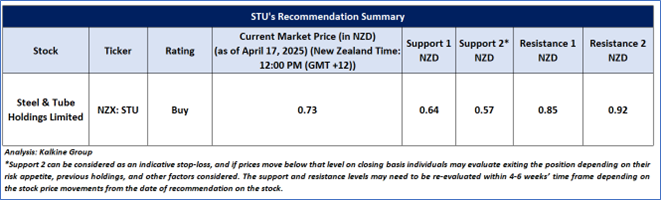
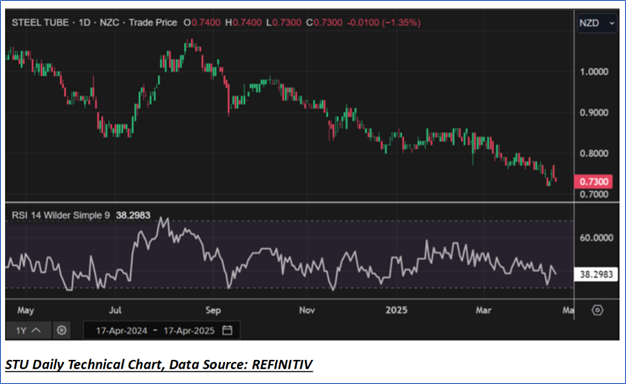
While undergoing a downtrend, STU’s stock prices are forming a descending wedge pattern, suggesting that the downside momentum on the stock is halting. Additionally, the momentum oscillator RSI (14-period) is forming bottom divergence in relations to prices, adding further evidence to the previous analysis. Prices are trading between its previous peak and trough, which might function as resistance and support levels for the stock, respectively. A significant support level for the stock is placed at NZD 0.64, while critical resistance level is located at NZD 0.85
Fundamental Valuation
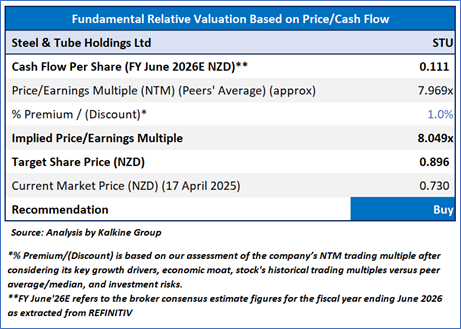
P/E Based Valuation
Stock Recommendation
Considering the aforementioned factors, a ‘Buy’ rating is given on the stock at the current market price of NZD 0.73 per share (New Zealand Time: 12:00 PM (GMT +12)) as on 17th April 2025.
2) Move Logistics Group Limited (Recommendation: Hold, Potential Upside: Low Double-Digit) (M-Cap: NZD 24.3 million)
Business Description:
Move Logistics Group Limited (NZX: MOV) is one of NZ’s largest private domestic freight and logistics platforms, with a nationwide network of branches, depots and warehouses.
Outlook:
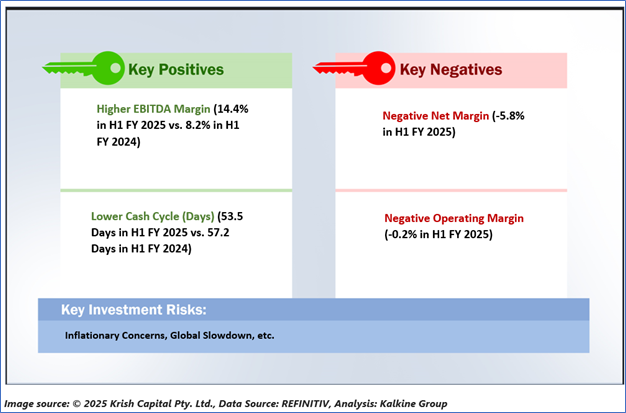
MOV’s focus is towards productivity improvements and positioning for stronger market activity and demand. Notably, a lift in market activity as well as customer demand, together with improvements from the transformation plan, would be enabling earnings growth. The company is on track to achieve its goals: 1) Positive adjusted net operating cashflow and a strong improvement in normalised EBT, and 2) Return to positive normalised EBT.
Technical Overview:
Technical Commentary
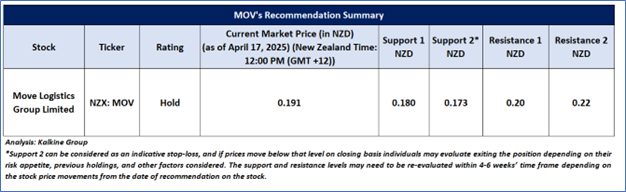
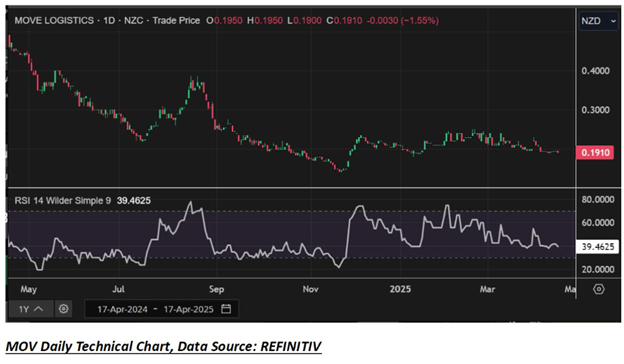
On the daily chart, MOV’s stock prices are forming a trading range characterized by identical highs and lows, suggesting that the sideways period on the stock might continue to persist in the near future. Moreover, the momentum oscillator RSI (14-period) is oscillating around the midpoint, adding further evidence to the previous analysis. Prices are trading between previous peak and trough, which might serve as resistance and support levels for the stock, respectively. A significant support level for the stock is positioned at NZD 0.180, while critical resistance level is located at NZD 0.200
Stock Recommendation
Considering the aforementioned factors, a ‘Hold’ rating is given on the stock at the current market price of NZD 0.191 per share (New Zealand Time: 12:00 PM (GMT +12)) as on 17th April 2025.
Markets are trading in a highly volatile zone currently due to certain macro-economic issues and geopolitical tensions prevailing. Therefore, it is prudent to follow a cautious approach while investing.
Note 1: Past performance is neither an indicator nor a guarantee of future performance.
Note 2: The reference date for all price data, currency, technical indicators, support, and resistance levels is April 17, 2025. The reference data in this report has been partly sourced from REFINITIV.
Note 3: Investment decisions should be made depending on an individual's appetite for upside potential, risks, holding duration, and any previous holdings. An 'Exit' from the stock can be considered if the Target Price mentioned as per the Valuation and or the technical levels provided has been achieved and is subject to the factors discussed above.
Note 4: Annual Dividend Yield is on a Trailing Twelve Month (TTM1) basis and are subject to change based on factors such as company performance, stock price changes, etc.
Note 5: Kalkine reports are prepared based on the stock prices captured either from REFINITIV or Trading View. Typically, REFINITIV or Trading View may reflect stock prices with a delay which could be a lag of 25-30 minutes. There can be no assurance that future results or events will be consistent with the information provided in the report. The information is subject to change without any prior notice.
Technical Indicators Defined: -
Support: A level at which the stock prices tend to find support if they are falling, and a downtrend may take a pause backed by demand or buying interest. Support 1 refers to the nearby support level for the stock and if the price breaches the level, then Support 2 may act as the crucial support level for the stock.
Resistance: A level at which the stock prices tend to find resistance when they are rising, and an uptrend may take a pause due to profit booking or selling interest. Resistance 1 refers to the nearby resistance level for the stock and if the price surpasses the level, then Resistance 2 may act as the crucial resistance level for the stock.
Stop-loss: It is a level to protect further losses in case of unfavourable movement in the stock prices.
Disclaimer This report has been issued by Kalkine New Zealand Limited (FSP691351) (NZBN:9429047678101) (“Kalkine”). Kalkine is a Financial Advice Provider (“FAP”) and is authorised by a Class 1 Financial Advice Provider Licence issued by Financial Markets Authority (“FMA”) to provide financial advice. Kalkine provides only general financial advice through its research reports following a person becoming a member. The reports contain buy/sell/hold and other recommendations in relation to equity securities, managed funds and other managed investment schemes and other financial advice products. The recommendations and opinions in this report and on Kalkine website do not take into account any of your investment objectives, financial situation or needs. Before you make a decision about whether to acquire a financial product, you should obtain the Product Disclosure Statement from the product issuer. You should consider the appropriateness of advice taking into account your own objectives, financial situation and needs and seek independent financial advice before making any financial decisions. If you act on the advice in the research reports, you may have to pay fees, expenses or other amounts (but not to Kalkine). Further information about the complaints and dispute resolution process, as well as information about Kalkine’s duties are available on Kalkine’s website. Please read our Financial Advice Provider (FAP) disclosure statement and Complaints Handling Guide, which are available on the website.
Past performance is not a reliable indicator of future performance.
 Please wait processing your request...