
 AU
AU
 UK
UK
 CA
CA
 US
US
 IND
IND

 NZ
NZ

Company Overview:
Air New Zealand Limited (NZX: AIR) is engaged in the transportation of passengers and cargo on an integrated network of scheduled airline services to, from and within New Zealand. Metro Performance Glass Limited (NZX: MPG) produces the range of customised glass products which are predominantly utilised in residential and non-residential construction applications like windows, doors, internal partitions, etc.
Kalkine’s Sector Report covers the Key Financial Metrics, Risks, Outlook, Technical Analysis along with the Valuation, Target Price, and Recommendation on the stock.
I. Sector Landscape and Outlook
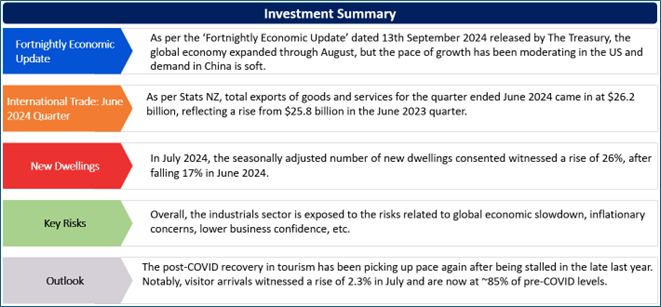
As per the ‘Fortnightly Economic Update’ dated 13th September 2024 released by The Treasury, the global economy expanded through August, but the pace of growth has been moderating in the US and demand in China is soft. In Australia, GDP growth was sluggish but is expected to pick up modestly over H2 of the year. The increased sales in the electricity, gas, water as well as waste services sector have been supported by increased prices for electricity. The combination of gas shortages as well as reduced low-cost hydro generation reflect reduced production in the utilities sector despite increased sales.
The net immigration has been dropping as departures climb and arrivals ease off. As per Stats NZ’s July release, the net immigration was settled at ~3,500 a month over the year so far. Even though net immigration of non-NZ citizens hovers above pre-COVID levels, the net migration of NZ citizens has been showing a strong monthly outflow like what was witnessed post-GFC. The real GDP increased 0.2% in the quarter ended June, the same as in the previous quarter, to be 1.0% higher than the same time in the previous year. This was the weakest annual growth rate since 1991 excluding COVID.
International Trade: June 2024 Quarter
As per Stats NZ, total exports of goods and services for the quarter ended June 2024 came in at $26.2 billion, reflecting a rise from $25.8 billion in the June 2023 quarter. The total imports of goods and services, for the same time period, were $27.0 Bn, up from $26.9 billion. Therefore, the total two-way trade for the June 2024 quarter stood at $53.2 Bn.
Notably, total services exports increased $690 Mn to $7.0 Bn in the June 2024 quarter as compared with the June 2023 quarter. With respect to overseas trade indexes, the merchandise (goods) terms of trade increased 2.0%, export prices for goods increased 5.2% and import prices rose 3.1% as compared with the March 2024 quarter.
Exhibit 1: Goods and Services (Exports and Imports)
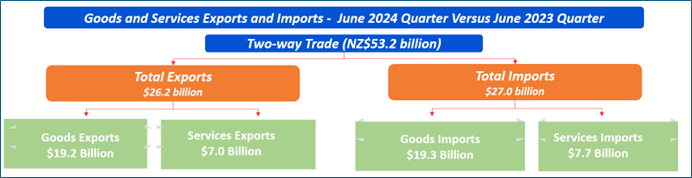
Data Source: This work is based on/includes Stats NZ’s data which are licensed by Stats NZ for reuse under the Creative Commons Attribution 4.0 International Licence; Chart Created by Kalkine Group
Building Consents Issued: July 2024
In July 2024, the seasonally adjusted number of new dwellings consented witnessed a rise of 26%, after falling 17% in June 2024. For the year ended July 2024, the actual number of new dwellings consented stood at 33,921, down by 22% from the year-ended July 2023. The annual value of non-residential building work consented amounted to $8.9 billion, down by 12% from the year ended July 2023.
In July 2024, there were 3,352 new dwellings consented, comprising 1,685 stand-alone houses, 1,333 townhouses, flats, and units, 234 retirement village units and 100 apartments. In the year ended July 2024, non-residential building consents stood at $8.9 Bn, down 12% from the year ended July 2023.
Exhibit: 2 New Dwellings Consented (Monthly)
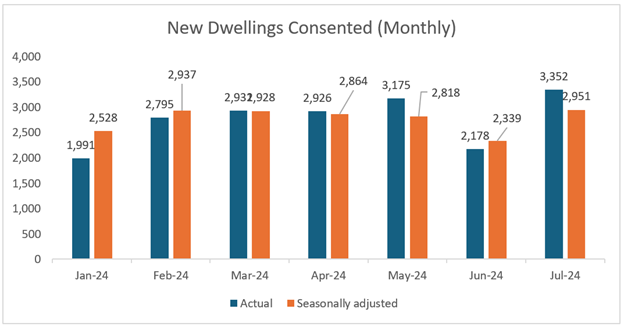
Data Source: This work is based on/includes Stats NZ’s data which are licensed by Stats NZ for reuse under the Creative Commons Attribution 4.0 International Licence; Chart Created by Kalkine Group
Key Risks and Challenges:
Recently, RBNZ stated that New Zealand commercial property market is soft because of increased interest rates, higher remote working as well as continued increase in online shopping. The performance of the commercial property sector is sensitive to the economic cycle. Notably, weak tenant demand in some parts of the commercial property market resulted in increased vacancy rates and soft rental growth.
While the US growth has been firm, there are indicators which reflect emerging weakness. The recent volatility in global asset markets implies nervousness regarding the US economic prospects, geopolitical risks, etc.
Exhibit 3. Key Risks in Industrials Sector:
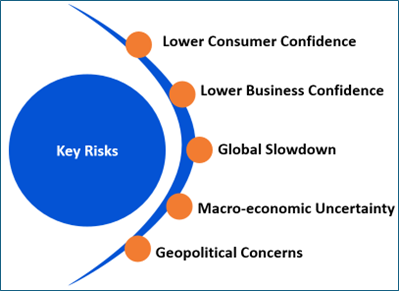
Source: Analysis by Kalkine Group
Outlook:
The post-COVID recovery in tourism has been picking up pace again after being stalled in the late last year. Notably, visitor arrivals witnessed a rise of 2.3% in July and are now at ~85% of pre-COVID levels. Notably, Chinese arrivals started to pick up, now at ~70% of pre-2020 levels, up from 60% over the first half year. The recent arrivals numbers seem to be promising.
The European Central Bank (or ECB) and the Bank of Canada reduced interest rates further at their policy meetings. The ECB reduced its key policy rate by 25 bps to 3.5%, while Canada’s central bank delivered the third 25bp cut. This took the policy rate to 4.25%. Notably, markets are expecting both central banks to ease policy further this year.
Notably, growth in Australia remained low during the June quarter, with robust growth in government spending offsetting the fall in consumer spending. A modest pickup is expected over H2 of 2024 as tax cuts, which started in July, and lower inflation help the real income growth.
Apart from the sector-specific factors, an analysis on 2 NZX-listed companies is provided. This report covers their insights, outlook, performance and potential as expected to be delivered in the near to medium term.
1) Air New Zealand Limited (Recommendation: Buy, Potential Upside: Low Double-Digit) (M-Cap: NZD 1.81 billion, Annual Dividend Yield (TTM)1: 5.87%)
Business Description:
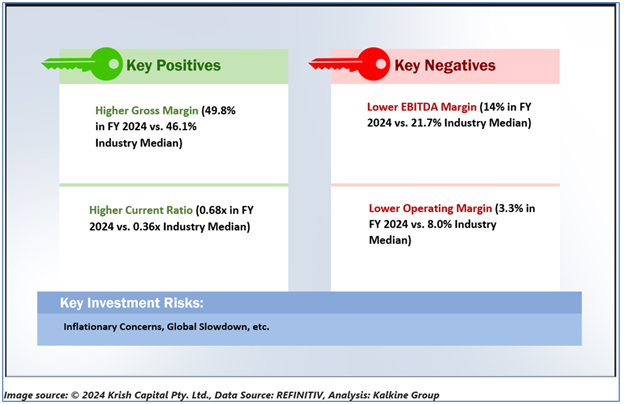
Air New Zealand Limited (NZX: AIR) is engaged in the transportation of passengers as well as cargo on integrated network of scheduled airline services to, from and within NZ.
Outlook:
The company is committed to investing for the future, with anticipated aircraft-related capital expenditure of $3.2 Bn over the upcoming 5 years. This includes the significant, multi-year interior retrofit programme on its 14 existing Dreamliner aircraft. The company is expecting delivery of the first new GE-powered Boeing 787-9 aircraft towards the end of the 2025 calendar year, which would provide options for continued growth, cost efficiencies as well as network expansion opportunities.
Technical Overview:
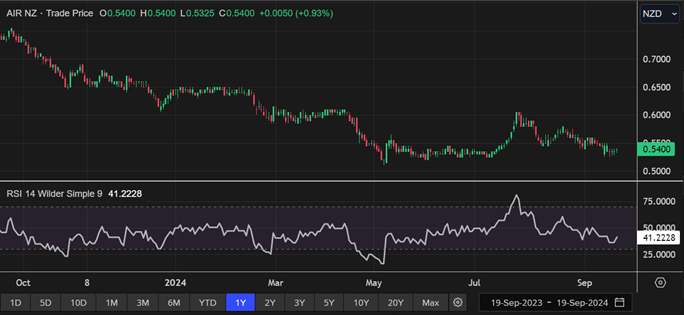
AIR Daily Technical Chart, Data Source: REFINITIV
Technical Commentary
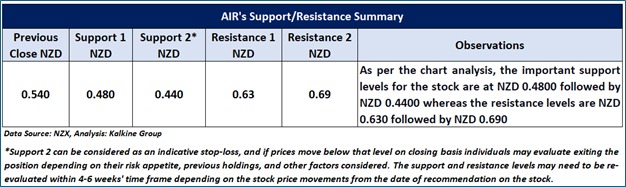
On the daily chart, AIR’s stock prices are undergoing a downtrend characterized by lower lows and lower highs, indicating a negative bias. In contrast, the stock is currently trading near a significant support established by the June 2022 low, anticipating for a potential minor rally. Moreover, the momentum oscillator RSI (14-period) is trading near its oversold region, providing more support to the previous observation. Prices are fluctuating between its previous peak and trough, which might serve as dynamic resistance and support levels for the stock, respectively. A significant support level for the stock is positioned at NZD 0.48, while critical resistance level is located at NZD 0.63
Fundamental Valuation
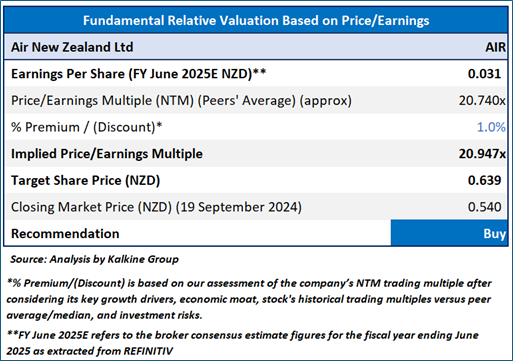
P/E Based Valuation
Stock Recommendation
Considering the aforementioned factors, a ‘Buy’ rating is given on the stock at the closing market price of NZD 0.540 per share, up by 0.93% as on 19th September 2024.
2) Metro Performance Glass Limited (Recommendation: Speculative Buy, Potential Upside: Low Double-Digit) (M-Cap: NZD 12.2 million)
Business Description:
Metro Performance Glass Limited (NZX: MPG) produces the range of customised glass products which are predominantly utilised in residential and non-residential construction applications.
Outlook:
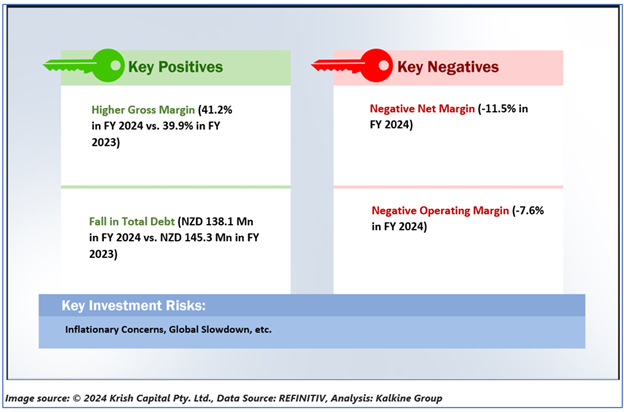
The company entered into conditional agreements with Cowes Bay Group Pty Ltd. Under the term sheets, Cowes Bay would be becoming a shareholder in the company through a placement of new shares, provide the commitment to invest further capital in the company’s planned equity capital raise, as well as become the company’s main lender. MPG is exploring and pursuing options of reducing debt.
Technical Overview:
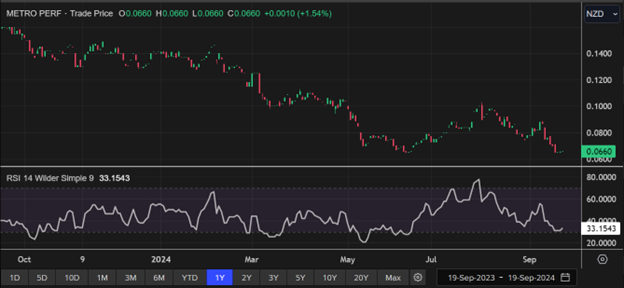
MPG Daily Technical Chart, Data Source: REFINITIV
Technical Commentary
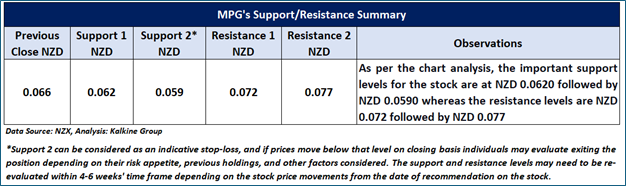
On the daily chart, MPG’s stock prices are experiencing a downtrend characterized by lower lows and lower highs, indicating a negative bias. In contrast, the stock is currently testing a support formed by its previous trough, anticipating for a potential minor rally. Moreover, the momentum oscillator RSI (14-period) is rebounding from its oversold region, adding more evidence to the mentioned recommendation. Prices are trading below both the trend-following indicators 21-period and 50-period SMAs, which might function as dynamic resistance levels for the stock; in contrast, the stock’s nearest round level may act as a sentimental support. A significant support level for the stock is placed at NZD 0.062, while critical resistance level is located at NZD 0.072.
Stock Recommendation
Considering the aforementioned factors, a ‘Speculative Buy’ rating is given on the stock at the closing market price of NZD 0.066 per share, up by 1.54% as on 19 September 2024.
Markets are trading in a highly volatile zone currently due to certain macro-economic issues and geopolitical tensions prevailing. Therefore, it is prudent to follow a cautious approach while investing.
Note 1: Past performance is neither an indicator nor a guarantee of future performance.
Note 2: The reference date for all price data, currency, technical indicators, support, and resistance levels is September 19, 2024. The reference data in this report has been partly sourced from REFINITIV.
Note 3: Investment decisions should be made depending on an individual's appetite for upside potential, risks, holding duration, and any previous holdings. An 'Exit' from the stock can be considered if the Target Price mentioned as per the Valuation and or the technical levels provided has been achieved and is subject to the factors discussed above.
Note 4: Annual Dividend Yield is on a Trailing Twelve Month (TTM1) basis and are subject to change based on factors such as company performance, stock price changes, etc.
Technical Indicators Defined: -
Support: A level at which the stock prices tend to find support if they are falling, and a downtrend may take a pause backed by demand or buying interest. Support 1 refers to the nearby support level for the stock and if the price breaches the level, then Support 2 may act as the crucial support level for the stock.
Resistance: A level at which the stock prices tend to find resistance when they are rising, and an uptrend may take a pause due to profit booking or selling interest. Resistance 1 refers to the nearby resistance level for the stock and if the price surpasses the level, then Resistance 2 may act as the crucial resistance level for the stock.
Stop-loss: It is a level to protect further losses in case of unfavourable movement in the stock prices.
Disclaimer This report has been issued by Kalkine New Zealand Limited (FSP691351) (NZBN:9429047678101) (“Kalkine”). Kalkine is a Financial Advice Provider (“FAP”) and is authorised by a Class 1 Financial Advice Provider Licence issued by Financial Markets Authority (“FMA”) to provide financial advice. Kalkine provides only general financial advice through its research reports following a person becoming a member. The reports contain buy/sell/hold and other recommendations in relation to equity securities, managed funds and other managed investment schemes and other financial advice products. The recommendations and opinions in this report and on Kalkine website do not take into account any of your investment objectives, financial situation or needs. Before you make a decision about whether to acquire a financial product, you should obtain the Product Disclosure Statement from the product issuer. You should consider the appropriateness of advice taking into account your own objectives, financial situation and needs and seek independent financial advice before making any financial decisions. If you act on the advice in the research reports, you may have to pay fees, expenses or other amounts (but not to Kalkine). Further information about the complaints and dispute resolution process, as well as information about Kalkine’s duties are available on Kalkine’s website. Please read our Financial Advice Provider (FAP) disclosure statement and Complaints Handling Guide, which are available on the website.
Past performance is not a reliable indicator of future performance.
 Please wait processing your request...