
 AU
AU
 UK
UK
 CA
CA
 US
US
 IND
IND

 NZ
NZ

Company Overview:
Foley Wines Limited (NZX: FWL) is the collection of iconic wineries and brands from New Zealand's most acclaimed wine regions. Seeka Limited (NZX: SEK) is an integrated horticultural and produce company which grows, processes, distributes and markets high quality produce to world markets.
Kalkine’s Sector Report covers the Key Financial Metrics, Risks, Outlook, Technical Analysis along with the Valuation, Target Price, and Recommendation on the stock.
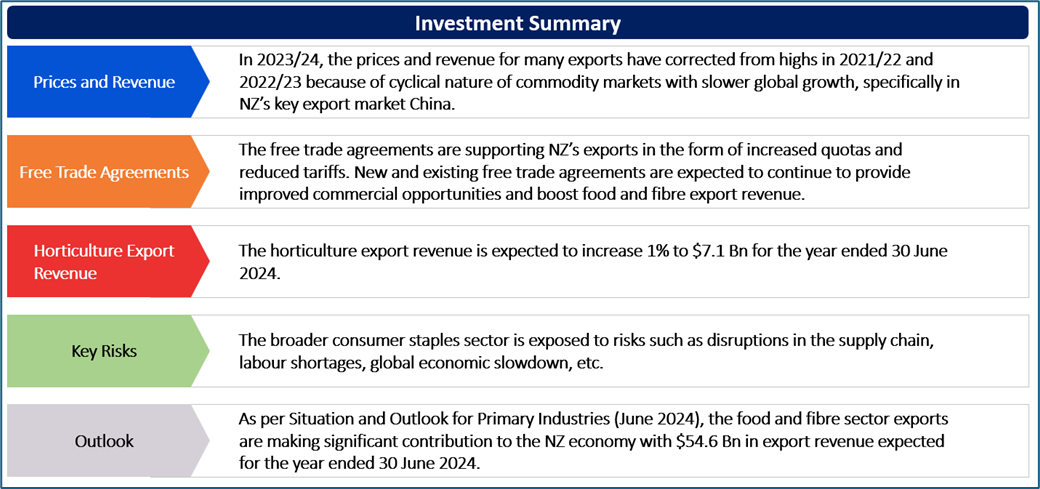
As per Situation and Outlook for Primary Industries (June 2024), in 2023/24, the prices and revenue for many exports have corrected from highs in 2021/22 and 2022/23 because of cyclical nature of commodity markets with slower global growth, specifically in NZ’s key export market China. The slowdown in global economic growth over previous 2 years is because of considerable surge in inflation, tightening of monetary policy, and rising geopolitical tensions.
In 2023/24, the rise in revenue for some of the smaller and emerging sectors is anticipated to limit overall decline in food and fibre export revenue. This forecast implies food and fibre sector’s diversity, which adds the level of resilience. The food and fibre sector is well-placed to ride through this cycle and start capitalising again whenever there is improvement in demand.
The free trade agreements are supporting NZ’s exports in the form of increased quotas and reduced tariffs. New and existing free trade agreements are expected to continue to provide improved commercial opportunities and boost food and fibre export revenue.
Exhibit 1: Top 10 Export Destinations (Year to 31 March 2024, NZ$ Mn)
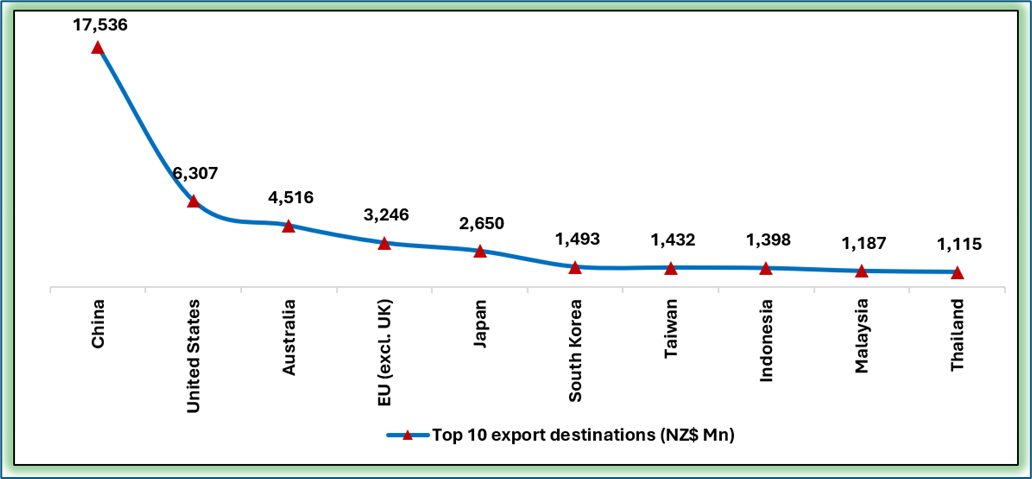
Data Source: This work is based on/includes Stats NZ’s data which are licensed by Stats NZ for reuse under the Creative Commons Attribution 4.0 International Licence; Chart Created by Kalkine Group
Fruit Quality Might Help Prices
The horticulture export revenue is expected to increase 1% to $7.1 Bn for the year ended 30 June 2024. The harvests were assisted by good supply of seasonal labour with both Recognised Seasonal Employer scheme workers and backpackers available, meaning picking as well as packing have been able to run at levels which are needed to handle the increased crops.
The demand for NZ fruit in the early phase of the 2024 selling season from the main markets in Asia and the Middle East was reported as steady. Notably, there is potential for higher demand from Germany, which is the largest European market for NZ apple exports, as a result of reduced domestic production in 2023 harvest. The NZ growers and exporters are confident that high quality of the 2024 crop would be supporting with repeat sales as well as minimise losses in storage.
Exhibit 2: Apple and Pear Revenue 2020–23
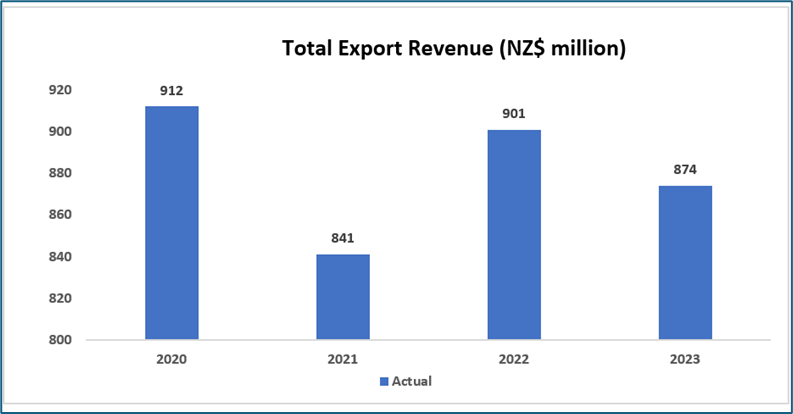
Data Source: This work is based on/includes Stats NZ’s data which are licensed by Stats NZ for reuse under the Creative Commons Attribution 4.0 International Licence; Chart Created by Kalkine Group
Kiwifruit Export Revenue to Recover
The kiwifruit export revenue is expected to rise 28% in the 2024/25 season (year to 31 March) to $3.3 Bn following the declines of 3% and 4% in the previous 2 seasons. The good weather this season witnessed a large quantity of good–quality fruit. This contrasts with poor growing conditions in the 2022/23 season as well as the quality issues impacting revenue in 2022/23.
This season’s forecast is for the 38% rise in green and 24% increase in gold harvests. This would put production at the record of ~180 million trays. The drier El Niño weather this summer has likely contributed to the good growing as well as harvest conditions. The higher production is expected with increasing planted area, developing management practices, along with technology all supporting this growth.
Key Risks and Challenges:
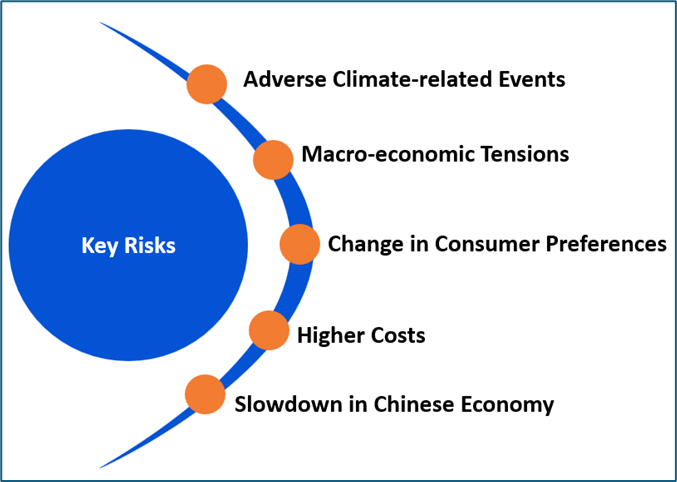
The broader consumer staples sector is exposed to risks such as disruptions in the supply chain, labour shortages, global economic slowdown, etc. Also, geopolitical tensions could trigger the global energy and food crisis.
Notably, NZ dairy farmers have witnessed considerable inflationary pressures over the previous 3 seasons. However, the rate of price increases has slowed significantly over previous 15 months. While the inflationary pressure on some farm expenses is easing, expenses associated with debt servicing continued to increase. Moreover, slowdown in the Chinese economy could also hit the consumer staples sector in NZ.
Exhibit 3. Key Risks in Consumer Staples Sector:
Source: Analysis by Kalkine Group
Outlook:
As per Situation and Outlook for Primary Industries (June 2024), the food and fibre sector exports are making significant contribution to the NZ economy with $54.6 Bn in export revenue expected for the year ended 30 June 2024. Looking to 2024/25, the export revenue is forecasted to rebound by 6% to a record $58.1 Bn. However, increased global production and export volumes for food commodities are weighing over export prices. The weaker NZD against the USD supported export revenue in 2023/24. Notably, export revenue is forecast to improve in 2024/25 because of improving market conditions and demand.
Notably, the strengthening export revenue in the dairy, meat, forestry, horticulture, seafood, and processed food and other products sectors is expected to enable growth while the arable sector is forecasted to maintain revenue level. Domestically, farm input costs are expected to remain elevated in 2024/25, impacting producer profitability. The pace of input cost growth has slowed as well as lower interest rates over the medium term would be providing some relief. With respect to labour, pressures are forecasted to remain lower than the COVID-19 period because of sufficient supply of migrant workers.
Apart from the sector-specific factors, an analysis on three NZX-listed companies is provided. This report covers their insights, outlook, performance and potential as expected to be delivered in the near to medium term.
1) Foley Wines Limited (Recommendation: Speculative Buy, Potential Upside: Low Double-Digit) (M-Cap: NZD 50.6 million)
Business Description:
Foley Wines Limited (NZX: FWL) is the collection of iconic wineries and brands from New Zealand's most acclaimed wine regions.
Outlook:
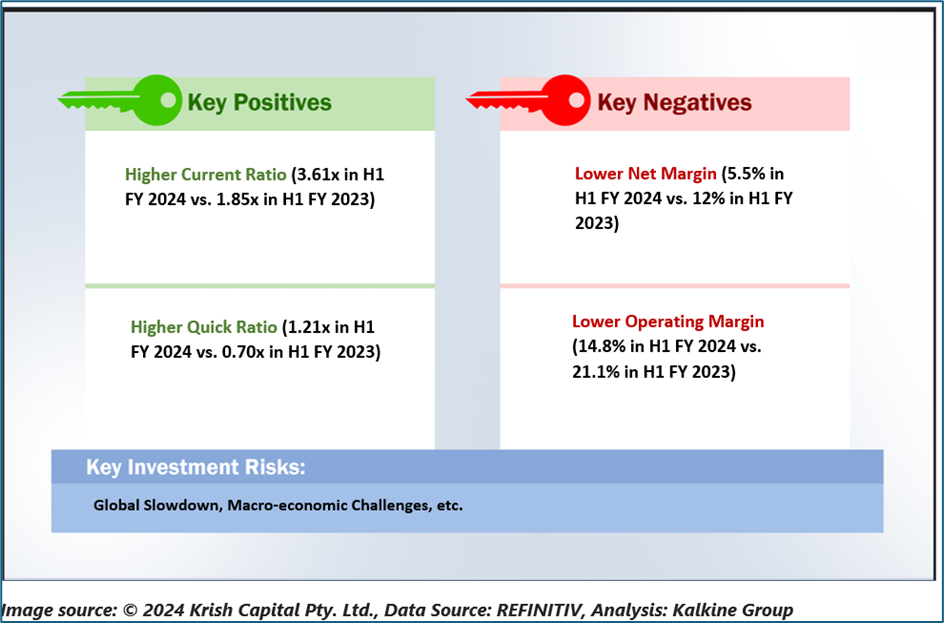
Notwithstanding the headwinds, FWL is expecting that it has routes to market which would enable the company to sell the brands. The company continues to secure strong new routes to market for the premium portfolio. Also, it has established some strong global partnerships which will certainly help in navigating the headwinds in the global economy.
Technical Overview:
Technical Commentary
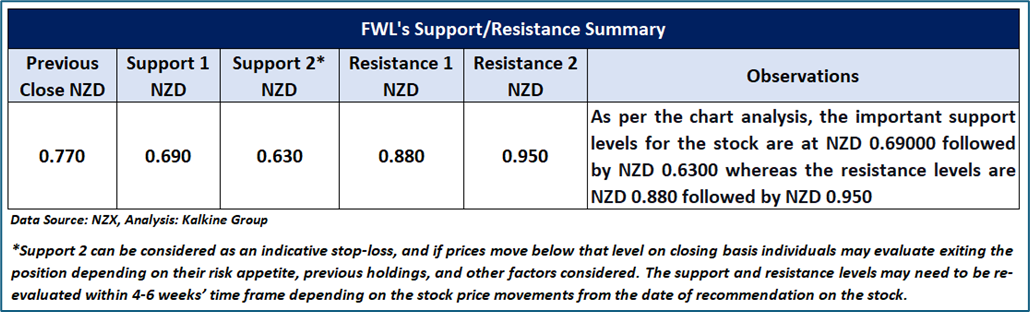
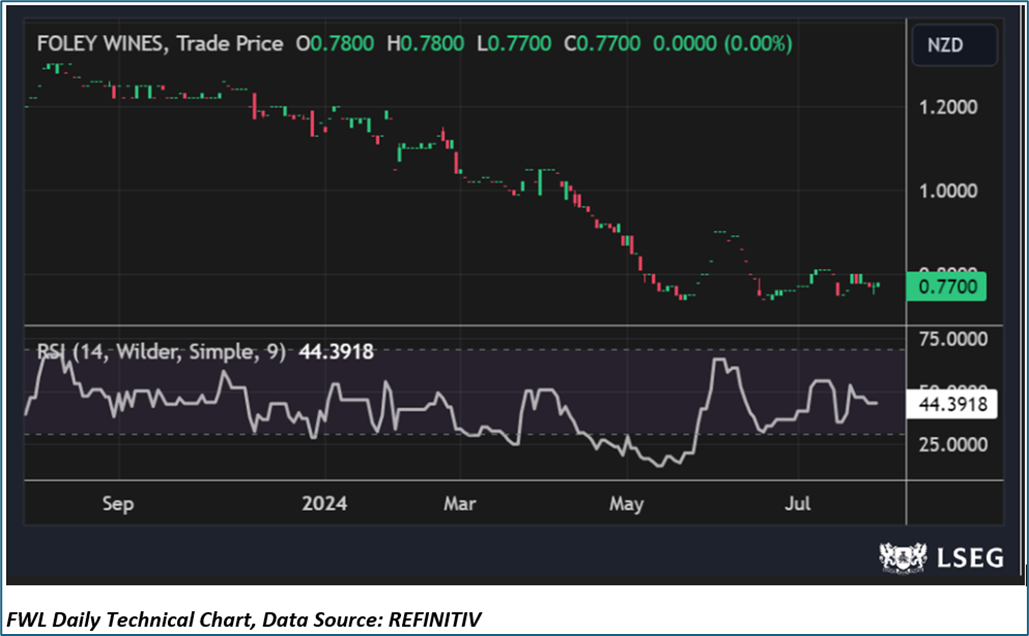
While experiencing a downtrend, FWL’s stock prices are forming a trading range characterized by lower highs and higher lows, suggesting that the sideways period on the stock might continue to remain in place in the near term. In addition, the momentum oscillator RSI (14-period) is trading near the midpoint, providing further support for the previous observation. Prices are trading between its previous peak and trough, which may serve as resistance and supports levels for the stock, respectively. An important support level for the stock is situated at NZD 0.69, while crucial resistance level is placed at NZD 0.88.
Stock Recommendation
FWL was last covered on June 27, 2024. Considering the facts above, a ‘Speculative Buy’ recommendation on the stock has been provided at the closing market price of NZD 0.770 per share as on 25th July 2024
2) Seeka Limited (Recommendation: Buy, Potential Upside: Low Double-Digit) (M-Cap: NZD 102.2 Mn)
Business Description:
Seeka Limited (NZX: SEK) is an integrated horticultural and produce company which grows, processes, distributes and markets high quality produce to world markets.
Outlook:
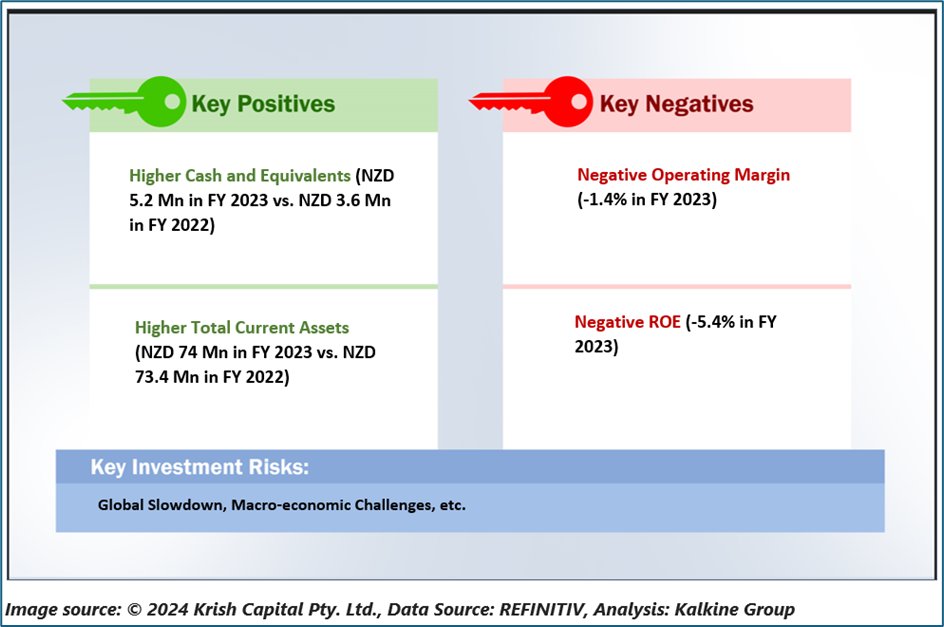
SEK advised that it has completed the financial forecasts for the year ending 31 December 2024 indicating an expected net profit before tax in the range of $15 million to $19 million. This compares to the net loss before tax of $21 Mn in the prior year. SEK is a seasonal business and the company is expecting to record a greater proportion of the full year profit in the first six months ended 30 June 2024. SEK’s strategy revolves around building revenue streams. It is focusing towards lifting returns as well as adding complementary services and products.
Technical Overview:
Technical Commentary
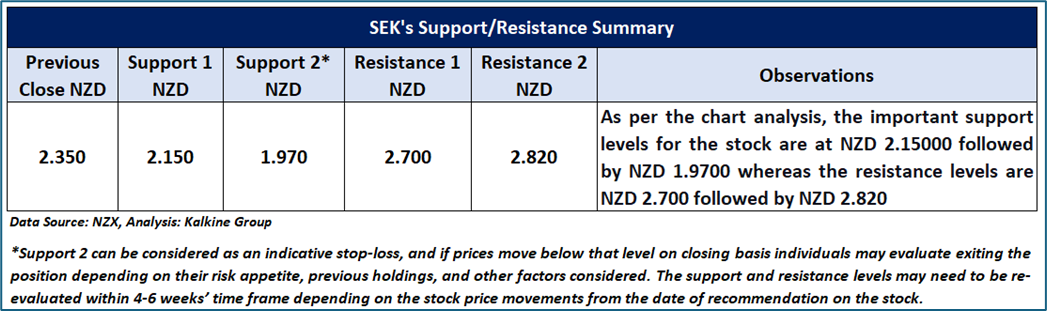
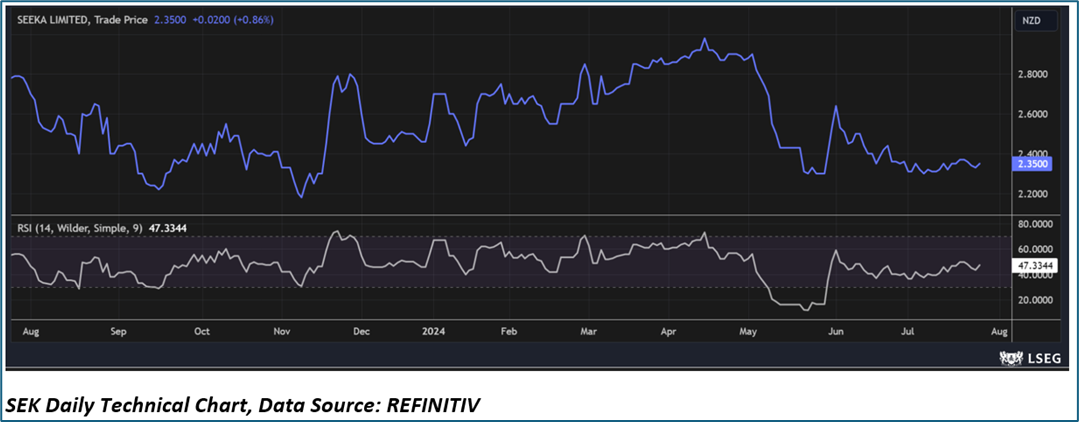
While experiencing a downtrend, SEK’s stock prices are developing a trading range on the daily chart characterized by identical highs and lows, suggesting that the sideways period on the stock might continue to persist in the near future. Moreover, the momentum oscillator RSI (14-period) is hovering near the midpoint, adding further evidence for the mentioned recommendation. Prices are fluctuating between its previous peak and trough, which may function as dynamic resistance and support levels for the stock, respectively. An important support level for the stock is placed at NZD 2.15, while key resistance level is situated at NZD 2.70.
Fundamental Valuation
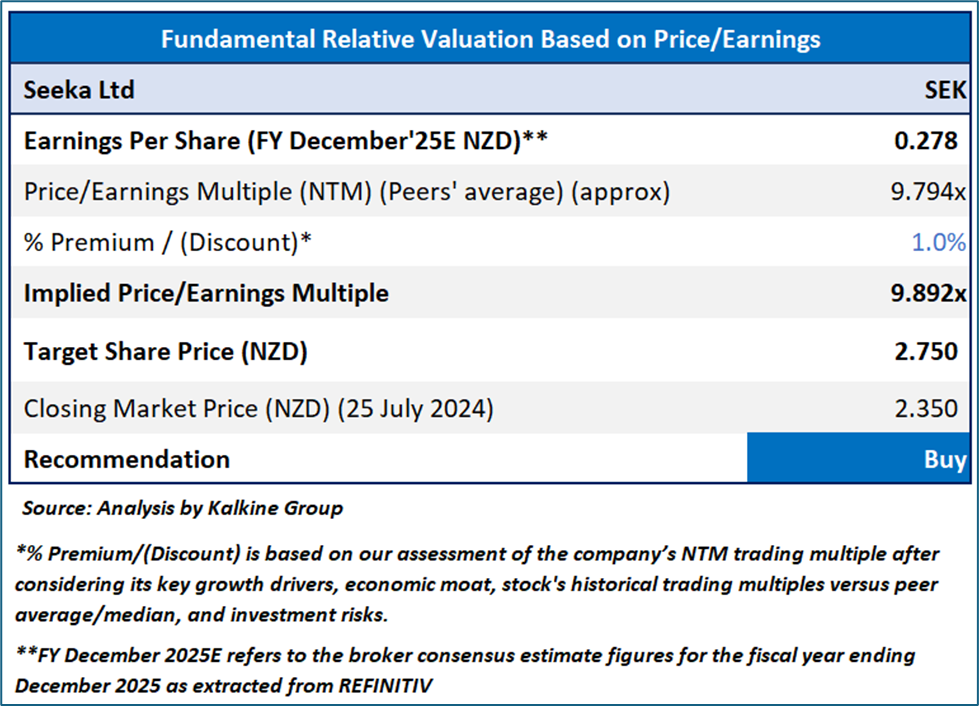
P/E Based Relative Valuation
Stock Recommendation
SEK was last covered on July 10, 2024. Considering the facts above, a ‘Buy’ recommendation on the stock has been provided at the closing market price of NZD 2.350 per share, up by 0.86% as on 25th July 2024.
Markets are trading in a highly volatile zone currently due to certain macro-economic issues and geopolitical tensions prevailing. Therefore, it is prudent to follow a cautious approach while investing.
Note 1: Past performance is not a reliable indicator of future performance.
Note 2: The reference date for all price data, currency, technical indicators, support, and resistance levels is July 25, 2024. The reference data in this report has been partly sourced from REFINITIV.
Note 3: Investment decisions should be made depending on an individual's appetite for upside potential, risks, holding duration, and any previous holdings. An 'Exit' from the stock can be considered if the Target Price mentioned as per the Valuation and or the technical levels provided has been achieved and is subject to the factors discussed above.
Note 4: Annual Dividend Yield is on a Trailing Twelve Month (TTM1) basis and are subject to change based on factors such as company performance, stock price changes, etc.
Technical Indicators Defined: -
Support: A level at which the stock prices tend to find support if they are falling, and a downtrend may take a pause backed by demand or buying interest. Support 1 refers to the nearby support level for the stock and if the price breaches the level, then Support 2 may act as the crucial support level for the stock.
Resistance: A level at which the stock prices tend to find resistance when they are rising, and an uptrend may take a pause due to profit booking or selling interest. Resistance 1 refers to the nearby resistance level for the stock and if the price surpasses the level, then Resistance 2 may act as the crucial resistance level for the stock.
Stop-loss: It is a level to protect further losses in case of unfavourable movement in the stock prices.
Disclaimer This report has been issued by Kalkine New Zealand Limited (FSP691351) (NZBN:9429047678101) (“Kalkine”). Kalkine is a Financial Advice Provider (“FAP”) and is authorised by a Class 1 Financial Advice Provider Licence issued by Financial Markets Authority (“FMA”) to provide financial advice. Kalkine provides only general financial advice through its research reports following a person becoming a member. The reports contain buy/sell/hold and other recommendations in relation to equity securities, managed funds and other managed investment schemes and other financial advice products. The recommendations and opinions in this report and on Kalkine website do not take into account any of your investment objectives, financial situation or needs. Before you make a decision about whether to acquire a financial product, you should obtain the Product Disclosure Statement from the product issuer. You should consider the appropriateness of advice taking into account your own objectives, financial situation and needs and seek independent financial advice before making any financial decisions. If you act on the advice in the research reports, you may have to pay fees, expenses or other amounts (but not to Kalkine). Further information about the complaints and dispute resolution process, as well as information about Kalkine’s duties are available on Kalkine’s website. Please read our Financial Advice Provider (FAP) disclosure statement and Complaints Handling Guide, which are available on the website.
Past performance is not a reliable indicator of future performance.
 Please wait processing your request...