
 AU
AU
 UK
UK
 CA
CA
 US
US
 IND
IND

 NZ
NZ

Company Overview:
Delegat Group Limited (NZX: DGL) is a New Zealand-based wine company. Comvita Limited (NZX: CVT) is engaged in manufacturing and marketing nature health products, and native forest management.
Kalkine’s Sector Report covers the Key Financial Metrics, Risks, Outlook, Technical Analysis along with the Valuation, Target Price, and Recommendation on the stock.
I. Sector Landscape and Outlook
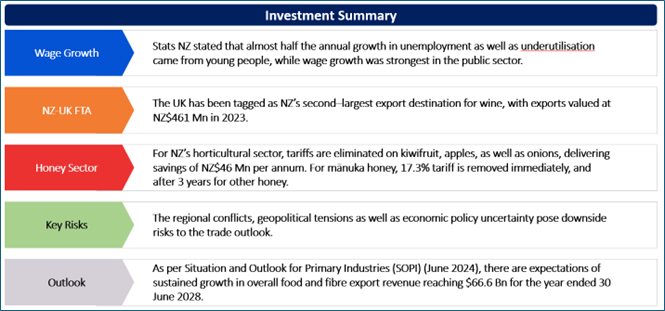
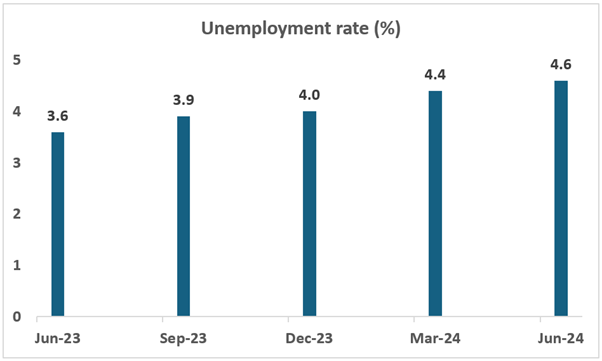
Stats NZ stated that almost half the annual growth in unemployment as well as underutilisation came from young people, while wage growth was strongest in the public sector. In the June 2024 quarter, the unemployment rate stood at 4.6% as well as underutilisation rate was 11.8%. The annual wage inflation was 4.3% and average ordinary time hourly earnings increased 5.0% annually to $41.52. Over the year, unemployment increased by 33,000 to 143,000.
The recent increases in unemployment align with other economic indicators, including increasing number of benefit recipients, a decreasing number of job vacancies as well as declining GDP (gross domestic product) per capita.
As per Situation and Outlook for Primary Industries (June 2024), the climatic conditions were also favourable for most crops recovering from the impacts of previous wet summers as well as cyclone damage. Notably, kiwifruit, apples, cherries, and vegetables all witnessed increases in production.
Exhibit 1: Unemployment Rate, Seasonally Adjusted, June 2023–June 2024 quarters
Data Source: This work is based on/includes Stats NZ’s data which are licensed by Stats NZ for reuse under the Creative Commons Attribution 4.0 International Licence; Chart Created by Kalkine Group
NZ-UK FTA Is A Win For New Zealand Wine
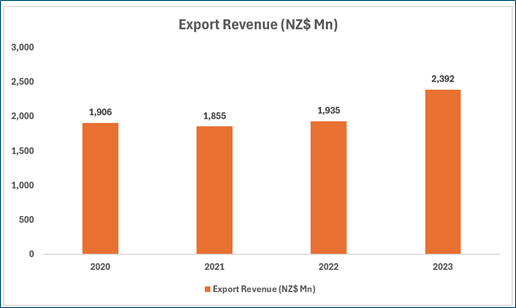
The UK has been tagged as NZ’s second–largest export destination for wine, with exports valued at NZ$461 Mn in 2023. Since entry into force of the NZ-United Kingdom Free Trade Agreement on 31 May 2023, NZ wine exports to the UK have supported from immediate tariff elimination as well as enhanced competitiveness of New Zealand wine in the UK market.
Exhibit 2: Export Revenue (Wine), Year to 30 June, NZ$ Mn
Data Source: This work is based on/includes MPI’s data which are licensed by MPI for reuse under the Creative Commons Attribution 4.0 International Licence; Chart Created by Kalkine Group
The NZ-UK FTA consists of an annex on wine and distilled spirits which provides for comprehensive recognition of NZ wine-making practices and minimising administrative pressures and costs from certification and labelling requirements. As per SOPI (June 2024), NZ currently commands a 51% value share of the Sauvignon Blanc market in the UK throughout grocery and major retail. NZ wine also has a premium price in the UK at £8.37 per bottle of still wine as compared to the overall average of £6.74 per bottle.
Overview of Honey Sector
The NZ-European Union Free Trade Agreement was entered into force on 1st May 2024. As NZ’s fourth-largest trading partner, the EU has been tagged as one of NZ’s most important markets with close to 450 Mn consumers. NZ exports to the EU totalled NZ$3.2 Bn for the year to 31 March 2024. The agreement provides tariff savings of $100 Mn per annum immediately for NZ’s exports, reaching $110 Mn per annum after 7 years.
For NZ’s horticultural sector, tariffs are eliminated on kiwifruit, apples, as well as onions, delivering savings of NZ$46 Mn per annum. For mānuka honey, 17.3% tariff is removed immediately, and after 3 years for other honey.
Key Risks and Challenges:
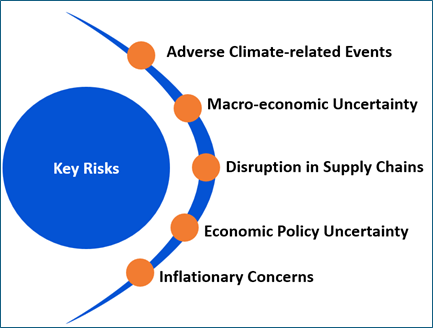
The regional conflicts, geopolitical tensions as well as economic policy uncertainty could impact the broader consumer discretionary sector of New Zealand. Also, despite some improvement in the prices, increased input costs could act as a critical challenge for fishers. Overall, the sector is exposed to risks such as increased labour shortages, inflationary concerns, supply-chain disruptions, etc.
Also, increased borrowing costs from restrictive monetary policies might also act as a hurdle for the companies operating in the consumer discretionary sector.
Exhibit 3. Key Risks in Consumer Discretionary Sector:
Source: Analysis by Kalkine Group
Outlook:
NZ’s food and fibre sector is responsible for more than 80% of New Zealand’s goods exports, and this Government recognises the important role it plays in driving the economic success whether this is via the jobs it provides, the rural communities it supports, or the millions of people around the world it sustainably feeds. As per Situation and Outlook for Primary Industries (SOPI) (June 2024), there are expectations of sustained growth in overall food and fibre export revenue reaching $66.6 Bn for the year ended 30 June 2028.
This strong performance is expected because of food and fibre sector’s successful navigation of significant global events like the pandemic and Cyclone Gabrielle and its resilience achieved through market and product diversification. Other key factors driving the forecasts consist of resilient global economy aided by slow and steady easing of inflation. Notably, the global trade is expected to bounce back after the economic and other shocks like pandemic with export orders already indicating improved conditions for trade in early 2024.
Apart from the sector-specific factors, an analysis on three NZX-listed companies is provided. This report covers their insights, outlook, performance and potential as expected to be delivered in the near to medium term.
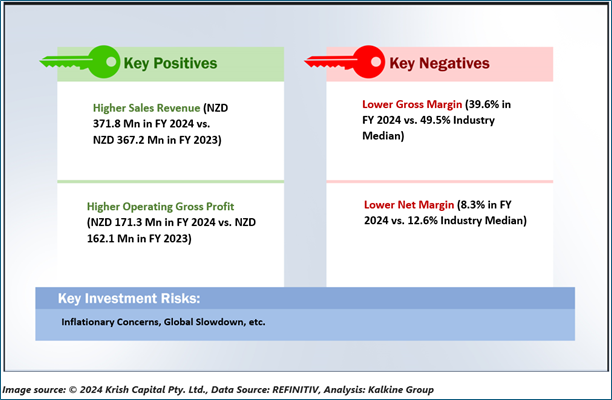
1) Delegat Group Limited (Recommendation: Buy, Potential Upside: Low Double-Digit) (M-Cap: NZD 559.2 million, Annual Dividend Yield: 5.02%1)
Business Description:
Delegat Group Limited (NZX: DGL) is a NZ-based wine company. It invests in wineries and vineyards in the prime grape growing regions of New Zealand and Australia.
Outlook:
DGL is focused towards exploring opportunities to improve case price realisation to improve profit margins. DGL is forecasting to increase case sales by 8% over the upcoming 3 years, with the primary driver of planned growth Oyster Bay sales in North America. The group is also focusing its investment towards consumer marketing in order to drive awareness and affinity.
Technical Overview:
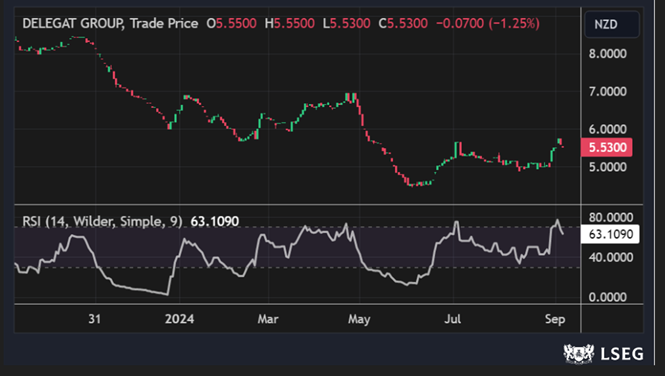
DGL Daily Technical Chart, Data Source: REFINITIV
Technical Commentary
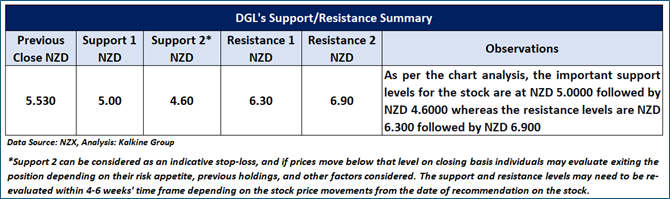
On the daily chart, while experiencing a downtrend, DGL’s stock prices are approaching rebounding from the upper boundary of a downward slope channel, suggesting that current downtrend might resume soon. Moreover, the momentum oscillator RSI (14-period) is heading southward from its oversold region, adding further evidence to the mentioned recommendation. Prices are trading above its previous trough, which might function as a support level for the stock; in contrast, the channel’s upper boundary may serve as a dynamic resistance. A significant support level for the stock is positioned at NZD 5.0, while critical resistance level is located at NZD 6.30.
Fundamental Valuation
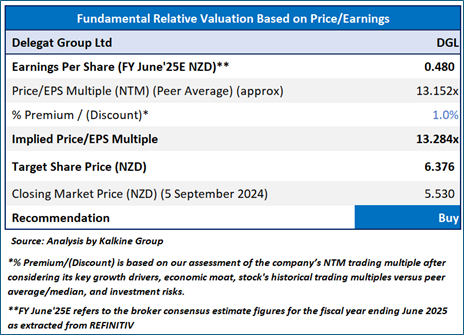
P/E Based Relative Valuation
Stock Recommendation
Considering the facts above, a ‘Buy’ recommendation on the stock has been provided at the closing market price of NZD 5.530 per share, down by 1.25% as on 5 September 2024.
2) Comvita Limited (Recommendation: Speculative Buy, Potential Upside: Low Double-Digit) (M-Cap: NZD 82.9 Mn, Annual Dividend Yield: 4.71%1)
Business Description:
Comvita Limited (NZX: CVT) is engaged in manufacturing and marketing nature health products, and native forest management.
Outlook:
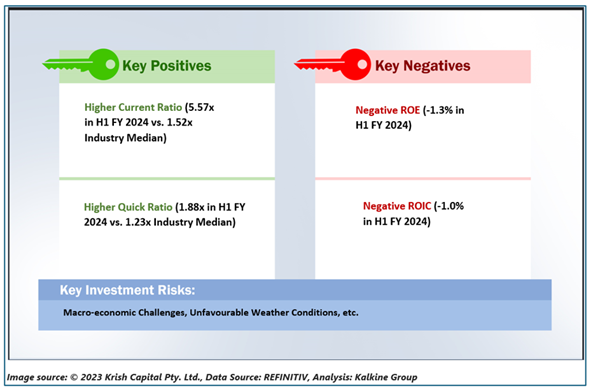
CVT’s emphasis in FY 2025 is towards cost reduction, positive operating cashflow as well as debt reduction. Commercially, the business would be targeting value-seeking consumers with new entry point ranges. The company recently announced its $10 Mn - $15 Mn annualised cost-out programme targeting $5 Mn – $8 Mn of cost of sale reductions as well as $5 Mn - $7 Mn of opex savings.
Technical Overview:
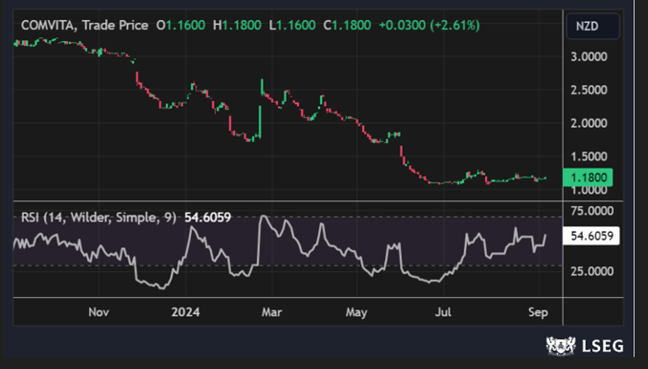
CVT Daily Technical Chart, Data Source: REFINITIV
Technical Commentary
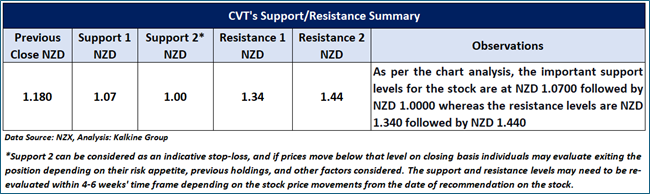
While experiencing a downtrend, CVT’s stock prices are developing a symmetrical triangle pattern characterized by higher lows and lower highs, indicating that the sideways period in the stock might continue to persist in the near future. In addition, the momentum oscillator RSI (14-period) is trading near its midpoint, providing further support for the previous observation. Prices are trading between its previous peak and trough, which might function as resistance and support levels for the stock, respectively. An important support level for the stock is placed at NZD 1.07, while key resistance level is situated at NZD 1.34.
Fundamental Valuation
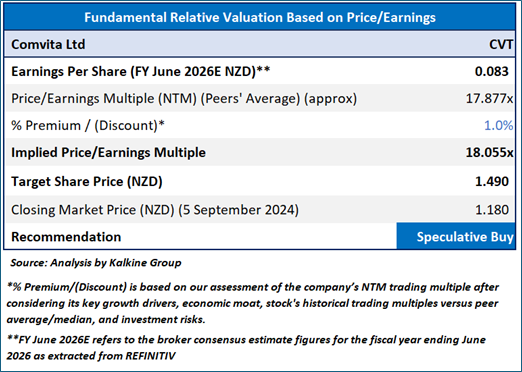
P/E Based Relative Valuation
Stock Recommendation
Considering the facts above, a ‘Speculative Buy’ recommendation on the stock has been provided at the closing market price of NZD 1.18 per share, up by 2.61% as on 5 September 2024
Markets are trading in a highly volatile zone currently due to certain macro-economic issues and geopolitical tensions prevailing. Therefore, it is prudent to follow a cautious approach while investing.
Note 1: Past performance is not a reliable indicator of future performance.
Note 2: The reference date for all price data, currency, technical indicators, support, and resistance levels is September 5, 2024. The reference data in this report has been partly sourced from REFINITIV.
Note 3: Investment decisions should be made depending on an individual's appetite for upside potential, risks, holding duration, and any previous holdings. An 'Exit' from the stock can be considered if the Target Price mentioned as per the Valuation and or the technical levels provided has been achieved and is subject to the factors discussed above.
Note 4: Annual Dividend Yield is on a Trailing Twelve Month (TTM1) basis and are subject to change based on factors such as company performance, stock price changes, etc.
Technical Indicators Defined: -
Support: A level at which the stock prices tend to find support if they are falling, and a downtrend may take a pause backed by demand or buying interest. Support 1 refers to the nearby support level for the stock and if the price breaches the level, then Support 2 may act as the crucial support level for the stock.
Resistance: A level at which the stock prices tend to find resistance when they are rising, and an uptrend may take a pause due to profit booking or selling interest. Resistance 1 refers to the nearby resistance level for the stock and if the price surpasses the level, then Resistance 2 may act as the crucial resistance level for the stock.
Stop-loss: It is a level to protect further losses in case of unfavourable movement in the stock prices.
Disclaimer This report has been issued by Kalkine New Zealand Limited (FSP691351) (NZBN:9429047678101) (“Kalkine”). Kalkine is a Financial Advice Provider (“FAP”) and is authorised by a Class 1 Financial Advice Provider Licence issued by Financial Markets Authority (“FMA”) to provide financial advice. Kalkine provides only general financial advice through its research reports following a person becoming a member. The reports contain buy/sell/hold and other recommendations in relation to equity securities, managed funds and other managed investment schemes and other financial advice products. The recommendations and opinions in this report and on Kalkine website do not take into account any of your investment objectives, financial situation or needs. Before you make a decision about whether to acquire a financial product, you should obtain the Product Disclosure Statement from the product issuer. You should consider the appropriateness of advice taking into account your own objectives, financial situation and needs and seek independent financial advice before making any financial decisions. If you act on the advice in the research reports, you may have to pay fees, expenses or other amounts (but not to Kalkine). Further information about the complaints and dispute resolution process, as well as information about Kalkine’s duties are available on Kalkine’s website. Please read our Financial Advice Provider (FAP) disclosure statement and Complaints Handling Guide, which are available on the website.
Past performance is not a reliable indicator of future performance.
 Please wait processing your request...