
 AU
AU
 UK
UK
 CA
CA
 US
US
 IND
IND

 NZ
NZ

Company Overview:
Foley Wines Limited (NZX: FWL) is an integrated wine company producing table wines with the marketing and sales of premium wines in New Zealand and various export markets. KMD Brands Limited (NZX: KMD) is a global outdoor, lifestyle as well as sports company. The company is a designer, marketer, retailer and wholesaler of apparel, footwear and equipment for surfing and the outdoors.
Kalkine’s Sector Report covers the Key Financial Metrics, Risks, Outlook, Technical Analysis along with the Valuation, Target Price, and Recommendation on the stock.
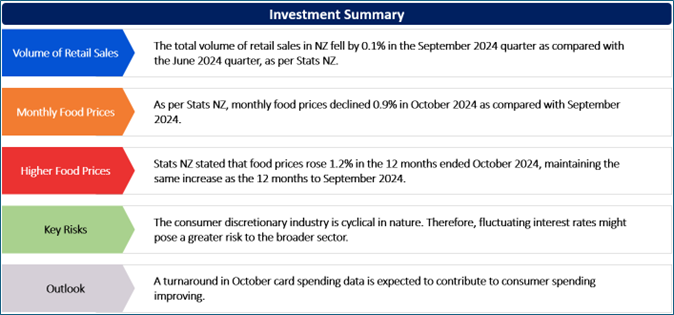
The total volume of retail sales in NZ fell by 0.1% in the September 2024 quarter as compared with the June 2024 quarter, as per Stats NZ. Ten of the 15 retail industries witnessed lower retail sales volumes in the September 2024 quarter as compared with the June 2024 quarter, after adjusting for price inflation and seasonal effects. Notably, the largest contributors to the fall in retail activity were supermarket and grocery stores, down 1.3%, and food and beverage services, down 2.1%.
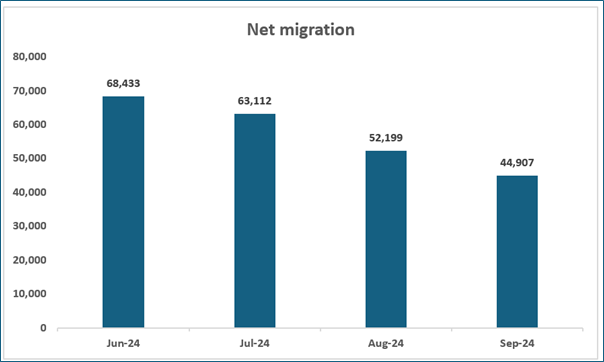
Also, NZ had a net migration gain of 44,900 in the September 2024 year, as per the provisional estimates released by Stats NZ on 13th November 2024. As per the release, annual net migration gains have continued falling from the provisional peak of 136,300 in the October 2023 year. The fall in net migration reflected that arrivals were down, and departures were up. There were 177,900 migrant arrivals in the September 2024 year, still high by historical standards. This compared with the record 235,500 migrant arrivals in the October 2023 year.
Exhibit 1: Estimated Migration, Rolling Year Ended June 2024–September 2024
Data Source: This work is based on/includes Stats NZ’s data which are licensed by Stats NZ for reuse under the Creative Commons Attribution 4.0 International Licence; Chart Created by Kalkine Group
Food Prices Declined in October 2024
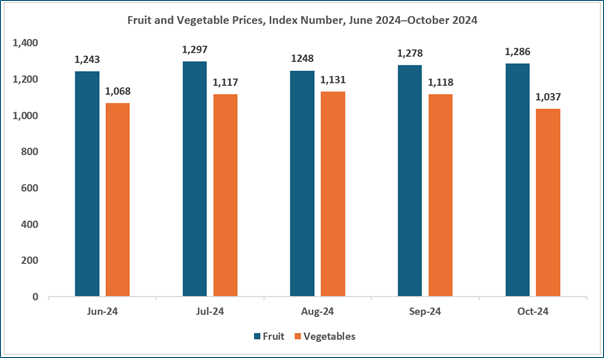
As per Stats NZ, monthly food prices declined 0.9% in October 2024 as compared with September 2024. The largest contributor to the decline was vegetables, down by 7.2%. This was partly offset by higher fruit prices, up by 0.6%. Over the last 2 years, vegetable prices declined 14.2%, while fruit prices increased 8.0%. In October, veggies were cheaper because of falling prices for tomatoes, cucumber, and capsicum, while apples, oranges, and bananas pushed up fruit prices. Overall, fruit and vegetable prices declined 4.1% in October 2024.
Stats NZ stated that food prices rose 1.2% in the 12 months ended October 2024, maintaining the same increase as the 12 months to September 2024. Higher prices for restaurant meals and ready-to-eat food and grocery food drove the annual rise in food prices, up 3.4% and 2.5%, respectively.
Exhibit 2: Fruit and Vegetable Prices, Index Number, June 2024 – October 2024
Data Source: This work is based on/includes Stats NZ’s data which are licensed by Stats NZ for reuse under the Creative Commons Attribution 4.0 International Licence; Chart Created by Kalkine Group
Key Risks and Challenges:
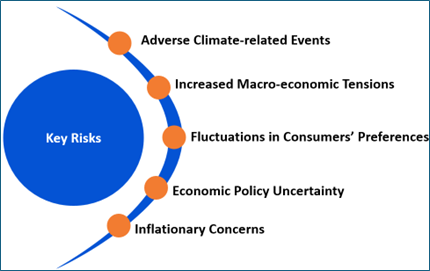
The regional conflicts, geopolitical tensions as well as economic policy uncertainty pose downside risks to the broader consumer discretionary sector. Apart from these risks, increased labour shortages and inflationary concerns are some of the additional concerns. Uncertainty related to the economic policies in the US might also impact the consumer behaviour and consumer confidence. These factors might result in lower discretionary spending, which might weigh over the broader consumer discretionary sector.
Exhibit 3. Key Risks in Consumer Discretionary Sector:
Source: Analysis by Kalkine Group
Outlook:
As per FEU dated 29th November 2024, retail spending may have flattened off. Of note, spending on discretionary goods witnessed a bounce back with motor vehicles, and electrical and electronic goods, both lifted strongly. The easing monetary policy is providing businesses a sense of optimism. According to the November ANZ Business Outlook (ANZBO), business confidence remains elevated at +65 and expected price and cost increases ease.
Meanwhile, a turnaround in October card spending data is expected to contribute to consumer spending improving. Stats NZ’s electronic card transactions release witnessed retail sales rise for the third month in a row, up 1.5% over the previous 3 months. Alos, the global markets have been responding to news around the US President-elect Trump’s policy plans and cabinet choices.
As per RBNZ, economic growth is expected to recover during 2025, as lower interest rates encourage investment and other spending. However, employment growth is expected to remain weak until mid-2025 and, for some, financial stress will take time to ease.
Apart from the sector-specific factors, an analysis on 2 NZX-listed companies is provided. This report covers their insights, outlook, performance and potential as expected to be delivered in the near to medium term.
1) Foley Wines Limited (Recommendation: Speculative Buy, Potential Upside: Low Double-Digit) (M-Cap: NZD 42.0 million)
Business Description:
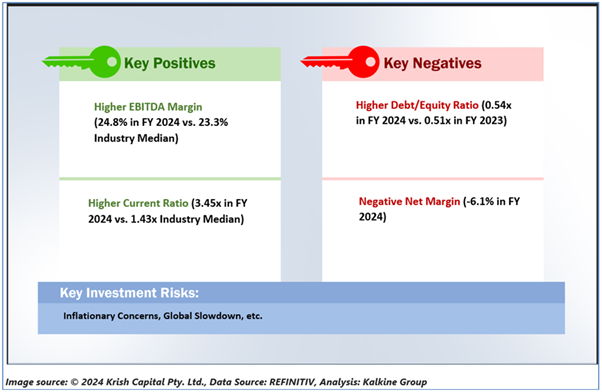
Foley Wines Limited (NZX: FWL) is an integrated wine company producing table wines with the marketing and sales of premium wines in New Zealand and various export markets.
Outlook:
FWL’s long-term strategic priorities revolve around realising the premiumisation strategy, leveraging the power of the portfolio and nurturing strong, long-term relationships. The company’s key focus is towards reducing debt this financial year and to manage capex prudently. Also, the company is focusing towards seeking out and cementing new opportunities and building momentum with The Runholder brand home.
Technical Overview:
Technical Commentary
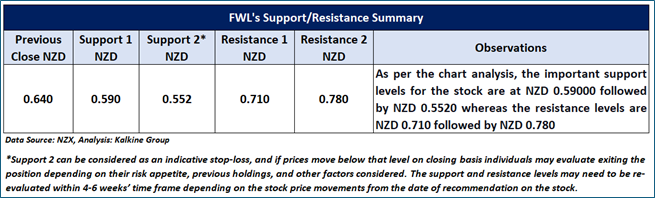
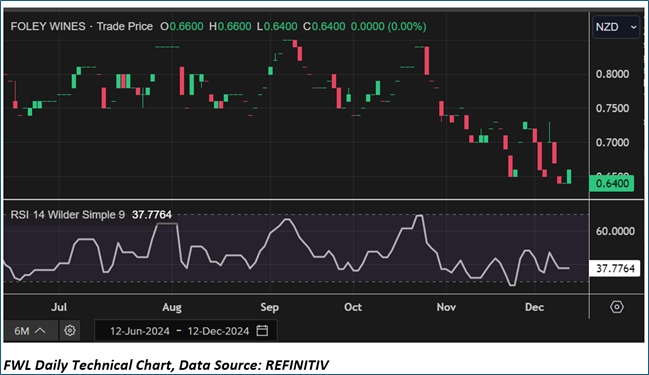
On the daily chart, FWL’s stock prices are forming a downtrend characterized by lower highs and lower lows, indicating a negative bias. Additionally, the momentum oscillator RSI (14-period) is trading below its midpoint, adding further evidence to the mentioned recommendation. Prices are trading below the 21-period a 50-period SMAs, which might function as a resistance levels for the stock; in contrast, the stock’s next round level might act as a sentimental support. An important support level for the stock is situated at NZD 0.59, while crucial resistance level is placed at NZD 0.71
Stock Recommendation
Considering the facts above, a ‘Speculative Buy’ recommendation on the stock has been provided at the closing market price of NZD 0.64 per share as on 12 December 2024
2) KMD Brands Limited (Recommendation: Buy, Potential Upside: Low Double-Digit) (M-Cap: NZD 291.7 Mn)
Business Description:
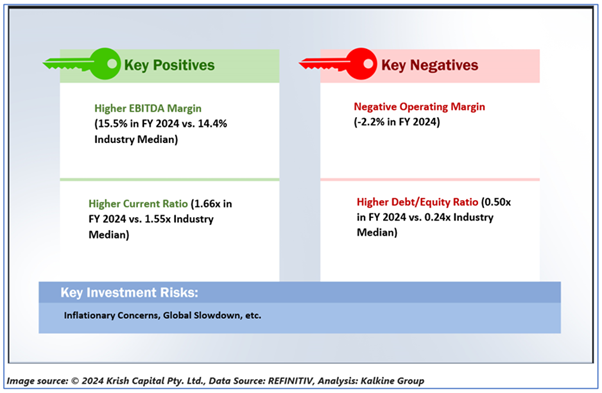
KMD Brands Limited (NZX: KMD) is a global outdoor, lifestyle as well as sports company. The company is a designer, marketer, retailer and wholesaler of apparel, footwear and equipment for surfing and the outdoors.
Outlook:
The company is encouraged that Kathmandu has continued to show an improving sales trend through the first quarter of the new financial year. Notably, refreshed authentic outdoor brand advertising has outperformed previous campaigns in Kathmandu’s largest market Australia. Brand awareness has improved, and the company is expecting that the new campaign will have a positive impact on building key long-term brand associations.
Technical Overview:
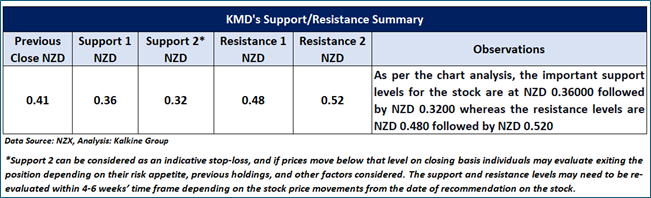
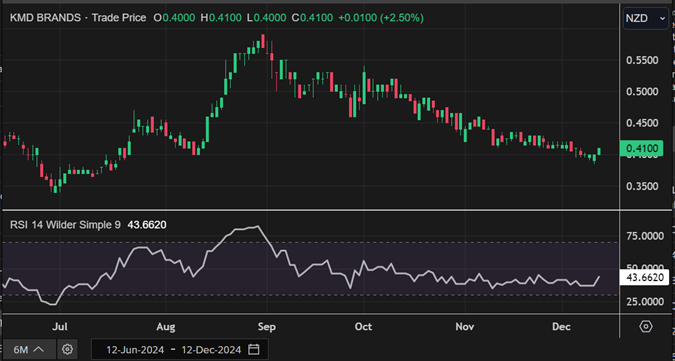
KMD Daily Technical Chart, Data Source: REFINITIV
Technical Commentary
While experiencing a downtrend, KMD’s stock prices are forming a descending wedge pattern, suggesting that the downside momentum in stock has been halting. Moreover, the momentum oscillator RSI (14-period) is forming a bottom divergence in relation to prices, adding further evidence for the mentioned recommendation. Prices are trading below both 21-period and 50-period SMAs, which might function as dynamic resistance levels for the stock; in contrast, the stock's previous trough may act as a support. An important support level for the stock is placed at NZD 0.360, while key resistance level is situated at NZD 0.480.
Fundamental Valuation
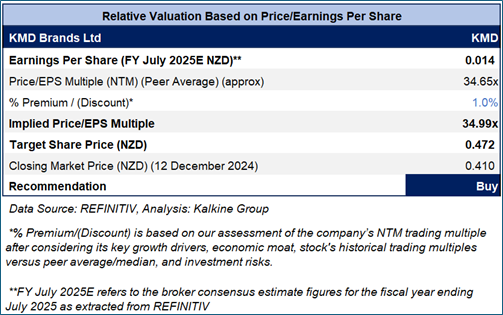
P/E Based Relative Valuation
Stock Recommendation
Considering the facts above, a ‘Buy’ recommendation on the stock has been provided at the closing market price of NZD 0.410 per share, up by 2.50% as on 12 December 2024.
Markets are trading in a highly volatile zone currently due to certain macro-economic issues and geopolitical tensions prevailing. Therefore, it is prudent to follow a cautious approach while investing.
Note 1: Past performance is not a reliable indicator of future performance.
Note 2: The reference date for all price data, currency, technical indicators, support, and resistance levels is December 12, 2024. The reference data in this report has been partly sourced from REFINITIV.
Note 3: Investment decisions should be made depending on an individual's appetite for upside potential, risks, holding duration, and any previous holdings. An 'Exit' from the stock can be considered if the Target Price mentioned as per the Valuation and or the technical levels provided has been achieved and is subject to the factors discussed above.
Note 4: Annual Dividend Yield is on a Trailing Twelve Month (TTM1) basis and are subject to change based on factors such as company performance, stock price changes, etc.
Note 5: Kalkine reports are prepared based on the stock prices captured either from REFINITIV or Trading View. Typically, REFINITIV or Trading View may reflect stock prices with a delay which could be a lag of 25-30 minutes. There can be no assurance that future results or events will be consistent with the information provided in the report. The information is subject to change without any prior notice.
Technical Indicators Defined: -
Support: A level at which the stock prices tend to find support if they are falling, and a downtrend may take a pause backed by demand or buying interest. Support 1 refers to the nearby support level for the stock and if the price breaches the level, then Support 2 may act as the crucial support level for the stock.
Resistance: A level at which the stock prices tend to find resistance when they are rising, and an uptrend may take a pause due to profit booking or selling interest. Resistance 1 refers to the nearby resistance level for the stock and if the price surpasses the level, then Resistance 2 may act as the crucial resistance level for the stock.
Stop-loss: It is a level to protect further losses in case of unfavourable movement in the stock prices.
Disclaimer This report has been issued by Kalkine New Zealand Limited (FSP691351) (NZBN:9429047678101) (“Kalkine”). Kalkine is a Financial Advice Provider (“FAP”) and is authorised by a Class 1 Financial Advice Provider Licence issued by Financial Markets Authority (“FMA”) to provide financial advice. Kalkine provides only general financial advice through its research reports following a person becoming a member. The reports contain buy/sell/hold and other recommendations in relation to equity securities, managed funds and other managed investment schemes and other financial advice products. The recommendations and opinions in this report and on Kalkine website do not take into account any of your investment objectives, financial situation or needs. Before you make a decision about whether to acquire a financial product, you should obtain the Product Disclosure Statement from the product issuer. You should consider the appropriateness of advice taking into account your own objectives, financial situation and needs and seek independent financial advice before making any financial decisions. If you act on the advice in the research reports, you may have to pay fees, expenses or other amounts (but not to Kalkine). Further information about the complaints and dispute resolution process, as well as information about Kalkine’s duties are available on Kalkine’s website. Please read our Financial Advice Provider (FAP) disclosure statement and Complaints Handling Guide, which are available on the website.
Past performance is not a reliable indicator of future performance.
 Please wait processing your request...