
 AU
AU
 UK
UK
 CA
CA
 US
US
 IND
IND

 NZ
NZ

Company Overview:
Delegat Group Limited (NZX: DGL) is a New Zealand-based wine company. The company invests in wineries and vineyards in the prime grape- growing regions of Australia and New Zealand. SkyCity Entertainment Group Limited (NZX: SKC) is a tourism, leisure and entertainment company.
Kalkine’s Sector Report covers the Key Financial Metrics, Risks, Outlook, Technical Analysis along with the Valuation, Target Price, and Recommendation on the stock.
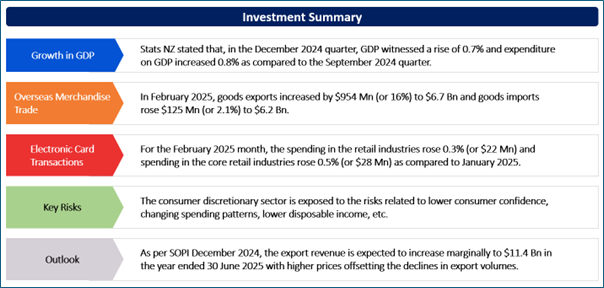
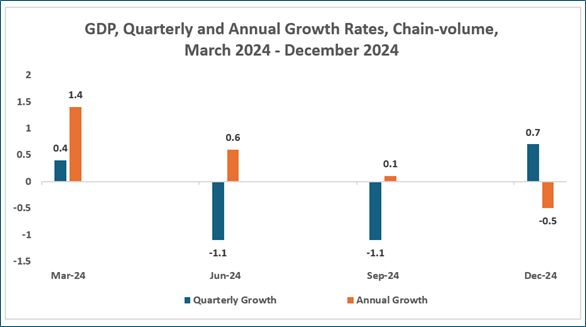
Stats NZ stated that, in the December 2024 quarter, GDP witnessed a rise of 0.7% and expenditure on GDP increased 0.8% as compared to the September 2024 quarter. Notably, the GDP per capita increased 0.4% and real gross national disposable income witnessed a rise of 1.5%. The rental, hiring, and real estate services increased 1.1% driven by rental and hiring services (except real estate), real estate services, and owner-occupied property operation (the imputed rental services which homeowners get from living in their own home). Notably, the retail trade and accommodation increased 1.9% because of accommodation, food and beverage services, and recreational, clothing, footwear, and personal accessory retailing.
However, the construction declined 3.1% as a result of construction services, non-residential and residential building construction. The information media and telecommunications fell 3.0%.
Exhibit 1: Gross Domestic Product, Quarterly and Annual Growth Rates, Chain-Volume
Data Source: This work is based on/includes Stats NZ’s data which are licensed by Stats NZ for reuse under the Creative Commons Attribution 4.0 International Licence; Chart Created by Kalkine Group
Overseas Merchandise Trade: February 2025
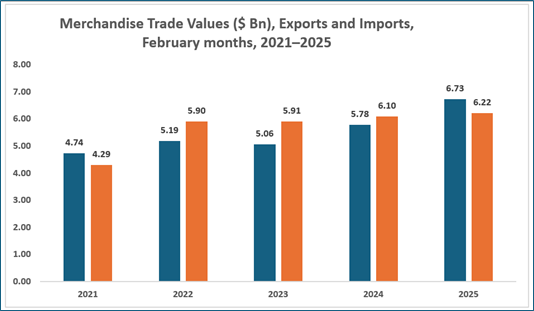
Stats NZ released data about overseas merchandise trade (February 2025). In February 2025, goods exports increased by $954 Mn (or 16%) to $6.7 Bn and goods imports rose $125 Mn (or 2.1%) to $6.2 Bn. Notably, the monthly trade balance was a surplus of $510 Mn. With respect to exports, milk powder, butter, and cheese rose $486 Mn (or 27%) to $2.3 Bn, while other dairy-based products, which include infant formula and casein and caseinates, also increased during the period. Infant formula is included in preparations of milk, cereals, flour, and starch, that increased $114 Mn (or 61%), to $303 Mn.
Exhibit 2: Merchandise Trade Values ($ Bn), Exports and Imports, February Months, 2021–2025
Data Source: This work is based on/includes MPI’s data which are licensed for reuse under the Creative Commons Attribution 4.0 International Licence; Chart Created by Kalkine Group
Electronic Card Transactions: February 2025
Stats NZ released data about electronic card transactions (February 2025). For the February 2025 month, the spending in the retail industries rose 0.3% (or $22 Mn) and spending in the core retail industries rose 0.5% (or $28 Mn) as compared to January 2025. By the retail spending category, consumables rose $16 Mn (or 0.6%), apparel increased $3.4 million (or 1.0%), while durables declined $1.1 Mn (or 0.1%).
Key Risks and Challenges:
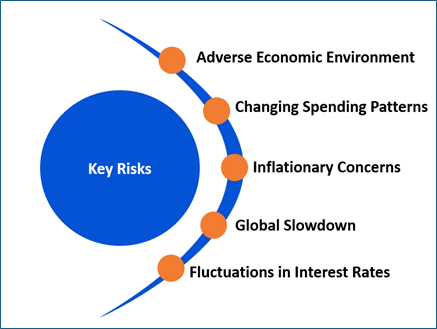
Recently, RBNZ noted that while reduced interest rates can underpin the recovery in domestic economy, the speed and timing of the recovery remain uncertain. As per the Committee, the tighter international financial conditions resulted in some downside risks to global growth, mainly for the countries possessing increased debt levels or fixed exchange rate regimes. Overall, the consumer discretionary sector is exposed to the risks related to lower consumer confidence, changing spending patterns, lower disposable income, etc.
Exhibit 3. Key Risks in Consumer Discretionary Sector:
Source: Analysis by Kalkine Group
Outlook:
As per SOPI December 2024, the export revenue is expected to increase marginally to $11.4 Bn in the year ended 30 June 2025 with higher prices offsetting the declines in export volumes. The increased prices are being aided by tighter global beef and mutton supplies and strong demand from Europe and the US. However, the sector might not be able to fully capitalise on increased prices because of lower production and export volumes resulting from the smaller flock, reduced lambing rates, and post-drought herd rebuilding.
As per SOPI December 2024, forestry export revenue is projected to rebound 4% to $6.0 Bn in the year ended 30 June 2025, recovering from NZ supply-side disruptions as well as slow global demand which impacted the previous 2 years. NZ log harvest is anticipated to rise to cater to any increases in overseas demand so an increased supply of logs might reflect that some of the price increases are short-lived.
Apart from the sector-specific factors, an analysis on 2 NZX-listed companies is provided. This report covers their insights, outlook, performance and potential as expected to be delivered in the near to medium term.
1) SkyCity Entertainment Group Limited (Recommendation: Buy, Potential Upside: Low Double-Digit) (M-Cap: NZD 927.4 million, Annual Dividend Yield: 5.98%)
Business Description:
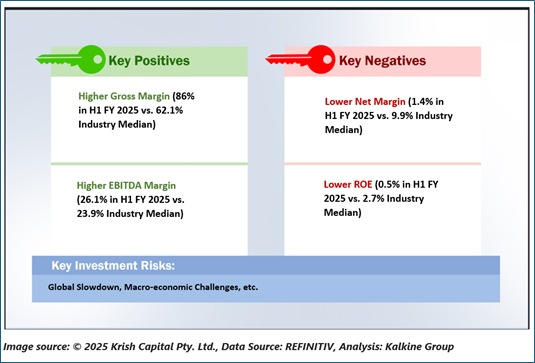
SkyCity Entertainment Group Limited (NZX: SKC) is the leading entertainment and gaming business.
Outlook:
For H2 FY 2025, SKC remains focused on maintaining a sustainable and prudent capital position, ensuring enough capital to support the business targets to move towards the resumption of dividend payments. Also, it is targeting to monetise select assets. For FY 2025, SKC is expecting core stay-in-business capex of between $60 Mn - $70 Mn.
Technical Overview:
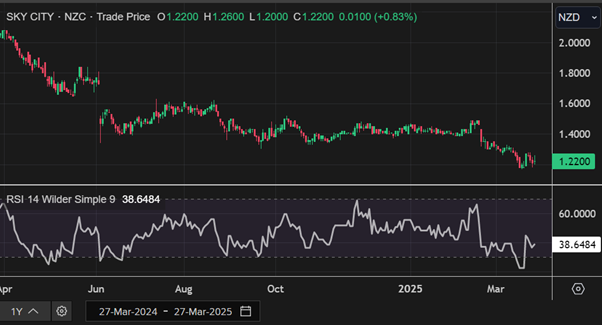
SKC Daily Technical Chart, Data Source: REFINITIV
Technical Commentary
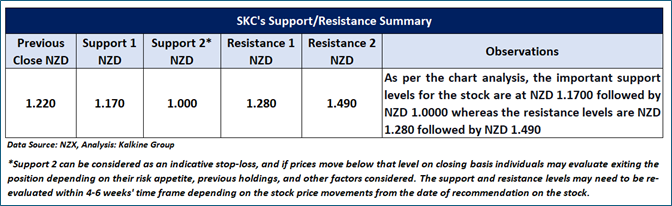
On the daily chart, SKC’s stock prices are undergoing a downtrend characterized by lower highs and lower lows, indicating a negative bias. Moreover, the momentum oscillator RSI (14-period) is trading below its midpoint, providing more support to the previous observation. Prices are trading below both the 21-period and 50-period SMAs, which might function as resistance levels for the stock; in contrast, the stock’s previous trough may act as a support. A significant support level for the stock is located at NZD 1.17, while critical resistance level is placed at NZD 1.28.
Fundamental Valuation
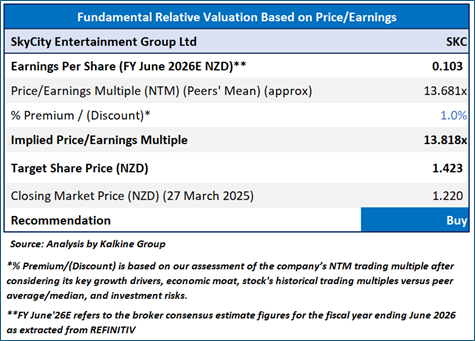
P/E Based Relative Valuation
Stock Recommendation
Considering the facts above, a ‘Buy’ recommendation on the stock has been provided at the closing market price of NZD 1.22 per share, up by 0.83% as on 27 March 2025.
2) Delegat Group Limited (Recommendation: Buy, Potential Upside: Low Double-Digit) (M-Cap: NZD 455.08 Mn, Annual Dividend Yield: 6.17%)
Business Description:
Delegat Group Limited (NZX: DGL) is a New Zealand-based wine company.
Outlook:
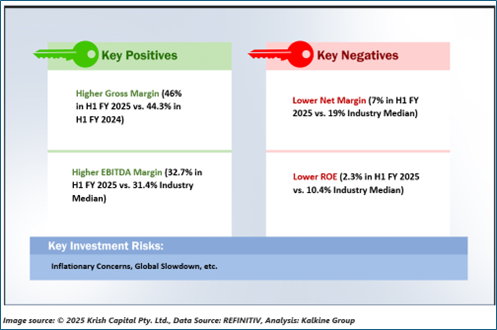
DGL is well-placed to finance its current operations and future capital investment in both NZ and Australia. Its net debt at 31 December 2024 stood at $345.6 Mn, a decrease of $6.7 Mn as compared to the last half-year as well as well within its bank debt facilities of $420 Mn. The company is investing in vineyard development and winery expansion in order to support the future earnings growth. During H1 FY 2025, DGL invested $43.2 Mn in New Zealand vineyard developments as well as winery expansion.
Technical Overview:
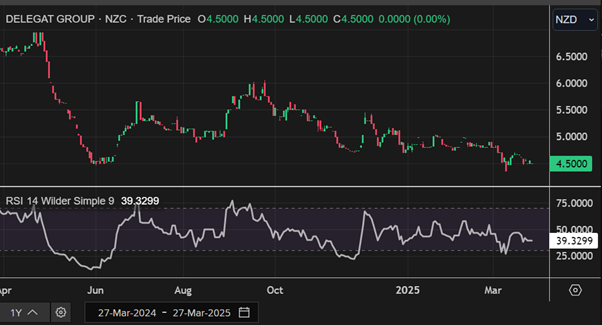
DGL Daily Technical Chart, Data Source: REFINITIV
Technical Commentary
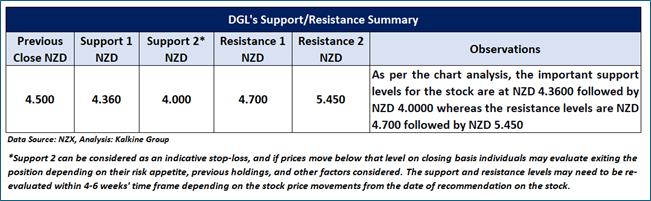
While experiencing a downtrend, DGL’s stock prices penetrated a Neckline of a Head and shoulders pattern, indicating a negative bias. Moreover, the momentum oscillator RSI (14-period) is trading below its midpoint, adding further evidence to the mentioned recommendation. Prices are trading between its previous peak and trough, which might function as resistance and support levels for the stock, respectively. A significant support level for the stock is located at NZD 4.36, while critical resistance level is placed at NZD 4.70.
Fundamental Valuation
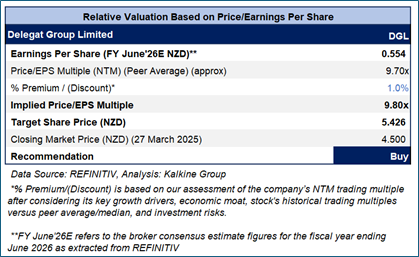
P/E Based Relative Valuation
Stock Recommendation
Considering the facts above, a ‘Buy’ recommendation on the stock has been provided at the closing market price of NZD 4.50 per share as on 27 March 2025
Markets are trading in a highly volatile zone currently due to certain macro-economic issues and geopolitical tensions prevailing. Therefore, it is prudent to follow a cautious approach while investing.
Note 1: Past performance is not a reliable indicator of future performance.
Note 2: The reference date for all price data, currency, technical indicators, support, and resistance levels is March 27, 2025. The reference data in this report has been partly sourced from REFINITIV.
Note 3: Investment decisions should be made depending on an individual's appetite for upside potential, risks, holding duration, and any previous holdings. An 'Exit' from the stock can be considered if the Target Price mentioned as per the Valuation and or the technical levels provided has been achieved and is subject to the factors discussed above.
Note 4: Annual Dividend Yield is on a Trailing Twelve Month (TTM1) basis and are subject to change based on factors such as company performance, stock price changes, etc.
Note 5: Kalkine reports are prepared based on the stock prices captured either from REFINITIV or Trading View. Typically, REFINITIV or Trading View may reflect stock prices with a delay which could be a lag of 25-30 minutes. There can be no assurance that future results or events will be consistent with the information provided in the report. The information is subject to change without any prior notice.
Technical Indicators Defined: -
Support: A level at which the stock prices tend to find support if they are falling, and a downtrend may take a pause backed by demand or buying interest. Support 1 refers to the nearby support level for the stock and if the price breaches the level, then Support 2 may act as the crucial support level for the stock.
Resistance: A level at which the stock prices tend to find resistance when they are rising, and an uptrend may take a pause due to profit booking or selling interest. Resistance 1 refers to the nearby resistance level for the stock and if the price surpasses the level, then Resistance 2 may act as the crucial resistance level for the stock.
Stop-loss: It is a level to protect further losses in case of unfavourable movement in the stock prices.
Disclaimer This report has been issued by Kalkine New Zealand Limited (FSP691351) (NZBN:9429047678101) (“Kalkine”). Kalkine is a Financial Advice Provider (“FAP”) and is authorised by a Class 1 Financial Advice Provider Licence issued by Financial Markets Authority (“FMA”) to provide financial advice. Kalkine provides only general financial advice through its research reports following a person becoming a member. The reports contain buy/sell/hold and other recommendations in relation to equity securities, managed funds and other managed investment schemes and other financial advice products. The recommendations and opinions in this report and on Kalkine website do not take into account any of your investment objectives, financial situation or needs. Before you make a decision about whether to acquire a financial product, you should obtain the Product Disclosure Statement from the product issuer. You should consider the appropriateness of advice taking into account your own objectives, financial situation and needs and seek independent financial advice before making any financial decisions. If you act on the advice in the research reports, you may have to pay fees, expenses or other amounts (but not to Kalkine). Further information about the complaints and dispute resolution process, as well as information about Kalkine’s duties are available on Kalkine’s website. Please read our Financial Advice Provider (FAP) disclosure statement and Complaints Handling Guide, which are available on the website.
Past performance is not a reliable indicator of future performance.
 Please wait processing your request...