
 AU
AU
 UK
UK
 CA
CA
 US
US
 IND
IND

 NZ
NZ

Investment Summary:
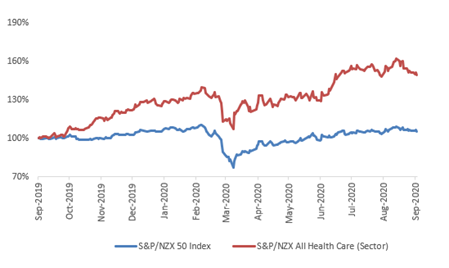
S&P/NZX50 Index v/s S&P/NZX All Health Care (Sector) (Source: S&P Dow Jones Indices)
Role of the New Zealand Government in Healthcare System
The national government of New Zealand plays a critical role in setting the health care policy program and service requirements and in deciding publicly funded annual health budget. The government of New Zealand controls all aspects of health care as the primary funder and supplier of health care. It is also responsible for putting regulations as well as monitoring compliance. The statutory framework of New Zealand’s health and disability system is made up of over 20 pieces of legislation. The most significant among them are the New Zealand Public Health and Disability (NZPHD) Act 2000, the Health Act 1956, and the Crown Entities Act 2004.
The NZPHD Act provides for the structure of public sector funding and strategic direction and goals for health and disability services. The Health Act 1956 talks about the roles and responsibilities of individuals to safeguard public health. It also contains provisions for environmental health, infectious diseases, health emergencies, etc. The Crown Entities Act 2004 provides for a fundamental statutory framework for the establishment, governance, and operation of crown entities.
National Entities and Their Roles: A Quick Look
As the country’s health system is mainly public, government-funded as well as government-appointed entities are responsible for controlling governance structures. Key national entities under the healthcare system are:
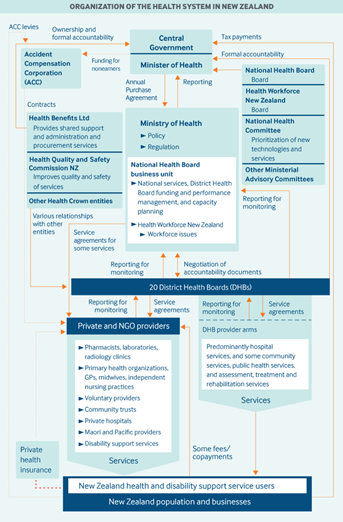
Organization of The Health System (Source: The Commonwealth Fund)
Government Secured Medical Supplies and Invested in COVID-19 Capacity
The Government has moved to ensure that the citizens of New Zealand continue to get access to the medicines they need, while at the same time deploying more towards contact tracing and other COVID-19 health responses. The Government has boosted funding for PHARMAC to purchase medicines. In the last year alone, there has been an announcement of an extra $220 million investment, and a one-off boost of $35 million in response to COVID-19.
The Government has approved $74 million more for PHARMAC this year, and $76 million in 2021/22, out of the COVID Response and Recovery Fund. The Government has also planned to invest a further $30 million in the National Close Contact Service, to provide for more capacity and initiatives on the front of information technology.
A breakup of total investments worth $302.6 million has been given below:
What Future Holds For NZ Healthcare Sector?
New Zealand is a land full of opportunities for the healthcare industry. Its healthcare sector is one of the fastest-growing sectors. It has also become one of the leading destinations for high-end diagnostic services. With the increase in competition, businesses are looking to explore the latest dynamics and trends, which will have a positive impact on their businesses. They are embracing strategies where talent can collaborate with technology to improve operating efficiency to deliver smart healthcare centered around patients and technology. New Zealand also offers vast opportunities in R&D as well as medical tourism. The COVID-19 crisis speeded up change in the health sector via increased innovation, collaborative problem solving, cross-sector partnerships, progress in digital solutions and increased understanding of the need for as well as use of data.
The sector is in a better position going forward, with established relationships, systems and processes in place. The COVID-19 pandemic generated enormous turmoil in the health sector, forcing creative and rapid responses that, in some cases, allowed planned development in a considerably shortened timeframe. The healthcare industry consists of companies ranging from pharma, aged care providers, health insurance providers and hospitals with unique dynamics of their own. During COVID-19, healthcare stocks have outperformed most of the other sectors. We expect this trend to continue in upcoming times as well given the focus this sector has started assuming from the governments across various continents.
Challenges Faced by the Healthcare Sector
In terms of pharmaceuticals and medical technology, New Zealand is extremely vulnerable as most of the products are imported from other countries. The country’s geographical separation meant that closed borders resulted in reduced airfreight capacity. This had a severe impact on medical supplies arriving in the country, and it was a challenge to keep trade routes open.
Since we now have a broad idea of the healthcare sector, it is important to look at the performance of some companies operating in the same sector (CBD, ARV, OCA, EBO).
1. Cannasouth Limited (NZX: CBD) (Recommendation: Buy, Potential Upside: Lower Double-Digit), (M-Cap: ~NZ$131.03 Million)
Business Description: Cannasouth happens to be a biopharmaceutical research and development company.
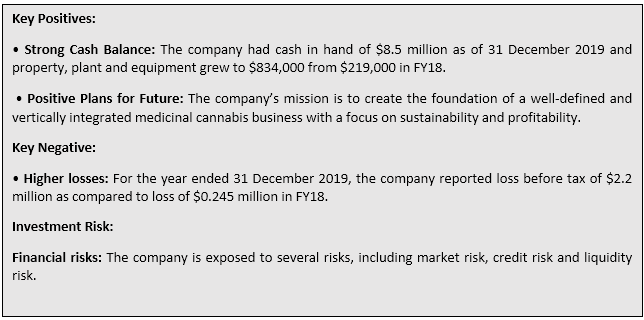
Key Metrics (Source: Refinitiv (Thomson Reuters))
Outlook: The company is focused on developing good clinical data to support medicinal cannabis products and establish education programmes for doctors and prescribers. Equipping the professionals with knowledge will be key to ensuring they have readily available quality information to make informed decisions.
Technical Overview:
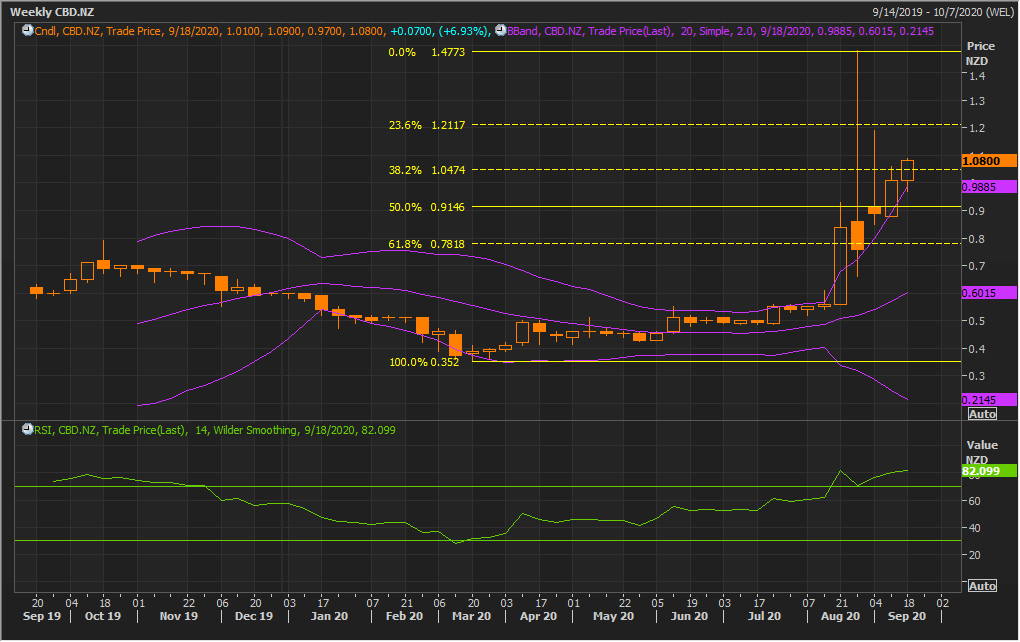
Weekly Chart –
Source: Refinitiv (Thomson Reuters)
Note: Purple colour lines are Bollinger Bands with the upper band suggesting overbought status while the lower band oversold status, and yellow lines are Fibonacci retracement lines which measure price rebound and backtrack.
The stock has been very resilient in the past and continuing with the same momentum, it has given stronger close for the ongoing week, closing around a peak price of $1.09 at $1.08. This reflects upon strength in an uptrend for the stock. The technical indicator RSI with 82 reading while suggests strong bullish momentum, it also suggests that the stock is in highly overbought territory.
Going forward, the stock may have resistance around the 23.6% retracement level of $1.21 whereas support could be around the 50% retracement level of $0.91.
We give a “Buy” at the price of NZ$1.08 per share, up by 6.93% on September 17, 2020.
2. Arvida Group Limited (NZX: ARV) (Recommendation: Buy, Potential Upside: Lower Double-Digit), (M-Cap: ~NZ$911.38 Million, Dividend Yield: 3.44%)
Business Description: Arvida Group Limited (NZX: ARV) is one of New Zealand’s largest aged care providers owning and operating 32 retirement villages located nationally.
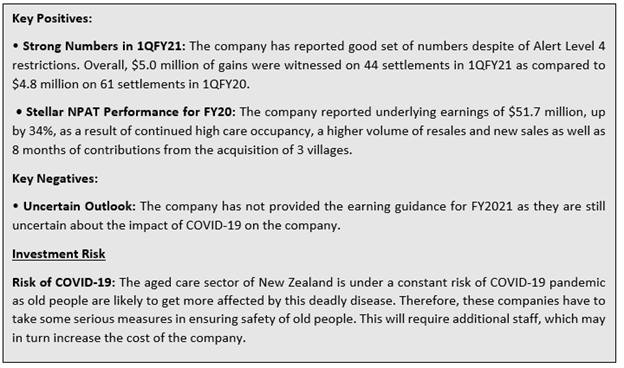
What to Expect: The company that early signs are reflecting resumption of the sales activity with good levels of demand as well as increasing enquiry since the easing of restrictions related to coronavirus.
Valuation: We have applied EV/EBITDA multiple based relative valuation (on an illustrative basis), and the target price reflects a rise of lower double-digit (in % terms).
EV/EBITDA Multiple Based Relative Valuation (Illustrative)
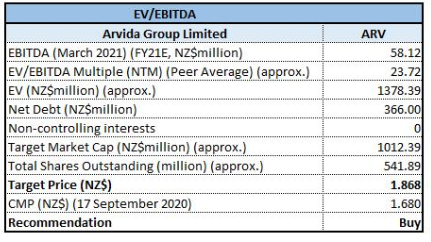
EV/EBITDA multiple Based Relative Valuation (Source: Refinitiv (Thomson Reuters))
We give a “Buy” at the price of NZ$1.680 per share, up by 0.60% on September 17, 2020.
3. Oceania Healthcare Limited (NZX: OCA) (Recommendation: Buy, Potential Upside: Lower Double-Digit), (M-Cap: ~NZ$653.08 Million, Dividend Yield: 3.33%)
Business Description: Oceania Healthcare Limited happens to be one of NZ’s leading owners as well as operators of retirement villages.
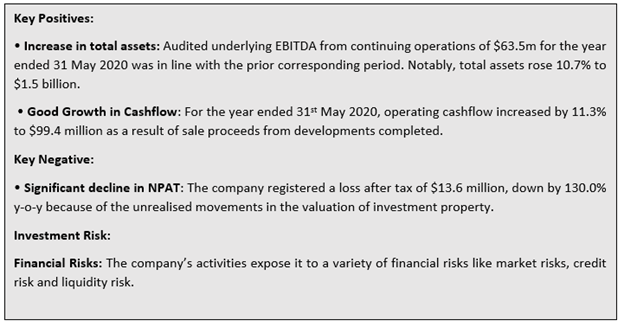
Outlook: Before Alert Level 4, the company was on track to complete 265 units in FY2020. In 1HFY20, the company completed 90 new care suites at Awatere (Hamilton) and 10 villas at Whitianga. In 2HFY20, the company completed 26 new apartments at Meadowbank (Auckland) and 12 villas at Elderslea (Upper Hutt) before the lockdown restrictions were imposed. The company has restarted construction of its developments at Eden (Auckland), The BayView Stage Two (Tauranga), The Bellevue (Christchurch) and Awatere Stage Two (Hamilton). The construction of 22 apartments as well as 71 care suites at The Bellevue (Christchurch) is anticipated to get completed during FY 2021 along with Stage Two at The BayView (Tauranga) and Green Gables (Nelson). This brings the company’s forecast FY21 build rate up to 217 retirement village units and care suites.
Valuation: We have applied P/BV multiple based relative valuation (on an illustrative basis), and the target price reflects a rise of lower double-digit (in % terms).
P/BV Multiple Based Relative Valuation (Illustrative)
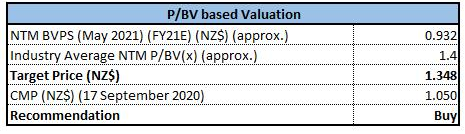
P/BV Multiple Based Relative Valuation (Source: Refinitiv (Thomson Reuters))
We give a “Buy” at the price of NZ$1.05 per share on September 17, 2020.
4. EBOS Group Limited (NZX: EBO) (Recommendation: Buy, Potential Upside: Lower Double-Digit), (M-Cap: ~NZ$3.96 Billion, Dividend Yield: 3.50%)
Business Description: EBOS Group Limited (NZX: EBO) is the most diversified and largest marketer, distributor, and wholesaler of pharmaceutical, healthcare, and medical products.
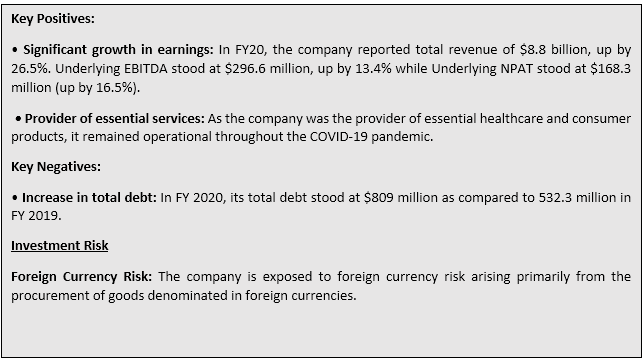
Outlook: The company reported robust financial performance in FY20 in both Healthcare and Animal Care segments. The company’s revenue and underlying EBITDA in July 2020 was up by 6.9% and 6.5%, respectively, on prior corresponding period, which was driven by growth in both Healthcare and Animal Care segments, reflecting an improvement in recent trading conditions and the defensive characteristics of the company’s core products and services.
Valuation: We have applied P/BV multiple based relative valuation (on an illustrative basis), and the target price reflects a rise of lower double-digit (in % terms).
P/BV Multiple Based Relative Valuation (Illustrative)
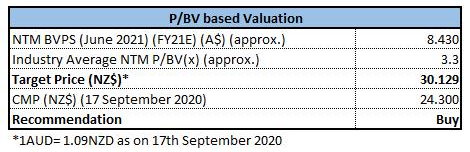
P/BV Multiple Based Relative Valuation (Source: Refinitiv (Thomson Reuters))
We give a “Buy” at the price of NZ$24.30 per share on September 17, 2020.
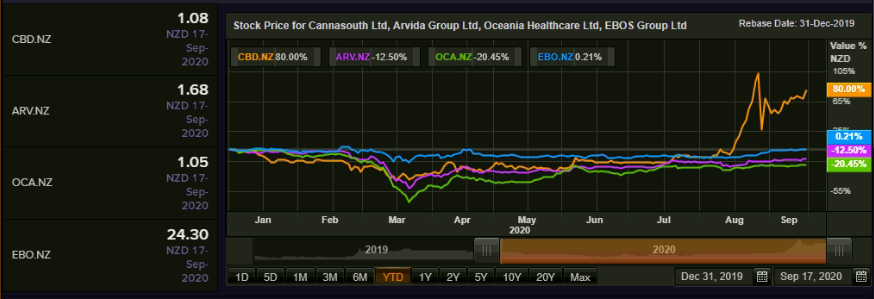
Comparative Price Chart (Source: Refinitiv (Thomson Reuters))
Disclaimer
Kalkine New Zealand Limited is authorised to provide class advice only. The information on this site does not take into account any of your investment objectives, financial situation or needs. Before you make a decision about whether to acquire a financial product, you should obtain the Product Disclosure Statement from the product issuer. You should consider the appropriateness of advice taking into account your own objectives, financial situation and needs and seek independent financial advice before making any financial decisions.
Past performance is not a reliable indicator of future performance.
 Please wait processing your request...