
 AU
AU
 UK
UK
 CA
CA
 US
US
 IND
IND

 NZ
NZ

.png)
New Zealand’s Healthcare Sector
Healthcare sector has always been under investors’ radar as the stocks under healthcare sector are believed to be non-cyclical and defensive in nature. New Zealand has a vibrant health technology sector with 140 medical device and health IT companies, an active research community and entrepreneurial clinicians and health providers. New Zealand has few companies; however, those companies have reached the scale required to operate as true multinational corporations.
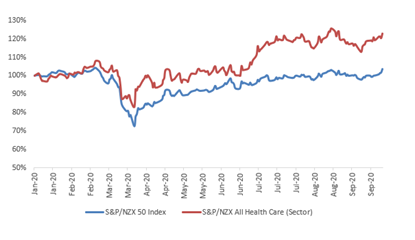
Figure 1: S&P/NZX 50 Index vs S&P/NZX All Health Care (Sector)
(Source: S&P Dow Jones Indices)
As shown above, S&P/NZX All Health Care (Sector) has outperformed S&P/NZX50 Index by 19.2% on YTD 2020 basis.
According to a report published by TIN (Technology Insights New Zealand), Export has been driving factor behind steady growth of HealthTech sector over the past five years. Of the 200 companies that were included in the report, 11% were HealthTech firms, and they generated 15.4% of the total revenue, which clearly shows the size and significance of the HealthTech sector in New Zealand. HealthTech companies generated $1.9 billion in revenue, with a five-year CAGR of 9.1% and global exports of healthcare technology accounted for $1.6 billion, or 87.5% of revenue. Device companies generated about two thirds of the HealthTech sector’s revenue.
NZ healthcare sector represents a total addressable market of worth NZ$20 million and reflects a growing market opportunity as per the estimates provided in the Fisher & Paykel Healthcare’s FY20 reports
Figure 2: Huge Opportunity with Total Addressable Market Estimates worth NZ$20 million*
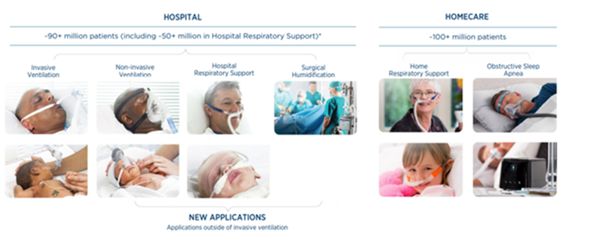
Data Source: Fisher & Paykel Healthcare Company Report; * based on US HCUP data using ICD10 codes for 2018, extrapolated to the world using healthcare spend as a % of GDP
Health care spending revives in June 2020
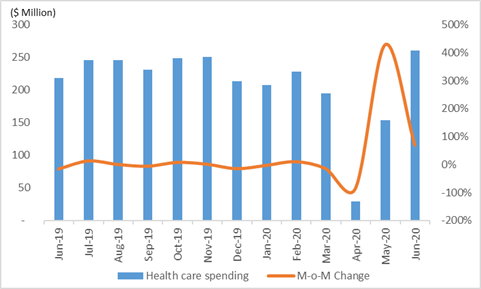
As per Stats NZ, monthly card spending on medical and other health care services reached a record high in June 2020. In the said month, the spending on medical and other health care services stood at $261 million, up 20 percent, or $43 million from June 2019.
Figure 3: Monthly HealthCare Spending till June 2020
Data Source: Stats NZ, Chart: Kalkine Group
Government’s Healthcare Spending on the Rise
The Government of New Zealand launched Budget 2020, which was mainly focussed on response, recovery and rebuild from COVID-19. Budget 2020 offers about $5.6 billion for the health sector, so that it can respond to the pandemic while retaining the sustainable delivery of current services.
The $5.6 billion investment includes $3.9 billion of operating funding for the 20 District Health Boards (DHBs) throughout the country. This signifies the largest ever annual investment in DHBs and will make sure they can continue delivering essential health services for growing and changing population.
Surge in Telehealth at DHBs
During the nationwide lockdown, the country’s DHBs delivered about 32,000 telehealth consultations to patients a week in April. The impact of national level lockdown due to Covid-19 has led to a rapid increase in the use of telehealth, both in electronic prescribing and telehealth consultations.
An investigation conducted by eHealthNews.nz revealed that there has been a significant impact on the use of telehealth by all 20 DHBs. Although three DHBs were not able to provide any data on telehealth pre-COVID, the rest of the 17 DHBs reported doing around 2,700 telehealth consultations per week in a pre-COVID month from November 2019 – January 2020.
In April, the telehealth consultation increased nearly twelvefold to 32,000 per week and then it fell to around 18,300 per week in June-August this year.
The Ministry of Health has also given $10.5 million ‘digital enablement funding’ to DHBs and general practice to help locally led delivery of telehealth services and digital inclusion. The fund included $7.1 million for DHBs and $3.4 million for GPs and the Ministry has created a digital enablement work programme, to guide the allocation of further available funding.
Statutory Landscape of New Zealand’s Health System
The statutory framework of New Zealand’s health and disability system is made up of over 20 pieces of legislation. The most significant among them are the New Zealand Public Health and Disability (NZPHD) Act 2000, the Health Act 1956, and the Crown Entities Act 2004.
The NZPHD Act provides for the structure of public sector funding and strategic direction and goals for health and disability services.
The Health Act 1956 talks about the roles and responsibilities of individuals to safeguard public health. It also contains provisions for environmental health, infectious diseases, health emergencies, etc.
The Crown Entities Act 2004 provides for a fundamental statutory framework for the establishment, governance, and operation of crown entities.
The New Zealand Health Strategy sets directions for health services to improve the health of people and communities.
The outbreak of COVID-19 has necessitated focused attention on the healthcare system. Investment in health care has never been more critical than now. In order to ensure that the system is responding to a pandemic, a total of $3.92 billion has been allocated to the District Health Board (DHB) through Budget 2020 to provide additional support over the next four years, and another $125.4 million over four years to meet further cost pressures on planned care. Of late, the country has seen a sharp drop in new cases, still, the government is vigilant so that necessary steps could be taken timely to contain the spread of the diseases.
Surge in Demand for Smart Care
With the outbreak of COVID-19 cases, there has been a surge in demand for smart care, centered around patients and technologies. The New Zealanders expect a high standard of products and services delivered to them. The demand for aged care, retirement villages, ventilators and other equipment are on the rise across the world, providing for great opportunities to healthcare sectors to capitalize on. As a result of ageing demographics, the need for health technologies to deliver an improved result assumes greater significance than ever in the past. Companies dealing in health products have opportunities to deliver technology innovations needed to address ageing related concerns by improving the performance of the clinical and health infrastructures.
Way Forward
The healthcare sector in New Zealand offers good opportunities for players in the sector. It has turned out to be one of the leading destinations for high-end diagnostic services. It is a very much diversified sector with full of opportunities for providers, payers, and medical technologies. Businesses are exploring the latest dynamics and trends amidst a rise in competition. They are embracing strategies to improve operating efficiency to deliver smart healthcare cantered around patients and technology. The country also offers vast opportunities in R&D and medical tourism.
Challenges Faced by New Zealand’s Healthcare Industry
In terms of pharmaceuticals and medical technology, the country is vulnerable as products are imported from foreign countries. Because of the geographical isolation, closed borders resulted in severely reduced airfreight capacity. This had a negative effect on medical supplies arriving at the country and it was a difficult task to keep trade routes open.
Since we have a broader idea of the healthcare sector, it is imperative to look at the performance of four healthcare companies listed on the NZX (PEB, AFT, CBD, FPH).
1. Pacific Edge Limited (NZX: PEB) (Recommendation: Buy, Potential Upside: Lower Double-Digit), (M-Cap: ~ NZ$456.601 Million)
About the Company
Business Description: Pacific Edge Limited (NZX: PEB) is a cancer diagnostic company, and it develops and commercializes diagnostic and prognostic tests for the better detection as well as management of cancer.
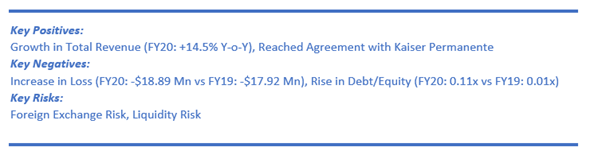
Outlook
The company is focussed on generating significant growth in the number of commercial tests processed in two laboratories, which will contribute towards revenue growth and improvement in cashflow. In New Zealand, monthly test volumes have recovered strongly from their April lows with total lab throughput for the month of September recording a 55% year on year increase. In the US, monthly test volumes have largely recovered from their April lows.
For Australia and Southeast Asia, the key focus of the company is to transition the public health care providers from their clinical studies to commercial customer relationships and to consequently grow commercial test volumes for these new markets.
Valuation :
We have applied EV/Sales multiple-based valuation method (on an illustrative basis) and the target price arrived reflects a rise of lower double-digit.
EV/Sales Based Relative Valuation (Illustrative)
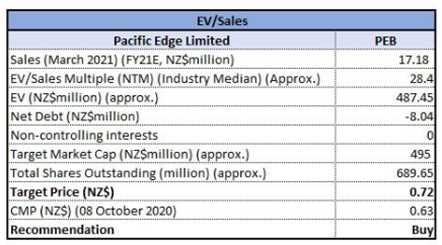
EV/Sales Based Relative Valuation (Source: Refinitiv (Thomson Reuters))
Note: All forecasted figures and peers have been taken from Thomson Reuters, NTM-Next Twelve Months
We give a “Buy” recommendation at the current market price of NZ$0.630 per share, down by 1.56% on October 8, 2020.
2. AFT Pharmaceuticals Limited (Recommendation: Hold, Potential Upside: Higher Single-Digit), (M-Cap: ~NZ$509.15 Million)
About the Company
Business Description: AFT Pharmaceuticals Limited (NZX: AFT) is in the business of developing, licensing as well as selling a range of medical products globally.
Outlook
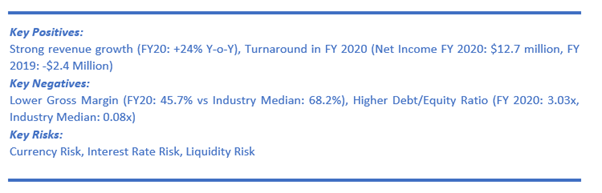
The company has significant potential for its products in both global and local markets. It is also witnessing good progress with strong local sales growth and accelerating momentum in international markets. The company also continues to develop and commercialise line extensions of the Maxigesic range and other products like NasoSURF and Pascomer. Despite all the present challenges, including the Covid-19 pandemic, the company is expecting to report positive cash flow and an operating profit of between $14.0 million to $18.0 million for FY21.
Valuation: We have applied P/E based relative valuation (on an illustrative basis) and the target price reflects a rise of higher single-digit (in % terms).
P/E Based Relative Valuation (Illustrative)
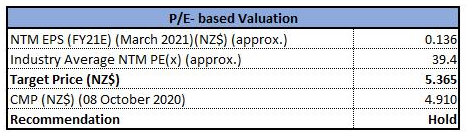
P/E Based Relative Valuation (Source: Refinitiv (Thomson Reuters))
Note: All forecasted figures and peers have been taken from Thomson Reuters, NTM-Next Twelve Months
We give a “Hold” recommendation at the current market price of NZ$4.910 per share, down by 2.00% on October 8, 2020.
3. Cannasouth Limited (NZX: CBD) (Recommendation: Buy, Potential Upside: Lower Double-Digit), (M-Cap: ~NZ$114.44 Million)
About the Company
Business Description: Cannasouth Limited (NZX: CBD) was formed to focus on the growth of the medicinally useful characteristics of cannabinoid compounds like THC, CBD, and other related chemical structures.
Outlook:
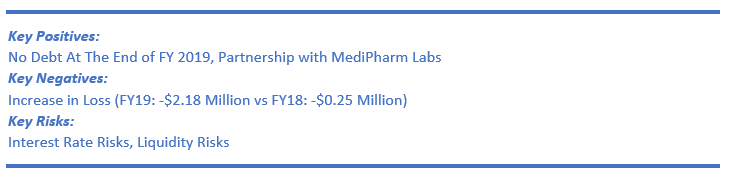
The company remains focussed on a vertically integrated commercial strategy and continues its commitment to produce medicinal cannabis products in New Zealand from locally produced raw materials. The company has entered into a supply agreement with MediPharm Labs Australia Pty Ltd for the supply of white label medicinal cannabis products.
Technical Overview:
Weekly Chart –
Source: Refinitiv (Thomson Reuters)
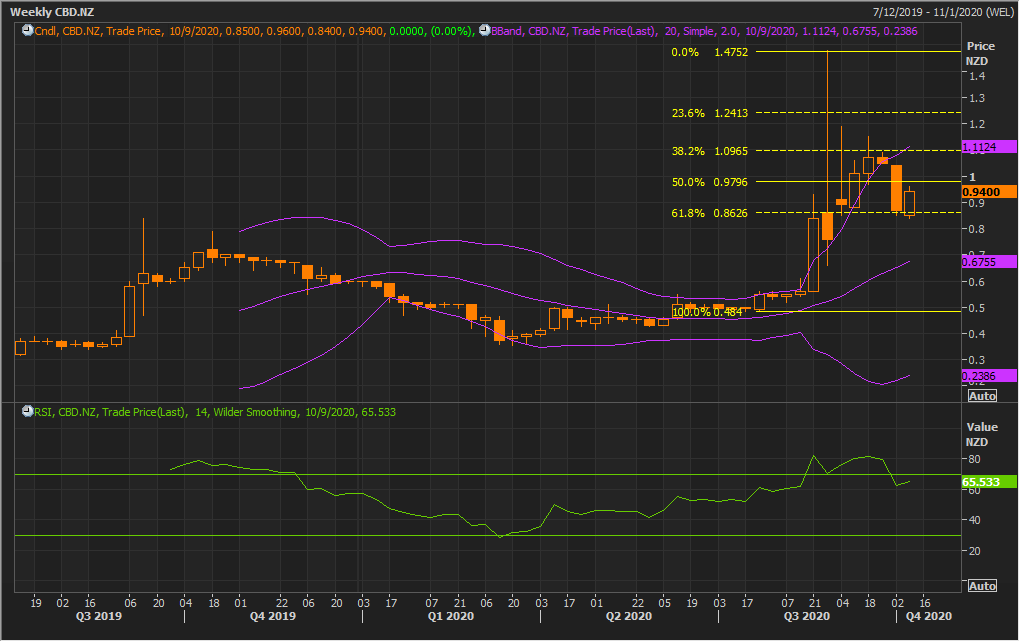
Note: Purple colour lines are Bollinger Bands with the upper band suggesting overbought status while the lower band oversold status, and yellow lines are Fibonacci retracement lines which measure price rebound and backtrack.
Having registered a sharp fall in the previous week, the stock for the ongoing week, opened at low but finally closed higher, covering almost 50% of the loss it would have incurred during the last week. The chart pattern confirms to ‘Bullish Harami’ which is towards confirmation of a bullish reversal for the stock. The technical indicator RSI with around 66 reading suggests strong bullish momentum for the stock.
Going forward, the stock may have resistance around the upper Bollinger band of $1.11 whereas support could be around $0.80.
Thus, we give a “Buy” recommendation at the current market price of NZ$0.940 on October 8, 2020.
4. Fisher & Paykel Healthcare Corporation Limited (Recommendation: Buy, Potential Upside: Lower Double-Digit), (M-Cap: ~NZ$19.84 Billion, Dividend Yield: 1.15%)
About the Company
Business Description: Fisher & Paykel Healthcare Corporation Limited (NZX: FPH) is a primary marketer, manufacturer and designer of systems and products for usage in surgery, acute care, respiratory care, and the treatment of obstructive sleep apnea.
Outlook:
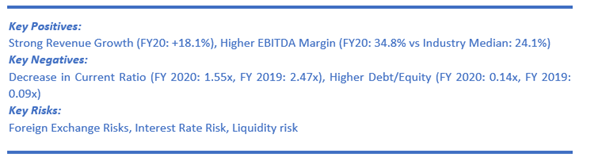
The company has recently provided FY 2021 trading update. It was mentioned that hospital hardware sales continued to steadily increase over first 4 months of FY 2021 with +390% constant currency revenue growth to the end of July 2020 in comparison to prior comparable period. The manufactured output of related consumables has increased over 4 months, enabling the company to begin rebuilding of inventory levels post a peak in the shipments in April.
Valuation: We have applied EV/Sales multiple-based valuation method (on an illustrative basis) and the target price arrived reflects a rise of lower double-digit.
EV/Sales Based Relative Valuation (Illustrative)
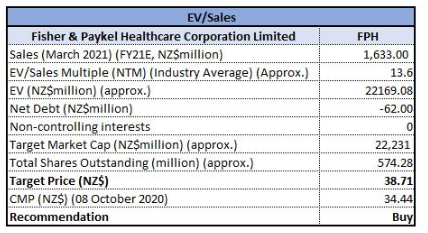
EV/Sales Based Relative Valuation (Source: Refinitiv (Thomson Reuters))
Note: All forecasted figures and peers have been taken from Thomson Reuters, NTM-Next Twelve Months
We give a “Buy” recommendation at the current market price of NZ$34.440 per share, up by 3.42% on October 8, 2020.
.png)
Comparative Daily Technical Chart (Source: Refinitiv (Thomson Reuters))
Disclaimer
Kalkine New Zealand Limited is authorised to provide class advice only. The information on this site does not take into account any of your investment objectives, financial situation or needs. Before you make a decision about whether to acquire a financial product, you should obtain the Product Disclosure Statement from the product issuer. You should consider the appropriateness of advice taking into account your own objectives, financial situation and needs and seek independent financial advice before making any financial decisions.
Past performance is not a reliable indicator of future performance.
 Please wait processing your request...