
 AU
AU
 UK
UK
 CA
CA
 US
US
 IND
IND

 NZ
NZ

Company Overview:
Ryman Healthcare Limited (NZX: RYM) is a New Zealand-based firm that develops, owns, and operates integrated retirement villages, rest homes, and hospitals for seniors in both New Zealand and Australia. Pacific Edge Limited (NZX: PEB) is a global company focused on cancer diagnostics.
Kalkine’s Sector Report covers the Key Financial Metrics, Risks, Outlook, Technical Analysis along with the Valuation, Target Price, and Recommendation on the stock.
I. Sector Landscape and Outlook
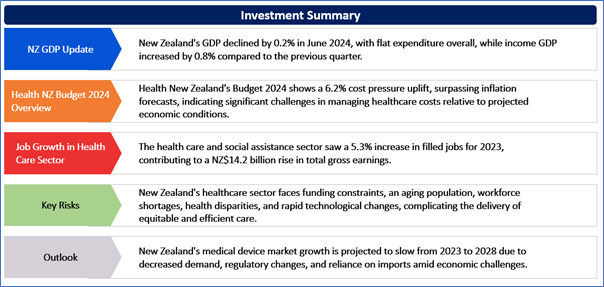
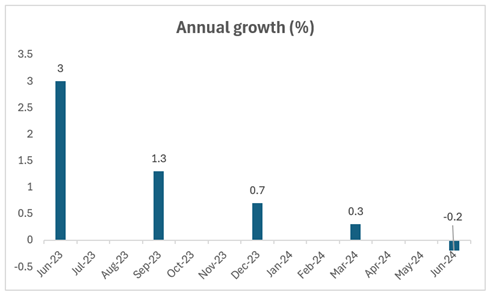
As per Stats NZ, New Zealand's economic activity, measured by gross domestic product (GDP), declined by 0.2% in the June 2024 quarter, following a 0.1% increase in the March 2024 quarter. Year-on-year, GDP also fell by 0.2% from June 2023. Expenditure on GDP remained flat at 0.0% in the June quarter, after a 0.3% rise in March, while it rose by 0.3% over the year ending June 2024 compared to the previous year. Further, in the June 2024 quarter, expenditure on GDP increased by 0.6% compared to the March 2024 quarter, while income GDP rose by 0.8%.
Exhibit 1: Gross domestic product, annual growth rates, June 2023 to June 2024
Data Source: This work is based on/includes Stats NZ’s data which are licensed by Stats NZ for reuse under the Creative Commons Attribution 4.0 International Licence; Chart Created by Kalkine Group
Health New Zealand's Budget 2024: Significant Cost Pressure Uplift Exceeds Inflation Forecasts
Health New Zealand’s (Health NZ) Budget 2024 indicates a cost pressure uplift of 6.2% across its operating budget, exceeding overall demographic and inflationary pressures. The government-funded cost pressures align with planning assumptions from March 2023, as detailed in the Treasury’s 2023 Economic and Fiscal Updates. The inflation component of this uplift incorporates both consumer price index (CPI) and wage inflation, based on forecasts from the Half Year Economic and Fiscal Update 2022. In contrast, the Treasury's inflation forecast for the year ending June 2025 is 2.2%, suggesting that the cost pressures reflect greater challenges than anticipated in managing inflation.
In 2023, New Zealand recorded a total of 226,600 work-related injury claims, an increase of 1,200 from 2022. The incidence rate for these claims was 86 per 1,000 full-time equivalent employees (FTEs), marking the lowest rate since data collection began in 2002. The manufacturing, agriculture, forestry, fishing, and construction industries reported the highest incidence rates. Trades workers accounted for the most claims by occupation, totaling 39,000.
There were 43,200 claims involving entitlement payments, unchanged from 2022, indicating serious injuries requiring additional compensation. The total number of fatal claims decreased to 54, down from 81 in 2022, representing the lowest annual total since 2002. The overall incidence rate fell from 88 to 86 claims per 1,000 FTEs, while the rate for entitlement payment claims remained stable at 16 per 1,000 FTEs since 2017.
Overview of Healthcare Sector
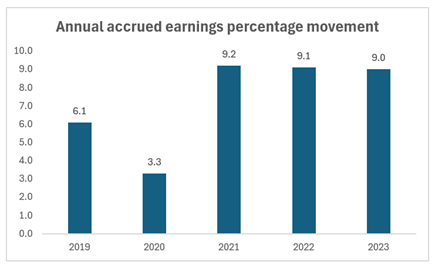
Exhibit 2: Annual accrued earnings in NZ Health Care Sector
Data Source: This work is based on/includes Stats NZ’s data which are licensed by Stats NZ for reuse under the Creative Commons Attribution 4.0 International Licence; Chart Created by Kalkine Group
According to Stats NZ, the health care and social assistance industry experienced a 5.3% increase in filled jobs, adding 13,692 positions for the year ending December 2023. Overall, filled jobs across all industries rose by 2.9% (64,843 jobs) compared to the previous year. Sue Chapman, a business employment insights manager, noted that job growth in health care had steadily increased throughout 2023 after a slower period in late 2022. Additionally, total gross earnings rose by NZ$14.2 billion (9.0%) to reach NZ$171.1 billion, with the health care sector contributing significantly gross earnings increased by $3.1 billion (17%). Public administration and safety also saw notable gains, with earnings up NZ$1.6 billion (12%).
Key Risks and Challenges:
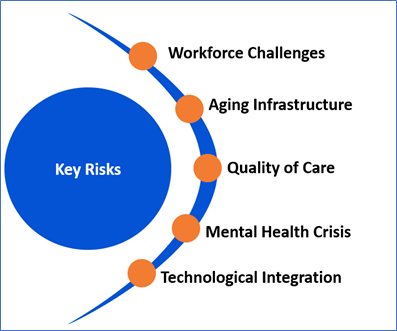
New Zealand's healthcare sector faces several key risks and challenges, including funding constraints that may limit service availability and quality. An aging population places increased demand on resources, while workforce shortages, particularly among healthcare professionals, contribute to strain and potential burnout. Additionally, disparities in health outcomes among different communities highlight the need for targeted interventions. The rapid pace of technological change also poses integration challenges, further complicating efforts to provide equitable and efficient care.
Exhibit 3. Key Risks in Consumer Discretionary Sector:
Source: Analysis by Kalkine Group
Outlook:
Growth in New Zealand's medical device market is expected to slow from 2023 to 2028, primarily due to decreased post-Covid demand and shifts in healthcare policy after a government change. The National Party's decision to repeal the Therapeutic Products Act may boost the market but raises concerns about patient safety. Additionally, New Zealand's heavy reliance on imports and a weak domestic manufacturing sector, compounded by currency weakness and reduced demand, will further limit market growth.
Apart from the sector-specific factors, an analysis on two NZX-listed companies is provided. This report covers their insights, outlook, performance and potential as expected to be delivered in the near to medium term.
1) Ryman Healthcare Limited (Recommendation: Hold) (M-Cap: NZD 3.36 billion)
Business Description:
Ryman Healthcare Limited (NZX: RYM) is a New Zealand-based firm that develops, owns, and operates integrated retirement villages, rest homes, and hospitals for seniors in both New Zealand and Australia. The company offers various retirement living options, including apartments, townhouses, and assisted living in serviced apartments.
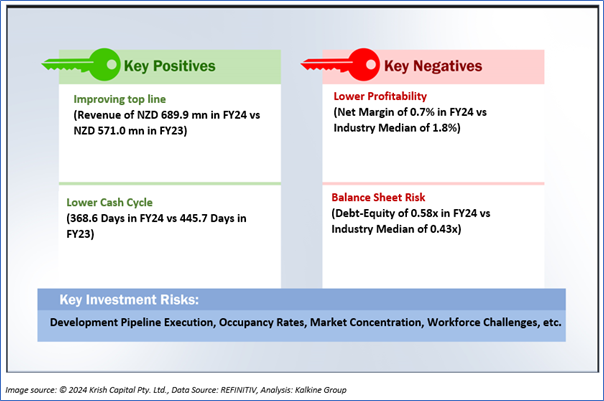
Technical Overview:
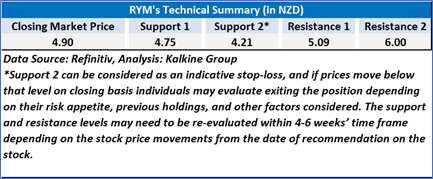
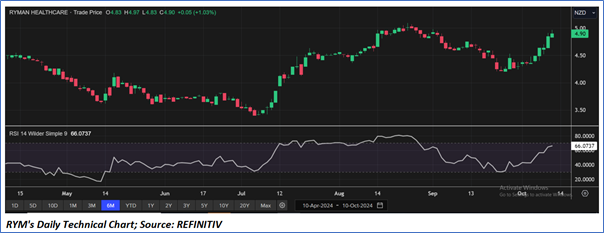
Technical Commentary
In July 2024, RYM’s stock prices broke above a long-term downward slope trendline, signalling a positive trend. Currently, while approaching a significant resistance established by its previous peak, the momentum oscillator RSI (14-period) is showing sign of strength by trading above its midpoint, suggesting that the currently rally in the stock might remain intact. Prices are trading above both the trend-following indicators 21-period and 50-period SMAs, which might serve as support levels for the stock; in contrast, the stock’s previous high may act as a resistance. A significant support level for the stock is positioned at NZD 4.75, while critical resistance level is located at NZD 5.09
Fundamental Valuation
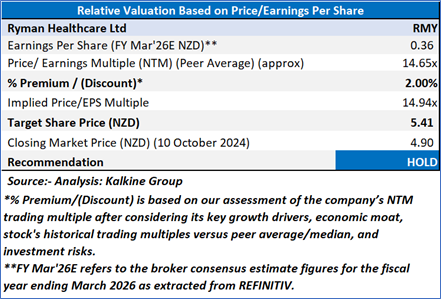
P/E Based Relative Valuation
Stock Recommendation
Considering the facts above, a ‘Hold’ recommendation on the stock has been provided at the closing market price of NZD 4.90 per share as on 10 October 2024.
2) Pacific Edge Limited (Recommendation: Speculative Buy) (M-Cap: NZD 130.71 million)
Business Description:
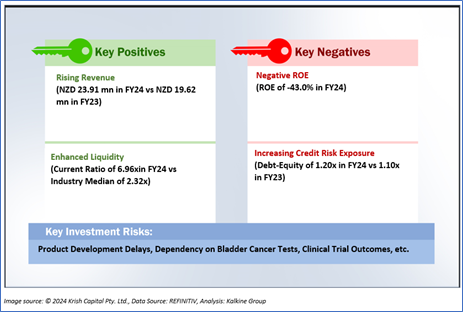
Pacific Edge Limited (NZX: PEB) is a global company focused on cancer diagnostics. It specializes in developing and commercializing diagnostic and prognostic tests for bladder cancer, specifically for patients with hematuria or those undergoing surveillance for recurrent disease. The company operates through two main segments: Commercial and Research.
Technical Overview:
Technical Commentary
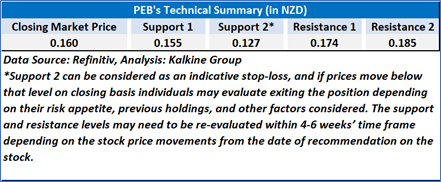
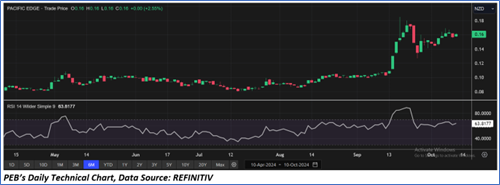
In September 2024, PEB’s stock prices surpassed the upper boundary of a trading range, indicating a positive trend. Currently, while undergoing a minor correction, the stock is rebounding from a significant support formed by the January 2024 peak as well as developing higher highs and higher lows, implying for an ongoing uptrend. Prices are trading between its previous peak and trough, which might function as resistance and support levels for the stock, respectively. An important support level for the stock is placed at NZD 0.155, while key resistance level is situated at NZD 0.174.
Fundamental Valuation
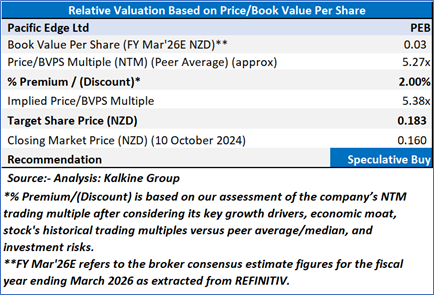
P/B Based Relative Valuation
Stock Recommendation
Considering the facts above, a ‘Speculative Buy’ recommendation on the stock has been provided at the closing market price of NZD 0.160 per share as on 10 October 2024
Markets are trading in a highly volatile zone currently due to certain macro-economic issues and geopolitical tensions prevailing. Therefore, it is prudent to follow a cautious approach while investing.
Note 1: Past performance is not a reliable indicator of future performance.
Note 2: The reference date for all price data, currency, technical indicators, support, and resistance levels is October 10, 2024. The reference data in this report has been partly sourced from REFINITIV.
Note 3: Investment decisions should be made depending on an individual's appetite for upside potential, risks, holding duration, and any previous holdings. An 'Exit' from the stock can be considered if the Target Price mentioned as per the Valuation and or the technical levels provided has been achieved and is subject to the factors discussed above.
Technical Indicators Defined: -
Support: A level at which the stock prices tend to find support if they are falling, and a downtrend may take a pause backed by demand or buying interest. Support 1 refers to the nearby support level for the stock and if the price breaches the level, then Support 2 may act as the crucial support level for the stock.
Resistance: A level at which the stock prices tend to find resistance when they are rising, and an uptrend may take a pause due to profit booking or selling interest. Resistance 1 refers to the nearby resistance level for the stock and if the price surpasses the level, then Resistance 2 may act as the crucial resistance level for the stock.
Stop-loss: It is a level to protect further losses in case of unfavourable movement in the stock prices.
Disclaimer This report has been issued by Kalkine New Zealand Limited (FSP691351) (NZBN:9429047678101) (“Kalkine”). Kalkine is a Financial Advice Provider (“FAP”) and is authorised by a Class 1 Financial Advice Provider Licence issued by Financial Markets Authority (“FMA”) to provide financial advice. Kalkine provides only general financial advice through its research reports following a person becoming a member. The reports contain buy/sell/hold and other recommendations in relation to equity securities, managed funds and other managed investment schemes and other financial advice products. The recommendations and opinions in this report and on Kalkine website do not take into account any of your investment objectives, financial situation or needs. Before you make a decision about whether to acquire a financial product, you should obtain the Product Disclosure Statement from the product issuer. You should consider the appropriateness of advice taking into account your own objectives, financial situation and needs and seek independent financial advice before making any financial decisions. If you act on the advice in the research reports, you may have to pay fees, expenses or other amounts (but not to Kalkine). Further information about the complaints and dispute resolution process, as well as information about Kalkine’s duties are available on Kalkine’s website. Please read our Financial Advice Provider (FAP) disclosure statement and Complaints Handling Guide, which are available on the website.
Past performance is not a reliable indicator of future performance.
 Please wait processing your request...