
 AU
AU
 UK
UK
 CA
CA
 US
US
 IND
IND

 NZ
NZ

Sector Landscape and Outlook
New Zealand Industrial businesses are involved in processing of raw materials to produce finish product, make goods in factories, and provide related services to producers and consumers. In addition, industries are grouped by the Australian and New Zealand Standard Industrial Classification (ANZSIC) that categorizes businesses in agriculture, forestry, and fishing; construction; manufacturing; and retail trade.
In particular, the manufacturing sector is a diverse, innovative, and vital part of the economy. In March 2019, it contributed ~10% of New Zealand’s economy, directly employs over ~242,000 people and accounts for over half of total exports. It is the foundation for added value to the agricultural products, allowing for higher value land use with minimal environmental impacts. Manufacturing is also a key facilitator to regional economies, attracting employment and investment. Moreover, the future of manufacturing will be highly digitised and automated as Industry 4.0 technology is become more acceptable. Manufacturers are also growing their products in a range of value-added services to benefit from the competitive edge in the market.
Export Value Rose 1.2% Y-o-Y in April 2021
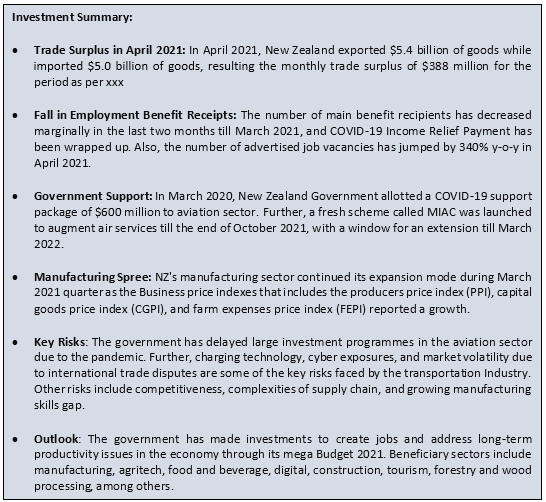
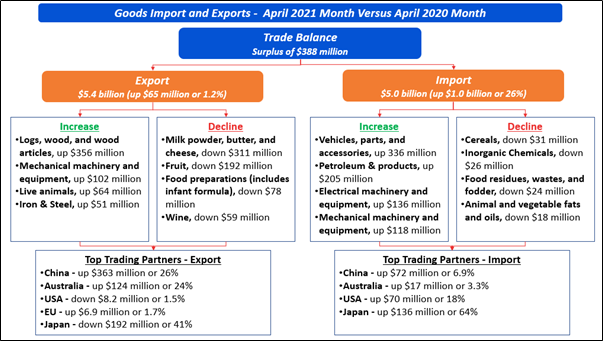
In April 2021, New Zealand exported $5.4 billion of goods representing a rise of $65 million or 1.2% over April 2020. Further, it imported $5.0 billion of goods indicating an increase of $1.0 billion or 26% over April 2020. Therefore, the monthly trade surplus in April 2021 was $388 million, versus $1.4 billion surplus in April 2020. Meanwhile the average monthly surplus in the previous five months was $561 million. Importantly, there were contrasting movements in exports to top destinations in April 2021.
In April 2021 year, goods exported were valued at $59.0 billion, fall of $1.4 billion or 2.4% from the previous year. Further, annual goods imported were valued at $58.3 billion, down by $4.6 billion or 7.2% from the previous year. This reflected an annual trade surplus of $733 million versus a deficit of $2.4 billion in April 2020.
Exhibit 1: Export Rose in April 2021 versus last year
Data Source: stats.govt.nz, Chart Created by Kalkine Group
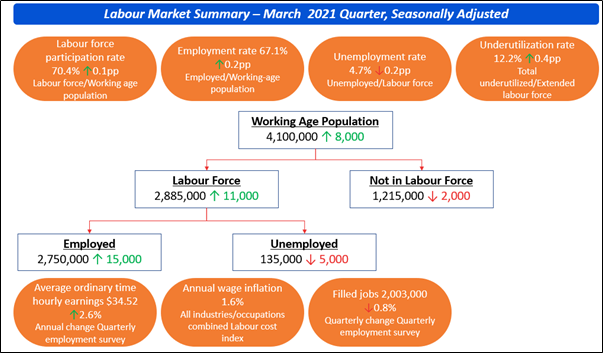
Employment rate rose 67.1% in March 2021 Quarter, up from 66.8% last quarter
Amid economic restrictions pertaining to COVID-19 circumstances, New Zealand’s labour market has held strong, better than expected, however it continued to be at lower level than pre-COVID-19 state. Further, the headline labour market measures grew in the March 2021 quarter, with the unemployment rate decreasing to 4.7% and the participation rate rising slightly to 70.4% as employment increased by 15,000 (seasonally adjusted) people over the quarter. However, the rise has been uneven as border closures continuing to have mixed impact for industries and regions. Meanwhile, the seasonally adjusted employment rate rose to 67.1% in March 2021 quarter, up from 66.8% last quarter.
Use of the original Wage Subsidy topped in June 2020 with coverage of 1.65 million unique jobs, use of the Wage Subsidy Extension topped in July 2020 with coverage of 587,000 unique jobs, and use of the Resurgence Wage Subsidy topped in September 2020 with coverage of 291,000 unique jobs. As of the start of May 2021, the COVID-19 Wage Subsidy March 2021 was covering 170,000 unique jobs.
Exhibit 2: March 2021 quarter, compared with the December 2020 quarter
Data Source: stats.govt.nz, Chart Created by Kalkine Group
Extension of Government's Support to the Aviation Sector
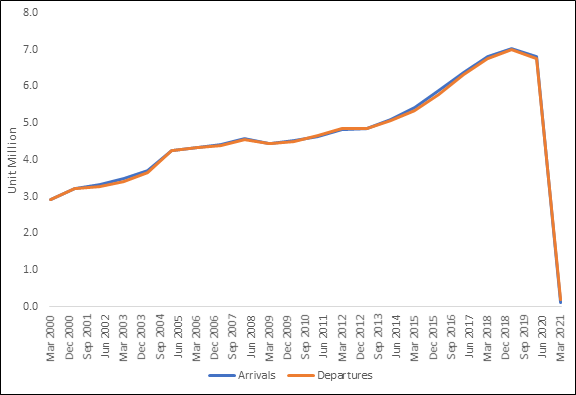
In March 2020, New Zealand Government allotted a COVID-19 support package of NZD$600 million aviation sector. Out of this, $372 million was committed for the International Air Freight Capacity (IAFC) scheme. On the success of the IAFC, the Government has set up a fresh scheme called Maintaining International Air Connectivity (MIAC) to augment air services till the end of October 2021, with a window for an extension till March 2022. Further, for domestic connectivity, the government parked NZD$30 million to the Essential Transport Connectivity (ETC) Scheme for aviation initiatives and an additional NZD$20 million for an ETC non-aviation initiatives. Importantly, the aviation network that provides effective regional connectivity is important for New Zealand's social and economic welfare and is crucial for the COVID-19 recovery.
Exhibit 3: Arrivals and Departures Across New Zealand Border
Data Source: stats.nz, Chart Created by Kalkine Group
Manufacturing into the Future – Indicating a Growing Trend
New Zealand's manufacturing sector continued in expansion mode during March 2021 quarter, according to the Stats New Zealand. Business price indexes that includes the producers price index (PPI), capital goods price index (CGPI), and farm expenses price index (FEPI) reported growth. The output PPI for March 2021 quarter increased 1.2% and input PPI grew 2.1%, farm expenses price index (FEPI) increased 1.0%, and capital goods price index (CGPI) increased 0.6%. Further, the largest output industry contributions were from electricity and gas supply that increased 17.4%, followed by petroleum and coal product manufacturing, up 12.2%, and dairy cattle farming, up 5.1%. Meanwhile, the largest input industry contributions were from electricity and gas supply, up 28.7%, dairy product manufacturing, up 4.7%, and petroleum and coal product manufacturing, up 9.3%
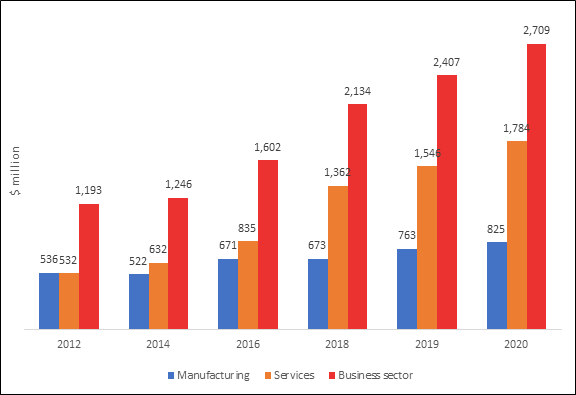
Manufacturing firms are more likely to invest in R&D. Manufacturing firms innovate through new and adjusted plant, processes, and inventory management, as well as products.
Exhibit 4: Total Research and Development Expenditure by Industry (Annual-Jun)
Data Source: infoshare.stats.govt.nz, Chart Created by Kalkine Group
Index Performance:
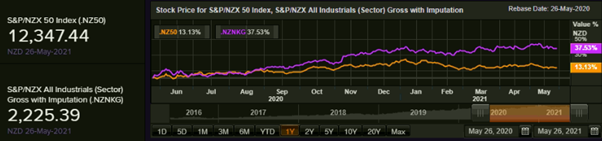
The S&P/NZX All Industrials (Sector) Index generated a 1-year return of ~37.53% as compared to ~13.13% by the S&P/NZX 50 Index. NZX All Industrials Index overperformed NZX50 Index by ~24.4% in 1-year period
Exhibit 5: S&P/NZX All Information Technology (Sector) vs S&P/NZX50 Index
Source: REFINITIV
Key Risks and Challenges:
As per the Commerce Commission of New Zealand, the expected investment in airports is not available, however, the large investment programmes have been delayed due to the pandemic. Further, long-term impact of the pandemic on the sector is not clearly visible, but the regulations that the government administers do not appear to be a barrier.
Further, charging technology, cyber exposures, and market volatility due to international trade disputes are some of the key risks faced by the Transportation Industry. In addition, experienced driver shortage, regulatory compliance and slow-down in infrastructure projects are the persistent challenges faced by the industry.
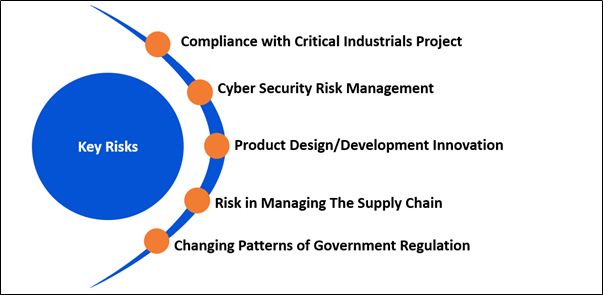
Beyond intellectual property concerns, manufacturers face the risk of competitiveness, complexities of supply chain, growing manufacturing skills gap, frequent change in technology, cybercrime, business interruption, and compliance risk, among others.
Exhibit 6: Key Risks in the Industrials Sector:
Outlook:
As per the Budget 2021, the government laid out to fund several initiatives from operating expenditure (budgeted at $3.8 billion for 2021 and $15.1 billion over the forecast period) to capital expenditure (budgeted at $3.9 billion for four years and $12 billion for capital allowance). Further, investments are made in education, skills, and training so that industries, businesses, and workers have the skills they require to prosper in a progressively evolving digital environment. Covid-19 budget support comprised of sectors such as Business, Science, and Innovation ($4.9 billion), Education ($2.2 billion), Transport, ($2.0 billion), and Building and Construction ($1.6 billion), among others.
Opportunities, such as quarantine-free travel between Australia and New Zealand, as well as New Zealand and the Cook Islands, is expected to augment the economic recovery, though keeping COVID-19 infections out of the communities.
Broadly, the government is driving the economic recovery through investments in business, infrastructure, and tourism support. The infrastructure investment over the next 4 years totals at $57.3 billion. Further, support, recovery and re-set for Tourism Communities has been set at $200 million and small business digital training, advisory and support program has been set at $44 million.
These investment support by the government is expected to accelerate economic growth in the coming quarters, thereby benefiting private and public companies immensely and raising output and incomes in the short run.
Apart from the sector-specific factors, we have also analysed four NZX-listed companies operating in the same sector. This report covers their insights, outlook, performance, and potential as expected to be delivered in the near to medium term.
1) Scott Technology Limited (Recommendation: Buy, Potential Upside: Low Double-Digit) (M-Cap: NZ$190.37 million, Gross Dividend Yield: 0.826%)
Business Description:
Scott Technology Limited (NZX: SCT) specialises in the design and manufacture of advanced automation systems that improve productivity, reliability, yield, and safety for manufacturers and processors globally.
Outlook:
The company secured phenomenal repeat business across all sectors example Rio Tinto, Alliance, Little Swan, Bosch, Candy Haier, McCain. Further, it has secured growth across Rocklabs sample preparation and BladeStop product businesses. In addition, it reported a significant decrease in lost time injuries, and extended focus on employee retention, development, and wellness. Meanwhile, it has delivered sustainable margin improvement across all regions with a positive pipeline of forward work operating off the reduced as well as streamlined cost structure.
Technical Overview:
Weekly Chart –
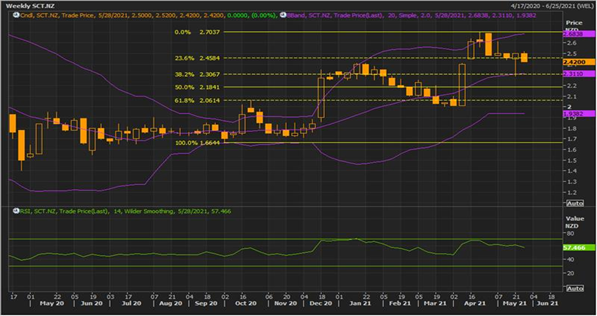
Note: Purple colour lines are Bollinger Bands® with the upper band suggesting overbought status while the lower band oversold status, and yellow lines are Fibonacci retracement lines which measure price rebound and backtrack. https://www.bollingerbands.com/
While remaining in an underlying uptrend, the stock has given a softer close below the 23.6% retracement level of $2.458 at $2.420. The technical indicator with a reading around 57 suggests bullish momentum for the stock.
Going forward, the stock may have resistance around its previous high of $2.70 whereas support could be around the converging point of a 38.2% retracement level and 20 periods SMA of $2.31.
Stock Recommendation
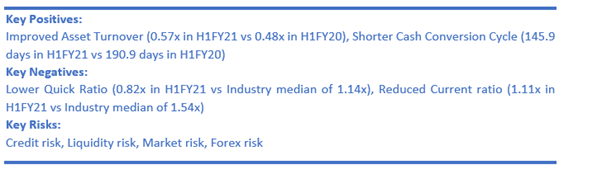
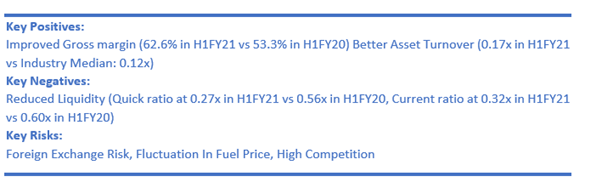
Considering turnaround from the net loss of $13.7 million in H1FY20 to the net profit of $4.7 million in H1FY21, 5% YoY growth in revenue in H1FY21, operating cash flow of $5.3 million in H1FY21 from $0.9 million in H1 FY 2020, total cash of $6.2 million, and strong long-term business outlook, we are positive on the fundamentals of the company.
Thus, we give a “Buy” rating on the stock at the current market price of $2.42 per share on 27th May 2021.
2) Air New Zealand Limited (Recommendation: Hold, Potential Upside: Low Double-Digit) (M-Cap: NZ$1.87 billion)
Business Description:
Air New Zealand Limited (NZX: AIR) operates a global network that offers passenger and cargo services to, from, and within New Zealand to ~17 million passengers a year.
Outlook
The company expects widespread vaccine rollouts across geographies that will support a rebound in commercial air travel. Meanwhile, there persists a large degree of uncertainty surrounding the lifting of travel restrictions and the subsequent level of demand. Despite strong domestic and cargo performance, the scenarios suggest that the company will make a significant loss in 2021.
Valuation Methodology: EV/Sales Based Relative Valuation (Illustrative)
.png)
Stock Recommendation
We have applied an EV/Sales based relative valuation (on an illustrative basis) and the target price reflects a rise of low double-digit (in % terms). We have applied a slight discount to EV/Sales Multiple (NTM) (Peer Average) because the industry is under pressure due to COVID-19 circumstances and travel restrictions.
Also, the company has been awarded an additional 5 months of cargo flights under the Government’s MIAC (or Maintaining International Air Connectivity) scheme.
For the purposes, we have taken peers such as Mainfreight Ltd (MFT.NZ), Qantas Airways Ltd (QAN.AX), and Guangdong Yueyun Transportation Co Ltd (3399.HK) to name a few.
Considering the aforesaid facts, we give a “Hold” recommendation on the stock at the current market price of $1.665 per share, down by 1.48% on 27th May 2021.
3) Accordant Group Limited (Recommendation: Speculative Buy, Potential Upside: Low Double-Digit) (M-Cap: NZ$45.31 million)
Business Description:
Accordant Group Limited (NZX: AGL) is the leading recruitment and resourcing company in New Zealand.
Outlook
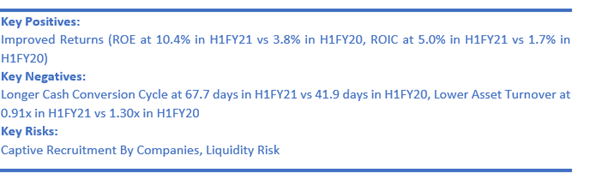
The business of the company is well-positioned to deal with the uncertainty. The company has announced an after-tax profit amounting to $6.2 million for the year ended 31st March 2021, reflecting a rise from $2.7 million in the year-ago period. The company was able to continue to deploy large number of people around the economy, and some were deployed in the areas which were designated as the essential services.
Technical Overview:
Weekly Chart –
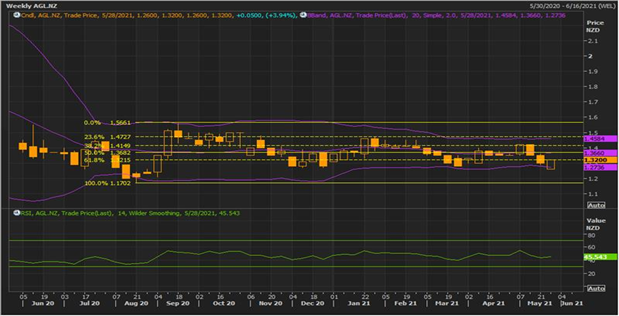
Note: Purple colour lines are Bollinger Bands® with the upper band suggesting overbought status while the lower band oversold status, and yellow lines are Fibonacci retracement lines which measure price rebound and backtrack. https://www.bollingerbands.com/
The stock opened down for the ongoing week but before closing it recovered the loss and finally gave a stronger close at $1.32. The technical indicator RSI with a reading around 46 and a curve at the end pointing up suggests gaining of bullish momentum.
Going forward, the stock may have resistance around the 38.2% retracement level of $1.41 whereas support could be around the weekly low of $1.26.Stock Recommendation
The company has witnessed significant rise in the hiring activity throughout temporary as well as permanent markets. Further, it possesses robust balance sheet. The Board has resumed dividend payments (after the 12-month suspension) with an 8.2 cps final dividend, which is payable on 30th June 2021.
Considering the aforesaid facts, we give a “Speculative Buy” recommendation on the stock at the current market price of $1.32 per share, up by 3.94% on 27th May 2021.
4) Port of Tauranga Limited (Recommendation: Buy, Potential Upside: Low Double-Digit) (M-Cap: NZ$4.93 billion, Gross Dividend Yield: 2.362%)
Business Description:
Port of Tauranga Limited (NZX: POT) is the central to key export commodity sources and has direct and dedicated access to New Zealand’s largest import market, the capacity to expand the infrastructure, and unrivalled sea, road, as well as rail connections.
Outlook
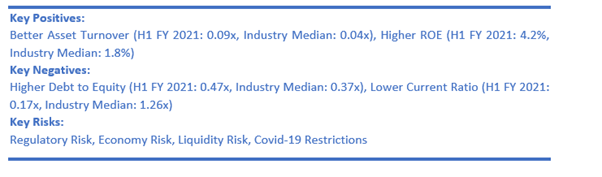
The company is strategically placed to cover the demand for port services, however, the situation in counterparts of the supply chain is under pressure due to COVID-19 restrictions. Further, the COVID-19 safeguards continue to have an important role on costs, as the company extends to prioritize the safety of the employees. Meanwhile, the company anticipates some nervousness in the second half of the year, while at the same time, it is prepared to tackle any challenges. The company expects full-year earnings to be in the range of $94 million and $100 million.
Valuation Methodology: Price/Earnings Per Share Multiple Based Relative Valuation (Illustrative)
.png)
Stock Recommendation
We have applied P/E based relative valuation (on an illustrative basis) and the target price reflects a rise of low double-digit (in % terms). We have applied a slight premium to P/E Multiple (NTM) (Peer Average) considering a decent balance sheet that enables the company to meet challenges arising from COVID-19 infection.
For the purposes, we have taken peers such as Auckland International Airport Ltd (AIA.NZ), Napier Port Holdings Ltd (NPH.NZ), and Atlas Arteria Group (ALX.AX) to name a few.
Considering the aforesaid facts, we give a “Buy” recommendation on the stock at the current market price of $7.25 per share, down 0.55% on 27th May 2021.
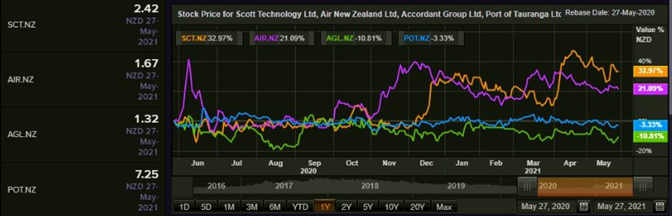
Comparative Price Chart (Source: REFINITIV)
Note 1: The reference data in this report has been partly sourced from REFINITIV.
Disclaimer
Kalkine New Zealand Limited is authorised to provide class advice only. The information on this site does not take into account any of your investment objectives, financial situation or needs. Before you make a decision about whether to acquire a financial product, you should obtain the Product Disclosure Statement from the product issuer. You should consider the appropriateness of advice taking into account your own objectives, financial situation and needs and seek independent financial advice before making any financial decisions.
Past performance is not a reliable indicator of future performance.
 Please wait processing your request...