
 AU
AU
 UK
UK
 CA
CA
 US
US
 IND
IND

 NZ
NZ

I. Sector Landscape and Outlook
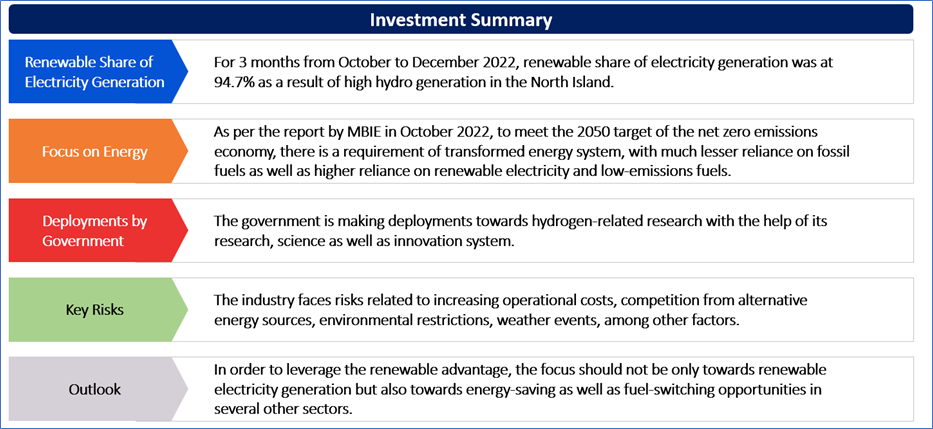
As per the Ministry of Business, Innovation and Employment (MBIE), energy is critical to the economy as well as the lives of New Zealanders. It is consumed across the economy in transport, electricity, for heating and by industry. In 2020, emissions from energy constituted 40% of the total gross emissions. As per the report by MBIE in October 2022, to meet the 2050 target of the net zero emissions economy, there is a requirement of transformed energy system, with much lesser reliance on fossil fuels as well as higher reliance on renewable electricity and low-emissions fuels.
The government’s renewable energy strategy work programme guided work to decarbonise the energy sector as well as prepare it for the more renewable future. Notably, the first Emissions Reduction Plan (ERP) which was released in May 2022 gives the broad range of actions to reduce energy as well as industry emissions. Growing NZ’s hydrogen industry can support NZ in achieving its commitments to reduce net emissions of all greenhouse gases (except biogenic methane) to zero by the year 2050 and has the potential to help the government’s goal of touching 100% renewable electricity by the year 2030.
Record Renewable Share Of Electricity Generation
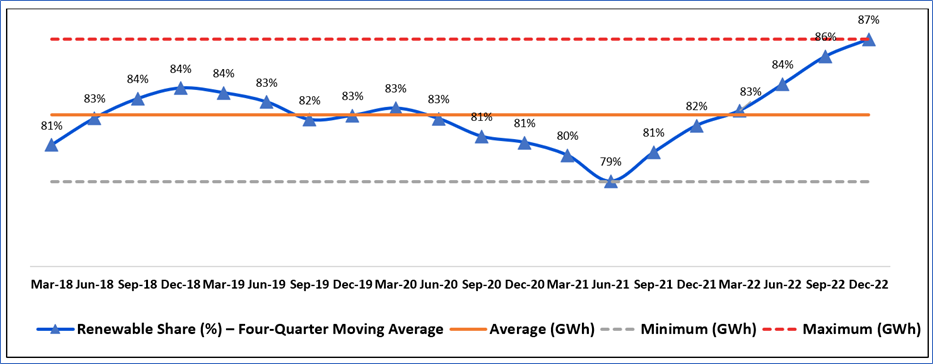
The latest NZ energy quarterly, for 3 months from October to December 2022, gives quarterly data as well as analysis on energy supply, demand, prices, and associated greenhouse gas emissions. According to MBIE, the figures reflect the renewable share of electricity generation at 94.7% as a result of high hydro generation in the North Island. Notably, the previous record was 94.6% during the March 1980 quarter.
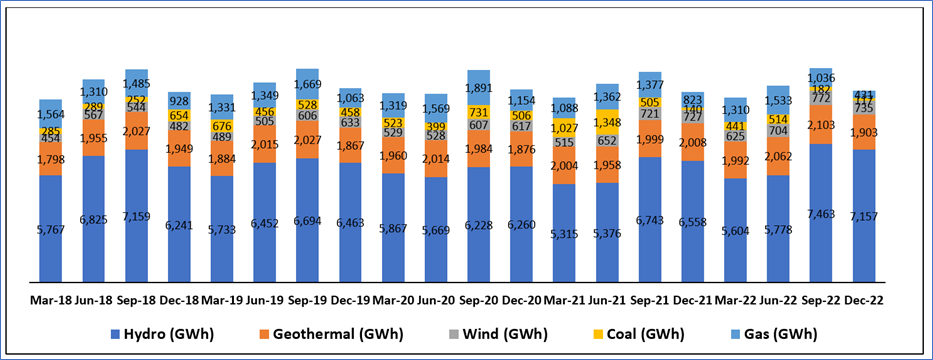
The electricity generation from hydro witnessed a rise of 38.9% as well as wind was up 1.1% as compared to the quarter ended December 2021. The higher hydro generation was because of rain in the North Island which was above or well above normal for much of the quarter. The higher generation from renewables resulted in lesser reliance on coal and natural gas for the electricity generation. It needs to be noted that electricity generation from coal witnessed a fall of 16.5% and natural gas fell 47.6% as compared to the previous December quarter.
Exhibit 1: Trend in Renewable Share (%)-Four-Quarter Moving Average
Data Source: This work is owned by the Ministry of Business, Innovation and Employment on behalf of the Crown which are licensed for reuse under the Creative Commons Attribution 4.0 International Licence; Chart Created by Kalkine Group
The Government’s Focus on Energy
The government is making deployments towards hydrogen-related research with the help of its research, science as well as innovation system. Some examples include $8.5 Mn from MBIE’s Endeavour Fund in 2020 for GNS Science’s project ‘Powering NZ’s green-hydrogen economy: Next-generation electrocatalytic systems for energy production and storage’, $9 Mn from the Government’s Advanced Energy Technology Platform deployed towards GNS Science’s programme ‘Aotearoa: Green Hydrogen Technology’ in 2020, etc.
The transport sector has been producing ~47% of NZ’s CO2 emissions, and between 1990 and 2018, domestic transport emissions rose 90%. Since transport decarbonisation plays the critical role in NZ’s progress towards the 2050 goals, the government has been extending the deployment towards reducing transport emissions with the Low Emission Transport Fund (or LETF).
The LETF would be supporting the demonstration of high potential as well as replicable solutions, and adoption of low emission transport technology, innovation and infrastructure in order to help in accelerating the decarbonisation of NZ transport sector.
Exhibit 2: Trend in Major Energy Contributor to Net Generation in New Zealand Since March 2018 Quarter
Data Source: This work is owned by the Ministry of Business, Innovation and Employment on behalf of the Crown which are licensed for reuse under the Creative Commons Attribution 4.0 International Licence; Chart Created by Kalkine Group
Index Performance:
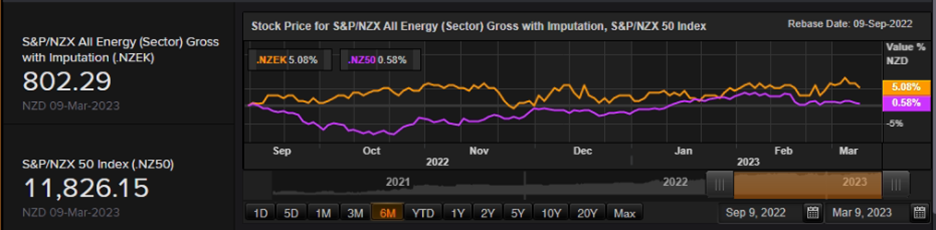
The S&P/NZX All Energy (Sector) Index generated a 6-month return of ~5.08% versus ~0.58% by the S&P/NZX 50 Index. Therefore, NZX All Energy Index overperformed NZX50 Index by ~4.5% in 6 months.
Exhibit 3: S&P/NZX All Energy (Sector) vs S&P/NZX50 Index
Source: REFINITIV
Key Risks and Challenges:
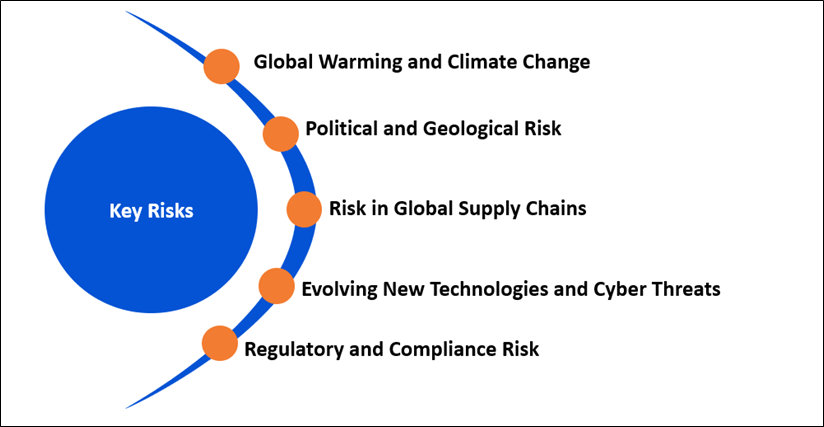
The government and private players are together in supporting the low-carbon electricity systems, a complex collaboration of multiple technologies with strategic functions to maximize output. However, the key risk include the uncertainty regarding the availability of raw materials utilised in renewable electricity generation implies an option value associated with the choice between future non-fossil-fuel generation and fossil-fuel technologies.
Increasing water temperature, air temperature as well as frequency/intensity of droughts are some risks that could impact the generation efficiency of hydropower generation. Also, the 2021 calendar year witnessed continued disruptions in the economic activity in NZ, and the impact of COVID-19 was also felt on the energy sector.
Exhibit 4. Key Risks in Utilities Sector:
Source:- Analysis: Kalkine Group
Outlook:
As per the report titled “New Zealand Energy Efficiency And Conservation Strategy 2017 – 2022”, NZ has significant supply of renewable energy resources, and it has one of the highest shares of renewable electricity generation in the world. In order to leverage the renewable advantage, the focus should not be only towards renewable electricity generation but also towards energy-saving as well as fuel-switching opportunities in several other sectors. The transport system focuses almost entirely towards fossil fuels in order to power the cars, trucks, aircraft, rail networks as well as ships.
New technology has been building opportunities for NZ to benefit from the increased level of renewable electricity. This is impacting the design, operation as well as maintenance of transport infrastructure. It is of utmost importance that the regulatory environment allows the widespread introduction of new applications. This can help in realising the benefits of innovation.
Coming to the innovative and efficient use of electricity, the target is that 90% of electricity would be generated from the renewable sources by 2025 (in an average hydrological year), providing security of supply is maintained. NZ’s high share of renewable electricity reflects that electrification provides the key opportunity to decarbonise NZ’s economy.
Apart from the sector-specific factors, an analysis on two NZX-listed companies is provided. This report covers their insights, outlook, performance and potential as expected to be delivered in the near to medium term.
1) Manawa Energy Limited (Recommendation: Buy, Potential Upside: Low Double-Digit) (M-Cap: NZD1.53 billion, Annual Dividend Yield (TTM)1: 13.8%)
Business Description:
Manawa Energy Limited (NZX: MNW) is one of Aotearoa NZ’s largest renewable electricity generators.

Outlook:
MNW’s revenue streams are largely insulated from the high inflationary environment. This is because these are often linked to the wholesale pricing or inflation-indexed contracts. Capex would be significant over the upcoming 2-3 years as the company deployed towards asset enhancements as well as replacements, dam safety, and built out new development options.
Technical Overview:
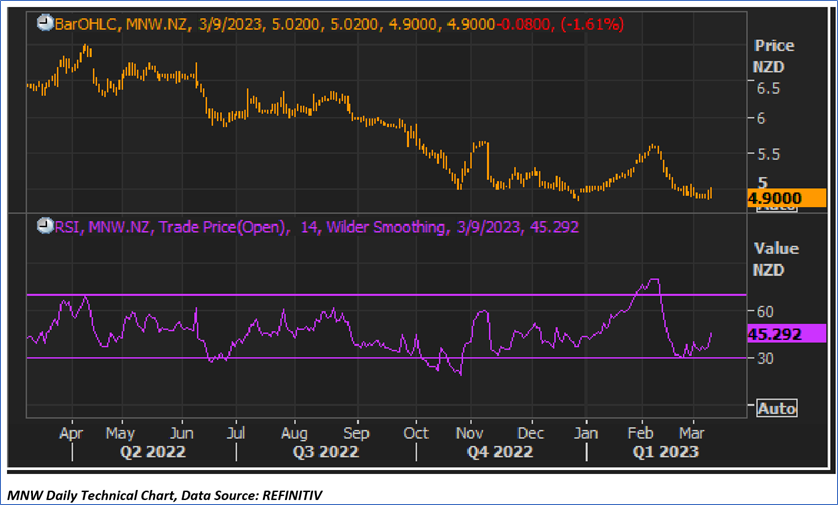
Daily Price Chart
Technical Commentary:
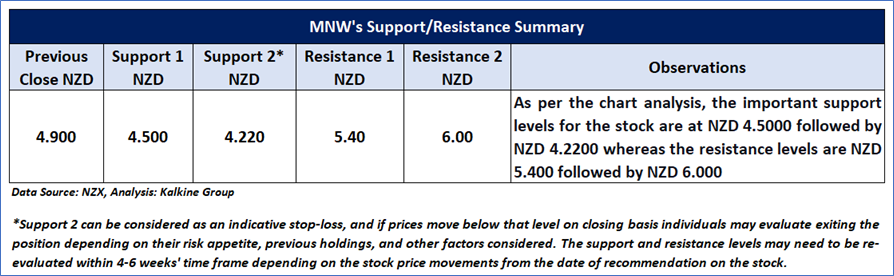
On the daily chart, MNW stock prices are consolidating above the major support zone and are trading above the same from the past few trading sessions. Moreover, the momentum oscillator RSI (14-period) is moving around the oversold zone and showing a reading of ~45.292 level, indicating the possibility of the positive momentum hereon. An important support level for the stock is placed at NZD4.5 while the key resistance level is placed at NZD5.4.
Fundamental Valuation:
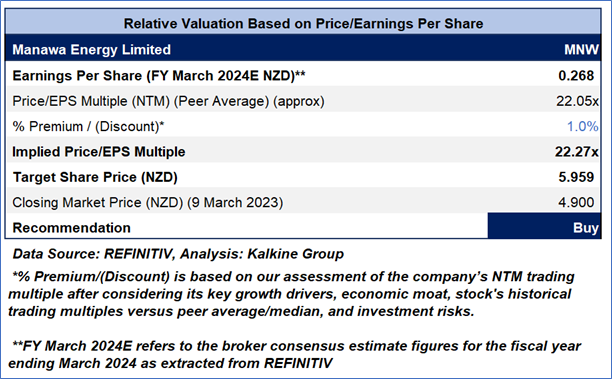
Price/EPS Based Relative Valuation
Stock Recommendation
Considering the facts above, a ‘Buy’ recommendation on the stock has been provided at the closing market price of NZD4.900 per share, down by 1.61% as of 9 March 2023.
2)Genesis Energy Limited (Recommendation: Hold, Potential Upside: Low Double-Digit) (M-Cap: NZD3.01 billion, Annual Dividend Yield (TTM)1: 8.1%)
Business Description:
Genesis Energy Limited (NZX: GNE) is a New Zealand-owned energy company which fosters robust links with the customers as well as community stakeholders.

Outlook:
GNE has updated its FY 2023 EBITDAF guidance to ~$515 Mn from ~$500 Mn, subject to hydrological conditions, gas availability as well as any material adverse events or unforeseeable circumstances. Notably, FY 2023 capex is expected to be ~$80 million, excluding investment towards Kupe well development. Also, long-run outlook for stay in business capex is $50 Mn - $70 Mn.
Technical Overview:
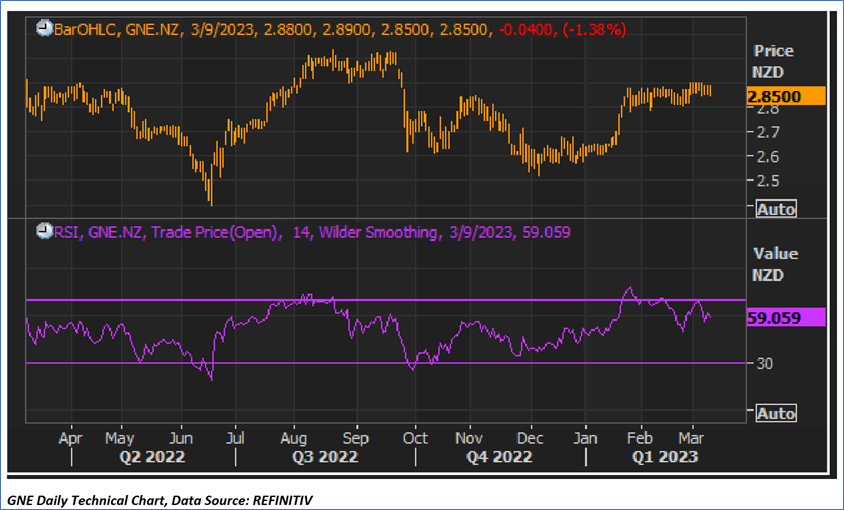
Daily Price Chart
Technical Commentary
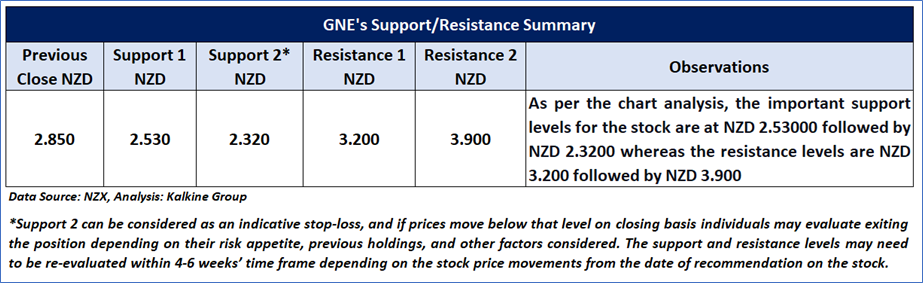
On the weekly chart, GNE stock prices recently broke the downward sloping trendline on the upside and are sustaining above the same from the past few trading sessions. Moreover, the momentum oscillator RSI (14-period) is moving above the midpoint and showing a reading of ~59.059 level, indicating the possibility of the positive momentum hereon. An important support level for the stock is placed at NZD2.53 while the key resistance level is placed at NZD3.20.
Fundamental Valuation:
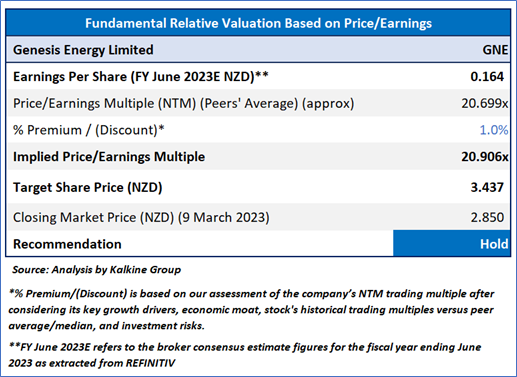
Price/EPS Based Relative Valuation
Stock Recommendation
Considering the aforementioned factors, a ‘Hold’ rating is given on the stock at the closing market price of NZD2.850 per share, down by 1.38% as of 9 March 2023.
Markets are trading in a highly volatile zone currently due to certain macro-economic issues and geopolitical tensions prevailing. Therefore, it is prudent to follow a cautious approach while investing.
Note 1: Past performance is neither an indicator nor a guarantee of future performance.
Note 2: The reference date for all price data, currency, technical indicators, support, and resistance levels is 9 March 2023. The reference data in this report has been partly sourced from REFINITIV.
Note 3: Investment decisions should be made depending on an individual's appetite for upside potential, risks, holding duration, and any previous holdings. An 'Exit' from the stock can be considered if the Target Price mentioned as per the Valuation and or the technical levels provided has been achieved and is subject to the factors discussed above.
Technical Indicators Defined: -
Support: A level at which the stock prices tend to find support if they are falling, and a downtrend may take a pause backed by demand or buying interest. Support 1 refers to the nearby support level for the stock and if the price breaches the level, then Support 2 may act as the crucial support level for the stock.
Resistance: A level at which the stock prices tend to find resistance when they are rising, and an uptrend may take a pause due to profit booking or selling interest. Resistance 1 refers to the nearby resistance level for the stock and if the price surpasses the level, then Resistance 2 may act as the crucial resistance level for the stock.
Stop-loss: It is a level to protect further losses in case of unfavourable movement in the stock prices.
Disclaimer
Kalkine New Zealand Limited is a Financial Advice Provider (“FAP”) and is authorised by a Transitional FAP license issued by Financial Markets Authority (“FMA”) to provide financial advice. Kalkine provides only general financial advice through its research reports following a person becoming a member. The reports contain buy/sell/hold and other recommendations in relation to equity financial products. The recommendations and opinions [on this website] / [in this report] do not take into account any of your investment objectives, financial situation or needs. Before you make a decision about whether to acquire a financial product, you should obtain the Product Disclosure Statement from the product issuer. You should consider the appropriateness of advice taking into account your own objectives, financial situation and needs and seek independent financial advice before making any financial decisions. If you act on the advice in the research reports, you may have to pay fees, expenses or other amounts (but not to Kalkine). Further information about the complaints and dispute resolution process, as well as information about Kalkine’s duties are available on Kalkine’s website. Please read our Financial Advice Provider (FAP) disclosure statement and Complaints Handling Guide, which are available on the website.
Past performance is not a reliable indicator of future performance.
 Please wait processing your request...