
 AU
AU
 UK
UK
 CA
CA
 US
US
 IND
IND

 NZ
NZ

I. Sector Landscape and Outlook
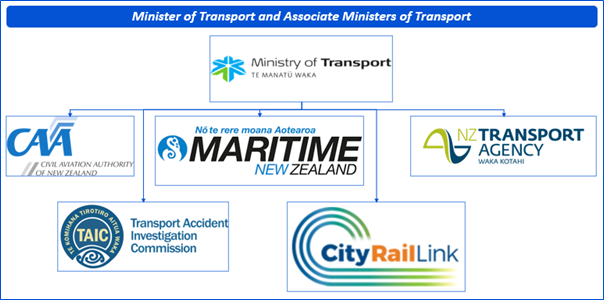
Transportation sector offers great economic and social opportunities. The Ministry of Transport provides expert advice to the Government to assist meeting its objectives for transport. This includes assistance on legislative, regulatory and policy settings, funding levels and priorities, and Crown agency governance, performance, and accountability. The Ministry also represents the Government’s transport interests internationally.
Exhibit 1: New Zealand Government Transport Sector
Data Source: transport.govt.nz, Chart Created by Kalkine Group
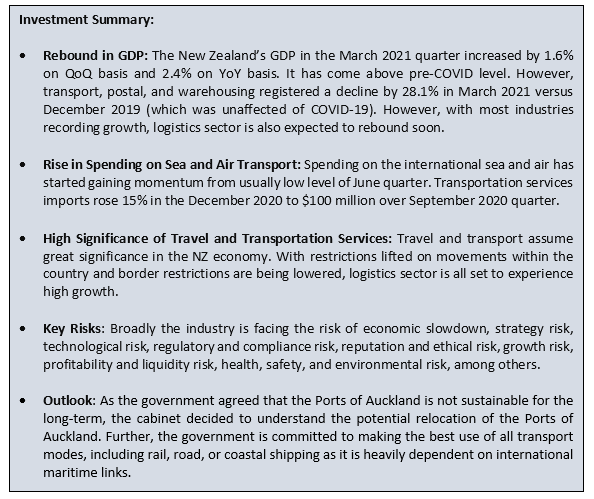
The New Zealand GDP increased by 1.6% in the March 2021 quarter over December 2020 quarter, where goods-producing industries increased by 2.4%, followed by a rise in service industries by 1.1% and primary industry by 0.3%. GDP per capita increased by 1.5% and real gross disposable national income per capita rose by 0.9%. The size of the economy is $325 billion at current prices in the year ended March 2021.
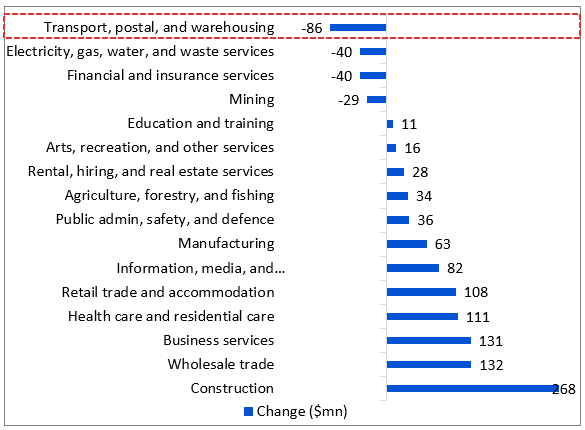
Transport, postal, and warehousing decreased by 28.1% compared with the December 2019 quarter increase of 7.0%. This industry experienced a decline as it is the most severely affected by the COVID-19 pandemic and related response. Extended border restrictions have driven the historic decline in air transport, while alert level changes have restricted domestic travel over the period, affecting road and rail transport.
Exhibit 2: GDP by industry – Change from December 2020 quarter to March 2021 quarter
Data Source: stats.govt.nz, Chart Created by Kalkine Group
Rise in Values of Sea and Air Transport in December 2020 versus June 2020
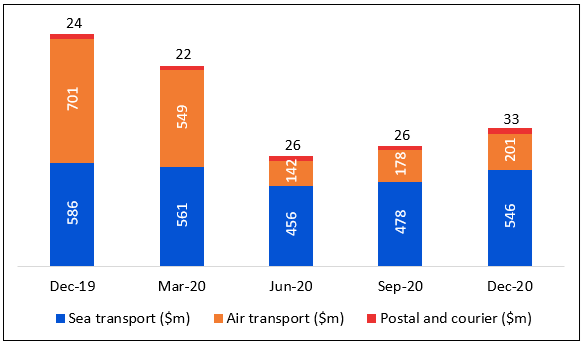
Spending on international sea and air transportation services has reported a decent growth in December 2020 quarter from a low level seen in the June 2020 quarter, pushing up total transportation services imports by $100 million in the December 2020 quarter (up 15% QoQ). International transportation spending fell post COVID-19 that hit in the March 2020 quarter, resulting in fall in New Zealand’s total import volumes, especially in fuel, and international air travel. However, in the December 2020 quarter, the spending on transportation by sea and air has increased that shows a sign of recovery.
Exhibit 3: Transportation Services Imports ($ million), December 2019–December 2020 quarters
Data Source: stats.govt.nz, Chart Created by Kalkine Group
Exports and Imports Lower in 2020, But Recovery is Underway
In a normal year, millions of tonnes of freight move around New Zealand by air, rail, road, and ship. The transport sector contributes to around 5% of New Zealand’s GDP and is a major employer of New Zealanders. Broadly, it is a much larger contributor to GDP as that the sector impacts many downstream businesses (imports and exports) and upstream businesses, which rely on the sector.
Sea transport increased ~$70 million between the September and December 2020 quarters. Air transport increased by about $24 million in the same period. Meanwhile, the value of total merchandise goods imported in the December 2020 quarter was 8.5 % higher than the September 2020 quarter.
In April 2021, goods exported reported at $5.4 billion, indicating an increase of 1.2% over April 2020, while goods imported grew 26% YoY to $5.0 billion. Reporting monthly trade balance surplus of $388 million. Meanwhile, the average monthly surplus in the previous five April months was $561 million, while the monthly trade balance in April 2020 was a surplus of $1.4 billion. Broadly, there were distinct movements in exports to top destinations, while imports increased from all top trading partners.
Exhibit 4: Yearly Trend in Import and Export of Overseas Cargo
.png)
Data Source: transport.govt.nz, Chart Created by Kalkine Group
Container Tonnage Down in Q4FY20 – But expected to Reclaim its Previous Level
The Ministry of Transport has developed a Freight Information Gathering System (FIGS) to provide an overview of freight activities around New Zealand, including containerized freight, rail freight, and bulk coastal freight. The largest container ports include Ports of Auckland, Port of Tauranga, Port of Napier, Port Nelson, CentrePort, Lyttelton Port Company, PrimePort Timaru, Port Otago, and South Port. In addition, KiwiRail provided rail data in both tonnes and tonne-kilometers.
Export from Auckland-Tauranga port reported de-growth of -3.6% in Q4FY20 over Q4FY19 and import fell by -2.6% in Q4FY20 over Q4FY19, in terms of container tonnage (‘000). A similar pattern was identified from Lyttelton-Timaru-Port Otago port as export reported de-growth of -3.8% in Q4FY20 over Q4FY19 and import fell by -2.1% in Q4FY20 over Q4FY19, in terms of container tonnage (‘000).
Exhibit 5: Ports Comparison: Auckland-Tauranga, Lyttelton-Timaru-Port Otago
.png)
Data Source: transport.govt.nz, Chart Created by Kalkine Group
Index Performance:
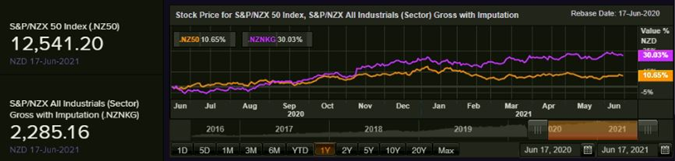
The S&P/NZX All Industrials (Sector) Index generated a 1-year return of ~30.03% versus ~10.65% by the S&P/NZX 50 Index. Therefore, NZX All Industrials Index overperformed NZX50 Index by ~19.38% in 1 year.
Exhibit 6: S&P/NZX All Industrials (Sector) vs S&P/NZX50 Index
Source: REFINITIV
Key Risks and Challenges:
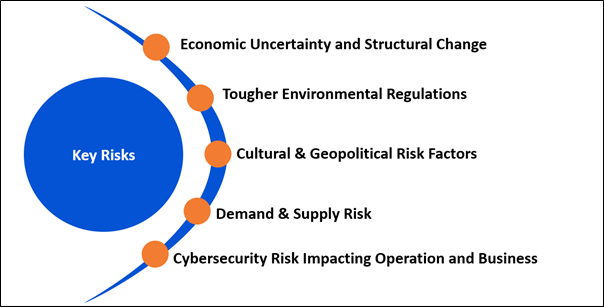
The major challenges in the transportation industry include supporting the growth of large cities, investments to slash emissions and build resilience to extreme events, and the adaption of economic and planning levers to influence and encourage sustainable growth and urban renewal. Further, greater certainty about the infrastructure pipeline is a regular request made to the transport sector, and infrastructure agencies mostly. Success at creating certainty would help New Zealand in attracting market capabilities, reduce delivery risks, and help the market plan more effectively and efficiently.
Further, any slowdown in China’s economy will be backed by falling demand for commodities and a fall in Chinese exports and imports, adversely affecting the shipping business. In addition, uncertainty in customer preferences because of changes in the shipping and freight market from general economic volatility, fall in global freight demand, and rising intense competition. In addition, IT risks about breakdown or disruption in the operation of the systems, or a security crack could negatively impact the businesses to compete. Meanwhile, regulatory and compliance risk due to changes in global and domestic laws, rules, policies, tax regulations, technical standards, and trade policies would impact the operations of the companies.
Exhibit 7. Key Risks in Freight, Logistics and Port Sector:
Sources: Analysis by Kalkine Group
Outlook:
As an island nation, the country is heavily dependent on international maritime links to augment its growing economy. By volume, 99% of exports and imports are sea freighted, linking the country to markets away from shores. Moreover, the shipping sector accomplishes a critical role in New Zealand’s freight system as it is the most cost-effective and efficient mode for transporting large, heavy cargo, like petroleum products, cement, and aggregate. Therefore, the government is committed to making the best use of all transport modes, whether that is rail, road, or coastal shipping.
Moreover, as per the government, the freight volumes are expected to continue their growth momentum, and all parts of the freight system will be supported by this growth. Consumer demand for next-day and same-day delivery is rising rapidly. Competition in the global market continues to drive a rising emphasis on speed, even when the nature of the freight may not require it.
Further, the government is pushing the GPS 2021 plans that include investigating the case for National Land Transport Fund support for coastal shipping and the land-based supporting infrastructure. The Government’s expectation for investment in coastal shipping is to provide freight transporters real choice, permit New Zealand flagged coastal shipping to operate on a level playing field with other freight operators, and facilitate the sustainability and competitiveness of the domestic sector. In addition to this, it also indicates the Government’s interest in partnering with industry to understand the challenges facing coastal shipping and working with it to address these challenges. The initial three years of funding stood at ~$45 million. As per the report, around 362,000 tonnes of CO2 are avoided annually because of coastal shipping compared to if moved that same freight by road. Therefore, coastal shipping has a big role to play in the vision of a zero-carbon future.
Apart from the sector-specific factors, we have also analysed four NZX-listed companies operating in the same sector. This report covers their insights, outlook, performance and potential as expected to be delivered in the near to medium term.
1) Mainfreight Limited (Recommendation: Buy, Potential Upside: Low Double-Digit) (M-Cap: NZ$7.40 billion, Gross Dividend Yield: 1.196%)
Business Description:
Mainfreight Limited (NZX: MFT) is engaged in the business of supply chain logistics. It offers a range of warehousing, domestic distribution, and international air and ocean freight services.
Outlook
In FY21, the company reported a record profit before tax of $262 million, increased revenues to exceed $3.5 billion, and net profit before abnormals of $188 million led by success in every one of the five regions where it is located. Further, businesses outside New Zealand now contribute ~76% of revenues and ~63% of net profit. Therefore, it can be said that the company has created itself a global business and has the potential to provide supply chain logistics services for customers around the world, competing with phenomenal larger global competitors. Further, the company expects inflated shipping and air cargo rates to continue further as freight demand is exceeding air and sea capacity. In the first seven weeks of FY22, the company sees similar activity levels as those of the past six months. This indicates confidence that the company will deliver further improved results in the near term.
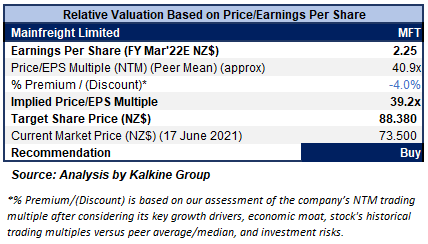
Valuation Methodology: Price/Earnings Per Share Based Relative Valuation (Illustrative)
Stock Recommendation
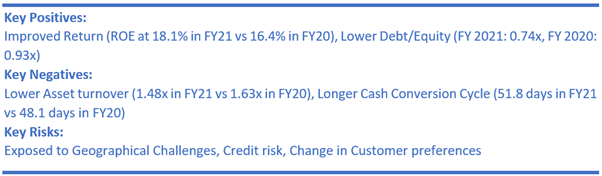
Considering the aforesaid facts, we have valued the stock using a P/E multiple-based illustrative relative valuation and have arrived at a target price that reflects a rise of low double-digit (in % terms). We believe the company can trade at a slight discount to its peer P/E (NTM Trading multiple) considering reduced Asset turnover and longer Cash conversion cycle.
For the purposes of relative valuation, we have taken peers like Port of Tauranga Ltd (POT.NZ), Napier Port Holdings Ltd (NPH.NZ), and Qube Holdings Ltd (QUB.AX).
Considering the aforesaid facts, we give a “Buy” recommendation on the stock at the current market price of $73.50 per share, down 1.08% on 17th June 2021.
2) Napier Port Holdings Limited (Recommendation: Buy, Potential Upside: Low Double-Digit) (M-Cap: NZ$695.57 million, Gross Dividend Yield: 3.095%)
Business Description:
Napier Port Holdings Limited (NZX: NPH) is engaged in the port and logistics services business. It provides Shipping connections, Marine services, Cargo handling, Cruise, Crane driver training, and port tech solutions.
Outlook
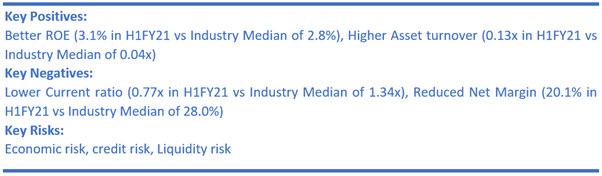
The demand for the region’s food and fibre exports remains robust. Further, Pipfruit exports are moving in line with last year's trend, but it is not clear what the eventual export crop size for FY21 will be because of the seasonal labour shortages. Similar dynamics play across all fresh produce sectors. Moreover, the company expects earnings from operating activities for FY21 to be in the range of $39 million and $42 million.
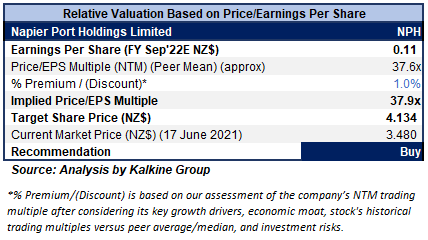
Valuation Methodology: Price/Earnings Per Share Based Relative Valuation (Illustrative)
Stock Recommendation
Considering the aforesaid facts, we have valued the stock using a P/E multiple-based illustrative relative valuation and have arrived at a target price that reflects a rise of low double-digit (in % terms). We believe the company can trade at a slight premium to its peer P/E (NTM Trading multiple) considering decent EBITDA margin and Operating margin. In addition, the company is well placed to capitalize on the future opportunities.
For the purposes of relative valuation, we have taken peers like Port of Tauranga Ltd (POT.NZ), Mainfreight Ltd (MFT.NZ), and Qube Holdings Ltd (QUB.AX).
Considering the aforesaid facts, we give a “Buy” recommendation on the stock at the current market price of $3.48 per share, down 0.57% on 17th June 2021.
3) South Port New Zealand Limited (Recommendation: Hold, Potential Upside: Low Double-Digit) (M-Cap: NZ$228.24 million, Gross Dividend Yield: 4.151%)
Business Description:
South Port New Zealand Limited (NZX: SPN) is New Zealand’s southernmost commercial deep-water port. It offers a complete range of marine services, cargo and container shipping, and on-site warehousing for domestic and international customers.
Outlook
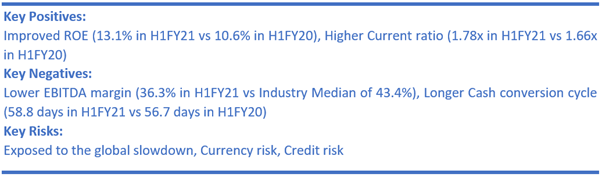
The company expects that COVID-19 will maintain its influence on the supply chain and evolve unexpected uncertainty in the marketplace. The export log market into China is indicating a strong performance with higher prices for A grade logs which bodes well for sales of New Zealand Radiata softwood into this region. The Dairy industry forecast is also very positive for the current season. However, some uncertainty persists in other cargoes and market destinations for New Zealand goods, especially in economies impacted severely by COVID-19. Moreover, the company forecasts that its full-year 2021 earnings will be in the ambit of $10.00 million to $10.50 million (FY2020: $9.43 million).
Technical Overview:
Weekly Chart –
Source: REFINITIV
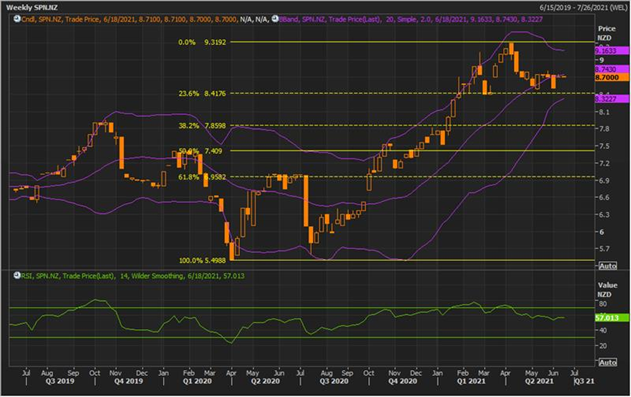
Note: Purple colour lines are Bollinger Bands® with the upper band suggesting overbought status while the lower band oversold status, and yellow lines are Fibonacci retracement lines which measure price rebound and backtrack. https://www.bollingerbands.com/
The stock having made an all-time high of $9.32, is currently on a correction path whereby it is hovering around the 23.6% retracement level of $8.42. For the ongoing week, it has given a flattish close at $8.70, experiencing low volatility. The technical indicator RSI with a reading around 57 and a flattish curve at the end, suggests flattening of bullish momentum.
Going forward, the stock may have resistance around the previous high of $9.32 whereas support could be around the 23.6% retracement level of $8.42.
Stock Recommendation
Considering current trading levels, strong footprints in southern region of New Zealand, strategic decisions, and a strong outlook, we give a “Hold” recommendation on the stock at the current market price of $8.70 per share on 17th June 2021.
4) TIL Logistics Group Limited (Recommendation: Hold, Potential Upside: Low Double-Digit) (M-Cap: NZ$87.69 million)
Business Description:
TIL Logistics Group Limited (NZX: TLL) is one of New Zealand’s leading domestic freight and logistics companies. It offers freight transport, warehousing services and coordinates freight movements offshore through international alliances.
Outlook:
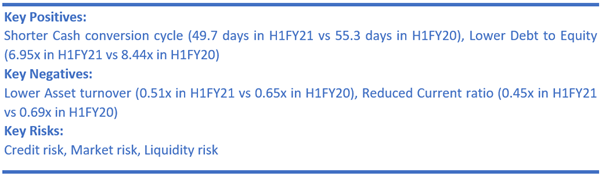
The existing business environment has realized the benefits of being a group of scale and diversity, with the ability to focus on health & safety, training, systems, and infrastructure. While economic conditions remain precarious, private & public investment, and consumer demand is expected to drive demand in certain sectors. The company is expected to maintain its focus on strategic priorities in H2FY21, which includes the Freight improvement plan, organic growth, targeted acquisition opportunities, group synergies, and growing shareholder value. Moreover, it expects EBITDA for FY21 to be ~$57.4 million.
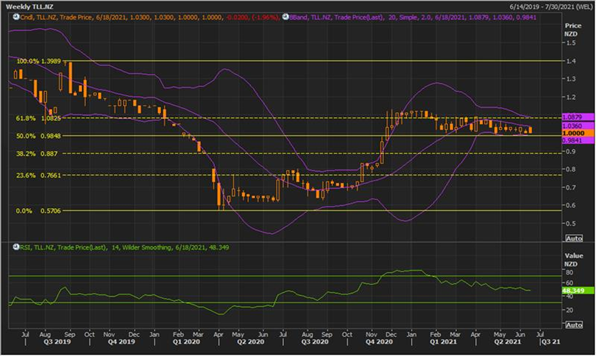
Weekly Chart –
Source: REFINITIV
Note: Purple colour lines are Bollinger Bands® with the upper band suggesting overbought status while the lower band oversold status, and yellow lines are Fibonacci retracement lines which measure price rebound and backtrack. https://www.bollingerbands.com/
For several weeks, the stock has been trading in the range provided by the 61.8% retracement level of $1.08 on the upside and the 50% retracement level of $0.98 on the downside. For the ongoing week, the stock has given close at $1.00, demonstrating weaker sentiment on the stock. The technical indicator RSI with a reading around 48 and a flattish curve at the end, suggests flattening of bullish momentum.
Going forward, the stock may have resistance around $1.08 whilst support could be around $0.98.
Stock Recommendation
Considering current trading levels, targeted acquisition, revenue growth, and a strong outlook, we give a “Hold” recommendation on the stock at the current market price of $1.00 per share, down 1.96% on 17th June 2021.
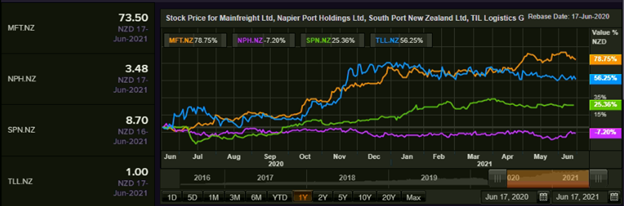
Comparative Price Chart (Source: REFINITIV)
Note 1: The reference data in this report has been partly sourced from REFINITIV.
Note 2: Investment decisions should be made depending on the investors’ appetite on upside potential, risks, holding duration, and any previous holdings. Investors can consider exiting from the stock if the Target Price mentioned as per the analysis has been achieved and subject to the factors discussed above alongside support levels provided.
Technical Indicators Defined: -
Support: A level where-in the stock prices tend to find support if they are falling, and downtrend may take a pause backed by demand or buying interest.
Resistance: A level where-in the stock prices tend to find resistance when they are rising, and uptrend may take a pause due to profit booking or selling interest.
Disclaimer
Kalkine New Zealand Limited is authorised to provide class advice only. The information on this site does not take into account any of your investment objectives, financial situation or needs. Before you make a decision about whether to acquire a financial product, you should obtain the Product Disclosure Statement from the product issuer. You should consider the appropriateness of advice taking into account your own objectives, financial situation and needs and seek independent financial advice before making any financial decisions.
Past performance is not a reliable indicator of future performance.
 Please wait processing your request...