
 AU
AU
 UK
UK
 CA
CA
 US
US
 IND
IND

 NZ
NZ

Summary:
New Zealand's export performance is strong and improving as compared to their peers. The country’s food and beverage industry has a combined revenue of $71.7 billion as on 2018/19. Although the country is a major F&B exporter, it has some noteworthy untapped capacity to export more.
New Zealand is still realizing its competitive advantages and new industries continue to develop. In the past 20 years, New Zealand's wine, honey, aquaculture, and avocados have all developed from almost nothing into world-leading sectors.
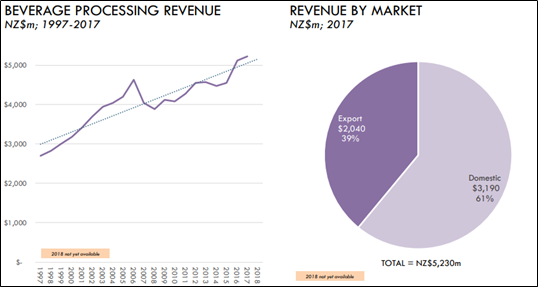
Key Data (Source: MBIE)
Marginal Increase in Total Volume of Alcoholic Beverages
As per the release by Stats NZ, the total volume of alcoholic beverages available for consumption rose 1.7 percent to 491 million litres in 2019.
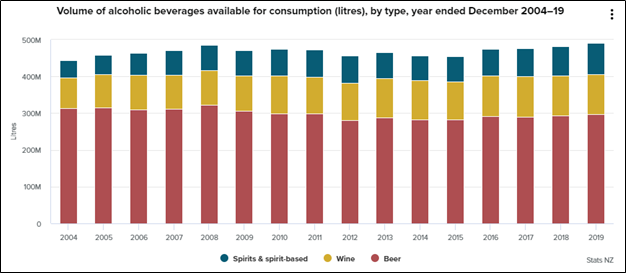
Volume (Source: Stats NZ)
Restaurant and Café Sector Recorded Highest Growth
As per the post by the Restaurant Association of New Zealand dated October 18, 2019, the nationwide sales for hospitality industry have continued to grow, and restaurant and café segment recorded highest growth at 5.2%. In 2019, NZ’s hospitality sector witnessed sales of more than $11.7 billion (year end March 2019).
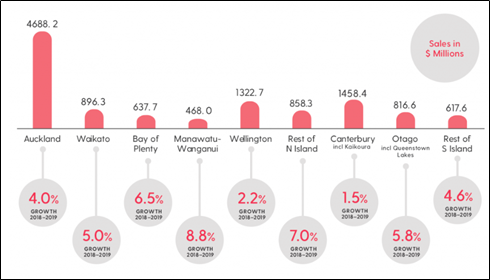
Regional Snapshot (Source: Restaurant Association of New Zealand)
Exports Might Help Broader F&B Sector
New Zealand is a major food and beverage exporter with industry accounting for 46% of all goods & services exports. It is the biggest exporter of dairy products and lamb and is a major exporter of beef, kiwifruit, apples and seafood.
The country’s economic plan envisions a more productive, sustainable and inclusive economy with strong investment in food and beverage value chain. The country has significant untapped capacity to export more and triple its food and beverage exports over the next 15 years. It has attracted investment in food and beverage manufacturing from around the world due to its world-class innovation and production.
The country exports food and beverages to many destinations, of which Asia is the largest. Within Asia, China, in particular, is driving exports from New Zealand.
Impact of Level-3 Lockdown
As New Zealand reported few cases of transmission of coronavirus, there have been new guidelines again, affecting the F&B sector directly. Auckland is under Level 3 lockdown, which means all the hospitality businesses are closed to the public other than through contactless delivery and pickup. For the rest of the country, where Alert level-2 has been implemented, restaurants and cafes have to follow the three ‘S’s’ where practicable -with diners seated, separated and served by a single server. There is also a limit of 100 guests per defined space.
Key Challenges Faced by the Industry
According to Restaurant Association of New Zealand, over the past few years, the rate of growth in the hospitality sector has been impressive, and the industry is also growing rapidly. Still, to provide steadiness in a period of rapid growth, it is crucial that the industry has the grounds to withstand its challenges to eliminate any obstacles and maximise openings for success.
The industry is facing various challenges like lack of skilled employees, building and maintaining sales volume, government legislation and compliance and managing the tax burden.
As per Stats NZ, many hospitality businesses in New Zealand did not have a substantial amount of assets in their hand to meet short-term liabilities due to trading restrictions caused by COVID-19. As per annual enterprise survey manager Melissa McKenzie, takeaway businesses, cafes, and motels had some of the lowest current ratios of NZ businesses in FY19. Notably, the current ratio for bars, cafes, restaurants, and takeaways in 2019 was 58%.
Since we now have a broad idea of F&B sector, it is important to look at the performance of some companies operating in the same sector (DGL, MWE, CGF, RBD).
1. Delegat Group Limited (NZX: DGL) (Recommendation: Buy, Potential Upside: Lower Double-Digit, M-cap: ~NZ$1.31 billion, Gross Dividend Yield: 1.856%)
Business Description: Delegat Group Limited is one of the most successful and largest wine companies in Australasia, appreciated both globally and within New Zealand for its significant and positive contribution to the wine industry.
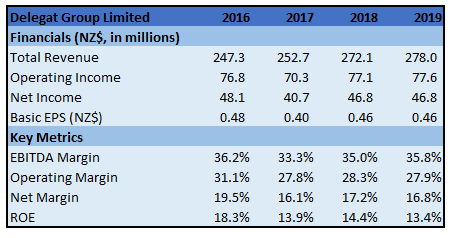
Key Metrics (Source: Refinitiv (Thomson Reuters))
Outlook: The company expects to achieve global case sales of 3,279,000 cases for the year, up by 9 per cent from last year. The company has revised its guidance on Operating Net Profit after Tax to $59.0 million for the year ending 30 June 2020, up 16% on the previous year. It had previously set guidance for Operating Net Profit after Tax of $52.4 million.
Key Risks: The company has exposure to financial risks in respect of its agricultural activities. The primary risks arising from the company’s financial instruments include foreign currency risk, credit risk, interest rate risk as well as liquidity risk.
Valuation: We have applied P/E Based Relative Valuation (on an illustrative basis), and the target price reflects a rise of lower double-digit (in % terms).
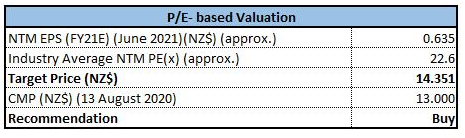
P/E Based Relative Valuation (Source: Refinitiv (Thomson Reuters))
Thus, we give a “Buy” recommendation at the current market price of NZ$13.000 per share, up by 2.20% on August 13, 2020.
2. Marlborough Wine Estates Group Limited (NZX: MWE) (Recommendation: Speculative Buy, Potential Upside: Lower Double Digit, M-cap: ~NZ$52.49 Million)
Business Description: Marlborough Wine Estates Group Limited operates as well as owns vineyards in Awatere Valley, Marlborough.
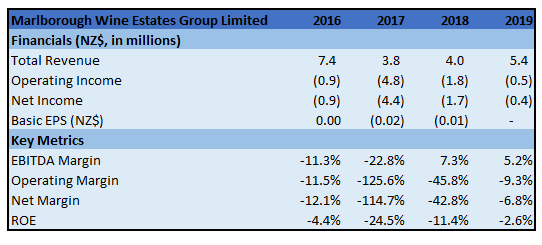
Key Metrics (Source: Refinitiv (Thomson Reuters))
Outlook: The company’s core strategy revolves around growing sales of the bottled wines as well as gradually allocate more of its grape production to bottled wine processing.
Key Risks: The company’s activities expose it to various financial risks like market risk, credit risk, liquidity risk and agricultural risk.
Valuation: On TTM basis, EV/Sales multiple stood at 10.0x, which is lower as compared to the industry average of 51.7x. Also, its P/B multiple stood at 4.0x as compared to the industry average of 18.6x.
Technical Overview:
Weekly Chart –
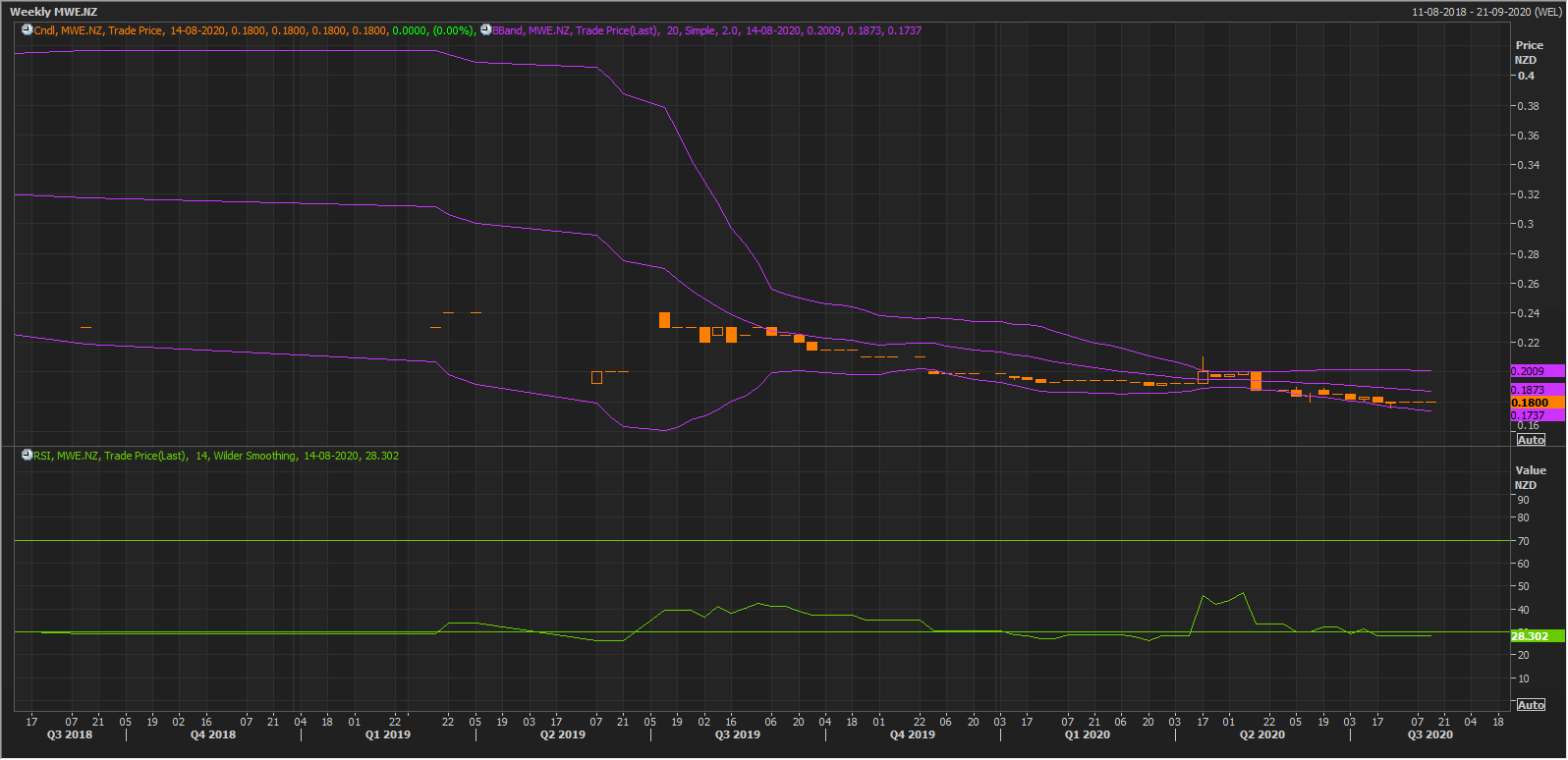
Note: Purple colour lines are Bollinger Bands with upper band suggesting overbought status while lower band oversold status.
The stock has been experiencing flattish close for the past three weeks including the on-going week. It is largely confirming to ‘Morning Star’ chart pattern with a near-term potential of a bullish reversal. Technical indicator RSI with 28 reading and curve at the end flattening, suggests flattish momentum along with the oversold status for the stock.
Going forward, the stock may have resistance around the upper Bollinger band of $0.200 while support could be around the lower Bollinger band of $0.173.
Thus, we give a “Speculative Buy” recommendation at the current market price of NZ$0.180 per share on August 13, 2020.
3. Cooks Global Foods Limited (NZX: CGF) (Recommendation: Speculative Buy, Potential Upside: Lower Double-Digit, M-cap: ~NZ$30.13 Million)
Business Description: Cooks Global Foods Limited owns the intellectual property and master franchising rights to Esquires Coffee Houses worldwide (excluding New Zealand and Australia).
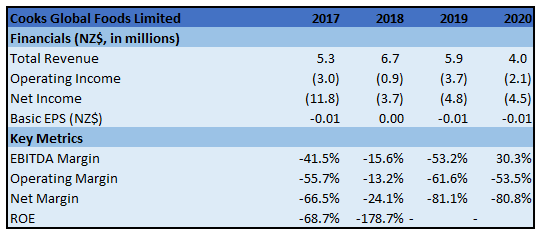
Key Metrics (Source: Refinitiv (Thomson Reuters))
Outlook: The company has been closely monitoring the effect of the COVID-19 outbreak, mainly on its Esquires café operations in Ireland and the United Kingdom, which are its two largest business units in revenue terms.
Key Risks: The company operates internationally and, therefore, it is exposed to foreign currency risk, which arises from various currency exposures.
Technical Overview:
Weekly Chart –
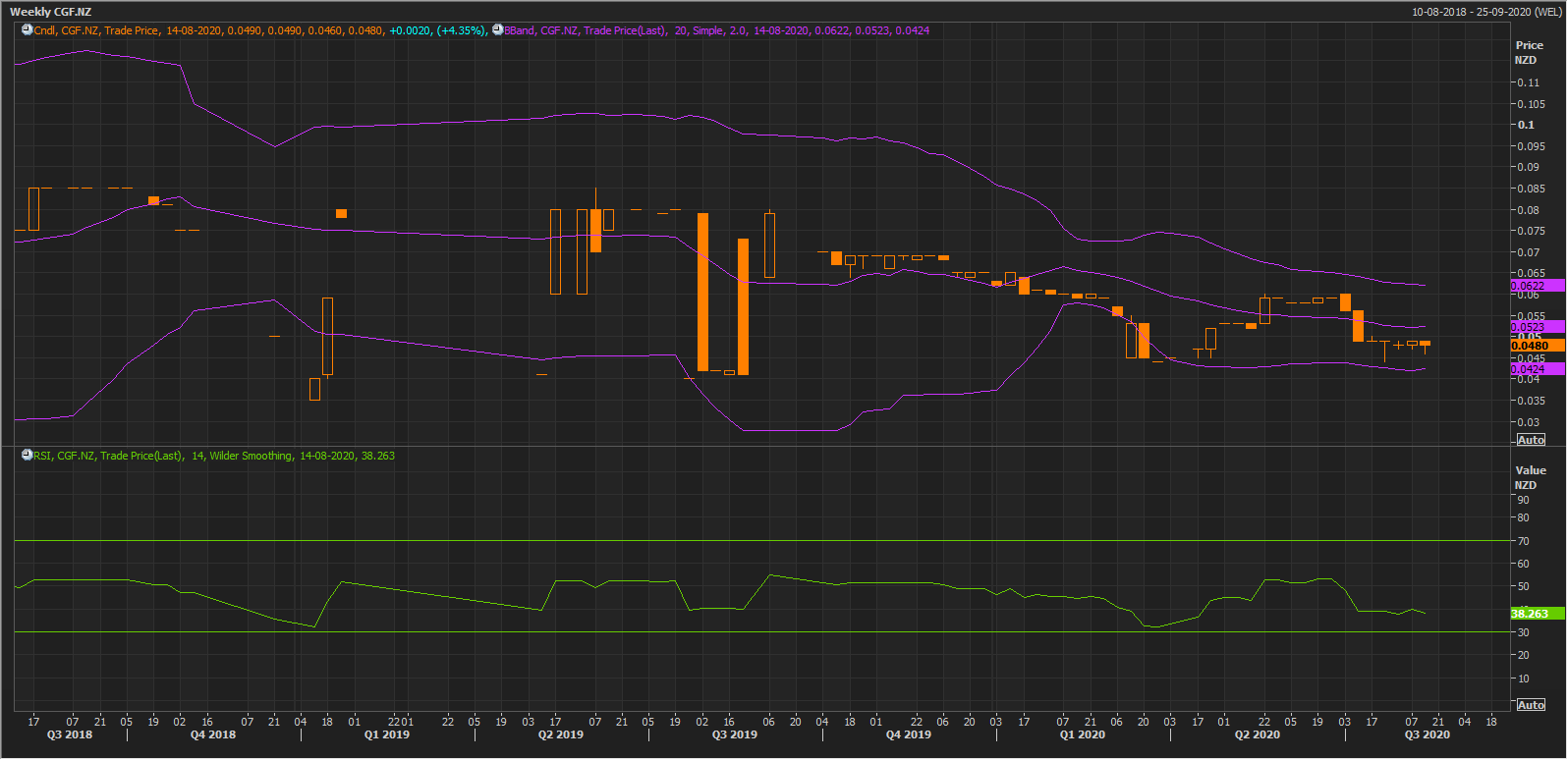
Note: Purple colour lines are Bollinger Bands with upper band suggesting overbought status while lower band oversold status.
The stock has given marginally lower close for the on-going week than the previous week close but with ‘Hammer’ pattern formed on the chart thereby indicating near-term upside for the stock. Technical indicator RSI with around 38 reading suggests gaining of bullish momentum.
Going forward, the stock may have resistance around 20 periods SMA of $0.052 while support could be around the lower Bollinger band of $0.042.
Thus, we give a “Speculative Buy” recommendation at the current market price of NZ$0.048 per share, up by 4.35% on August 13, 2020.
4. Restaurant Brands New Zealand Limited (NZX: RBD) (Recommendation: Buy, Potential Upside: Lower Double-Digit, M-cap: ~NZ$1.50 billion)
Business Description: Restaurant Brands New Zealand Limited is a corporate franchisee and specialises in handling multi-site branded food retail chains.
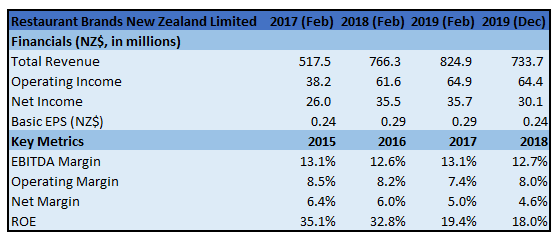
Key Metrics (Source: Refinitiv (Thomson Reuters))
Outlook: The company’s Q2 sales were significantly impacted by Government-mandated trading restrictions that were implemented in response to coronavirus crisis. The company is expected to disclose half year trading results on September 8, 2020.
Key Risks: The company is exposed to foreign currency risk because some of its purchases are denominated in a currency other than the NZ dollar.
Valuation: We have applied EV/Sales based relative valuation (on an illustrative basis), and the target price reflects a rise of lower double-digit (in % terms).
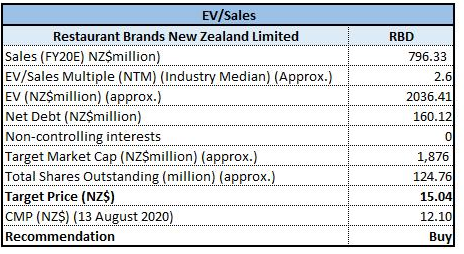
EV/Sales based relative valuation (Source: Refinitiv (Thomson Reuters))
Thus, we give a “Buy” recommendation at the current market price of NZ$12.100 per share on August 13, 2020.
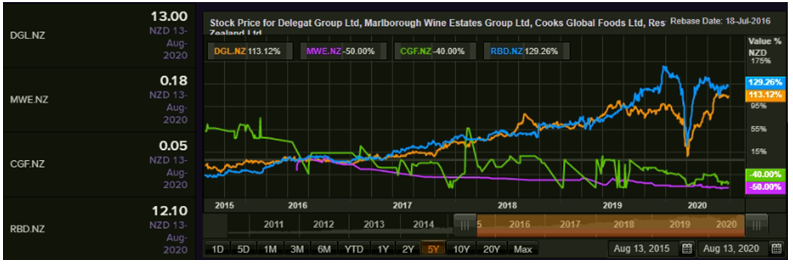
Disclaimer
Kalkine New Zealand Limited is authorised to provide class advice only. The information on this site does not take into account any of your investment objectives, financial situation or needs. Before you make a decision about whether to acquire a financial product, you should obtain the Product Disclosure Statement from the product issuer. You should consider the appropriateness of advice taking into account your own objectives, financial situation and needs and seek independent financial advice before making any financial decisions.
Past performance is not a reliable indicator of future performance.
 Please wait processing your request...