
 AU
AU
 UK
UK
 CA
CA
 US
US
 IND
IND

 NZ
NZ

I. Sector Landscape and Outlook
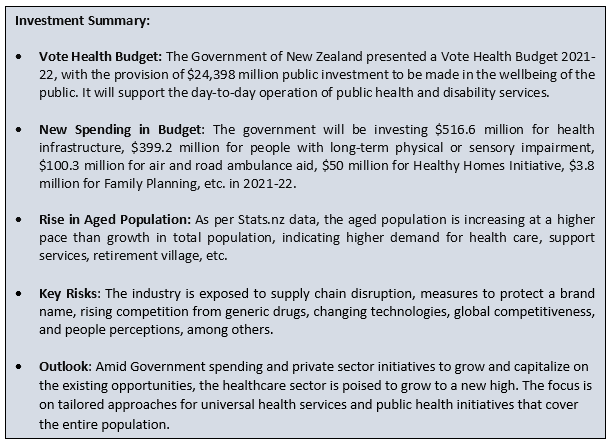
Most healthcare funding received by New Zealanders is from Vote Health, followed by ACC public funding. The Government funding announced by Vote Health directly supports the regular operation of public health and disability services delivered by the skilled workforce in communities, hospitals, and other care providers. Budget 2021 provides District Health Boards (DHBs) with a funding of $2.7 billion for the next four years, up 4.37% from the current baseline. The Ministry of Health has a stewardship responsibility and accountability to oversee positive change in the health and disability system.
The resident population by age and sex was estimated to be 5,099,700 on 31 March 2021, up 87,000 (or 1.74%) from 31 March 2020. This rise is lower than the rise seen in the previous quarter. As of 31 December 2020, the resident population by age and sex was estimated to be 5,087,100, up 101,500 (or 2.04%) from 31 December 2019. From the data released by Stats.nz, it is visible that the aged population, as well as the total population, is increasing. It is also visible that the aged population is increasing at a faster pace than the total population. This rise in population will seek for better healthcare support services hence the government and private players must constantly grow the healthcare system to meet the demand.
Exhibit 1: Higher Rise in Aging Population over All Ages
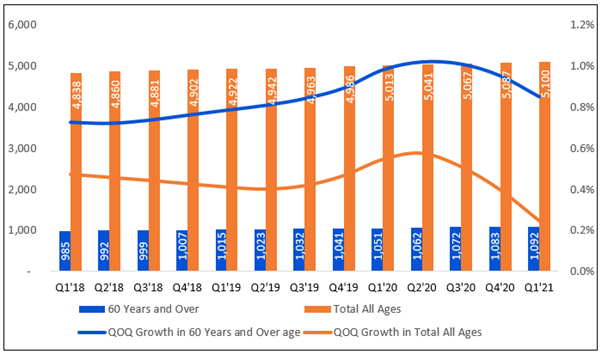
Data Source: This work is based on/includes Stats NZ’s data which are licensed by Stats NZ for reuse under the Creative Commons Attribution 4.0 International Licence; Chart Analysis by Kalkine Group
Health Budget 2021-22 Focused on Wellbeing of New Zealanders and their Families
The Government of New Zealand has presented Vote Health Budget 2021-22, totalled at $24,398 million to supports the day-to-day operation of public health and disability services. The Vote plays a major role in improving health equity for Māori and other groups, child wellbeing, mental wellbeing, wellbeing through prevention, and primary health care, among others. The Government is also funding to support the early establishment of entities at national and sub-national levels and to strengthen capabilities in these new entities, it is taking measures such as commissioning, cultural capability, Māori service design, and data and digital expertise.
Health Budget for 2021-22 Comprises the Following:
Exhibit 2: 23.6% of the Health Budget 2021-22 Allocated Towards Health and Disability Sector
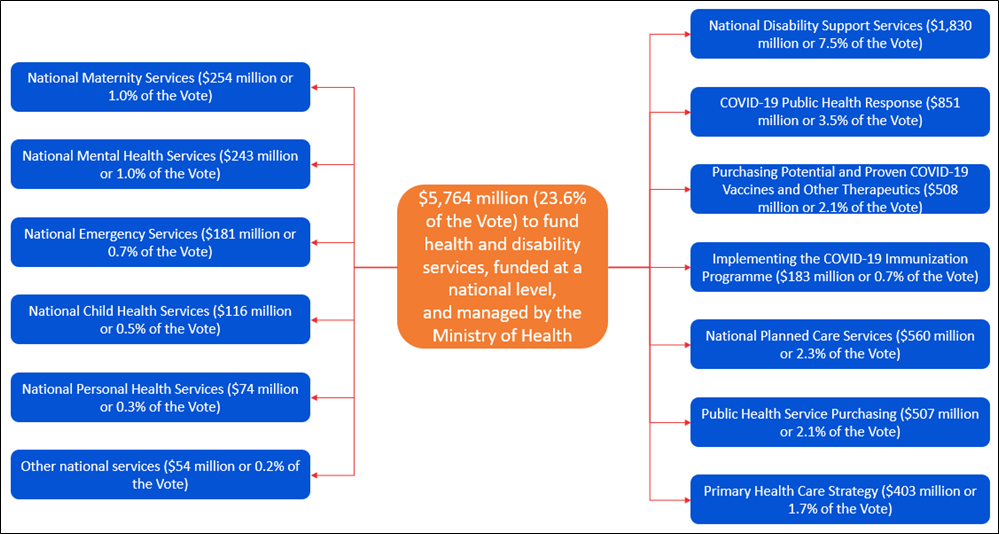
Data Source: budget.govt.nz, Copyright material on the Budget website is protected by copyright owned by the Treasury on behalf of the Crown. It is licensed for re-use under a Creative Commons Attribution 4.0 International Licence; Chart Created by Kalkine Group
Healthcare Spending by Government in key Area
The Budget 2021-22 dedicated $486 million over four years to implement the health reforms. This comprised of replacing the 20 District Health Boards with Health NZ, establish locality networks to closely monitor and act on the voices of community people, and starting to establish the Māori Health Authority. In addition to this, it focused on various other areas of concern to support the wellbeing of New Zealanders and lift the health curve of the country to a new high.
Exhibit 3: Vote Health 2021-22 Major Budget Spending
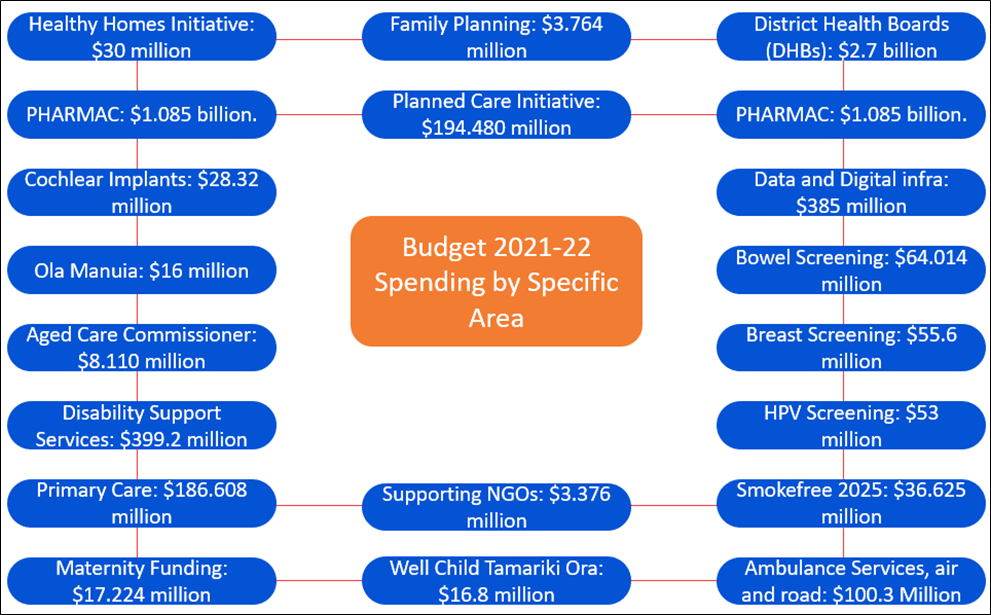
Data Source: health.govt.nz, Copyright in content on this website is owned by either the Ministry of Health on behalf of the Crown or its licensors. It is licensed for re-use under a Creative Commons Attribution 4.0 International Licence; Chart Created by Kalkine Group
Index Performance:
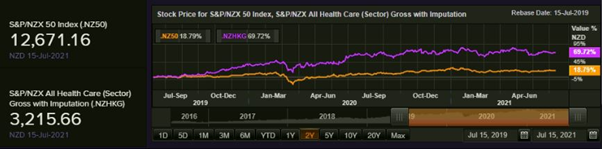
The S&P/NZX All Healthcare Index generated a 2-year return of ~69.72% versus ~18.79% by the S&P/NZX 50 Index. Therefore, S&P/NZX All Healthcare Index overperformed S&P/NZX 50 Index by ~50.93% in 2-year.
Exhibit 4: S&P/NZX All Healthcare Index vs S&P/NZX 50 Index
Source: REFINITIV
Key Risks and Challenges:
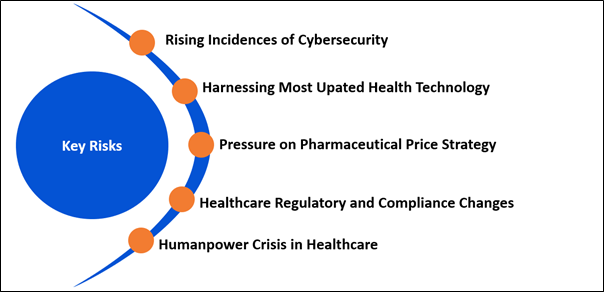
The New Zealand Government is closely working on a new and comprehensive regulatory system to regulate therapeutic products in New Zealand that is expected to replace the Medicines Act 1981 and its Regulations. This regime will cover all therapeutic products such as medical devices, cell and tissue therapies which are currently not fully regulated in New Zealand. This regime is expected to streamline the healthcare system further and minimize the serious risks of harm, especially if used inappropriately. Accordingly, it will impact the companies who are following different practices other than the regime specified by the Ministry of Health.
Further, the Ministry of Health is planning to roll out a regulation to check the health and disability system, so that health service providers and products are safe, and operate in an ethically acceptable way. This will provide assurance to New Zealanders that they can trust the services they use. Moreover, through this regime, it seeks to improve and manage sector regulation so that patient health is protected while minimizing compliance costs. On the company’s front, they must make necessary changes in their system as per the new regime, if not accustomed in past, so that they do not face any regulatory and compliance risk.
Exhibit 5. Key Risks in Healthcare Sector:
Sources: Analysis by Kalkine Group
Outlook:
The Government of New Zealand is focused to keep Aotearoa New Zealand safe from COVID-19, support the recovery and rebuild from the impacts of COVID-19, and invest in the foundations for the future to ensure the wellbeing of New Zealanders. It is investing $4.7 billion in Health that includes additional funding for PHARMAC, as well as the transition to a new health system and establishment of a Māori Health Authority.
The Government has issued $4.6 billion for COVID-19 response and recovery and $5.1 billion remains in the COVID-19 Response and Recovery Fund (CRRF) as a contingency fund to respond to further outbreaks, if any, and to continue the economic rebuild of the country.
The Government has issued quarantine-free travel between Australia and New Zealand and New Zealand and the Cook Islands, to accelerate economic activity and support economic recovery while keeping COVID-19 under control. Moreover, the government is constantly looking for opportunities for businesses and New Zealanders, while protecting New Zealanders’ wellbeing against a COVID-19 resurgence.
The measures taken by the Government are expected to support economic recovery and benefit the healthcare sector especially, as the focus has been shifted on the wellbeing of the Kiwis, followed by economic recovery and growth. More money by the Government in the healthcare system means better technological tools, sound infrastructure, care and wellbeing for the society, and improved health.
Apart from the sector-specific factors, we have also analysed four NZX-listed companies operating in the same sector. This report covers their insights, outlook, performance and potential as expected to be delivered in the near to medium term.
1) Fisher & Paykel Healthcare Corporation Limited (Recommendation: Buy, Potential Upside: Low Double-Digit) (M-Cap: NZ$17.61 billion, Gross Dividend Yield: 1.732%)
Business Description:
Fisher & Paykel Healthcare Corporation Limited (NZX: FPH) is a leading designer, manufacturer, and marketer of products and systems for acute and chronic respiratory care, surgery, and the treatment of obstructive sleep apnea.
Outlook:
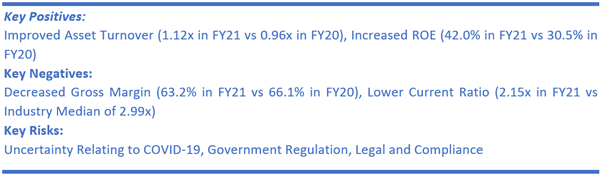
Amid ongoing uncertainties of vaccinations, lockdowns, COVID-19 variants, localized waves and return to stable hospitalization rates around the world, the company is not releasing guidance for FY22. Further, it expects Hospital and Homecare revenue for FY22 to be interrupted by the pandemic circumstances. Meanwhile, it will continue with its manufacturing plan and hold higher levels of inventory so that any surge in demand can be met. Importantly, Hospital revenue continues to remain variable with higher volumes of Hospital hardware with an ongoing shift towards Optiflow of nasal high flow therapy. OSA shows signs of recovery after a slower Q4FY21.
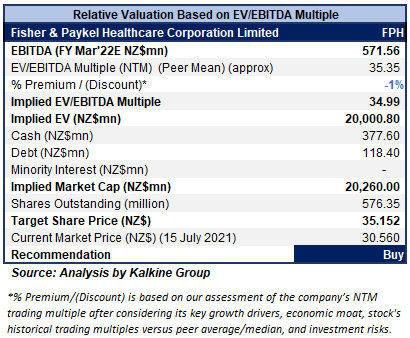
Valuation Methodology: EV/EBITDA Based Relative Valuation (Illustrative)
Stock Recommendation
We have applied EV/EBITDA based relative valuation (on an illustrative basis) and the target price reflects a rise of low double-digit (in % terms). We have applied a discount to EV/EBITDA Multiple (NTM) (Peer Average) considering the associated risks as well as rise in operating expenses.
For relative valuation, we have taken peers like Ryman Healthcare Ltd. (RYM.NZ), Arvida Group Ltd. (ARV.NZ), and Cochlear Ltd. (COH.AX).
Considering the aforesaid facts, we give a “Buy” recommendation on the stock at the current market price of $30.56 per share, up 0.26% on 15th July 2021.
2) TruScreen Group Limited (Recommendation: Speculative Buy, Potential Upside: Low Double-Digit) (M-Cap: NZ$23.95 million)
Business Description:
TruScreen Group Limited (NZX: TRU) offers the latest technology in cervical screening and provides real-time, accurate detection of pre-cancerous and cancerous cervical cells that helps to improve the health and wellbeing of women.
Outlook
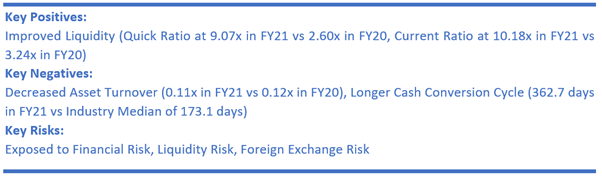
Amid a strong sales pipeline, a growing commercial user base, and several key projects reaching finalization, the company expects that the Chinese market will grow substantially in the next 12-24 months. Further, the company is expected to capitalize on its strong distributor network, especially in Central & Eastern Europe. In Russia, the company is expecting substantial clinical evaluations that will cement the way for public and private screening programs.
Technical Overview:
Weekly Chart –
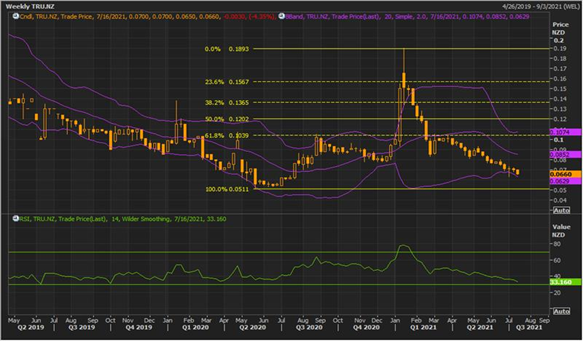
Source: REFINITIV
Note: Purple colour lines are Bollinger Bands® with the upper band suggesting overbought status while the lower band oversold status, and yellow lines are Fibonacci retracement lines which measure price rebound and backtrack. https://www.bollingerbands.com/
The stock has broadly been on a downward journey, ever since it made a high of 0.19. In the process, it has reached closure to the oversold zone, as is obvious from RSI reading of 33. The near oversold status limits downside potential for the stock while brightening the prospect of technical rebound.
Going forward, the stock may have resistance around $0.075 whereas support could be around $0.058.
Stock Recommendation
As per the release dated 1 July 2021, it received its first order from Serbia, Eastern Europe. Further, the cervical cancer screening device achieved product registrations in Czech Republic, Slovakia, and Poland. Moreover, it has also filed product registrations in countries such as Croatia, Slovenia, Macedonia, and Bosnia Herzegovina.
Considering the aforesaid facts, we give a “Speculative Buy” recommendation on the stock at the current market price of $0.066 per share, down 4.35% on 15th July 2021.
3) Ebos Group Limited (Recommendation: Hold, Potential Upside: Low Double-Digit) (M-Cap: NZ$5.21 billion, Gross Dividend Yield: 2.785%)
Business Description:
Ebos Group Limited (NZX: EBO) is the marketer, wholesaler, and distributor of healthcare, medical and pharmaceutical products. Also, it is a marketer and distributor of recognized consumer products and animal care brands.
Outlook
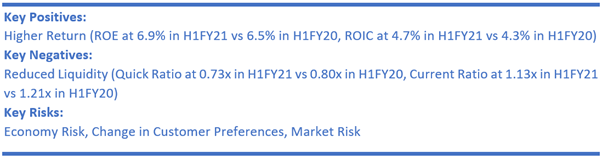
The company is riding on the robust distribution system as it operates in the largest and power pack healthcare distribution network in ANZ with an investment of ~$200 million since 2014 to boost exceptional customer outcomes and productivity. Further, the business generates organic growth and phenomenal cash flow, which funds EBO’s strategy of re-investing for growth, in addition to providing dividends for shareholders. These investments and strategies are expected to drive future growth momentum for the company.
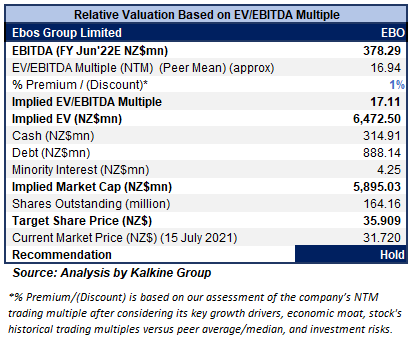
Valuation Methodology: EV/EBITDA Multiple Based Relative Valuation (Illustrative)
Stock Recommendation:
We have applied EV/EBITDA based relative valuation (on an illustrative basis) and the target price reflects a rise of low double-digit (in % terms). We have applied a slight premium to EV/EBITDA Multiple (NTM) (Peer Mean) considering reduction in Debt to Equity in H1FY21 from H1FY20 and higher ROE in H1FY21 versus Industry Median.
For relative valuation, we have taken peers like Ryman Healthcare Ltd. (RYM.NZ), Summerset Group Holdings Ltd. (SUM.NZ), and Arvida Group Ltd. (ARV.NZ).
Driven by an organic and inorganic growth, current trading levels, and strong management outlook, we recommend a ‘Hold’ rating on the stock at the current market price of $31.72 per share, down 2.40% on 15th July 2021.
4) Summerset Group Holdings Limited (Recommendation: Hold, Potential Upside: Low Double-Digit) (M-Cap: NZ$3.07 billion, Gross Dividend Yield: 0.959%)
Business Description:
Summerset Group Holdings Limited (NZX: SUM) has grown to become one of the leading operators in the retirement village and aged care sector in New Zealand. Currently, it has 29 retirement villages in the country.
Outlook
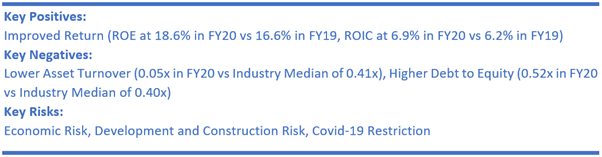
For Q2FY21, the company reported 270 sales, comprising 154 new sales and 116 resales. Therefore, the total sales stood at 545 for the six months to 30 June. As per the management, the demand continues to be strong for both new sales and resales. The company is realizing good diversification of sales across the country with 70% of new sales coming from four villages: Casebrook (Christchurch), Ellerslie (Auckland), Rototuna (Hamilton), and Te Awa (Napier).
Valuation Methodology: EV/EBITDA Based Relative Valuation (Illustrative)
Stock Recommendation
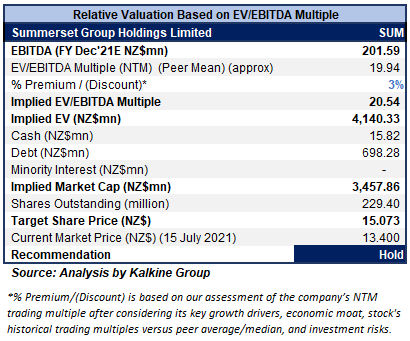
We have applied EV/EBITDA based relative valuation (on an illustrative basis) and the target price reflects a rise of low double-digit (in % terms). We have applied a slight premium to EV/EBITDA Multiple (NTM) (Peer Average) considering strong sales and pre-sale of home to serviced apartments, a care centre and a state-of-the-art memory care centre, as well as resident amenities such as a swimming pool, gym and café.
For the purposes of relative valuation, we have taken peers such as Ryman Healthcare Ltd. (RYM.NZ), Arvida Group Ltd. (ARV.NZ), EBOS Group Ltd. (EBO.NZ), to name a few.
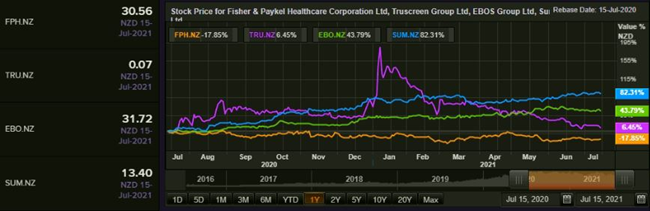
Considering the aforesaid facts, we give a “Hold” recommendation on the stock at the current market price of $13.40 per share, down 1.11% on 15th July 2021.
Comparative Price Chart
Source: REFINITIV
Note 1: The reference data in this report has been partly sourced from REFINITIV.
Note 2: Investment decisions should be made depending on the investors’ appetite on upside potential, risks, holding duration, and any previous holdings. Investors can consider exiting from the stock if the Target Price mentioned as per the analysis has been achieved and subject to the factors discussed above alongside support levels provided.
Technical Indicators Defined: -
Support: A level where-in the stock prices tend to find support if they are falling, and downtrend may take a pause backed by demand or buying interest.
Resistance: A level where-in the stock prices tend to find resistance when they are rising, and uptrend may take a pause due to profit booking or selling interest.
Disclaimer
Kalkine New Zealand Limited is authorised to provide class advice only. The information on this site does not take into account any of your investment objectives, financial situation or needs. Before you make a decision about whether to acquire a financial product, you should obtain the Product Disclosure Statement from the product issuer. You should consider the appropriateness of advice taking into account your own objectives, financial situation and needs and seek independent financial advice before making any financial decisions.
Past performance is not a reliable indicator of future performance.
 Please wait processing your request...