
 AU
AU
 UK
UK
 CA
CA
 US
US
 IND
IND

 NZ
NZ

Landscape of Financial Sector in New Zealand
The Reserve Bank of New Zealand (RBNZ) regulates banks, insurers and non-bank deposit takers so that it can promote and maintain sound and efficient financial system. Additionally, RBNZ oversees and operates financial market infrastructures of NZ. Let's have a look at the composition of financial sector in NZ:
.png)
Composition of NZ Financial Sector (As at September 30, 2019) (Source: RBNZ)
As per the composition of NZ Financial Sector (as at September 30, 2019):
.png)
Composition of S&P/NZX50 and Performance of S&P/NZX50 vs S&P/NZX All Financials (Source: Thomson Reuters)
Broader NZ Economy And Financial Sector To Stay Afloat: A Glimpse of Initiatives
Reserve Bank of New Zealand has been working closely with the government and industry in order to keep the financial system stable and ensuring that foreign exchange, debt and money markets continue to operate efficiently and at a lower cost. They are keeping cash-flow moving throughout the economy – between banks, firms, households, as well as the government.

Source: Reserve Bank of New Zealand
With the outbreak of Coronavirus across the globe and the impact from COVID-19 driven crisis on economy and financial position, most of the Central banks have adopted significant measures to keep a check on basic financial hygiene. As New Zealand is among the ones hit by the Pandemic, RBNZ has been on the forefront in identifying the efforts required to manage the crisis.
Initiatives that are likely to help revive NZ economy include:
Given that capital framework implementation has been deferred, banks now have significant capital headroom. RBNZ is also in the process of identifying other regulatory initiatives which can be deferred.
Uncertainty around the depth and duration of COVID-19 has compelled companies to preserve liquidity and cashflow over investing. However, with a slew of fiscal and monetary measures taken, the overall economic impact of the Coronavirus outbreak is expected to be short-lived.
Let us look at key components of the Financial sector as a whole - Investment Management and Banking
Investment Management Industry- What Drives It?
The investment management industry is one of the key industries and its performance is linked with the performance of financial markets and for that matter economy as whole. The success of this industry primarily revolves around assets under management (or AUM) and the fee rates. Investment management industry generates revenue from managing the assets, which are broadly termed as assets under management. The players operating in the industry garners revenue which is dependent on AUM and are mainly classified as management and performance fees. Generally, the management fees is affected by the fluctuations in the level of AUM, while performance fees vary with investment performance.
The companies operating in the funds management industry are sensitive to various macro-economic factors, and these companies have exposure to different sectors. Well, there are pros and cons of making investments in funds management companies. On one hand, these companies are prone to risk if global growth comes into question but, on the other hand, if some sectors act as laggards, defensive sectors tend to balance the overall performance.
What the Largest Asset Manager Has to Say?
Global fund managers have been relying on their respective risk-management tools, and most of them have been tackling the risks with the help of portfolio construction. The global funds management industry is getting influenced by COVID-19 outbreak. It is an abnormal time that calls for a coordinated approach from the policymakers to counter the ill-effect of a virus. According to the world’s leading asset management firm, BlackRock, the broader industry is going through the period of consolidation, fee compression and technological transformation. Amidst these unprecedented times, the biggest change for asset managers would be how they use technology. The companies operating in the asset management industry would have to fully integrate technology in order to connect with the clients, generate investment insights, create the operational efficiencies, etc. Considering the lower oil prices and interest rates and struggling environment of equities, market players are expected to choose asset managers as these companies can serve their entire portfolio with robust investment capabilities.
In the current environment, investors need to think from the long-term perspective as, in the long-term, asset managers are poised to witness strong growth. The economies have adopted significant policy actions to help businesses sail through the uncertainty like monetary and fiscal policies and measures related to public health.
Monetary and Fiscal Policies Should Help Revive Global Economy
Responding to call of the time, the policymakers across the world are working in unison, and central banks around the world have called an emergency meeting and have eased rates. The Federal Reserve has been more proactive having slashed fund rate by 100 bps to virtually zero. The Reserve Bank of Australia has cut its rate to an all-time low of 0.25%. The Bank of England has slashed rates to 0.1%, its lowest level ever.
Most of the central banks, beside cutting rates, have also resorted to asset purchase programme. Prominent among them are Federal Reserve, BoE, ECB and BoJ. The US congress has passed a $2 trillion stimulus package.
The European Central Bank (or ECB) rolled out PEPP (or Pandemic Emergency Purchase Programme) which has an overall envelope of €750 billion. The US Federal Reserve will also be lending to small businesses and would establish a facility to give term financing, and it also plans to buy US corporate bonds. The steps taken by monetary and fiscal authorities are expected to reduce the downside risks and could also help in maintaining resilience of the global economy.
The monetary stimulus injected by the global central banks is aimed to bring stability in the broader equity markets and in the global economy. These measures are expected to benefit several sectors and large blue-chip companies which could help asset managers as fund management companies have diversified exposure.
NZ Companies Have Global Exposure
Some of the NZ companies are having exposure to the markets outside of NZ, thus, providing an opportunity for the New Zealanders to have access to global markets. For example, The City of London Investment Trust Plc (NZX: TCL) focuses on providing long-term growth in income and capital, primarily by making investment in equities that are listed on London Stock Exchange. Then we have Barramundi Limited (NZX: BRM) which is also a listed investment company investing in growing Australian companies. Another company, JPMorgan Global Growth & Income plc (NZX: JPG), aims to deliver capital growth by making investments in the world stock markets.
The broader financial sector of New Zealand is influenced by the performance of global and NZ economy. Therefore, it is important to understand what’s going in the financial space across different economies.
Another related economy for New Zealand is Australia
As we all know, banks and insurers play critical role in supporting Australian households, businesses and broader economy during this period of uncertainty. APRA made recent adjustments with respect to the regulatory requirements and timetables, including ability for entities to utilize the capital buffers if needed. APRA stated that ADIs (or authorised deposit-taking institutions) and insurers need to limit the discretionary capital distributions in the upcoming months, to ensure that they utilize buffers as well as maintain their capacity to continue to lend and underwrite insurance.
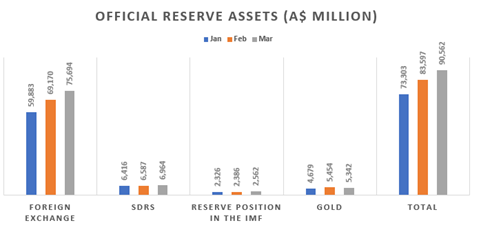
Official Reserve Assets (Source: Reserve Bank of New Zealand)
As per the recent statement by Philip Lowe, once the virus is contained, global economy is expected to recover, and this would be backed by fiscal packages and easing in monetary policy. This monetary and fiscal response, along with complementary measures adopted by leading banks in Australia, is expected to reduce the economic contraction and might help in ensuring that Australian economy is well-positioned to recover after health crisis is passed. These responses have been providing strong support to the Australian households and businesses. Moreover, the financial system of Australia is resilient and is well-capitalised. It is in a robust liquidity position and has financial buffers available to be drawn down if needed to help the broader economy. Notably, the cash rate in Australia stood at 0.25% and the apex bank has no plans to increase this rate until it sees some progress being made towards full employment.
FTSE All Share Index Might Benefit Due to Composition
Let us quickly have a look at the broader composition of FTSE All Share Index and what could influence the performance of the broader index. FTSE All Share Index has witnessed some improvement in its performance in the past few days and this could be primarily attributed to positive news pertaining to COVID-19 and fiscal and monetary packages announced.

Market Capitalisation By Sector of FTSE All Share Index (Source: Thomson Reuters)
The sector composition is dominated by financial sector and consumer goods. While oil & gas makes up 14.39%, basic materials account for 10.34%. The technology sector is very sensitive to the global macro-economic environment and is prone to market volatility and global slowdown. Fortunately, this sector makes up only 1.17% of FTSE All Share Index.
Moving forward, investment sentiment is likely to recover on the back of measures taken by the policymakers in terms of infusing huge liquidity into the system and signs of recovery in the world’s second-largest economy which could help the financial sector. China has shown some signs of recovery and its good for the manufacturers around the world who are reliant on Chinese supply.
Economic activities have started picking up in China which gets reflected in the performance of PMI Manufacturing Index which has risen to 52 as per March data release, defying expectations of a contraction. PMI readings above 50 indicate expansion while those below the said level signal contraction.
Banking Space
The banking space is expected to get affected by the global uncertainty and worries related to COVID-19. However, the central banks have rolled out stimulus packages which could help the broader sector in tackling the headwinds. Once the economy revives, the banking sector can also witness favourable momentum.
Global Financial Industry Weighed by COVID-19 Outbreak: A Look At the Silver Lining & 4 NZX Stocks
Equity and debt markets provide sources of funds for corporates. The financial marketplace is dominated by institutional players such as investment management companies which make the investment in financial markets with the utmost care. Their investment decisions are usually based on the intrinsic value of the investment instruments which largely depends on the earning potential of the companies which, in turn, is associated with the quality of management and on economic activities that affect corporates’ profit and investors’ sentiments. The success of the economy leads to the success of overall markets. For without a positive and healthy economic environment, companies in general, find it difficult to flourish.
However, the global financial industry has lately been experiencing the impact of the COVID- 19 as this pandemic has affected several industries. Most of the investors might be considering that 2019 year was a good year for equities even though a trade spat between the US and China kept them on their toes. In 2020, the financial markets have witnessed the impact of two major events, i.e. coronavirus outbreak and crude oil war. These two events have forced the central banks to cut the interest rates and resume quantitative easing so that fears of global recession can be dealt with.
After discussing the broader financial sector in detail, it’s time to look at few stocks which are operating in the same sector
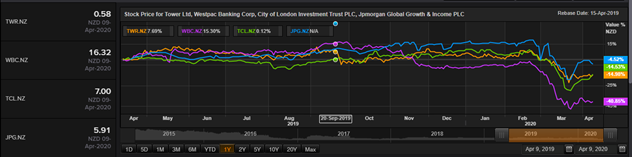
Comparative Price Chart (Source: Thomson Reuters)
Business Description: Tower Limited (NZX: TWR) is primarily engaged in the provision of general insurance. The company mainly operates in New Zealand with some of its operations based in the Pacific Islands region.
Outlook: Over the past four years the company has completely transformed itself into an increasingly profitable and growth achieving company by challenging and breaking industry norms. Over the last year, the company has reduced its claims ratio from 56.4% in FY18 to 48.8% in FY19 led by benign weather and improved underwriting. The Gross Written Premium (GWP) in the company’s core New Zealand book, including Youi NZ portfolio, rose 11% in the 4 months to January 31, 2020 as compared to the same period last year. The total Tower GWP rose by 8% over the same period. The company’s latest easy-to-use digital platform is being well received by customers, with new business through this channel accounting for over 55% of GWP, as compared to less than 10% in 2016. It has also improved its digital claims lodgement process and delivered innovations like a claims chatbot, Charlie, which has resulted in 27% of claims being lodged online in September 2019, indicating that digital is the way of the future.
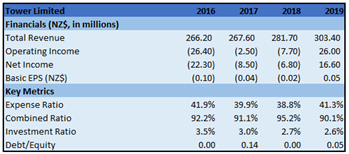
Key Metrics (Source: Thomson Reuters)
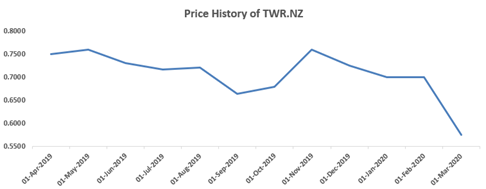
Price History (Source: Thomson Reuters)
Valuation: The company has given underlying NPAT guidance of $27 million to $30 million for FY20. The company’s focus mainly shifts to maximising new platform, putting new products out into the market as well as improving productivity. We have applied P/E based relative valuation method and, for the purposes, FY20E EPS of NZ$0.065 has been taken into consideration. There are expectations that the stock price might witness an increase of lower double-digit (in % terms).
P/E Based Relative Valuation
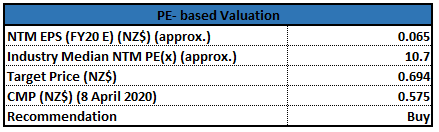
P/E Based Relative Valuation (Source: Thomson Reuters)
Business Description: Westpac Banking Corporation (NZX: WBC) provides financial services like lending, deposit taking, payments services, investment platforms, superannuation and funds management, insurance services, leasing finance, general finance, interest rate risk management and foreign exchange services.
Outlook: After doing an assessment of the economic impact of the COVID-19 pandemic on the Australian and New Zealand economies, Fitch Ratings have downgraded their long-term ratings for the major Australian banks including Westpac Banking Corporation by one notch from AA- to A+. The bank has also reduced its March quarter GDP forecast to -0.2% and forecast of annual GDP growth over 2020 to 1.9%. Without coronavirus and drought annual GDP growth forecast would have been 2.7%. RBNZ has reduced Official Cash Rate from 1.0 percent to 0.25 percent and it will remain at this level for at least the next 12 months. In 2020, the bank is expecting operating conditions to continue to remain soft, with growth remaining low. While this environment will continue to drag the performance in the 2020 year, the bank is expected to see balance sheet growth without a significant deterioration in credit quality. The house price inflation will stall during the period of virus-related disruption but will pick up later in response to even-lower interest rates. The house price inflation and economic growth is bound to decline in the short run, but by 2021 it is expected to increase. And consistent with that, the Reserve Bank will begin increasing the OCR again from early-2022.
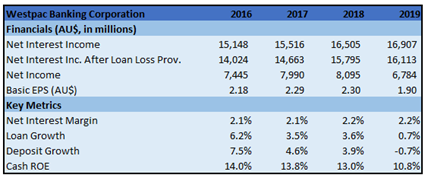
Key Metrics (Source: Thomson Reuters)
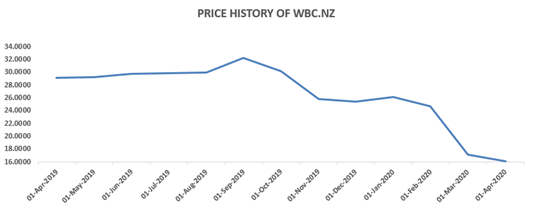
Price History (Source: Thomson Reuters)
Valuation: The broader financial sector is facing headwinds primarily because of the COVID-19 pandemic. S&P Global Ratings recently affirmed Australia’s AAA/A-1+ ratings but it has revised the outlook on these ratings to “negative”. The release also stated that because of the change in Australia’s sovereign rating outlook, the rating outlooks for major banks in Australia, which includes Westpac, have also been revised to “negative” from “stable”. As can be seen from the valuation table, FY20E EPS value of A$1.592 has been taken into consideration as we have applied P/E based relative valuation multiple. There are expectations that the stock price might witness a fall. We advise the investors to wait for the some more growth catalysts which could drive the performance of stock.
P/E Based Relative Valuation
.png)
P/E Based Relative Valuation (Source: Thomson Reuters)
Business Description: JPMorgan Global Growth & Income plc (NZX: JPG) focuses on investing in the best ideas from across the world’s stock market, whilst the Company delivers a predictable quarterly income distribution – set at the beginning of its financial year.
Outlook: The company’s objective is to provide superior total returns and outperform the MSCI All Country World Index over the long-term by investing in companies based around the world. The Investment Managers of the company are cautious in the near term and are watching carefully to see what effect the spread of the COVID-19 virus might have on global economic activity. On a quarterly rolling 12-month basis, the company reported NAV return of 23.87%, as compared to benchmark index, which was up by 21.71%. The company’s top ten holdings include stocks like Microsoft, Alphabet, Amazon and Coca-Cola, which were the major contributors to the outperformance.
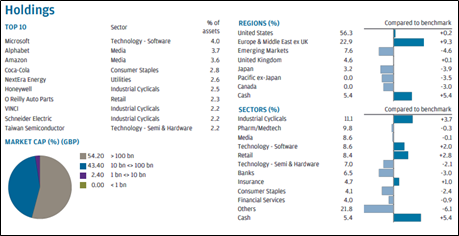
Top Holdings (Source: Company Reports)
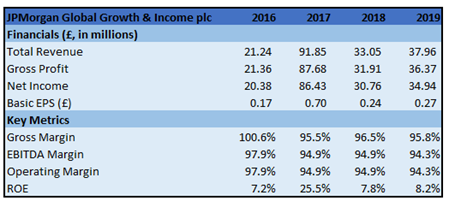
Key Metrics (Source: Thomson Reuters)
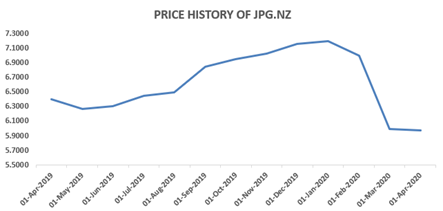
Price History (Source: Thomson Reuters)
Valuation: The company’s major exposure is towards United States and Europe & Middle East, which comprises of 56.3% and 22.9%, respectively of the portfolio. The US congress has passed a $2 trillion stimulus package. Further, the Fed has launched Monetary Market Mutual Fund Liquidity (MMFL) to support the flow of credit to households and businesses. It has announced that it is turning a quantitative easing programme into an open-ended one and expanded the list of securities to be purchased. On the backdrop of these measures, the US equities are expected to perform which could help the stock moving forward. On TTM basis, the stock’s P/E multiple stood at 4.520x which is lower than the broader industry average (Financials) of 9.3x and, thus, it looks like the stock is undervalued. Also, JPG’s portfolio is backed by the companies with robust fundamentals which are likely to whether headwinds. Therefore, we give a Buy rating on the stock at the price of NZ$5.98 per share on April 8, 2020.
Business Description: The City of London Investment Trust Plc (NZX: TCL) is a large British investment trust dedicated to providing long-term growth in income and capital, principally by investment in equities listed on the London Stock Exchange.
Outlook: The company's objective is to provide long term growth in income and capital, principally by investment in UK equities. The company’s net asset value total return was 2.7%. which was ahead of the AIC UK Equity Income sector average, 5.3% ahead of the IA UK Equity Income OEIC sector average and 2.1% ahead of the FTSE All-Share Index. The company’s top ten holdings include stocks like Royal Dutch Shell, HSBC, British American Tobacco and Diageo, which were the major contributors to the outperformance. The dividend yield of the portfolio is much higher than fixed interest yields and bank deposit rates.
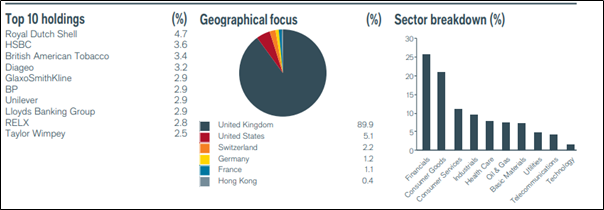
Portfolio Summary (Source: Company Reports)
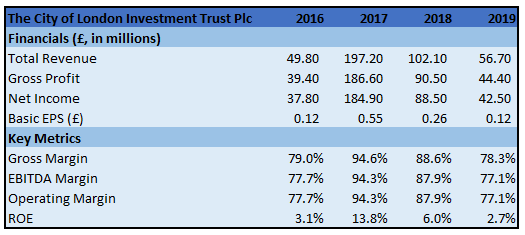
Key Metrics (Source: Thomson Reuters)
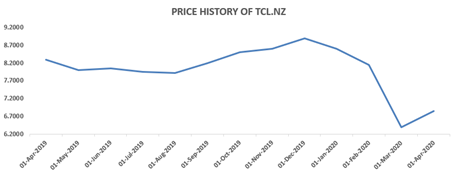
Price History (Source: Thomson Reuters)
Valuation: The company’s major exposure is towards United Kingdom and United States, which comprises of 89.9% and 5.1%, respectively of the portfolio. The company’s portfolio is mainly invested in large international companies. On the valuation perspective, the stock’s historical price-to-tangible book value stood at 1.01x which is slightly higher as compared to broader industry median (Financials) of 0.8x on TTM basis. The stock has fallen 26.11% in the span of past three months while, in the previous six months, it fell by 16.88%. We advise the investors to wait for the stock price to stabilise a bit and for some growth catalysts. Given the recent stimulus by the apex bank, equity markets will witness favourable momentum. Therefore, we have a watch stance on TCL at the current price NZ$6.85 per share on April 8, 2020
Disclaimer
Kalkine New Zealand Limited is authorised to provide class advice only. The information on this site does not take into account any of your investment objectives, financial situation or needs. Before you make a decision about whether to acquire a financial product, you should obtain the Product Disclosure Statement from the product issuer. You should consider the appropriateness of advice taking into account your own objectives, financial situation and needs and seek independent financial advice before making any financial decisions.
Past performance is not a reliable indicator of future performance.
 Please wait processing your request...