
 AU
AU
 UK
UK
 CA
CA
 US
US
 IND
IND

 NZ
NZ

Company Overview: Energy generator and digital retailer, Contact Energy Limited (NZX: CEN) is involved in providing electricity, natural gas, and liquefied petroleum gas (LPG), along with broadband services. The electricity is generated via thermal, hydro, and geothermal sources. The businesses are operated under two segments i.e. Customer segment and Generation segment. The Customer segment is involved in delivering, servicing, and distributing energy to customers, and the Generation segment is engaged in the business of selling electricity to the wholesale electricity market and the Customer segment. The Company's stations include Ohaaki, Poihipi and Te Rapa in Waikato, Te Huka and Te Mihi in Taupo Wairakei in Taupo, and Whirinaki in Hawke’s Bay along with Ahuroa and Stratford in Taranaki.
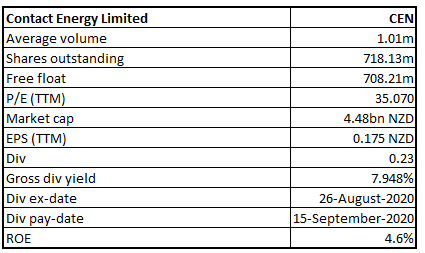
CEN Details
Investment Summary:
Good Progress on ‘Covid-19’ Vaccine Development Raising Positive Sentiments: Contact Energy Limited (NZX: CEN) is a New Zealand-based energy company with a diverse mix of assets which helps it to maintain a reliable, affordable and environmentally sustainable electricity supply in the country. It also has a strong presence in wholesale gas distribution, gas retailing, and electricity retailing. It has a market capitalization of ~$4.48 billion as on August 17, 2020.
Looking at the past performance over FY16 to FY20, the bottom line of the company improved from -$66.0 million in FY16 to $125 million in FY20.
Despite a decline in FY20 profits, the company delivered investors a 39 cents per share annual dividend this year which is in line with last year, which can be attributed to CEN’s operational efficiency, continued strength of its balance sheet and high quality and flexible portfolio of gas-fired and renewable generation assets.
Its ownership of Simply Energy post-August 31, 2020 will play a big role in helping companies reduce their carbon footprint and enhancing the decarbonization of New Zealand’s energy system. The company is currently executing various mitigation options to help move renewable electricity generation in the lower South Island north through the national transmission network and it is also working with commercial and industrial customers to deliver reductions to their carbon footprints by connecting them with low-carbon, reliable electricity.
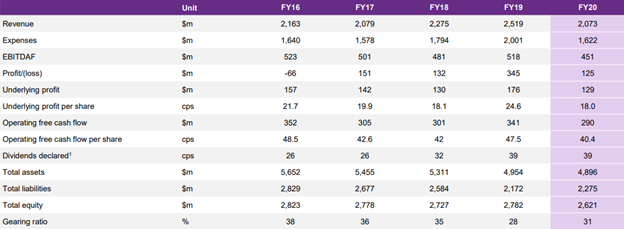
Historical Performance (Source: Company Reports)
Top 10 Shareholders: The top 10 shareholders have been highlighted in the table, which together forms around 19.69% of the total shareholding. Accident Compensation Corporation and The Vanguard Group, Inc. are holding maximum stake in the company at 5.54% and 5.00%, respectively, as provided in the table below:
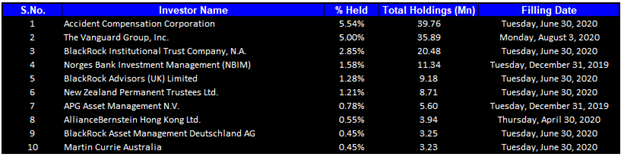
Top 10 Shareholders (Source: Refinitiv (Thomson Reuters))
A Quick Look at Key Metrics: Its gross margin and EBITDA margin for FY20 stood at 31.0% and 21.5%, better than the FY19 result of 28.4% and 20.3%, respectively, implying an improvement in operating efficiency of the company than the previous year period. Its Debt to Equity ratio for FY20 stood at 0.46x, in-line to the industry median of 0.46x, depicting a reasonable leverage position of the company.
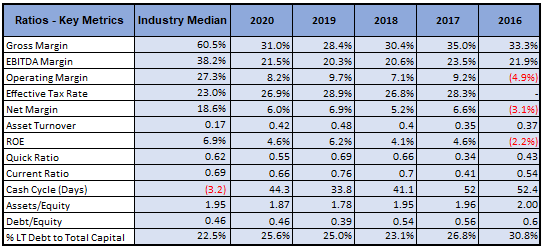
Key Metrics (Source: Refinitiv (Thomson Reuters))
June 2020 Operational Performance: Under the Customer business, Mass market electricity and gas sales stood at 447 GWh as compared to 453 GWh in the previous corresponding period, and Mass market electricity and gas netback stood at $101.03/MWh, as compared to $90.98/MWh in pcp.
Under the Wholesale business, Contracted Wholesale electricity sales, including that sold to the Customer business, was reported at 829 GWh as compared to 834 GWh in pcp; Electricity and steam net revenue stood at $94.80/MWh, as compared to $94.83/MWh in pcp; Electricity generated (or acquired) stood at 877 GWh, as compared to 932 GWh in pcp. The unit generation cost, which includes acquired generation was reported at $42.82/MWh, as compared to $33.68/MWh in pcp.
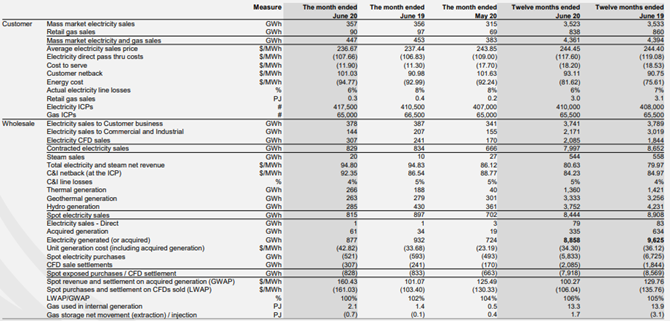
June 2020 Operational Data Metrics (Source: Company Reports)
As on July 9, 2020, South Island controlled storage was 77% of mean, as compared to 78% as on June 30, 2020. North Island controlled storage was 70% of mean, as compared to 73% as on June 30, 2020. Total Clutha scheme storage (including uncontrolled storage) was 63% of mean. Inflows into Contact’s Clutha catchment for June 2020 were 93% of mean.
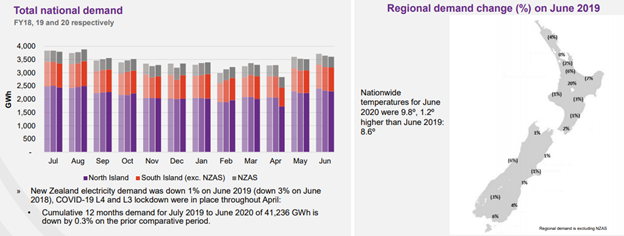
Data on Electricity Demand (Source: Company Reports)
Subdued FY20 Financial Performance: The company reported that its profit from continuing operations for FY20 (ended June 30, 2020) stood at $125 million which is $220 million lower than FY19 which included a $170 million gain on the sale of the Rockgas business and Ahuroa gas storage facility. EBITDAF from continuing operations stood at $451 million, a decline of 11% on previous year, mainly due to the impact of rising costs of thermal generation and restricted gas supply, along with lower renewable generation and lower wholesale prices. CEN’s operating free cash flow for FY20 stood at $290 million, a decline of 15% on previous year, mainly due to a combination of lower operating earnings, offset by lower stay-in-business capital expenditure and interest costs. The Board of Directors declared a final ordinary dividend of 23 cents per share partially imputed, with payment date on 15 September 2020.
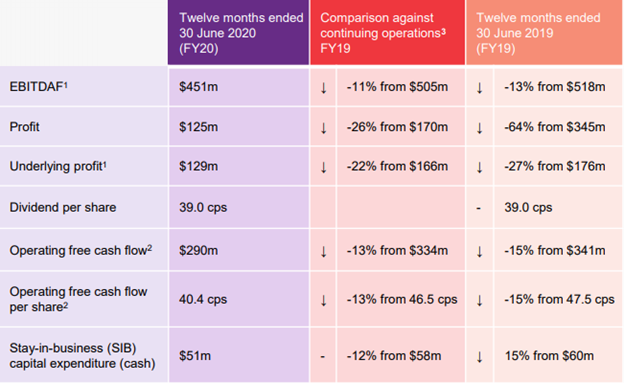
FY20 Key Metrics (Source: Company Reports)
Company Outlook: The company is disappointed by NZAS exit; however, it believes that the more investment in utility sector would be crucial to optimize the operations. Its operation at Tauhara has been put on hold but expects that it will play an important role in New Zealand’s transition to a low-carbon future.
Utility Sector Outlook: The power sector is united to decarbonise transport and accelerate the electrification of South Island industry away from a reliance on coal. NZAS has subsidised transmission costs to consumers for years. Not only will those costs now fall to other customers, there will also be additional costs for the significant transmission investment from Transpower now needed to shift surplus energy from the lower South Island north to where it is needed. In the meantime, the surplus water currently being used to generate renewable energy in Southland will in large part end up flowing down the Clutha River.
Key Risks: The company is exposed to certain financial risks like market risk, liquidity risk as well as credit risk. Exit of NZAS from New Zealand poses a good risk of uncertainty of reduction in demand and therefore leading to shrink in margins. Best way to mitigate the challenge is to optimize the operation and promote awareness towards utilizing of green energy.
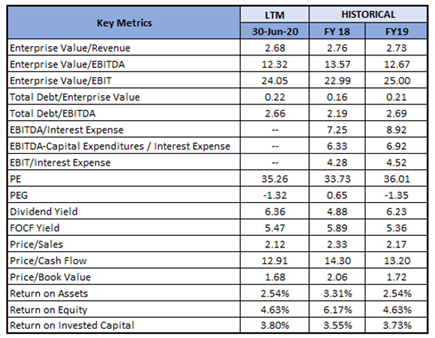
Key Valuation Metrics (Source: Refinitiv (Thomson Reuters))
Valuation Methodology: Price to Cash Flow Multiple Based Relative Valuation (Illustrative)
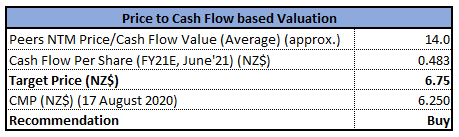
Price to Cash Flow Multiple Based Relative Valuation (Source: Refinitiv (Thomson Reuters))
Note: All forecasted figures and peers have been taken from Thomson Reuters, NTM-Next Twelve Months
Technical Overview:
Weekly Chart –
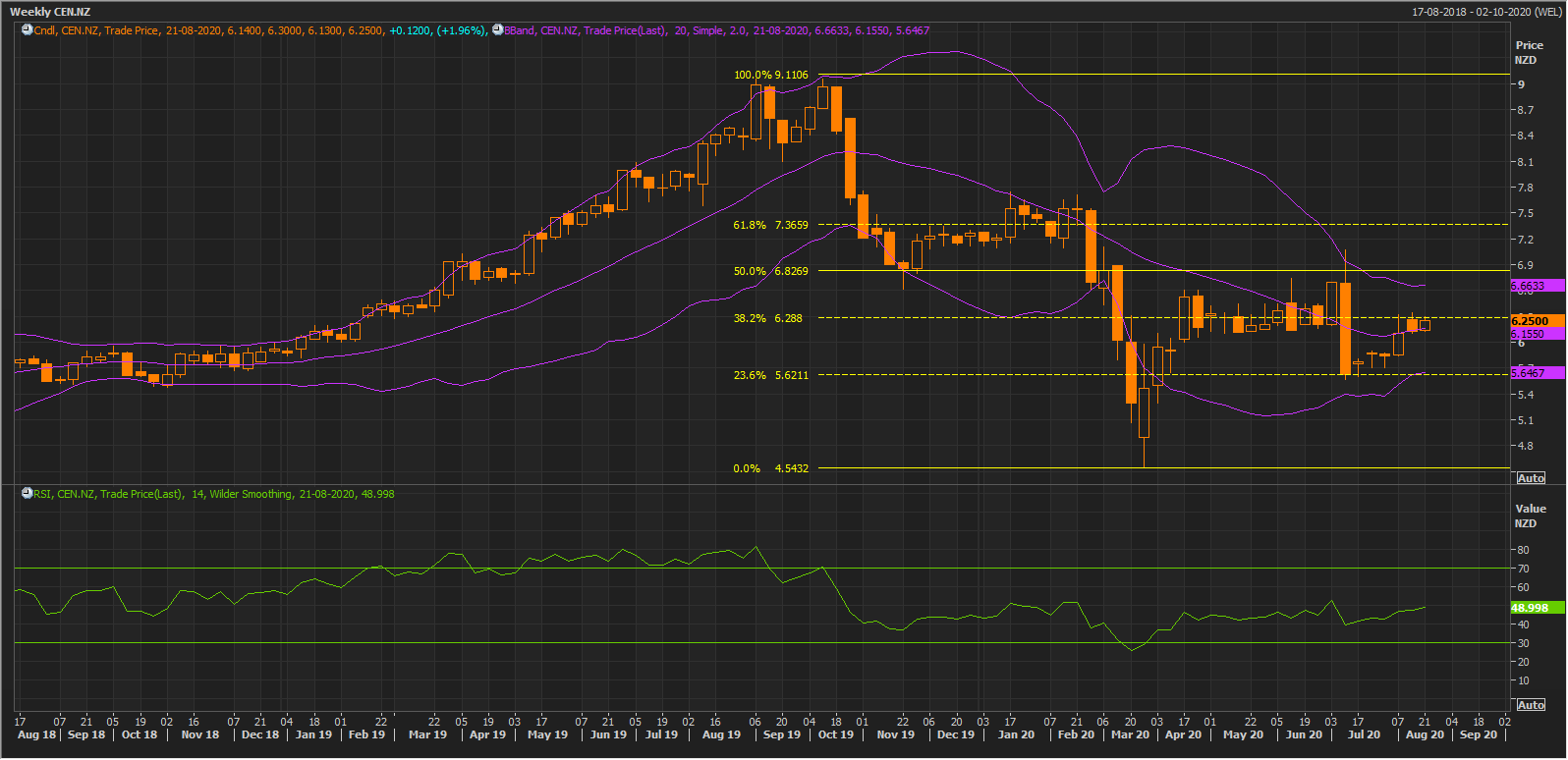
Source: Refinitiv (Thomson Reuters)
Note: Purple colour lines are Bollinger Bands with upper band suggesting overbought status while lower band oversold status, and yellow lines are Fibonacci retracement lines which measure price rebound and backtrack.
The stock for past few weeks has been maintaining uptrend. Following the existing uptrend, the stock in today’s trading session of the on-going week gave higher close at $6.25 than the previous week close thereby exhibiting strength in uptrend. Technical indicator RSI with around 49 reading and curve at the end pointing up, suggests strong bullish momentum.
Going forward, the stock may have resistance around 50% retracement level of $6.82 while support could be around $5.65.
Stock Recommendation: The company’s portfolio of long-life renewable generation assets, flexible thermal assets and fuel contracts, and strong balance sheet places it in a comfortable position even in a lower demand environment. Moreover, it is accelerating its mitigation plans to minimise the financial impact from the effect of Covid-19 and exit of NZAS.
Considering the aforesaid facts, recent updates and FY20 results, we have valued the stock using P/CF multiple based relative valuation method (on an illustrative basis) and arrived at a target price of higher single-digit growth (in % terms).
Hence, we give a “Buy” recommendation on the stock at the current market price of NZ$6.250 per share, up by 1.96% on August 17, 2020.
.png)
CEN Daily Technical Chart (Source: Refinitiv (Thomson Reuters))
Disclaimer
Kalkine New Zealand Limited is authorised to provide class advice only. The information on this site does not take into account any of your investment objectives, financial situation or needs. Before you make a decision about whether to acquire a financial product, you should obtain the Product Disclosure Statement from the product issuer. You should consider the appropriateness of advice taking into account your own objectives, financial situation and needs and seek independent financial advice before making any financial decisions.
Past performance is not a reliable indicator of future performance.
 Please wait processing your request...