
 AU
AU
 UK
UK
 CA
CA
 US
US
 IND
IND

 NZ
NZ

I. Sector Landscape and Outlook
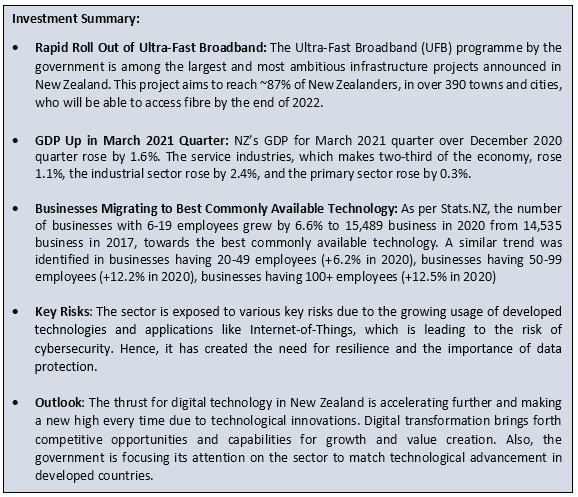
As per ‘New Zealand Immigration’, a part of the Ministry of Business, Innovation, and Employment (MBIE), the tech sector of New Zealand is diverse and advanced. It has thrust for innovation and competes successfully on the world platform. The industry is a crucial and growing business in New Zealand, contributing ~8% for GDP and employing 5% of the workforce. Tech exports grew gradually to $7.4 billion in 2019, making tech the country’s third-largest export sector.
Service Industry Leads the March 2021 Quarter Growth
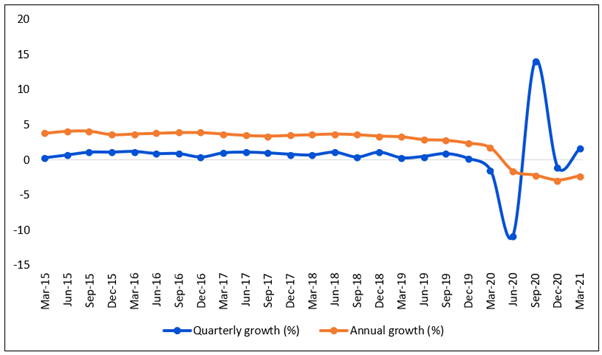
As per Stats.NZ, GDP for March 2021 quarter as compared to December 2020 quarter grew by 1.6%, primarily contributed by the service industries, which accounts for two-thirds of the economy, grew 1.1%. Leading contributors to service industry growth were wholesale trade (up 4.0%), business services (up 1.9%), healthcare and social assistance (up 2.8%), and retail trade and accommodation (up 2.3%). Business services posted a third consecutive quarter of growth, with most sub-industries reporting a rise. However, on an annual basis, business services decreased 3.4%.
Further, the gross fixed capital formation rose 6.4%. However, net exports remain a drag on economic growth as falling exports and rising imports contributed negatively to GDP. Since the March 2020 quarter was depressed because of the slump in economic activities owing to the outbreak of COVID-19, annual growth comparison might not reflect a real trend so quarterly performance has been taken into consideration.
Exhibit 1: GDP Quarterly and Annual Rates, March 2015 – March 2021
Data Source: This work is based on/includes Stats NZ’s data which are licensed by Stats NZ for reuse under the Creative Commons Attribution 4.0 International Licence; Chart Created by Kalkine Group
UFB Infrastructure Project is Expected to Reach ~87% of New Zealanders
As per the ‘Ministry of Business, Innovation and Employment (MBIE)’, the Ultra-Fast Broadband (UFB) programme is among the largest and most ambitious infrastructure projects announced in New Zealand. This project is expected to see ~87% of New Zealanders, in over 390 towns and cities, who will be able to access fibre by the end of 2022. As of August 2017, ~$1.8 billion was invested in UFB infrastructure to ensure most New Zealanders are experiencing the social and economic benefits of faster broadband.
Second Phase of Rural Broadband Initiatives:
The second phase of the Rural Broadband Initiative (RBI2) is aimed at expanding high-speed broadband to over 70,000 households and businesses. This programme aims to offer fast broadband infrastructure to the most needed rural homes and businesses. With this programme, other rural broadband choices are available from private network players.
Growing Demand for Fibre-to-Premise Plan:
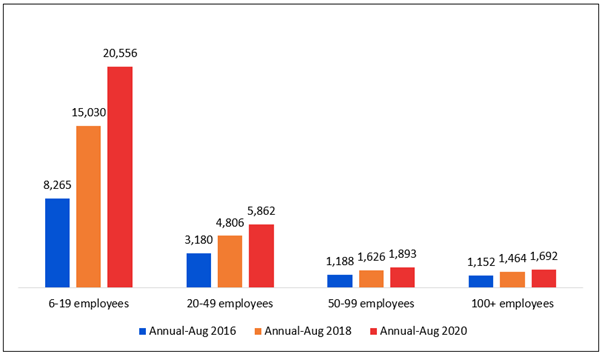
A Fibre-to-premise plan is most suitable in urban areas with higher population density. Users can access speeds close to 1,000 Megabits per second enabling them to use business applications for improving productivity, access educational and entertainment content, and a whole range of other benefits. As per Stats.NZ, the internet connection plan to use fibre-to-the-premise by business size having 6-19 employees grew by 148.7% to 20,556 in 2020 from 8,265 in 2016, followed by the rise of 84.3% of businesses having 20-49 employees to 5,862 in 2020 from 3,180 in 2016. Further, the business size having 50-99 employees grew 59.3% to 1,893 in 2020 from 1,188 in 2016, followed by 46.9% growth in businesses having 100+ employees to 1,692 in 2020 from 1,152 in 2016. This growth momentum indicates that internet connection plans to use fibre-to-the-premise grew significantly for smaller businesses than a business having 100+ employees. This also indicates, the rising use of technology by business owners to operate and manage their businesses.
Exhibit 2: Trend in Internet Connection by Business Already Using Internet – (Annual-Aug)
Data Source: This work is based on/includes Stats NZ’s data which are licensed by Stats NZ for reuse under the Creative Commons Attribution 4.0 International Licence; Chart Analysis by Kalkine Group
Growth in NZ Businesses that are Migrating to Best Commonly Available Technology
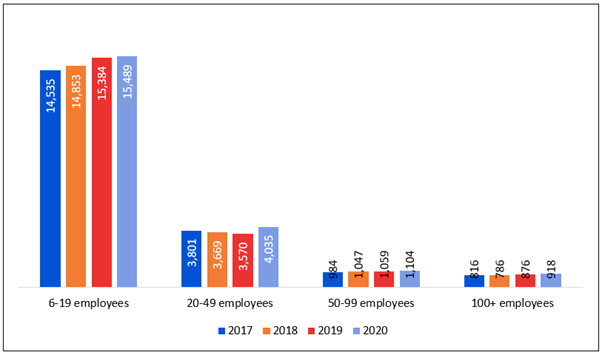
As per Stats.NZ, the number of businesses with 6-19 employees that have migrated to best commonly available technology grew by 6.6% to 15,489 business in 2020 from 14,535 business in 2017, followed by the businesses having 20-49 employees that grew by 6.2% to 4,035 in 2020 from 3,801 business in 2017. Also, the big businesses having 50-99 employees grew 12.2% to 1,104 in 2020 from 984 in 2017, followed by businesses having 100+ employees that grew 12.5% to 918 in 2020 from 816 in 2017. This growth momentum for the best commonly available technology indicates that the businesses in the NZ market have developed/sourced newer technological platforms to support their business growth.
Exhibit 3: Comparison with Best Commonly Available Technology by Business Size (Annual-Aug)
Data Source: This work is based on/includes Stats NZ’s data which are licensed by Stats NZ for reuse under the Creative Commons Attribution 4.0 International Licence; Chart Analysis by Kalkine Group
Index Performance:
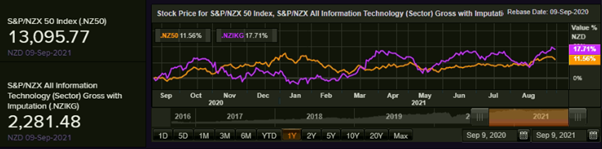
The S&P/NZX All Information Technology (Industry Group) Index generated a 1-year return of ~17.71% as compared to ~11.56% by the S&P/NZX 50 Index.
Exhibit 4: The NZX All Information Technology (Industry Group) overperformed NZX50 Index by ~6.15% in one year period:
Source: REFINITIV
Key Risks and Challenges:
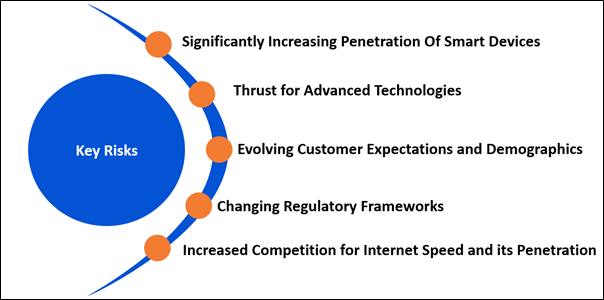
The use and development of an IT platform is a critical factor to success as it is dependent on designing, implementing, operating, maintaining, and monitoring the same. The speed of change, complexity and changing requirement in the technology sphere is impacting the industry. Broadly, the industry is exposed to risks that include cybersecurity, information security, IT systems development projects, IT governance, outsourced IT services, social media use, mobile computing, IT skills among internal auditors, emerging technologies, board, and audit committee technology awareness.
Amid the risk of monopolistic behaviour in the telecommunications sector, the New Zealand Commerce Commission plays a crucial regulatory role. The regulatory policies have evolved in recent years to mirror technological changes and have regulatory frameworks for areas such as fibre wholesale services or copper line wholesale services.
Exhibit 5. Key Risks in Communication and Information Technology Sector:
Sources: Analysis by Kalkine Group
Outlook:
As per the New Zealand Ministry of Foreign Affairs and Trade Manatu Aorere, the ministry targets to push export to 40% of GDP by 2025. The ministry has a sound understanding of most parts of the export sectors, but one of the least -understood sectors is ‘commercial services’, which is identified as dynamic, fast-growing, and largely weightless, and if strategically supported, it has the potential to be an above-the-line driver of export growth.
COVID-19 lockdowns in 2020 have changed the way Kiwis worked, learned, and played and thereby open doors for new opportunities through a digital platform. The fear of not going out has led to remarkable growth in fixed broadband usage, which is expected to reach smaller cities and towns in New Zealand now. Average fixed broadband usage per month increased by 77GB this year to 284GB, as per ‘Commerce Commission New Zealand’. This indicates a growth rate of 37% compared to 2019 when the growth rate was 15%. In 2020, 14% of residential on-account subscribers bought uncapped ‘endless’ or ‘unlimited’ mobile bundles, an increase of 7% in 2019. Similarly, 8% of business on-account subscribers purchased uncapped mobile bundles in 2020, up from 2% in 2019.
Apart from the sector-specific factors, we have also analysed four NZX-listed companies operating in the same sector. This report covers their insights, outlook, performance, and potential as expected to be delivered in the near to medium term.
1) Vital Limited (Recommendation: Buy, Potential Upside: Low Double-Digit) (M-Cap: NZ$29.79 million, Gross Dividend Yield: 4.960%)
Business Description:
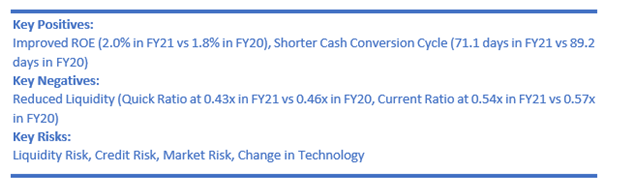
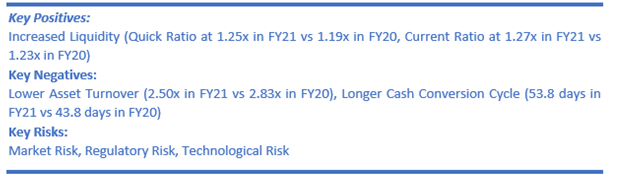
Vital Limited (NZX: VTL) offers a wide range of innovative services and enables critical communications across New Zealand. The company aims to provide the most connected, seamless, integrated networks and absolute coverage at locations.
Outlook
As per the management, the company has completed its infrastructure projects and the focus is now on leveraging nationwide presence, and new solutions that the company can offer. A great effort and time are being placed into the engagement around winning PSN, which is expected to be a major build and transformation catalyst for the company. The investments made over the last few years has cemented the position of the company to win PSN.
Daily Price Chart
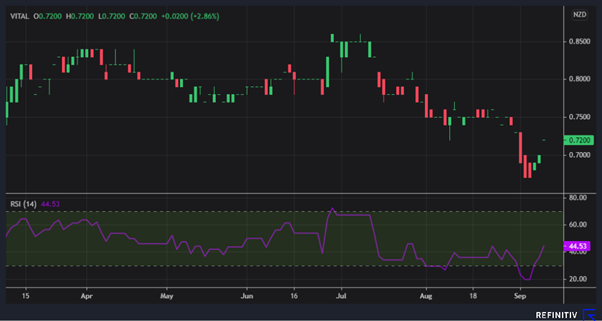
Source: REFINITIV, Note: Purple color line reflects Relative Strength Index (14-Period)
Stock Recommendation
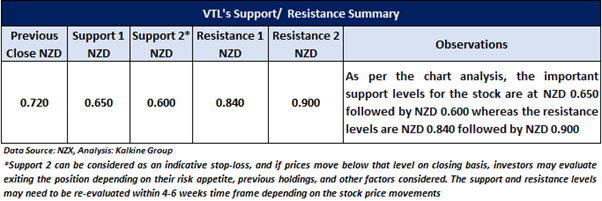
The stock has made a 52-week low and high of $0.67 and $0.86, respectively and is currently trading below the average of 52-week high-low range.
Considering the aforesaid facts, current trading level, and risks associated with the stock we give a “Buy” recommendation on the stock at the current market price of $0.72 per share, up2.86% as on 9th September 2021.
2) Solution Dynamics Limited (Recommendation: Speculative Buy, Potential Upside: Low Double-Digit) (M-Cap: NZ$45.237 million, Gross Dividend Yield: 6.019%)
Business Description:
Solution Dynamics Limited (NZX: SDL) is a full-service technology-focused communications solutions provider and is engaged in improving customer communication delivery through digital transformation. The company helps in streamlining the customer communications delivery for businesses through its integrated solutions.
Outlook
The company expects FY2022 net profit of around $2.5 million on the assumption that the growth momentum in North America will continue and key recovery in UK volumes in H2FY22 as the economy is expected to begin to normalise from the effects of COVID-19. The company assumes some customers to continue realizing reduction in physical communication volumes, particularly those involved in developing markets, which is expected to impact the earnings during FY2022.
Daily Price Chart
Source: REFINITIV, Note: Purple color line reflects Relative Strength Index (14-Period)
Stock Recommendation:
The company has invested phenomenally in personnel in recent years (both in New Zealand and internationally), hence the skills and staff now in place must be capable of supporting the growth momentum of the company.
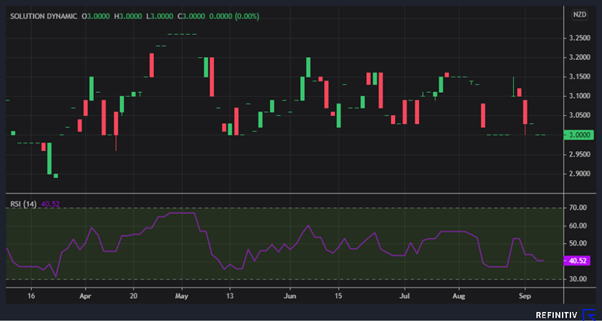
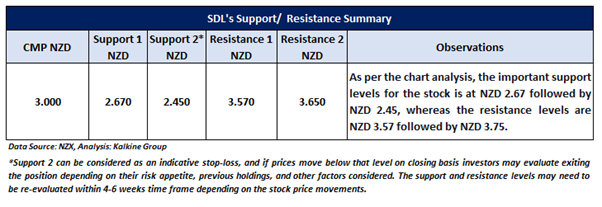
Considering the acceleration in onboarding and ramp-up of new client wins for the software & technology services and products internationally, the sustained investments globally across sales channel development and customer support infrastructure to sustain the growth trajectory, we give a “Speculative Buy” recommendation on the stock at the current market price of $3.00 per share, (New Zealand Time: 11:29 AM (GMT +12) as on 9th September 2021.
3) ikeGPS Group Limited (Recommendation: Hold, Potential Upside: Low Double-Digit) (M-Cap: NZ$167.78 million)
Business Description:
ikeGPS Group Limited (NZX: IKE) is a technology company that designs, sells, and delivers solutions for the collection, analysis, and management of distribution assets for electric utilities and communications companies.
Outlook
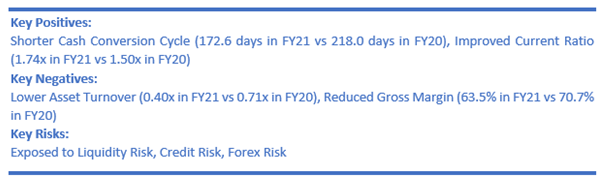
As per the presentation released on 11 August 2021, the company reported a 300% growth in new contracts versus pcp, indicating confidence around the potential for substantial revenue growth in FY22. Recurring subscription and transaction revenues have increased in absolute and relative terms in Q1FY22 with the growth of +12% on pcp and +30% on a constant currency basis as NZD: USD FX rate shifted from $0.60 to $0.70.
As per the release dated 31 August 2021, the company successfully completed its oversubscribed Share Purchase Plan (SPP), collecting A$5.2 million (NZ$5.5 million) versus a target of $3 million, resulting in the issue of ~5,486,112 ordinary shares. Together with the fully underwritten share placement, the company raised a total of A$23.6 million (NZ$24.7 million). Proceeds from the Placement and SPP will be utilities for customer wins, help accelerate a growing sales pipeline, and provide flexibility to pursue potential acquisition opportunities.
Daily Price Chart
Source: REFINITIV, Note: Purple color line reflects Relative Strength Index (14-Period)
Stock Recommendation
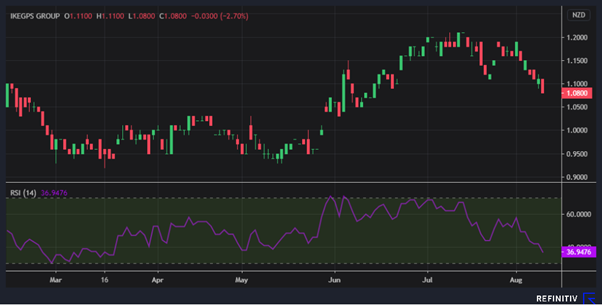
Considering the aforesaid facts, we give a “Hold” recommendation on the stock at the current market price of $1.08 per share, (New Zealand Time: 11:12 AM (GMT +12) on 9th September 2021.
4) PaySauce Limited (Recommendation: Hold, Potential Upside: Low Double-Digit) (M-Cap: NZ$45.69 million)
Business Description:
PaySauce Limited (NZX: PYS) offers cloud-based software to manage the human resource of the customers, from contracts to digital timesheets, payroll, banking, and filing to small and medium-sized businesses in New Zealand.
Outlook
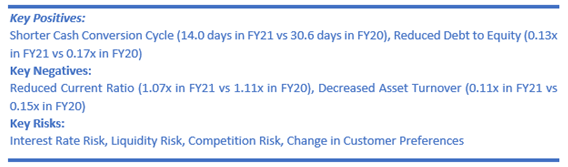
The company finished its Q1FY22 with the accelerated customer and revenue growth. Processing fees from customers increased 44% YoY, driven by a 39% rise in customer numbers and a 51% YoY increase in the value of payroll processed through the PaySauce platform. Total recurring revenue for Q1FY22 increased 36% YoY. This measure includes both processing fees and interest income. The continued low-interest-rate environment has resulted in interest income declining 33% YoY. At $31k, interest revenue was just 5% of the total Recurring Revenue in Q1FY22 although the float of funds held on behalf of customers increasing in line with customer growth.
Daily Price Chart
Source: REFINITIV, Note: Purple color line reflects Relative Strength Index (14-Period)
Stock Recommendation
Overall employees paid through the PYS platform rose substantially by 44% YoY to 20k in Q1FY22 and the total payroll business customers increased by 39% to 3,933.
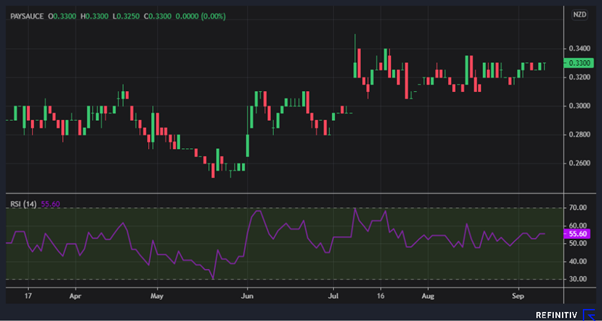
Considering the traction in payroll processing, acceleration in its customer base, resilient Q1FY22 performance, and its growth strategies, we give a “Hold” recommendation on the stock at the current market price of $0.330 per share, as on 9th September 2021.
Note 1: The reference data in this report has been partly sourced from REFINITIV.
Note 2: Investment decisions should be made depending on the investors’ appetite on upside potential, risks, holding duration, and any previous holdings. Investors can consider exiting from the stock if the Target Price mentioned as per the analysis has been achieved and subject to the factors discussed above alongside support levels provided.
Technical Indicators Defined: -
Support: A level where-in the stock prices tend to find support if they are falling, and downtrend may take a pause backed by demand or buying interest.
Resistance: A level where-in the stock prices tend to find resistance when they are rising, and uptrend may take a pause due to profit booking or selling interest.
Stop-loss: It is a level to protect further losses in case of unfavourable movement in the stock prices.
Disclaimer
Kalkine New Zealand Limited is authorised to provide general advice only. The information on this website does not take into account any of your investment objectives, financial situation or needs. Before you make a decision about whether to acquire a financial product, you should obtain the Product Disclosure Statement from the product issuer. You should consider the appropriateness of advice taking into account your own objectives, financial situation and needs and seek independent financial advice before making any financial decisions.
Past performance is not a reliable indicator of future performance.
 Please wait processing your request...