
 AU
AU
 UK
UK
 CA
CA
 US
US
 IND
IND

 NZ
NZ

1. Sector Landscape and Outlook
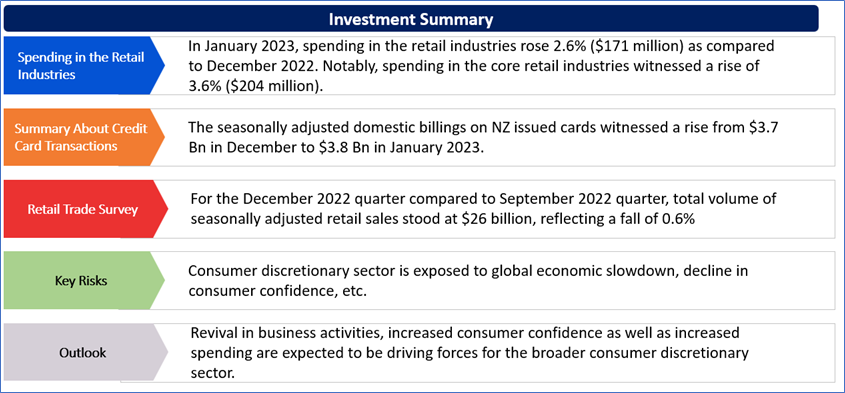
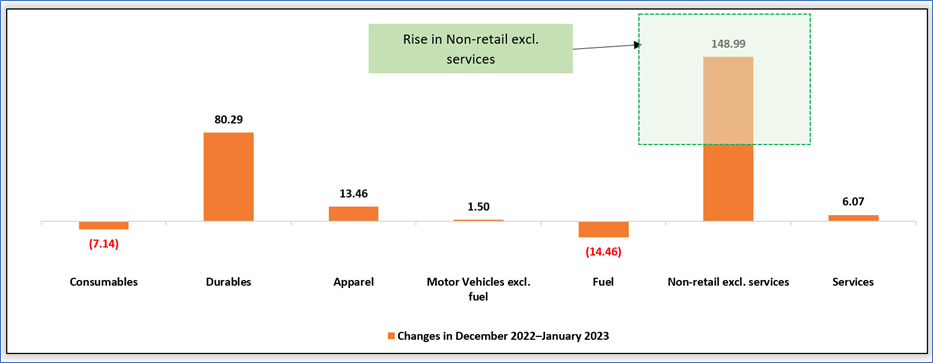
Stats.NZ has recently released electronic card transactions for the month of January 2023. In the month, spending in the retail industries rose 2.6% ($171 million) as compared to December 2022. Notably, spending in the core retail industries witnessed a rise of 3.6% ($204 million). The increase in the retail spending was supported by an $80 Mn (or 5.1%) rise in the durables category, which includes items like furniture, hardware, and appliances. The increased spending on durables was witnessed after decreases in November and December last year.
The largest contributor to the increase in total seasonally adjusted card spending was the non-retail excluding services category, that rose $149 Mn (or 7.8%). This category consists of transport, travel agents and other tour services, and schools as well as tertiary education. In actual terms, retail card spending rose $169 Mn (or 2.7%) in January 2023 as compared to January 2022. As per the release, spending in the hospitality category witnessed an increase of $187 Mn (or 16.6%) compared to the same month of last year. The hospitality category consists of accommodation and food services.
Credit Card Summary
The seasonally adjusted domestic billings on NZ issued cards witnessed a rise from $3.7 Bn in December to $3.8 Bn in January 2023. The seasonally adjusted total billings in NZ amounted to $4.5 Bn in January, reflecting a rise of 4.4% as compared to December. Notably, seasonally adjusted total advances outstanding were steady at $6.1 billion. As compared to one year ago, advances outstanding rose 3.1% from $5.9 billion.
Total credit limits amounted to $21.3 billion (not seasonally adjusted), same as December. Total credit limits were 1.9% lower as compared to December 2021.
Exhibit 1: Change in seasonally adjusted card transaction values by spending category ($ Mn)
Data Source: This work is based on/includes Stats NZ’s data which are licensed by Stats NZ for reuse under the Creative Commons Attribution 4.0 International Licence; Chart Created by Kalkine Group
Retail Trade Survey: December 2022 Quarter
The retail trade survey measures the sales as well as stock of businesses which offer household and personal goods and services – such as car yards, petrol stations, supermarkets, cafes and restaurants, and hotels.
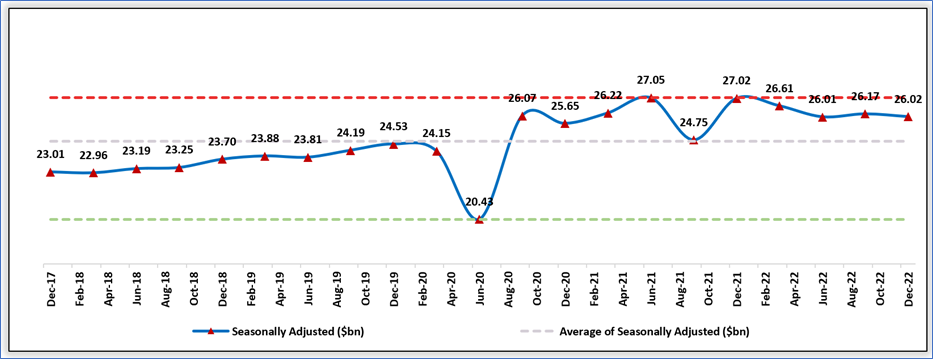
As per Stats.NZ, for the December 2022 quarter compared to September 2022 quarter, total volume of seasonally adjusted retail sales stood at $26 billion, reflecting a fall of 0.6% and total value of seasonally adjusted retail sales amounted to $31 billion, up 1.7%. Notably, 13 of the 16 regions witnessed higher seasonally adjusted sales values.
As compared to December 2021 quarter, total actual value of retail sales stood at $33 billion, reflecting an increase of 5.4% (or $1.7 billion).
Exhibit 2: Trend in Total Retail Trade Sales ($bn), Volumes, September 2017–September 2022 Quarters
Data Source: This work is based on/includes Stats NZ’s data which are licensed by Stats NZ for reuse under the Creative Commons Attribution 4.0 International Licence; Chart Created by Kalkine Group
Index Performance:
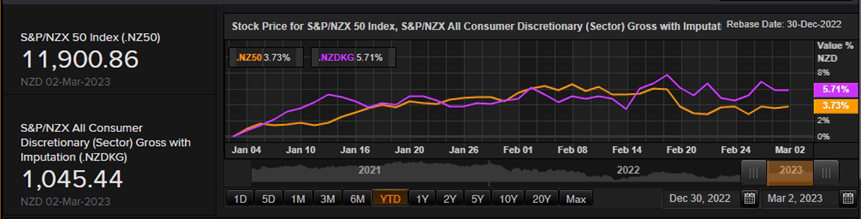
The S&P/NZX All Consumer Discretionary Index generated a YTD return of ~5.71% versus ~3.73% by the S&P/NZX 50 Index. Therefore, S&P/NZX All Consumer Discretionary Index overperformed S&P/NZX 50 Index by ~1.98% on the YTD basis.
Exhibit 3: S&P/NZX All Consumer Discretionary Index vs S&P/NZX 50 Index
Source: REFINITIV
Key Risks and Challenges:
The consumer discretionary market is exposed to high competition from domestic as well as international tech- e-commerce companies, new brands and stores. This could create significant pressure on margins as well as profits. Notably, the broader consumer discretionary sector is exposed to supply chain costs, labour shortages and higher hourly rates as well as the general economic cost pressures.
COVID-19 pandemic has had a major impact on numerous businesses which are operating in NZ in the similar industry. Also, such challenges might arise in the future which could impact the margins of the companies and demand of the products. Therefore, short-term effects on prices, choice and availability of discretionary items, etc. are some of the risks.
Exhibit 4. Key Risks in Retail & Consumer Sector:
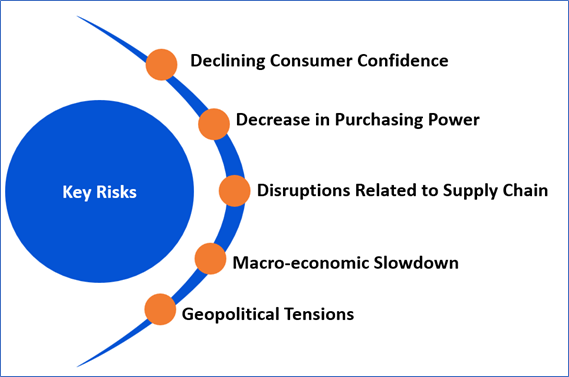
Source: Analysis by Kalkine Group
Outlook:
As per the release on Beehive.govt.nz dated 19 December 2022, the government is putting in place rules which would make it easier for consumers to compare the price of grocery products at the supermarket. The new rules would require supermarkets as well as other large grocery retailers to clearly and consistently display unit pricing – like the price of a product per kilogram or litre.
As per the final report dated 8 March 2022 published by Commerce Commission New Zealand, in the workably competitive market, they would expect to see firms deploying as well as innovating in the anticipation of generating additional profits by meeting consumer demands. Also, they would anticipate high margins as well as profits derived from innovation and deployment to attract new entry as well as expansion. Even though relationship between innovation and competition is complex, in general there are expectations that workable competition would offer strong incentives for innovation and deployment.
Apart from the sector-specific factors, an analysis on 2 NZX-listed companies is provided. This report covers their insights, outlook, performance and potential as expected to be delivered in the near to medium term.
1 ) Restaurant Brands New Zealand Limited (Recommendation: Buy, Potential Upside: Low Double-Digit) (M-Cap: NZD785.97 million, Annual Dividend Yield (TTM)1: 7.05%)
Business Description:
Restaurant Brands New Zealand Ltd (NZX: RBD) is a corporate franchisee that specialises in managing multi-site branded food retail chains.

Annual Results
Total assets amounted to $1,417.3 Mn, reflecting a rise of $87.4 Mn on FY 2021 mainly because of new store acquisitions as well as store builds which increased the value of both property, plant and equipment as well as lease assets. Over the year, RBD renewed the bank lending facilities with Westpac, JPMorgan, Rabobank and Bank of China - the majority of which were due to expire in the month of April 2023.
Valuation Methodology: EV/Sales Multiple Based Relative Valuation (Illustrative)

Technical Overview:
Daily Price Chart
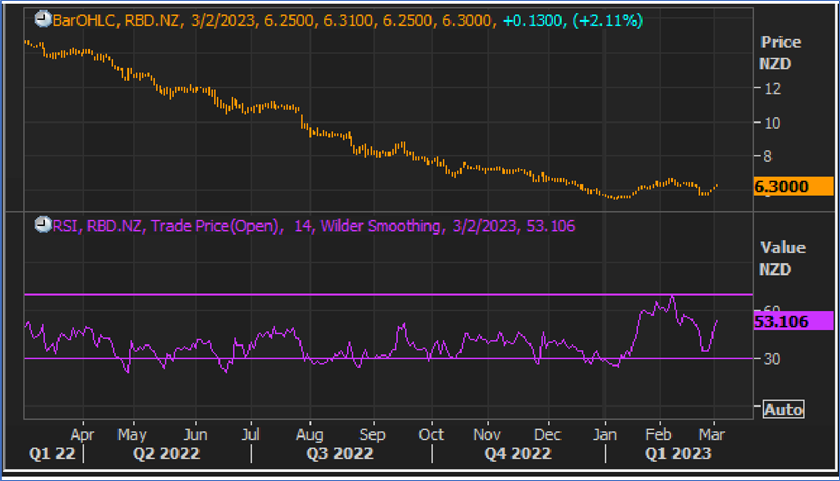
RBD Daily Technical Chart, Data Source: REFINITIV
Technical Commentary
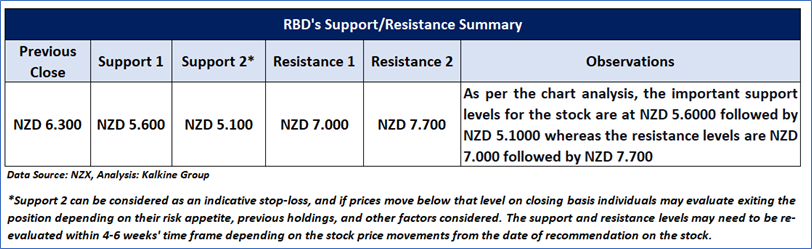
On the daily chart, RBD prices have started to move upside after taking support from the downward sloping trendline and are sustaining above the same from the past few trading sessions. Moreover, the momentum oscillator RSI (14-period) is moving above the midpoint and showing a reading of ~53.106 level, indicating the possibility of an upside hereon. An important support level for the stock is placed at NZD5.60 while the key resistance level is placed at NZD7.0.
Stock Recommendation
Considering the aforementioned factors, a ‘Buy’ rating has been assigned on the stock at the closing market price of NZD6.300 per share, up by 2.11% as on 2nd March 2023.
2 ) Delegat Group Limited (Recommendation: Buy, Potential Upside: Low Double-Digit) (M-Cap: NZD925.34 million, Annual Dividend Yield (TTM)1: 3.04%)
Business Description:
Delegat Group Limited (NZX: DGL) is a NZ-based wine company. The Company has deployed towards wineries as well as vineyards in the prime grape growing regions of New Zealand and Australia.

Outlook
DGL is on target to achieve global case sales for the full year of 3,649,000, reflecting a rise of 9% on the last year. The Group is forecasting the 2023 Operating Profit guidance in the range of $59 Mn - $62 Mn.
Fundamental Valuation
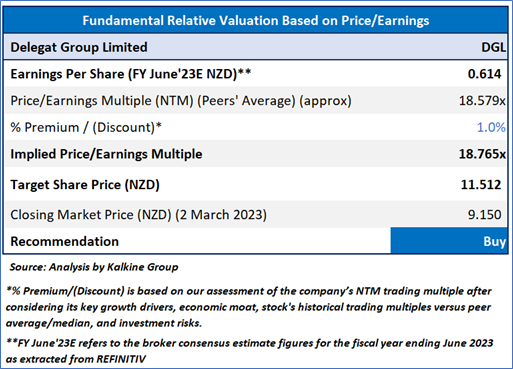
Price/EPS Multiple Based Relative Valuation
Technical Overview:
Daily Price Chart
DGL Daily Technical Chart, Data Source: REFINITIV
Technical Commentary:
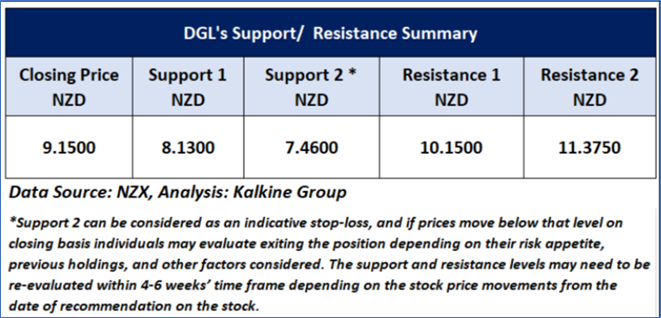
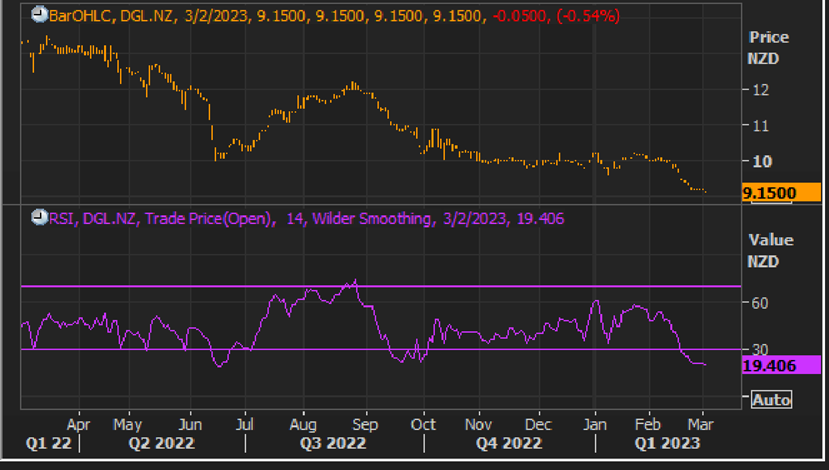
The stock prices of DGL formed near-term support around NZD 9.00 levels and the momentum indicator, RSI is below the oversold region of the 30 mark. The deep-down readings printed by RSI 19.406 are poised for a rebound which can push the stock toward the north. The near-term support is placed around NZD 8.13, whereas the resistance is marked around NZD 10.15
Stock Recommendation:
Considering the aforementioned factors, a ‘Buy’ recommendation has been assigned on the stock at the closing market price of NZD9.150 per share, down by 0.54% as of 2 March 2023.
Markets are trading in a highly volatile zone currently due to certain macro-economic issues and geopolitical tensions prevailing. Therefore, it is prudent to follow a cautious approach while investing.
Note 1: Past performance is not a reliable indicator of future performance.
Note 2: The reference date for all price data, currency, technical indicators, support, and resistance levels is March 2, 2023. The reference data in this report has been partly sourced from REFINITIV.
Note 3: Investment decisions should be made depending on an individual's appetite for upside potential, risks, holding duration, and any previous holdings. An 'Exit' from the stock can be considered if the Target Price mentioned as per the Valuation and or the technical levels provided has been achieved and is subject to the factors discussed above.
Note 4: Annual Dividend Yield is on a Trailing Twelve Month (TTM1) basis and are subject to change based on factors such as company performance, stock price changes, etc.
Technical Indicators Defined: -
Support: A level at which the stock prices tend to find support if they are falling, and a downtrend may take a pause backed by demand or buying interest. Support 1 refers to the nearby support level for the stock and if the price breaches the level, then Support 2 may act as the crucial support level for the stock.
Resistance: A level at which the stock prices tend to find resistance when they are rising, and an uptrend may take a pause due to profit booking or selling interest. Resistance 1 refers to the nearby resistance level for the stock and if the price surpasses the level, then Resistance 2 may act as the crucial resistance level for the stock.
Stop-loss: It is a level to protect further losses in case of unfavourable movement in the stock prices.
Disclaimer
Kalkine New Zealand Limited is a Financial Advice Provider (“FAP”) and is authorised by a Transitional FAP license issued by Financial Markets Authority (“FMA”) to provide financial advice. Kalkine provides only general financial advice through its research reports following a person becoming a member. The reports contain buy/sell/hold and other recommendations in relation to equity financial products. The recommendations and opinions [on this website] / [in this report] do not take into account any of your investment objectives, financial situation or needs. Before you make a decision about whether to acquire a financial product, you should obtain the Product Disclosure Statement from the product issuer. You should consider the appropriateness of advice taking into account your own objectives, financial situation and needs and seek independent financial advice before making any financial decisions. If you act on the advice in the research reports, you may have to pay fees, expenses or other amounts (but not to Kalkine). Further information about the complaints and dispute resolution process, as well as information about Kalkine’s duties are available on Kalkine’s website. Please read our Financial Advice Provider (FAP) disclosure statement and Complaints Handling Guide, which are available on the website.
Past performance is not a reliable indicator of future performance.
 Please wait processing your request...