
 AU
AU
 UK
UK
 CA
CA
 US
US
 IND
IND

 NZ
NZ

Company Overview: Australia and New Zealand Banking Group Limited (NZX: ANZ) provides a range of banking and financial products and services. The bank’s strategy revolves around improving the financial well-being as well as the sustainability of the customers.

ANZ Details


Australia and New Zealand Banking Group Limited (NZX: ANZ) provides a range of banking and financial products and services. The market capitalisation of the company stood at ~$75.4 billion on 7th March 2022.
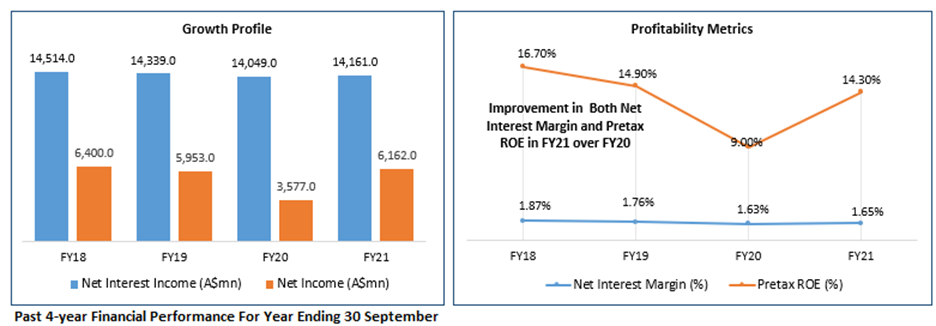
Net Interest Income of the bank improved from $14.05 billion in FY20 to $14.16 billion in FY21. Profit for the year of the bank improved from $3.57 billion in FY20 to $6.16 billion in FY21.
Exhibit 1: Financial Statistics

Source: Analysis by Kalkine Group
Result Performance for FY21 (Year Ended 30 September 2021)
First Quarter FY22 Update:
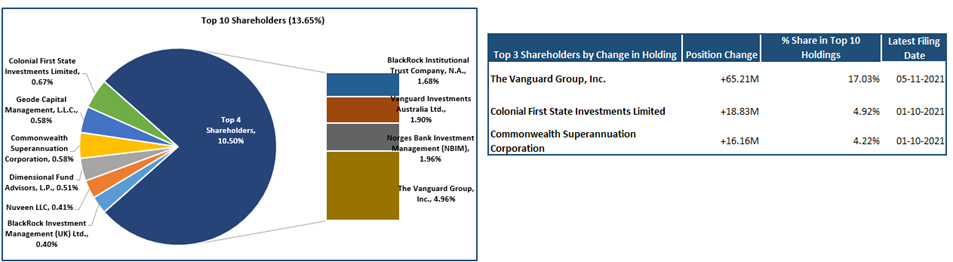
Top 10 Shareholders: The top 10 shareholders have been highlighted in the table, which together forms around 13.65% of the total shareholding. The Vanguard Group, Inc. holds ~ 4.9565% and Norges Bank Investment Management (NBIM) holds 1.9625%. The following charts depicts the pattern:
Exhibit 2: Top 10 Shareholders
Source: Analysis by Kalkine Group
A Quick Look at Key Metrics:
In FY 2021, ANZ’s loan growth stood at 2% as compared to 0.6% in FY 2020. The bank’s pre-tax ROE in FY 2021 was better as compared to the industry median. In FY 2021, its pre-tax ROE was 14.3% while industry median was 10.1%.
Exhibit 3: Key Metrics
Source: Analysis by Kalkine Group
Recent Updates:
ANZ recently announced that it would be combining its Digital Division, including ANZx, and its Australian retail business with Maile Carnegie appointed Group Executive Australian Retail, reporting to the ANZ CEO Shayne Elliott. Also, ANZ would be separating out its commercial businesses in Australia into the new division in order to better prepare it for the growth opportunities.
ANZ recently announced that it had brought forward the ANZ Capital Notes 7 Bookbuild as well as had allocated $1.28 Bn of ANZ Capital Notes 7 under it and the margin has been set at 2.7% per annum.
Outlook:
ANZ has transformed multiple aspects of its business in FY21. The company’s simplification strategy combined with its focus on group-wide automation, cloud mitigation and digitization, will help reduce costs and create sustainable customer growth. ANZ’s business strategy revolves around growing in the way which is more closely aligned to the resilient as well as sustainable economy which helps the Paris Agreement goals and Sustainable Development Goals.
Its key priorities for FY 2022 include restoring momentum in Australian home loans and working on group simplification & productivity. It is focusing towards risk-adjusted returns, capital & investment allocation, disciplined execution as well as growth initiatives.
Risks:
The bank is exposed to credit, market, and liquidity risk that arises in the normal course of the business. ANZ is also prone to foreign exchange risk and regulatory risks. It is also exposed to the risks related to the global slowdown.
Valuation Methodology: Price/Book Value Based Relative Valuation (Illustrative)
.png)
Technical Overview:
Chart:
.png)
Source: REFINITIV
Note: Purple Color Line Reflects RSI (14-Period)
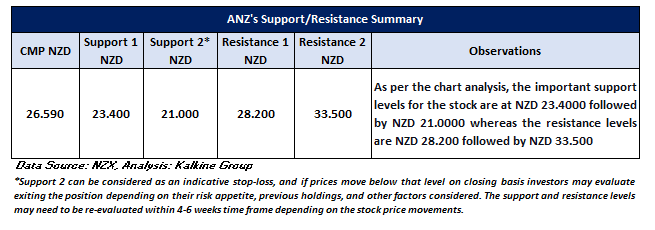
Stock Performance:
Despite ongoing impacts to the business, the company has a solid roadmap ahead for any further disruptions.
The stock has been valued using Price/Book value per share based relative valuation (on an illustrative basis), and the target price so arrived reflects a rise of low double-digit (in % terms). A slight premium has been applied to Price/Book value Multiple (NTM) (Peer Average) considering the decent outlook as well as key priorities for FY 2022.
Markets are trading in a highly volatile zone currently due to certain macro-economic issues and geopolitical tensions prevailing. Therefore, it is prudent to follow a cautious approach while investing
Considering the aforementioned facts and its current trading levels, we give a “Buy” recommendation on the stock at the current market price of NZ$26.590 per share (New Zealand Time: 3:36 PM (GMT +12)) on 7th March 2022.
Note 1: The reference data in this report has been partly sourced from REFINITIV.
Note 2: Investment decisions should be made depending on the investors’ appetite on upside potential, risks, holding duration, and any previous holdings. Investors can consider exiting from the stock if the Target Price mentioned as per the analysis has been achieved and subject to the factors discussed above alongside support levels provided.
Technical Indicators Defined:-
Support: A level where-in the stock prices tend to find support if they are falling, and downtrend may take a pause backed by demand or buying interest.
Resistance: A level where-in the stock prices tend to find resistance when they are rising, and uptrend may take a pause due to profit booking or selling interest.
Stop-loss: It is a level to protect further losses in case of unfavourable movement in the stock prices.
Disclaimer
Kalkine New Zealand Limited is authorised to provide general advice only. The information on this website does not take into account any of your investment objectives, financial situation or needs. Before you make a decision about whether to acquire a financial product, you should obtain the Product Disclosure Statement from the product issuer. You should consider the appropriateness of advice taking into account your own objectives, financial situation and needs and seek independent financial advice before making any financial decisions.
Past performance is not a reliable indicator of future performance.
 Please wait processing your request...