
 AU
AU
 UK
UK
 CA
CA
 US
US
 IND
IND

 NZ
NZ
Section 1: Company Overview and Fundamentals
Company Overview:
AbbVie Inc. (NYSE: ABBV) is a global, diversified research-based biopharmaceutical company. The Company is engaged in research and development, manufacturing, commercialization and sale of medicines and therapies. Its product portfolio includes Immunology, Oncology, Aesthetics, Neuroscience, Eye Care and Other Key Products.
Kalkine’s Low Carbon Research Report covers the Investment Highlights, Low Carbon Emission Initiatives, Key Financial Metrics, Risks, and Technical Analysis along with the Valuation, Target Price, and Recommendation on the stock.
Stock Performance:
1.2 Why do Low Carbon Emissions matter?
The shift toward a low-carbon economy is one of the most significant challenges of current time, spurred by the urgent need to combat climate change and reduce the environmental impact of corporate activities. This report covers the US-listed low-carbon emission company (NYSE: ABBV), that is committed to sustainability and responsible environmental practices.

Carbon and Waste Management - Key Metrics
AbbVie has demonstrated a consistent improvement in environmental efficiency from 2019 to 2023, with total waste per million dollars in revenue decreasing from 1 metric ton in 2019 to 0.56 metric tons in 2023, reflecting a 44% reduction over the period, and total CO2 emissions per million dollars in revenue declining from 16.98 metric tons in 2019 to 10.42 metric tons in 2023, a 38.6% reduction, showcasing the company’s effective waste management and decarbonization strategies, including a 32% reduction in Scope 1 and 2 emissions by 2024 and increased renewable energy sourcing to over 60%, which supports its 2030 science-based targets and enhances its ESG profile for investors.

Peer Comparison: Carbon Emission and Waste Management Metrics
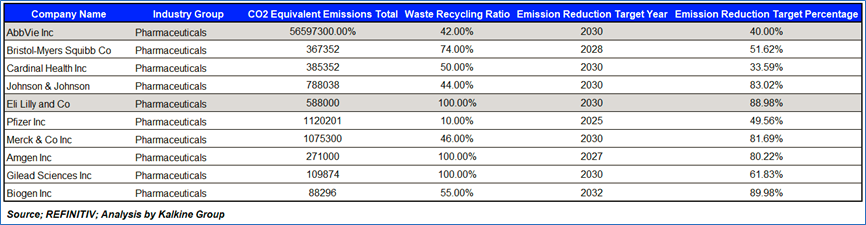
AbbVie Inc. exhibits a mixed environmental performance within the pharmaceutical industry as of May 30, 2025, with CO2 equivalent emissions totaling 56,597,300 metric tons—significantly higher than peers like Bristol-Myers Squibb (367,352 metric tons) and Biogen (88,296 metric tons), indicating a substantial carbon footprint that poses a challenge despite its 2030 target of a 40% emissions reduction, which is less ambitious compared to peers like Johnson & Johnson (83.02%) and Eli Lilly (88.98%); however, AbbVie’s waste recycling ratio of 42% is moderate, trailing behind leaders like Amgen and Gilead Sciences (both at 100%), but its broader ESG efforts, including a 32% reduction in Scope 1 and 2 emissions by 2024 and 41.7% of suppliers setting science-based GHG targets, suggest a committed yet lagging approach to sustainability that investors should weigh against its high emissions profile.
1.2 The Key Positives, Negatives, and Investment summary

1.3 Top 10 shareholders:
The top 10 shareholders together form ~30.94% of the total shareholding, signifying diverse shareholding. The Vanguard Group, Inc. and BlackRock Institutional Trust Company, N.A. are the biggest shareholders, holding the maximum stake in the company at 9.80% and 5.15%, respectively.

1.4 Key Metrics
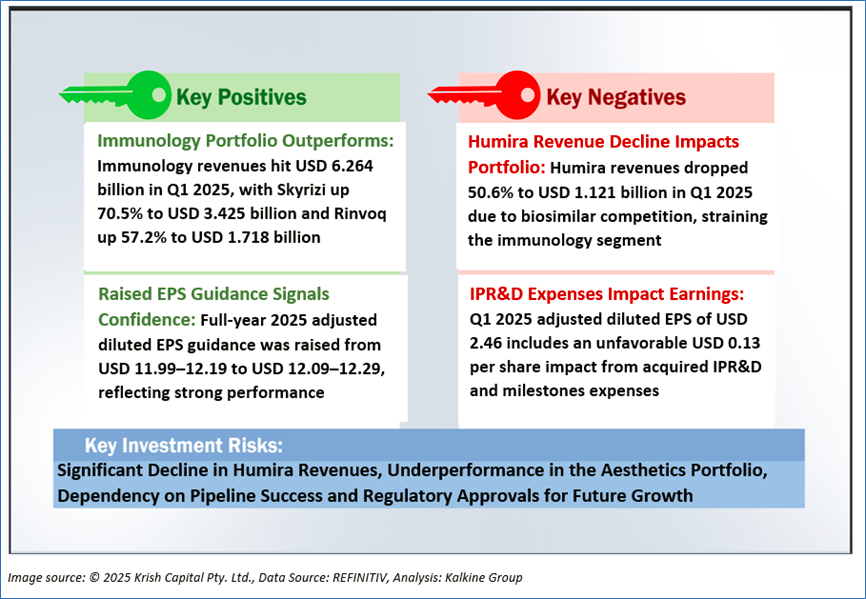
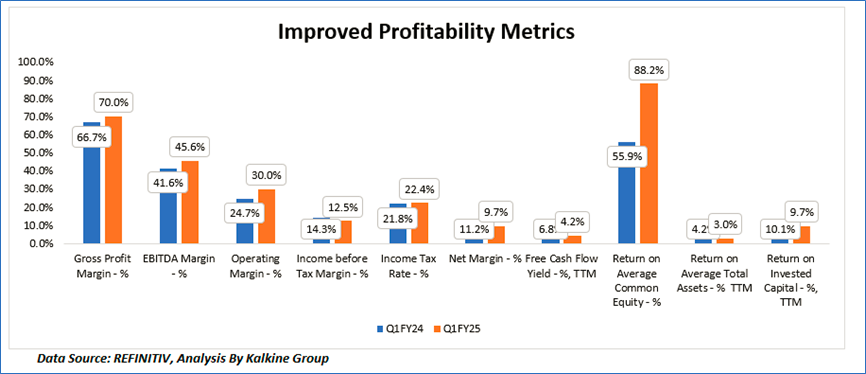
AbbVie’s Q1 FY25 financial metrics reveal a mixed performance with notable improvements in profitability margins but some concerning declines in other key indicators. The gross profit margin increased from 66.7% in Q1 FY24 to 70.0% in Q1 FY25, and the EBITDA margin rose from 41.6% to 45.6%, while the operating margin improved significantly from 24.7% to 30.0%, reflecting enhanced operational efficiency and cost management despite a USD 0.13 per share impact from acquired IPR&D expenses. However, the income before tax margin decreased from 14.3% to 12.5%, and the net margin fell from 11.2% to 9.7%, with a slight rise in the income tax rate from 21.8% to 22.4%, indicating pressures on net profitability, potentially due to higher R&D costs and a 50.6% decline in Humira revenues. Additionally, free cash flow yield (TTM) dropped from 6.8% to 4.2%, suggesting reduced cash generation efficiency, while return on average common equity surged from 55.9% to 88.2%, contrasting with declines in return on average total assets (TTM) from 4.2% to 3.0% and return on invested capital (TTM) from 10.1% to 9.7%, highlighting strong equity returns but weaker asset utilization and overall capital efficiency.
Section 2: Business Updates and Corporate Business Highlights
2.1 Recent Updates:
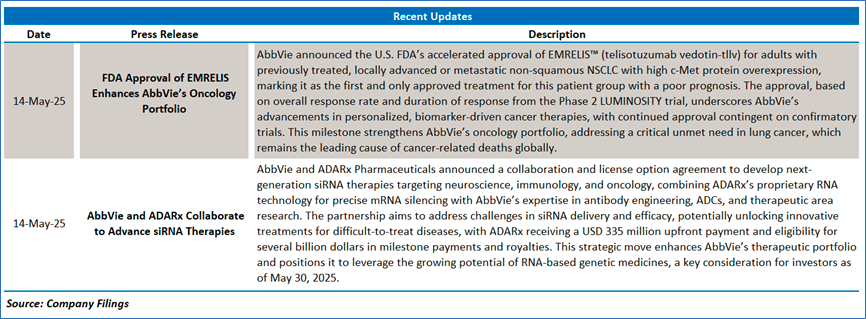
The below picture gives an overview of the recent updates:
2.2 Insights of Q1FY25:

Section 3: Key Risks & Outlook
Section 4: Stock Recommendation Summary:
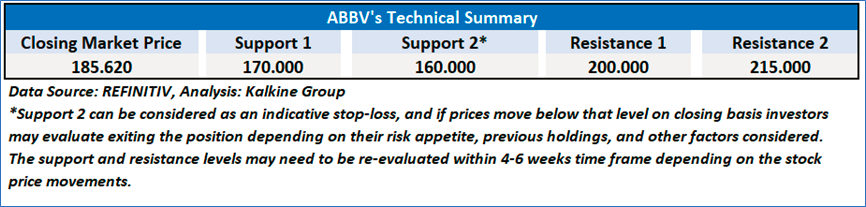
4.1 Price Performance and Technical Summary:
Stock Performance:

4.2 Fundamental Valuation
Valuation Methodology: Price/Earnings Per Share Multiple Based Relative Valuation
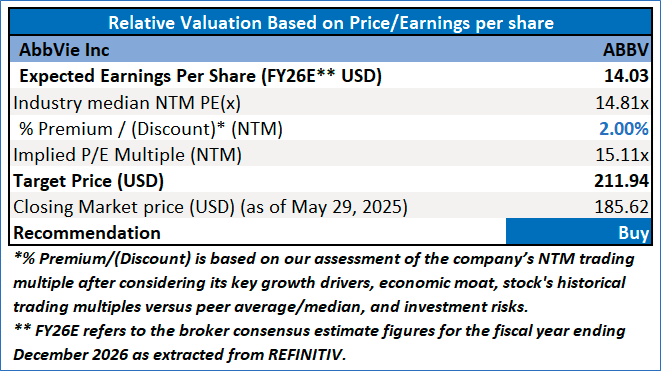

Markets are trading in a highly volatile zone currently due to certain macroeconomic issues and geopolitical tensions prevailing. Therefore, it is prudent to follow a cautious approach while investing.
Note 1: Past performance is not a reliable indicator of future performance.
Note 2: The reference date for all price data, currency, technical indicators, support, and resistance levels is May 29, 2025. The reference data in this report has been partly sourced from REFINITIV.
Note 3: Investment decisions should be made depending on an individual's appetite for upside potential, risks, holding duration, and any previous holdings. An 'Exit' from the stock can be considered if the Target Price mentioned as per the Valuation and or the technical levels provided has been achieved and is subject to the factors discussed above.
Note 4: The report publishing date is as per the Pacific Time Zone.
Technical Indicators Defined: -
Support: A level at which the stock prices tend to find support if they are falling, and a downtrend may take a pause backed by demand or buying interest. Support 1 refers to the nearby support level for the stock and if the price breaches the level, then Support 2 may act as the crucial support level for the stock.
Resistance: A level at which the stock prices tend to find resistance when they are rising, and an uptrend may take a pause due to profit booking or selling interest. Resistance 1 refers to the nearby resistance level for the stock and if the price surpasses the level, then Resistance 2 may act as the crucial resistance level for the stock.
Stop-loss: It is a level to protect against further losses in case of unfavorable movement in the stock prices.
Disclaimer This report has been issued by Kalkine New Zealand Limited (FSP691351) (NZBN:9429047678101) (“Kalkine”). Kalkine is a Financial Advice Provider (“FAP”) and is authorised by a Class 1 Financial Advice Provider Licence issued by Financial Markets Authority (“FMA”) to provide financial advice. Kalkine provides only general financial advice through its research reports following a person becoming a member. The reports contain buy/sell/hold and other recommendations in relation to equity securities, managed funds and other managed investment schemes and other financial advice products. The recommendations and opinions in this report and on Kalkine website do not take into account any of your investment objectives, financial situation or needs. Before you make a decision about whether to acquire a financial product, you should obtain the Product Disclosure Statement from the product issuer. You should consider the appropriateness of advice taking into account your own objectives, financial situation and needs and seek independent financial advice before making any financial decisions. If you act on the advice in the research reports, you may have to pay fees, expenses or other amounts (but not to Kalkine). Further information about the complaints and dispute resolution process, as well as information about Kalkine’s duties are available on Kalkine’s website. Please read our Financial Advice Provider (FAP) disclosure statement and Complaints Handling Guide, which are available on the website.
Past performance is not a reliable indicator of future performance.
 Please wait processing your request...